
SUSA, DIOCESI di – Arch erected by King Cozio I in honor of Augustus in 9 B.C. – Susa.
having arrived from Jerusalem, the sad news concerning the failure to rebuild the city walls. Between the two tell of the acropolis and the Apadana (citadel), a vast quadrilateral raised above the plain, there is the depression that constituted a great square (parade ground and bazaar), the heart of the city. In the so-called “imperial quarter,” it has been possible to trace the sequence from the Muslim period back to the Sassanid and Parthian periods, with rich finds. As for the Palace of Darius I, it has been possible to identify the location of the inner and outer walls, which have completely disappeared.
SUSA, DIOCESI di. – City and diocese of Piedmont, in the valley of the same name, in the province of Turin.
The present diocese comprises the entire territory of the valley of S. and has 51,800 inhabitants, of whom 51,200 are Catholics distributed among 62 parishes, served by 108 diocesan priests and 8 religious priests; it has 4 male and 4 female religious communities.
It is the ancient “Segusium,” seat of King Donno, a contemporary and friend of Caesar and an ally of the Romans, who recognized him as possessing royal rank and authority. When Italy was divided by the Romans into regions, Marco Giulio Cozio I, son of Donno, was appointed prefect of his own region, in place of the royal title. In honor of Augustus, returning from Gaul in 9 B.C., Cozio erected the magnificent triumphal arch that can still be admired today. At the death of Cozio II, the Segusian Kingdom was definitively annexed to the Empire and incorporated into the province of Cisalpine Gaul (A.D. 67). At the fall of the Empire, the valley of S. belonged successively to the Heruli, the Goths of Theodoric, the Greeks of Narses, and the Burgundians, until Charlemagne, having defeated the Lombards at the Chiuse and at Pavia (774), restored S. to Italy. In 906 the valley of S. again suffered a terrible invasion by the Saracens of Frassineto, who had entered Italy by way of Mont Cenis: only in 946 were they definitively driven from the Val S. by Arduino Glabrione, count of Turin and, following his successful enterprise, marquis of S. The valley thus remained subject to the marquises of Turin until 1406, when Countess Adelaide of S. married Count Oddone of Savoy, son of Umberto Biancamano, thereby uniting her possessions with those of the House of Savoy.
In 1174 Barbarossa burned S. and reduced it to a heap of ruins; having risen again and flourished, S. was once more the scene of the wars between the French and the Spanish (1536-1707), and for a long time suffered all their painful consequences. After Marengo, S. became the seat of a subprefecture, and matters remained so until the Treaty of Paris of 30 May 1814, by which the Royal House of Savoy regained possession of its mainland territories.
The diocese of S. was erected on 3 August 1772 by Clement XIV with the bull Quod nobis, having been separated from Turin (v.). Pius VII was then compelled to suppress it with the bull Gravissimis of 17 August 1805, once again uniting it to Turin; but, circumstances having changed, he restored it with the other bull Cunctis ubique of 17 July 1817. The first bishop of S. was Mgr. Giuseppe M. Ferraris of the counts of Genola, who had the episcopal palace built at his own expense. The cause for the beatification of Bishop Mgr. Edoardo Rosaz, the apostle of the poor and of abandoned children, is in progress: he founded the congregation of the Tertiary Sisters of S. Francis.
Among the celebrated natives of Val Susa are Cardinal Enrico De Bartolomei, the poet Norberto Rosa, Senator Luigi Des Ambros, minister of Carlo Alberto and Vittorio Emanuele II, General Michele Bes, and the architect Meano.
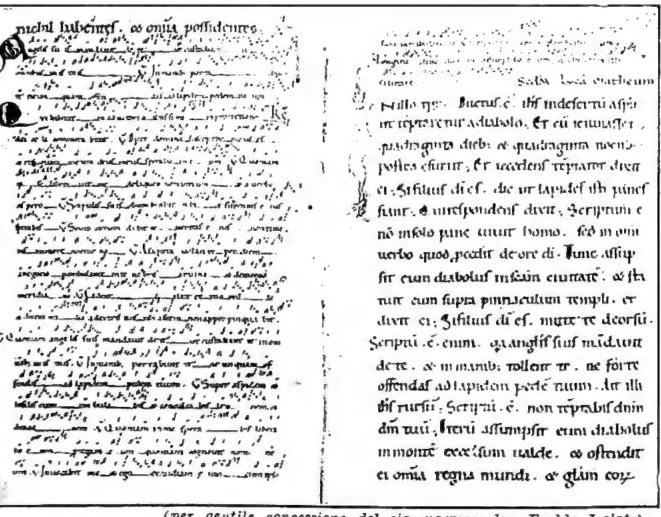
(by kind permission of the parish priest, Don Eraldo Isolato)
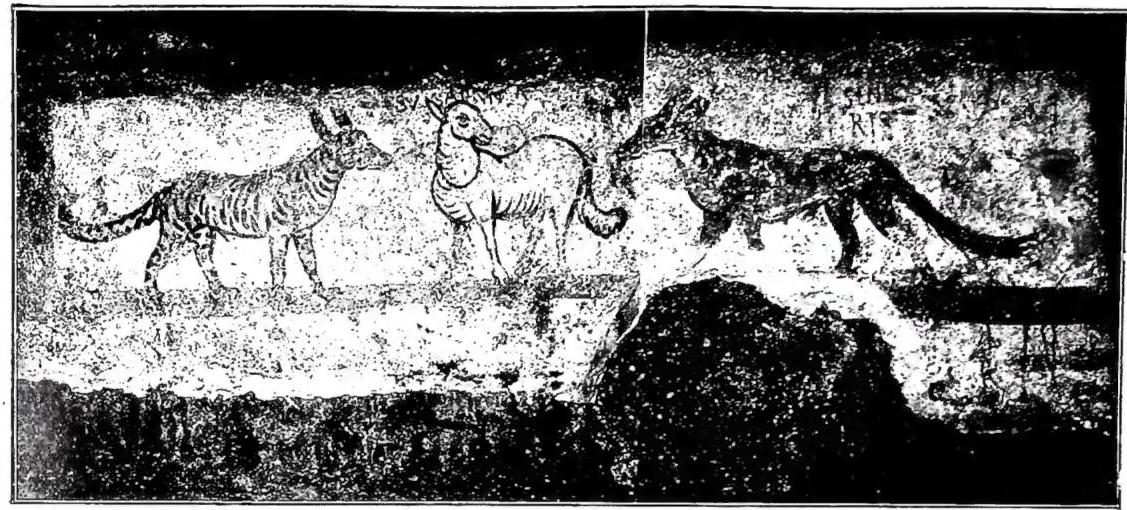
SUSANNA - S. under the guise of a sheep beset by two wolves. Fresco on the front of the arcosolium of Celerina (mid-fourth century) - Rome, cemetery of Pretestato.
at Salbertrand there is a portal of the type in use in the Dauphiné. Among its most ancient monasteries are: Novalesa (v.) and the abbey of the Sagra di S. AMARI, MICHELE (v.). - Vedi tav. CVII.