Machine translation of the 1948–1954 Italian original. The original text is authoritative.
NARSETE. — General of the Byzantine army under Giustiniano, born around 480, died in Rome in 574. He entered the court early and received favors and important missions. In 532 he put down a revolt against the Emperor, and in 537 restored peace in Alessandria, disturbed by religious disputes. In 538 he came to Italia to assist Belisario against the Goti, and in 551, at over 70 years of age, received supreme command. In a pitched battle near Tagina he defeated Totila (July 552), who lost his life there.
He easily occupied Roma, and the following year destroyed
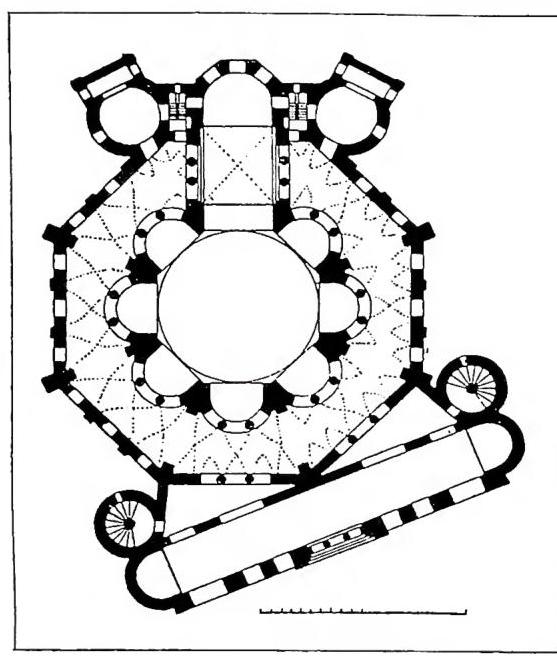
(from J. Cibulka, in Atti del IV Congr. int. di archeologia cristiana, II, Città del Vaticano 1938, p. 381, fig. 8) NARTECE – Plan of S. Vitale (6th century) with n. – Ravenna.He completely destroyed the Gothic Kingdom by defeating Teia, Totila’s successor, on the banks of the Sarno (March 553). For approximately 20 years N. ruled Rome with full civil and military powers, bearing the title of ex-consul and the dignity of patrician. He had churches and monasteries built, and bridges and other public works repaired. Through his intervention, Pope Vigilius was able to leave Constantinople, where he was being held prisoner, and when he died (555), N. succeeded in securing the acceptance of the election of Pelagius I, thereby averting a schism in the Roman Church. In the final years of his government, however, N. became arrogant and authoritarian and was also accused of collusion with the Lombards. For these reasons, in 568 the emperor Justin III ordered him to return to Constantinople, but N. refused and moved to Naples, whence, at the invitation of Pope John III, he returned to Rome; he lived there as a private citizen until his death.
BIBL.: F. Gregorovius, Storia della città di Roma nel medio-evo, Italian trans., II, Città di Castello 1938, pp. 221–70; G. Romano-A. Solmi, Le dominazioni barbariche in Italia, 3rd ed., Milan 1940, pp. 249–53, 269–70; O. Bertolini, Roma di fronte a Bisanzio e ai Longobardi, Bologna 1941, pp. 182–86, 217–24.
Agostino Amore
Cite this article
“NARSETE.” Enciclopedia Cattolica, vol. VIII (1952), p. 981. Azione Romana digital edition, https://azioneromana.com/article/narsete.