
NARTECE. – From the Greek νάρθηξ, it denotes the interior space at the rear of the basilica, enclosed by railings or by doors called speciose; it was occupied by catechumens and certain categories of penitents.
In Rome, the n. is found in S. Pudenziana, S. Sabina, S. Vitale, and S. Stefano on the Via Latina; in S. Clemente and in the cemetery basilicas of S. Petronilla, S. Lorenzo, and S. Agnese, the separation was made by means of columns and movable railings. In S. Sabina and S. Maria Maggiore, Grisar identified, in two facing columns of the central nave, the deep holes, now partly blocked, into which the railings were fitted (P. Crostarosa, Le basiliche cristiane, Rome 1892). It is also found at Ravenna in S. Martino in caelo aureo (today S. Apollinare nuovo) and in S. Apollinare in classe.
In Constantinople and in Greece, the n. is never open as in Rome; in S. Sofia there is a double internal n., with five doors toward the exterior and nine toward the interior; SS. Sergio e Bacco had six doors toward the interior and four toward the exterior (Procopio, De aedificiis, V, 6). In Greece, in the basilicas of Eleusis and of the Theotokos of Pelion, where the atrium is lacking, the n. is double (G. A. Soteriou, Die altchristlichen Basiliken Griechenlands, in Atti del IV Congresso internaz. di archeol. crist., I, Vatican City 1940, pp. 376–80). In Romania, in the Byzantine basilica of Tropaeum, the n. is divided into three parts (cf. D. Ciurea, La basilica cristiana in Romania, in ibid., I, p. 389 and pl. III). In Egypt, the n. is very widespread; it may be simple and rectangular, as in the church of Luqsor, the principal basilica of Saqqara, and the small one at Medinet Habu; in the White Monastery and in the church of Denderà, however, the n. is also rectangular but terminates at either end in an apse; in that of Old Cairo, the apse is on the left (U. Monneret de Villard, La basilica cristiana in Egitto, ibid., p. 302 and figs. 17, 14, 10, 7, 9, 21). In Tripolitania, at Sabratha, the n. is narrow and lies outside the Justinian Basilica (P. Romanelli, Le basiliche cristiane nell'Africa settentrionale, in ibid., pp. 254–255, fig. 7); likewise, it is external, but deep and divided into three spaces, at el-Assab (id., ibid., p. 270); it is instead internal in the church of the old Forum at Leptis Magna (id., ibid., p. 264, fig. 13) and in the basilica of Ptolemais in Cyrenaica (id., ibid., pp. 282–83, figs. 28–29). The internal n. appears among the group of basilicas in Asia Minor, as in the basilicas of the Madonna at Ephesus and in that of Rusafah; in Syria, in the ancient basilica of S. Simeone Stilita at Qal'at Sim'an.
Enrico Josi
ARTE. — The narthex of the church on Mount Athos has a distinctive arrangement: in the oldest type, which persisted until the 16th century, it is preceded by a portico and flanked by two chapels; but in churches dating from the end of the 13th century and in most of those of the 16th century, it consists of a large rectangular hall divided into bays by columns.
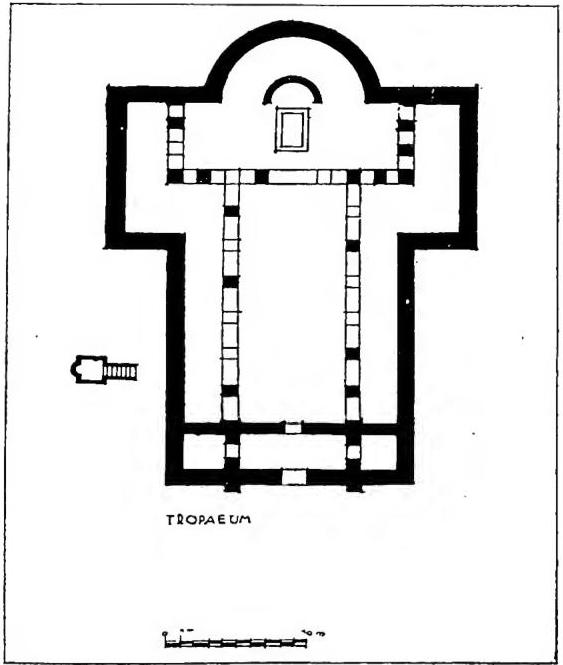
(from D. Ciurea, in Atti del IV Congr. int. di archeologia cristiana, I, Città del Vaticano 1938, pl. 3 after p. 381)
NARTECE – Plan of the basilica (5th century) at Tropaeum (Adam-Clissi) with n. – Romania.
BIBL. C. Diehl, Manuel d'art byzantin, Parigi 1910, passim; H. Leclercq, s. V. in DACL, XII, cols. 888–89. Mario Zocca
LITURGY. – After the suppression of the catechumenate and the development of penitential rites, the external n. disappeared or was transformed, while the internal n. remained and was and is used for various liturgical purposes, at least in the Byzantine rite: the first part of the baptismal rites (the ancient rites of the catechumenate) was performed there, according to tradition; the priest and clergy go there at the end of Vespers on the eve of Sundays and major feasts to perform the liti or supplication; finally, in monasteries the n. is furnished with seats because the monks generally recite there the lesser hours of the divine office, that is, mesonyctics, the daytime hours, and apodipnon (= compline).