
GRISAR, HARTMANN. — Jesuit, historian, archaeologist, and apologist, born in Coblenz on 22 September 1845, died in Innsbruck on 25 February 1932. After his early studies in Coblenz, he went to Münster, then to Innsbruck, to the Jesuit boarding school, and subsequently to Rome, to the German-Hungarian College. Ordained a priest, he entered the Society of Jesus in Rome on 24 November 1868. Having gone to Austria in 1870, he was appointed to the chair of ecclesiastical history in the Theological Faculty of Innsbruck.
In Ferdinando Gregorovius’s History of Rome in the Middle Ages, the principal element was lacking, namely, the fact that Rome is the center of the Catholic Church; H. G. undertook to take up the subject anew and conceived the plan of his work almost as “a civil history of the papacy in the Middle Ages against the background of the history of Rome.” He divided the material into six volumes: the 1st from the 4th to the 6th century, the 2nd from Gregory the Great to the Carolingian era, the 3rd from that era to the Investiture Controversy, in the time of Gregory VII, the 4th up to the fall of the Hohenstaufen, the 5th up to the entire period of the papal residence in Avignon, and the 6th up to the Renaissance popes, so as to connect with the History of the Popes from the End of the Middle Ages by his colleague at the University of Innsbruck, Ludovico von Pastor.
The first volume, entitled History of Rome and the Popes in the Middle Ages, Part 1, Rome at the End of the Ancient World, began to appear in installments in 1898; the first Italian edition was published in 1900, followed by the German edition in 1901, the French edition in 1906, the second Italian edition in 1908, the English edition in 1911–12, and the third Italian edition, with an introduction by A. Bartoli, in 1930.
G. began with a lucid description of Rome at the moment of paganism’s agony, then describing the condition of the City and of the papacy during the period of Gothic rule, before passing to Rome’s relations with the Byzantine court and the Goths, up to the restoration of imperial power in Italy; then to the period of Narses and the first exarchs, up to the continuous decline of the Roman state, while, by contrast, the development of the life of the Church grew ever greater. Through a judicious selection of illustrations, the author places before the reader the transformation of the city into a Christian city, while at the same time presenting the history of its institutions and the evolution of its civil and religious life, combining these with the history of its monuments.
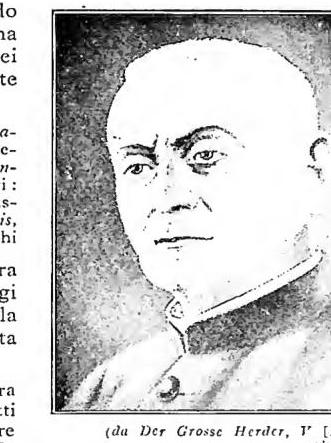
(du Der Grosse Herder, V [1933], col. 167)
GRISAR, HARTMANN — Portrait.
essays on individual themes pertaining to the history of Rome, which he had not been able to develop fully in his volume but had previously treated in several specialized periodicals, such as the Zeitschrift für katholische Theologie (essays 1, 2, 3, 4, and 9), the Civiltà Cattolica (essays 5, 12, 13, 14, 15), the Römische Quartalschrift (essays 10–11), and the Studi e documenti di storia e diritto (essay 6); essay 7, on the other hand, was unpublished. Thus his Analecta Romana came into being. The first five dissertations concern the sources: Liber Pontificalis, letters of the popes and collections of their documents; collections of Roman inscriptions, the Roman Ordines and formularies for papal processions, stations, and Masses; the origins of the Roman Martyrology, that is, the primitive Roman calendar, and the Hieronymian Martyrology. The following four dissertations concern the tombs of the princes of the Apostles, the prerogatives of the See of Peter in the time of Leo the Great—an unpublished treatment and the theme with which G. opens the volume of his History—Honorius I, and the Sixth Council. Then come three dissertations illustrating monuments of Christian Rome, such as the gate of S. Sabina; the ancient basilica of S. Pietro and the mosaic of the Lateran oratory of S. Venanzio; two dissertations contain studies relating to churches of Rome: S. Croce in Gerusalemme, the oratory of the S. Croce at the Lateran, S. Pudentiana, S. Maria Maggiore, S. Anastasia, and SS. Apostoli. The series closes with an examination of the famous bronze statue of S. Pietro in the Vatican Basilica, which G. attributes to the beginning of the sixth century.
Concerning Gregory the Great and his pontificate, G. published a monograph in part 3 of the first Italian edition of the Storia and later in the collection I Santi (Rome 1904).
His address at the Congress of Catholic Scholars, held in Munich in September 1900, was truly historical. H. G. courageously rose against the accusations that Catholic scholarship was lagging behind in historical studies, that it lacked criticism, and that it feared the truth; he demonstrated that one had to guard both against excessive readiness to doubt and deny (hypercriticism) and against excessive anxiety to defend all so-called traditions (“pium est credere”), thereby compromising the credit and esteem enjoyed by the Holy Church. He concluded by repeating the Ciceronian maxim that Pope Leo XIII had recalled when opening the Vatican Archives to scholars: “ne falsum dicere audeat, ne verum dicere non audeat”.
During the Roman period H. G. was an active member of the Pontificia accademia romana di archeologia and of the Società dei Cultori di archeologia cristiana, and a contributor to the Nuovo bullettino di archeologia cristiana, for example with the articles: Note archeologiche sulla Mostra di arte sacra antica a Orvieto, in N. bull. di arch. crist., 3 (1897), pp. 5–44; Una scuola classica di marmorarii medievali, ibid., 2 (1896), pp. 42–57; as well as studies in the Römische Quartalschrift and in the Festschrift zum Elfthundertjährigen Jubiläum des deutschen Camposanto, 1897 (Das römische Pallium und die ältesten liturgischen Schärpen, pp. 83–114).
G. understood the full importance of the contribution made to the history of Rome by the archaeological discoveries that had been so remarkable and inexhaustible since the middle of the nineteenth century. He had immediately been fascinated by them during his youth, first at the Collegio Germanico and then during his novitiate at S. Andrea al Quirinale. And although during his stay in Innsbruck his fruitful activity had made him one of the most assiduous and valuable contributors to the Zeitschrift für katholische Theologie, of which he had been one of the founders as early as 1877, after being summoned to Rome by Cardinal Hergenröther he devoted himself deeply to the study of Rome’s Christian monuments, libraries, archives, museums, and countryside. The invaluable fruit of his long years of research is found in the chronicles that, under the title Archeologia, he published abundantly in the Civiltà Cattolica during his lengthy Roman residence, which made him one of the profoundest connoisseurs of ancient Rome, both classical and Christian.
To him is owed the accurate topographical identification of S. Maria Antiqua, confirmed by the discovery of 1900.
G. deserves the credit for having proved that the apostolic memorial in Catacumbus was located in the Basilica itself and not in the so-called platonia to its west, which was the burial place of the martyr S. Quirino. He discovered a privilegium dated 1521 relating to the basilica of S. Sebastiano, which he himself found in Umbria (Die römische Sebastianuskirche und ihre Apostelkraft im Mittelalter, in Römische Quartalschrift, 9 [1895], pp. 409–61). To him belongs the merit—rose-covered yet full of thorns, like every noble human activity—of the treasure of the Sancta Sanctorum, which he admirably illustrated in two editions: Il Sancta Sanctorum ed il suo tesoro sacro (Rome 1907); Die römische Kapelle Sancta Sanctorum und ihre Schatz (Freiburg 1908).
Forced to leave Rome, he turned his studies to Luther. The great work Luther appeared in Freiburg im Breisgau (1911–13; English ed. 1913–17); later came six fascicles of Lutherstudien (ibid. 1921), then Der deutsche Luther im Weltkrieg und in der Gegenwart (ibid. 1924); finally Martin Luthers Leben und sein Werk (ibid. 1926, with a Hungarian ed. in 1929, an English ed. in 1930, and a French ed. in 1931; Italian, Turin 1933).
In 1924 his monograph Die Stationen und ihre Perikopen in römischen Missale. Liturgiegeschichtliche Studien aus der römischen Stadtgeschichte appeared in Miscellanea Ehrle (Studi e testi, 58), II, Rome 1924, pp. 101–140. These are studies of the history of the liturgy in relation to the history of the city of Rome; the first group consists of Masses with local elements of the Station; the second group of Masses with hagiographical elements; the third group of Roman usages for explaining the stational Mass. Then come the stations of Holy Week, of the three Sundays before Lent, of the Ember Days, Advent, Christmas, Easter, and Pentecost. He later developed the same subject in Das Missale im Lichte der römischen Stadtgeschichte (Freiburg im Breisgau 1925).
His final work is a tribute to the Holy Virgin, to whom he had always been deeply devoted: Marienblüten. Systematische Marienlehre aus dem grossen Marienwerk des Petrus Canisius (ibid. 1930). He wrote his autobiography in Religionwissenschaft in Selbstdarstellungen (ibid. 1927), pp. 37–56.