
LITURGICAL STATION. – Church in which liturgical services are celebrated on particular occasions.
I. GENERAL NOTIONS
Originally, statio meant the act of stopping, the place where one stops, and finally the persons who stop at the indicated point. In these three fundamental senses, the word acquired the most varied meanings: sojourn, horse station, quarter, military guard detachment, roadstead or harbor in nautical language. Thus, for example, one finds « statio aquarum, annonae, municipiorum », etc., as the seat of particular magistrates or offices. The same word naturally also entered Christian usage, with derived meanings of its own, but always connected with the primitive sense. Thus, for example, the word statio was used, as in military language, in the sense of an advanced sentry, alert and ready for action, to signify the Christian’s state during a fast, that is, wholly intent upon the strictest guarding of both body and soul: famous in this regard is s. Ambrogio’s apostrophe to his people at the beginning of Lent, in which he compares the « iter quadraginta dierum » with military life and the « devotio ieiuniorum » with the « castra », from which he derives the word « stationes », so that « stantes et commorantes in eis, inimicorum insidias repellamus. Castra enim sunt ieiunia christianis » (Sermo 21: PL 17, 644). This sense is also reflected in the meaning of the word stazione as specifically a “station” fast, that is, a half-day fast, on the liturgical ferias of Wednesday and Friday, a practice that soon fell into disuse (cf. the Shepherd of Hermas, Similit., V, 1, ed. F. X. Funk, I, 528, and the Didaché, VIII, ed. F. X. Funk-K. Bihlmeyer, Tubinga 1924, p. 5).II. LA S. L. IN PARTICOLARE. - Era quindi cosa naturale che la parola s. fosse presa per indicare la casa, e in seguito la chiesa in cui sarebbero stati celebrati i divini Misteri, e in seguito per estensione la stessa celebrazione liturgica e l'adunanza dei fedeli. Questo uso è assai antico, e si trova in Tertulliano, De ieiunio (ed. Oehler), cap. 1 (p. 852); cap. 2 (p. 853); cap. 10 (p. 864); e nell'Ad
uxorem (ed. Oehler), II, cap. 4 (p. 688), e in altri luoghi; poi in Cassiano, in De institutis coenobiorum, lib. I, cap. 5 (PL 49, 236-43) e in Isidoro, Etymologiae, lib. VI, cap. 19 (PL 82, 258).
III. THE S. L. PIORI OF ROME. — In many ancient episcopal sees, furnished with numerous churches, the bishops used to celebrate, on certain feast days or for other liturgical reasons, now in one, now in another; these liturgical gatherings, and the churches in which they took place, were called stationes. The information concerning these s. l. outside Rome is somewhat fragmentary; nevertheless, it makes it possible to know that this custom, and the corresponding technical term, were known, for example, as early as the fourth century in Antioch, in Jerusalem (cf. the Peregrinatio of Eteria), in Egypt at Oxyrhynchus (papyrus of 535); in the West, in Milan, Carthage, Ravenna, Vercelli, in the Gallic regions and in Germany, at Paris, Strasbourg, Mainz, and Cologne. The s. l. in use at Tours are listed in the so-called Calendar of Bishop Perpetuus (ca. 460), preserved by Gregory of Tours (Hist. Francorum, X, 31: PL 71, 556); the 3rd canon of the Council of Orléans (541) prescribed that the greater feasts and Easter be celebrated with the bishop (Mansi, IX, 114). Bishop Chrodegang of Metz (766) established in his see an entire system of s. l., modelled on Roman usage.
IV. THE PARTICULAR DEVELOPMENT OF THE S. L. IN ROME. — The place where the s. l. underwent a wholly particular development and assumed general importance in liturgical life and practice was Rome. The solemn pontifical celebrations which, especially after the Constantinian peace, were endowed, with the rapid development of the liturgical year, with extraordinary external solemnity, were not tied to the church attached to the papal residence (the Lateran), but also took place in other great urban and cemetery basilicas, and in the city’s titular churches. Already in the correspondence exchanged between Pope Cornelius and Cyprian of Carthage (mid-third century), the term s. occurs in the sense of s. l. as an ordinary matter (Cyprian, Ep. 43, ad Cornelium; Ep. 48, Cornelii ad Cyprianum; ed. G. Hartel, II, 597, 612). The Luciferian presbyters Faustus and Marcellinus, in their Libellus precum against Damasus, presented in 384 to Theodosius the Great, speak of the s. held by Ursinus, the antipope (PL 13, 81, 83). The Lib. Pont. (I, pp. 244, 246) reports that Pope Hilary (461–68) donated a splendid liturgical service, including the sacred vessels necessary for the s. l., to the Roman Church; but a regular system of s. l. must certainly have existed long before. Even later, the Lib. Pont. and other sources report papal gifts for stational celebrations. The Ordines, on the other hand, deal with the manner of celebrating them (cf., for example, G. Löw, Il Codice A 14 della Bibliot. Vallicell. [del sec. IX] e il suo contributo alla liturgia romana, in Misc. L. C. Mohlberg, II, Rome 1949, pp. 246–48).
Gregory the Great also reorganized the Roman s., not only in the liturgical texts and chants but, it seems, also by making adjustments to the order of the stational churches. In any event, he did everything possible to keep the s. l. alive and operative as a major instrument of pastoral liturgy. John the Deacon reports in his Vita (II, 18, 19: PL 75, 94) not only on the aforementioned reorganization, but above all on the Pontiff’s fervor in preaching and on the religious enthusiasm of the people, who came even from afar to take part in the s. l. The stational system established by Gregory M. was completed by Gregory II (d. 731) with the addition of the s. on the Thursdays of Lent, which ancient tradition had left free from the burdensome stational service (Lib. Pont., I, p. 402), so that by the eighth century all the days of Lent had the same service. From the Ordines Romani it is known that the Roman s. l. continued to take place with unchanged splendor and dignity until the Avignon period. Thereafter they declined, and upon the Pope’s return to Rome the s. l. was no longer regarded as a pontifical function. It continued, however, in lesser and more modest forms, as can be seen from the later Ordines Romani and other sources. Of particular interest in this regard is, for example, the description of Lent with its s., left by the priest Giacomo Rubus (parish priest and preacher at the court of Munich in Bavaria) during the Holy Year of 1575 (ed. K. Schottenloher, Munich 1925).
V. LE CHIESE STAZIONALI ROMANE
1. Lent. – The most complete system of liturgical stations is found in Lent, although here too its completion took place over successive periods. The first days to have stations were ferias II, IV, VI, and Saturday; ferias III and V, and the aliturgical Sundays, followed later on account of a vigil celebration.a) The great Basilicas as Lenten stations. – S. GIOVANNI IN LATERANO, the Pope’s cathedral: the 1st Sunday of Lent (that is, the primitive beginning of the great fast); Palm Sunday (that is, the beginning of Holy Week); Holy Thursday; and the Easter Vigil between the evening of Holy Saturday and Matins of Easter Sunday, namely, the days of the greatest Sacraments. S. PIETRO IN VATICANO: Passion Sunday (that is, the beginning of the most primitive period of fasting; but the station is relatively recent, since it was preceded by a vigil celebration that concluded on Sunday). S. PAOLO FUORI LE MURA: Wednesday (the 4th week of Lent), the day of the great scrutiny for the catechumens. S. MARIA MAGGIORE: Wednesday of Holy Week, which originally had a great liturgical service similar to that of Good Friday (as well as during the Ember Days, V. below). S. CROCE IN GERUSALEMME: the 4th Sunday and Good Friday. S. LORENZO AL VERANO: the 3rd Sunday.
b) The most ancient Lenten liturgical ferias. – In parentheses is given the “collecta,” that is, the church at which the people gathered before proceeding in procession to the station church, generally located nearby. Ferias II: 1st week of Lent: (SS. Cosma e Damiano), S. Pietro in Vincoli (this was the second day of primitive Lent, and thus the presentation of the Roman community to the Prince of the Apostles); 2nd week: (S. Cosma e Damiano), S. Clemente; 3rd week: (S. Adriano), S. Marco; 4th week: (S. Stefano al Celio), SS. Quattro Coronati; Passion Week: (S. Giorgio in Velabro), S. Crisogono (two churches of martyrs believed to have been soldiers); Holy Week: (S. Balbina), SS. Nereo ed Achilleo, S. Prassede (until the 10th century there were several changes between the two indicated station churches). Ferias III: 1st week: (S. Nicola in Carcere), S. Anastasia (it should be noted that S. Nicola has existed only since the 9th century); at S. Anastasia, as an almost palatine church, the second station was held after the first Sunday; 2nd week: S. Balbina; 3rd week: (S. Sergio), S. Pudenziana (at present S. Agata dei Goti also has equal right); 4th week: (S. Maria de domna Rosa), S. Lorenzo in Damaso; Passion Week: S. Ciriaco (destroyed in the 15th century; the station was transferred to S. Maria in Via Lata); Holy Week: (S. Maria in Porticu), S. Prisca. Ferias IV: 1st week: Ember Days, V. below; 2nd week: (S. Giorgio in Velabro), S. Cecilia; 3rd week: (S. Balbina), S. Sisto vecchio; 4th week: S. Paolo (v. above); Passion Week: (S. Marco), S. Marcello; Holy Week: (S. Pietro in Vinc.), S. Maria Maggiore (v. above). Ferias VI: 1st week: Ember Days, V. below; 2nd week: (S. Agata dei Goti), S. Vitale; 3rd week: (S. Maria ad martyres, that is, the Pantheon, consecrated for worship in 613), S. Lorenzo in Lucina; 4th week: (S. Vito), S. Eusebio; Passion Week: (SS. Giovanni e Paolo), S. Stefano sul Celio. c) Saturdays: 1st week, Ember Days, V. below; 2nd week: (S. Clemente), SS. Marcellino e Pietro; 3rd week: (S. Vitale), S. Susanna; 4th week: Saturday called “Sitientes,” of particular importance in the system of preparation for the catechumens, S. Lorenzo in Lucina, later replaced by S. Nicola in Carcere, a church known only since the 9th century.
2. Stations added with their churches. – a) Under Gregory the Great: since this Pope advanced the beginning of Lent to the Wednesday preceding the first Sunday of Lent, that is, to “Ash Wednesday,” in order to bring the days of actual fasting to the number forty, he instituted the following two liturgical stations: “Ash Wednesday”: (S. Anastasia), S. Sabina; Friday after Ash Wednesday: (S. Lucia in Septizonio), SS. Giovanni e
(phot. Giordani)
LITURGICAL STATION - Lenten station in the basilica of S. Marco: exposition of the Relics - Rome.
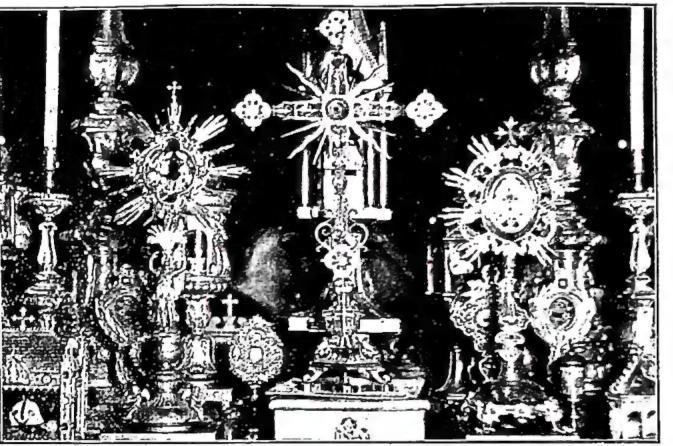
3. Easter Season. - The Octave of Easter, with stations among the most ancient, since it was customary to visit, with the neophytes, the city’s most renowned churches in order to celebrate the solemn Easter stations. Easter Sunday: S. Maria Maggiore (of later institution, since originally the Easter Vigil concluded on the morning of that same Sunday, at S. Giovanni in Laterano); Monday: S. Pietro in Vaticano; Tuesday: S. Paolo fuori le mura; Wednesday: S. Lorenzo fuori le mura: thus a visit to the principal churches of the three great patrons of the City. Thursday: SS. Apostoli; Friday: S. Maria ad Martyres; Saturday in albis: S. Giovanni in Laterano, the true «octave» of Baptism; Sunday «in albis»: S. Pancrazio, the young martyr who served as a model for the neophytes: this last station, therefore, is an addition, though a fairly ancient one. The Sundays after Easter, although they had very ancient Mass formularies, likewise had no liturgical station; only for the Second Sunday after Easter is there an isolated notice indicating the station at SS. Cosma e Damiano, but this must have been a late custom of short duration. Ascension: S. Pietro in Vaticano, a liturgical station at least since the seventh and eighth centuries.
4. Pentecost and its Octave. - It should immediately be noted that the summer Ember days were fixed within the same octave of Pentecost only between the seventh and eighth centuries. Saturday, that is, the vigil of Pentecost: baptismal celebration as at the Easter Vigil, and therefore a station at the Lateran. Sunday: perhaps without a station, as originally on Easter Sunday, then S. Pietro in Vaticano; Monday: S. Pietro in Vincoli, Tuesday: S. Anastasia; Wednesday: S. Maria Maggiore; Thursday: XII Apostoli, a primitive station, but soon abandoned; Thursday remained without a liturgical station until the tenth century; S. Lorenzo fuori le mura was then assigned to it; Friday: SS. Giovanni e
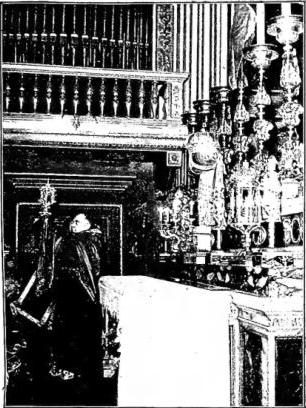
(phot. Giordani)
LITURGICAL STATION — Lenten station in the church of S. Marcello: final blessing with the relics of the Holy Cross — Rome.
5. Christmas season
The liturgical stations of Advent are of more recent date, that is, from the 9th century, except for that of the December Ember Days; the stations of the great Christmas feasts are in part older and in part still more recent.a) The Sundays of Advent: first Sunday: S. Maria Maggiore; second Sunday: S. Croce in Gerusalemme; third Sunday: S. Pietro in Vaticano: perhaps the first station established in Advent. It was a vigil celebration, held until the 12th century with the utmost splendour. Fourth Sunday: as the conclusion of the Ember Days, with the Vigil originally without a station; from the 9th century there appears a church of S. Eugenia, known from no other source (perhaps S. Eufemia, a monastery famous in the Middle Ages); only in the Avignon period does the church of the XII Apostoli appear.
b) The Christmas feasts: the preferred stational church for this season is S. Maria Maggiore, the church of the “Mother of God” since Sisto III, and where, perhaps already from that time, there was a representation of the Nativity scene. c) Vigil: this is of more recent institution, since the true vigil Mass was the present first Mass. From the 8th century the vigil as well (as the preceding day) had its liturgical station: S. Maria Maggiore. Christmas: first Mass, the true nocturnal Mass: station at S. Maria Maggiore “ad Presepe,” that is, in the subterranean chapel of the “Presepe.” Second Mass: S. Anastasia, from the Byzantine period, since the feast of the Saint fell on the same 25 December; third Mass: S. Pietro in Vaticano (this was the primitive liturgical station for Christmas); it appears that under Innocenzo II (1130–43) it was replaced by the present station at S. Maria Maggiore (the triple celebration in three churches so far apart being too onerous). 26 December, feast of s. Stefano: S. Stefano al Celio; the liturgical station is expressly recorded only from the 12th century. 28 December, feast of s. Giovanni ap.: station perhaps at the Laterano; certainly, the missals of the Avignon period bear this indication; only with the printed missals does the present station appear: S. Maria Maggiore. 28 December, feast of the Innocents: S. Paolo fuori le mura; the station is
recorded from the 8th century onward; perhaps already at this period, and certainly later, relics of these saints were venerated there.
d) Octave of Christmas (Circumcision), primitive station at the Pantheon, that is, at S. Maria ad Martyres, replaced by S. Maria in Trastevere from the Avignon period. e) Epiphany: S. Pietro in Vaticano; second Sunday after Epiphany: SS. Giovanni e Paolo; third Sunday after Epiphany: S. Eusebio; but these stations appear only, and for a short time, in the 8th century.
6. The Ember Days
The Ember Days, regardless of their later arrangement, partly in Lent, partly in the octave of Pentecost, partly in Advent, had from their institution their particular stational churches, always of imposing size, so as to contain the whole multitude of the faithful; these liturgical stations are fixed and identical on all Ember Days. Wednesday: S. Maria Maggiore; Friday: SS. XII Apostoli; Saturday, for the nocturnal vigil celebration extending until the morning of the following Sunday: S. Pietro in Vaticano. The reason why the Vatican Basilica was chosen is immediately understandable: the dignity and authority of Holy Orders had to proceed from the tomb of the Prince of the Apostles.7. The litanies
The greater litany, of Roman origin, linked to the date of 25 April (independently of the later feast of S. Marco), with its grand procession, originally had a collect and three stations: collect: S. Lorenzo in Lucina; first station: S. Valentino fuori Porta Flaminia (cemetery basilica); second station: S. Croce, an oratory beyond Ponte Milvio, toward the Vatican; third station: S. Pietro in Vaticano. The lesser litanies, introduced from Gaul into Rome during the 9th century (Leone III, 795–816), were celebrated in the three great major basilicas: Monday: S. Maria Maggiore; Tuesday: S. Giovanni in Lat.; Wednesday: S. Pietro in Vaticano.8. The great Marian feasts
The four great Marian feasts, the Purification (2 February), Annunciation (25 March), Assumption (15 August), and Nativity (8 September), were celebrated in Rome with great solemnity, namely with the collect at S. Adriano sul Foro romano and the procession to the liturgical station at S. Maria Maggiore.9. Present practice
With the fall of the temporal power of the Popes (1870), public religious observance had to be confined within the churches. The celebration of the liturgical stations, with its processions, likewise disappeared from the outward life of Rome. The revival was slow. Credit for restoring them to honour belongs to the “Collegium cultorum martyrum,” and it may be said that in recent decades the liturgical celebration of the Roman stations has been fully revived, naturally no longer as a service of the Supreme Pontiff, but as a public liturgical celebration that always attracts a great number of faithful, Romans and foreigners. In the stational churches the relics are displayed, the floor is strewn with laurel leaves, and the solemn Mass of the station is celebrated in the morning, while toward evening there takes place, often with great solemnity, the procession with the singing of the litany of the saints and the prescribed prayers, ending with the blessing with a relic of the Holy Cross.Since the Middle Ages special indulgences, revised by Pio VI (9 July 1777) and now established in the Enchiridion indulgentiarum (Rome 1952, no. 780), have also been attached to the pious practice of the liturgical stations. Just as in the early Middle Ages there are instances of imitations of the Roman liturgical stations, some bishops have recently organized in their episcopal cities a kind of liturgical station, with visits to specified churches and religious services similar to the Roman one. — See plate LXXXIX.
8 (1933), pp. 38-43; R. Hierzegger, Die röm. Stations prozess. im frühen Mittelalt., in Zeitschr. f. hath Theol., 60 (1936), pp. 511-44; C. Callewaert, La durée et le caractère du Carême ancien dans l'Egl. lat., in Sacris erudiri, Steenbrugge 1940, p. 486 sgg.; M. Righetti, Man. di II. lit., II, Milano 1946, pp. 106-11. Si V. anche V. Monachino, La cura pastor. a Milano, Cartagine e Roma nel sec. IV, Roma 1947; J. A. Jungmann, Missarum sollemnia, 2 voll., 3ª ed., Vienna 1952, V. indice alle voci; Statio, Stationsgottesdienst. Stationskirchen, Stationsstage; H. Leclercq, Stations liturg., in DACL, XV (1951), coll. 1653-57. Giuseppe Löw