
ROGAZIONI (Litaniae maiores et minores). — Processions instituted by the Church to implore heavenly assistance; those which occur every year are ordinary, while extraordinary ones are those instituted in times of calamity (e.g., those ordered by s. Gregorio in 590 and 603). The ordinary ones are distinguished into major and minor; the former are of Roman origin, the latter Romano-Gallican. They were held in spring and were already in use among the pagans. They are inspired by the same need and the same sentiment, with similar rites for lustrating and blessing the cultivated fields.
1. The R. of 25 Apr. are called the major ones and already in an invitation formula of 598 (Lib. Pont., II, 36) were so designated, not in comparison with the Gallican ones called minor, but in opposition to the other Roman processions, which were less solemn, important, or ancient. They replaced the pagan processions imploring assistance for a successful sowing, especially against the danger of grain rust. In Rome there were two processions in use: that of the «Robigalia» ([v.], urbani) and those of the «Ambarvalia» ([v.], rural),
G. Belet, in the Rationale divinorum officiorum, chap. 123, says that Pope Liberius (352-366) replaced the pagan «Robigalia» with the Christian r. on the same day. The procession of the Christian r. called «litania quae maior ab omnibus appellatur» (Gregorio) followed the same itinerary: according to the Gregorianum, it began at the church of S. Lorenzo in Lucina, made its first station at S. Valentino near Ponte Milvio, from there turned left toward the Vatican, made a third station at a cross whose location can no longer be determined, and ended with Mass in the basilica of S. Pietro.
2. The minor R. originated in Gaul, and s. Mamerto, bishop of Vienne (d. ca. 470), is regarded as their author; in reality, however, they are a continuation of the ancient «Ambarvalia», which received new impetus from Mamerto when his diocese suffered great calamities (fire, earthquake, war, poor harvest), as s. Sidonio Apollinare says (Epist., V, 14 and VIII, 11).
The first diocese to follow the example of s. Mamerto was Clermont, under s. Sidonio Apollinare himself, and then Arles in the time of s. Cesario; meanwhile, the Council of Orleans (511, can. 27) prescribed the procession, called «Rogationes», throughout Gaul, on the three days preceding the Ascension, with fasting and abstention from servile work. From France the r. passed into Spain, where, instead of being held before the Ascension, they took place during the week after Pentecost, thus corresponding more closely to the ancient discipline of not fasting during the Quinquagesima after Easter (Council of Gerona of 517, can. 2); likewise, r. were held during the first days of Nov. (ibid., can. 3; Council of Toledo, 632) and at the autumnal equinox. In England the r. were introduced by the Council of Cloveshoe of 747 (can. 16). Milan and an unidentified Church of northern Italy, in the seventh-eighth century, celebrated them on the three ferial days following the Sunday after the Ascension. In Germany they were introduced after the Council of Mainz of 813. At the same time, under Leone III (795-816), the Roman liturgy adopted the Frankish r., but not as an institution to be renewed annually; finally, the late Ordines Romani XIII, 25 and XIV, 49, 52, contain them as the result of a compromise: the fast was abolished, and only the three-day procession with the Mass of the major litanies was retained.
Today the major litanies, like the minor ones, have the same liturgy, except for the station churches: during the procession, since the ninth century, the litanies of the saints have been sung; originally, psalms were recited (psalm 69 may perhaps be an indication of this), with collects interspersed, and formulas of a litany-like kind were added (Kyrie eleison; te rogamus, audi nos); finally, the station Mass was celebrated. Along the route, a brief stop was made in another church or chapel, in order to sing an antiphon in honor of the titular saint, with the corresponding versicle or collect; this custom is already mentioned in the Gothic and Old Gallican Sacramentaries (at Milan, for example, 13 churches were visited on the first day, 11 on the second, and 12 on the third). At Genoa and Milan, even today, as formerly at Vercelli and at Rouen in France, a kind of «Ordo Missae Catecumenorum» is added, consisting of the Introit, Collects, Epistle, Gradual, and Gospel.
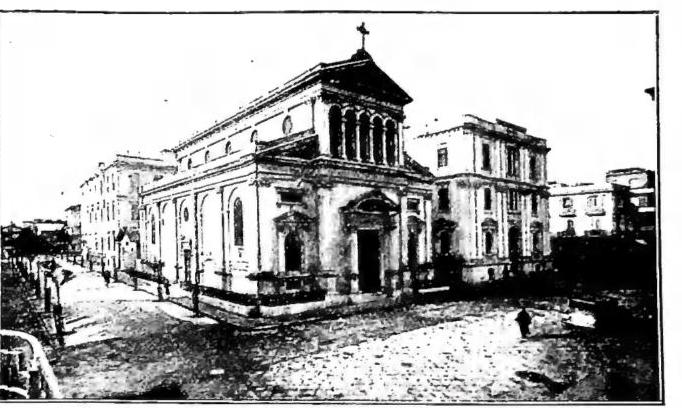
(photo Marconi)
ROGAZIONISTI - Santuario e Istituto S. Antonio - Messina, Casa madre dei R.
tutto il libro di Tobia. Le r. avevano nel medioevo ed hanno conservato finora uno dei primi posti fra le devozioni popolari.