

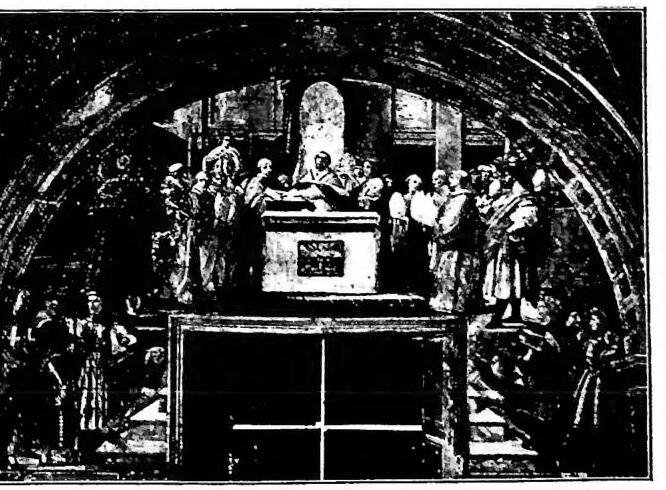
LEO III, Pope, Saint. - Elected on 26 Dec. 795, d. 12 June 816. On the very day of the death of Adrian I, L. was elected, who held the high office of papal oestararius and had the presbyteral title of St. Susanna. The choice had been made by the clergy in opposition to the lay nobility, which, predominant under Adrian, felt threatened and openly manifested its own opposition to L.; the latter, by natural reaction, turned to Charles, king of the Franks, sending him a copy of the act of election, the keys of the Confession of St. Peter and the banner of Rome, inviting him to send one of his dignitaries to induce the people to take the oath of allegiance.
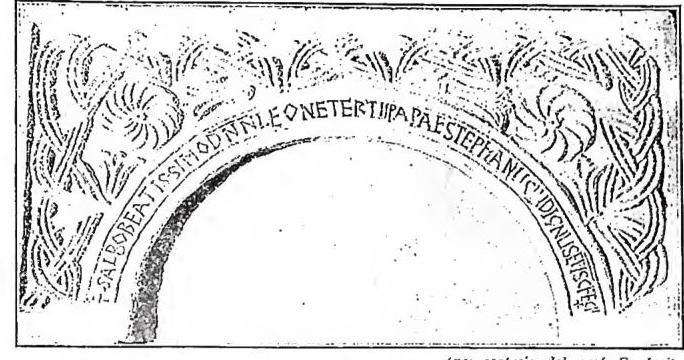
Although these acts of L. show that he accepted
the pre-eminence of Charles in Rome, one must not forget
that the Pontiff simultaneously had the Lateran triclinium
decorated with the famous mosaic depicting
St. Peter in the act of granting the pallium to L. and the
standard to Charles, thus revealing a clear tendency to claim
for the bishop of Rome a position of political parity with
respect to the Frankish sovereign.
In any case, the relations between the two dignitates were soon to be brought to a clarification. In
799 the opposition of the Roman nobles, led by the relatives
of Adrian I, erupted tragically on 25 April, when,
during the procession of the greater litany, L. was
seized by force of arms by the primicerius Paschal and the sacellarius Campulus, who even attempted to blind him.
During the night the Pontiff was able to take refuge in St. Peter's and,
with the protection of the duke of Spoleto, reached Charles
at Paderborn; the king arranged that L. be accompanied with
every honor to Rome (29 Nov. 799), together with some
Frankish commissioners of inquiry, who however reserved
to Charles every judgment on the accusations made against the Pontiff.
Thus, when the king came to Rome (1 Dec. 800) he found himself
faced with a complex situation in that, on the one hand,
the accusers abandoned the case, and on the other,
very many maintained that no one could judge the
Pope. The latter, in any case, resolved the strange situation
by justifying himself with a purgatio per Sacramentum, read from the top of the ambo of St. Peter, on 23 Dec., declaring however that he acted without
having been judged or compelled; without there existing
in that regard any laws or customs;
without there being able to derive from his attitude
an obligation for his successors, should similar circumstances have arisen. The next day, during the Mass of
Christmas, the coronation of Charlemagne took place, which has given rise to quite disparate
assessments: the fact remains that, toward the coronation
in Rome, Charles was driven by a whole
situation that was maturing and that
had its roots in the extraordinary power he had attained, in his position
as protector of the Confession of St. Peter,
in the exhortations of the learned who, with Alcuin
of York (Carmina, XLV, 63, in MGH,
Poëtae lat. aev. carol., I, 1, p. 258), said
to him «spectat te Roma patronum!». To the
same coronation L. was inclined, who
saw what an increase of prestige would
derive from it for himself personally and for the Church, for which it would thus have been so easy to carry
to completion that mission of spreading the
faith that it now claimed: thus was born the Sacrum Imperium, which exercised so much
fascination on medieval consciences. Although L.'s relations with the Emperor were
good even after 800, nine
years later the Pope was to oppose the Frankish
intervention in the question of the Filioque (v.).
In 814 the noble opposition erupted
again, provoking grave disturbances, not
entirely quelled in 816, at the death of L.
The latter moreover linked his memory, in the field
of dogma, to the definitive condemnation of Adoptionism. His name was inserted in the Roman Martirology in 1673. Feast on 12 June.
Bibliography3 works
III et la révolte des Romains de 799, in Annuaire
de la Fac. des lett. de Lyon, 1883; L. Duchesne,
Les premiers temps de l'Etat pontif., Paris 1911,
p. 167 ff.; K. Heldman, Das Kaisertum Karls
d. Gr., Weimar 1928; F. Calasso, Storia del Diritto
it., Milan 1948, pp. 49-67; Martyr. Rom.,
pp. 234-35; Fliche-Martin-Frutz, VI, pp. 158-69,
184-88.