
ADRIANO I, PAPA. — Pontiff from 1 (6) February 772 to 26 (25) December 795.
Born in Rome into an aristocratic family, he lost his father Teodoro at an early age and received care and education from his uncle Teodato, consul and duke and later primicerius. Intelligent, pious, and charitable, he soon attracted the attention of Pope Paolo I, who ordained him subdeacon. He was a deacon when he was called to succeed Stefano III in particularly difficult circumstances. His first concern was to undermine the influence of Paolo Afiarta, agent of Lombard policy, toward whom his predecessor had shown excessive pliancy; to this end he sent him to King Desiderio, who was proposing a renewal of the agreement concluded with Stefano II and promising to restore to the Holy See the territories he had usurped. But Desiderio failed to keep his word and invaded the Patrimony of St. Peter with the complicity of Afiarta himself. The latter, who was also held responsible for the part he had played in the killing of the secondicerius Sergio during the preceding pontificate, was seized by the archbishop of Ravenna and put to death against the will of the Pontiff, who had intended merely to exile him.
In the face of the renewed pressure of the Lombard threat, A. did not hesitate to follow through the path already indicated by his predecessors, appealing for Frankish assistance; indeed, he turned to Carlomagno. Having rapidly crossed the Alps in 773, Carlomagno defeated the Lombards and besieged Pavia, arriving in Rome on the occasion of Easter 774. Thus, on Wednesday of Easter week, 6 April, a memorable meeting took place in the secretarium of St. Peter. There Carlomagno undertook to implement the promise made at Quierzy-sur-Oise in 754 to Pope Stefano II, according to which the papal territories were to extend to the duchies of Spoleto and Benevento, Tuscia, Corsica, the Venetian lagoon, and Istria, in addition to the Duchy of Rome, the Pentapolis, and the Exarchate of Ravenna, as they had been before the conquest by Liutprando.
It should be said at once that, to many historians, the agreements of Quierzy and Rome appeared implausible, whereas others, in agreement with Duchesne (Liber Pontificalis, I, Paris 1886, pp. CCXXXVI-LIII), insist on considering them unquestionably authentic, while all nevertheless admit that, if they ever existed, they must have remained on an ideal plane that the Carolingians subsequently made no effort to realize. In fact, it was only through successive concessions obtained from Carlomagno during two further visits to Rome, in 781 and 787, that A. succeeded in constituting the Papal States, which remained more or less intact throughout the Middle Ages until Pio IX. Nevertheless, in his capacity as patricius Romanorum, Carlo sought to arrogate to himself the direction of foreign policy and a right of supreme oversight in internal affairs. The interference of his agents was at times highly vexatious, so that A. was forced to protest, though he always ended by reaching an agreement. In this way he persuaded the Frankish king to refrain from intervening in the election of the archbishop of Ravenna (Ep. 48, ad Carolum regem: PL, 98, cols. 416–18).
A.’s more specifically ecclesiastical activity was also considerable. First of all, he worked extensively to suppress abuses in episcopal elections and to free the churches from Carolingian caesaropapism; thus he restored all the rights of the former metropolitan sees (Ep. ad Bertherium episc.: PL 96, 1215–16). The fact remains, however, that his delicate position vis-à-vis Carlomagno did not allow him to implement all the reforms that were necessary and desired. According to Sigeberto di Gembloux, he is said to have granted Carlomagno, who had returned to Rome after the capture of Pavia (774), the right to elect the Pope and the right of investiture for the episcopal sees in his kingdom. This fable, which probably dates from the period of Ottone I, is already mentioned in a decree of the antipope Leone VIII in 963 and subsequently passed into the Decretum of Graziano under the name of Privilegium Hadriani pro Carolo.
The clergy of the Franks had acquired the habit of carrying weapons and making war. A. therefore called Carlomagno’s attention to this matter (Ep. 25: PL 98, 367). He also worked toward the unification of the Roman and Gallican liturgies, sending the same sovereign a copy of the Gregorian Sacramentary (ca. 780), just as in 774 he had given him the Collection of Canons of Dionysius Exiguus.
A.’s influence on the Spanish Church was eminently disciplinary and doctrinal. In one of his two letters to Egilas (PL 98, 333 and 346), he discusses fasting on Wednesday and Saturday, the feast of Easter, predestination, grace, and free will. He also devoted two dogmatic letters to the question of Spanish Adoptionism (PL 99, 374 and 386; V. ADOZIANISMO).
The most important religious event of A.’s pontificate was the restoration of ecclesiastical unity between East and West, a unity broken by the iconoclast persecution. At the Second Council of Nicea, the seventh ecumenical council (787), in which the Pope participated by sending two legates, the veneration of the saints, of their images, and of their relics was recognized as legitimate and salutary. The Pope’s letter to the empress Irene and to her son Costantino VI, in which the Roman primacy was emphatically proclaimed, was solemnly approved by the Fathers of the council. Since this council was composed almost exclusively of Easterners and the bishops of the West had not been invited, it was viewed very unfavorably by Carlomagno and his theologians. The Latin translation of its acts, carried out on A.’s orders, was particularly defective. Thus the Greek word προσκύνησις, which means veneration, was rendered as adoratio,
as though the council had defined the adoration of images. At the inspiration and under the direct control of Carlomagno, a group of theologians composed a detailed and polemical refutation of everything in the conciliar acts that struck them least favorably, and from this emerged what came to be called the Libri carolini. A. then took up his pen to defend the council and provide the necessary explanations to the Frankish king, doing so in a tone of gentle firmness and with remarkable erudition (PL 98, 1247–92; Mansi, XIII, 759–810). It seems, however, that this reply arrived too late to prevent the Synod of Frankfurt in 794 from condemning the Council of Nicea, on the grounds that it had taught the adoration of images.
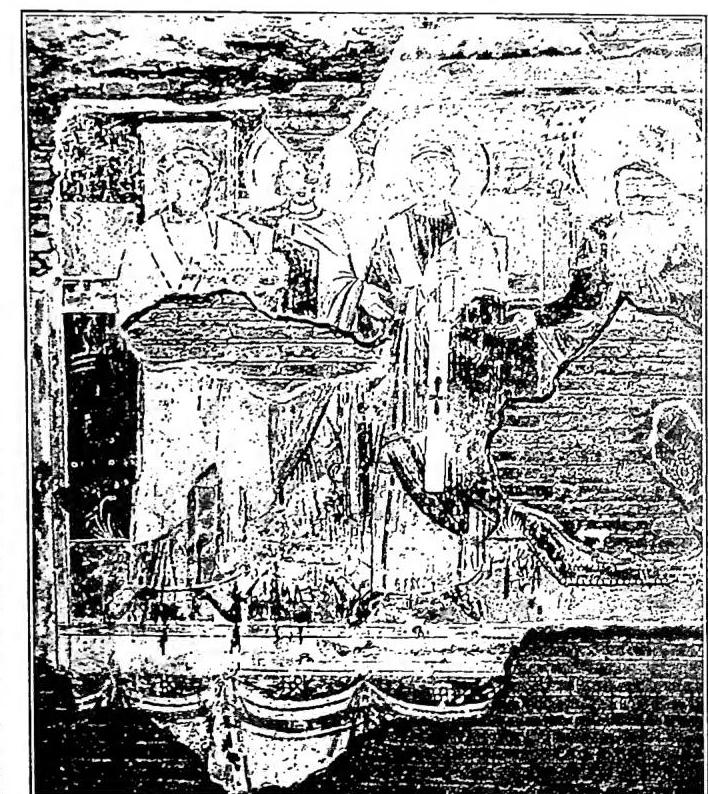
A.’s biographer tells us that he was a great lover of churches, amator ecclesiarum, and emphasizes the restorations and embellishments to which the basilicas and Roman churches were subjected during his pontificate; nor did A. fail to distinguish himself through his great charity toward the poor. He died on Christmas Day in 795, after a pontificate of approximately twenty-four years. Carlomagno mourned in him a friend and a father and had a nineteen-distich epitaph carved in marble; it is now set into the rear wall of the portico of the Vatican basilica (cf. G. B. De Rossi, L'inscription du tombeau d'A. I, in Mélanges d'archéologie et d'histoire de l'École française de Rome, 8 [1888], pp. 478–501).
A.’s character presents a remarkable combination of firmness and adaptability. Inflexible toward the Lombard king, he showed himself conciliatory, without baseness, toward Charlemagne, while employing all the extraordinary resources of his skilful diplomacy for the greater good of the faith and the exaltation of the Holy See. One might almost be tempted to reproach him for some weakness in repressing certain abuses, if, as we have said, one did not take into account the fact that the very nature of his relations with Charlemagne compelled him to show particular consideration. His dogmatic letters reveal a patristic erudition that was anything but ordinary. They abound in citations from the Greek Fathers, a very rare phenomenon in the West during the Middle Ages.
BIBLI: The principal source is the Vita Hadriani, in the Liber Pontificale, ed. L. Duchesne, I, Paris 1886, pp. cxxxxi ff. and 486–523, which appears twice in PL: 96, 1167–1204, and 128, 1163–98. Of the 58 letters of A. that have come down to us, 48 are addressed to Charlemagne and deal with the affairs of the Papal State. They are to be consulted in vols. 96 and 98 of the aforementioned PL: also in the Codex Carolinus (collection of papal letters to the Frankish kings), ed. MGH, Epistol. III, p. 476; Jaffé-Wattenbach, I, p. 289 ff.; S. Abel, Papst Hadrian I. und die weltliche Herrschaft des römischen Stuhls, in Forschungen zur deutschen Geschichte, 1 (1864), pp. 483–532; W. Martens, Die drei unechten Kapitel der Vita Hadriani I, in Theologische Quartalschrift, (1886), pp. 601–20; L. Duchesne, Les premiers temps de l'Etat Pontifical, 3rd ed., Paris 1911; H. Hemmer, s. V. in DThC, I, cols. 448–52; M. Jugie, s. V. in DHG., I, cols. 614–19. Martino Jugie