
PAPAL STATE. — The first nucleus of the P. S. was the Duchy of Rome. The duke, who represented Byzantine supremacy and resided on the Palatine, disappeared under the pontificate of Stephen II, and the Duchy remained, in fact, autonomous and had the pope as head of government. The authentic and juridical foundation of the P. S. does not rest on the Constantine I (v.) to St. Silvester, which is a forgery (L. Duchesne-P. Fabre, Le Liber censium, I, Paris 1901, pp. 366–69); but on the promise of territorial cessions made in 754 at Querzysur-Oise (Aisne) by Pepin the Short, who thus satisfied a debt of gratitude toward Pope St. Zachary. For did he not, in fact, fearing the hegemony of the Lombards and preferring the protection of the Franks, legitimize the seizure of power by authorizing its consecration? Having become master of Italy by right of conquest over the Lombards, in 756 Pepin granted to the Holy See, according to the version of the Liber Pontificalis, Comacchio, Ravenna, the region situated between the Apennines and the Adriatic from Forlì to Jesi, Sinigallia, Gubbio, Ancona, Faenza, Imola, Bologna, and Ferrara; neither the Duchy of Spoleto nor that of Benevento formed part of the donation.
The Lombard king Desiderius had indeed restored Faenza and Ferrara, but had failed to fulfill his other promises; then, under the pontificate of Hadrian I, he reconquered the two ceded cities and moreover threatened Ravenna. Charlemagne came to the aid of the Holy See and enlarged (6 April 774) the P. S. by the Duchies of Spoleto and Benevento, Luni, Berceto, Parma, Reggio Emilia, Mantua, Monselice, Venetia, Istria, Tuscia, and Corsica. In 787, moreover, he further enriched the Duchy of Rome with Lombard Tuscia and, to the south, with places situated on the right bank of the Liri, such as Sora, Arpino, Arce, Aquino, Teano, and Capua. The gift was so magnificent that it aroused doubts (P. Kehr, Die sogenannte karolinische Schenkung von 774, in Historische Zeitschrift, 70 [1893], pp. 385–441); but it did not reach its full implementation, although it was subsequently confirmed by Louis the Pious (817), Otto I (13 February 962), and Henry II (April 1020; cf. Liber censuum, I, pp. 363–65; 368–73 and Th. von Sickel, Das Privilegium Ottos I. für die römische Kirche vom Jahre 962 beleuchtet, Innsbruck 1883). The importance of the imperial privilege should not be exaggerated, since it represents a diplomatic instrument different from reality. Thus the Duchy of Spoleto long remained independent of the Roman Pontiff.
In any event, after a thousand vicissitudes, following the generous concessions made by Countess Matilda to Gregory VII in 1077, confirmed in 1102 to Paschal II, the P. S. extended beyond the left bank of the Po di Goro, from its mouth in the Adriatic to a point upstream from Felonica; it skirted the Modenese territory almost parallel to the Panaro, crossed the Apennines near Monte Cimone, then skirted Tuscany near Lake Trasimeno and below Chiusi, and ended below Orbetello. From there, the flat coastline along the Mediterranean reached as far as Terracina. The country became mountainous, and the boundary, skirting the Abruzzi, ran northward and, at the height of the S. Pellegrino Pass, turned eastward and ended at Porto d’Ascoli. Pontecorvo and Benevento remained isolated within the Kingdom of Naples after the latter had been enfeoffed to Charles I of Anjou.
The Papal States were divided into seven provinces: 1) the district of Benevento; 2) Campania and Marittima; 3) the Patrimony of St. Peter, enlarged by the county of Sabina, the terra Arnulphorum, and the cities and dioceses of Narni, Terni, Rieti, Amelia, and Todi; 4) the Duchy of Spoleto; 5) the March of Ancona with the districts of Urbino, Massa Trabaria, and the land of St. Agatha; 6) Romagna; 7) the city and county of Bologna.
The administration of each province belonged, save for exceptions, to a rector appointed by the pope or, occasionally, by a legate, under whose presidency the parliaments were held at irregular intervals, according to the needs of the moment. In these assemblies, the delegates of the municipalities discussed matters concerning their district, apportioned the extraordinary subsidies required to meet military expenses, entered into obligations, and took note of papal decisions. The rectors determined
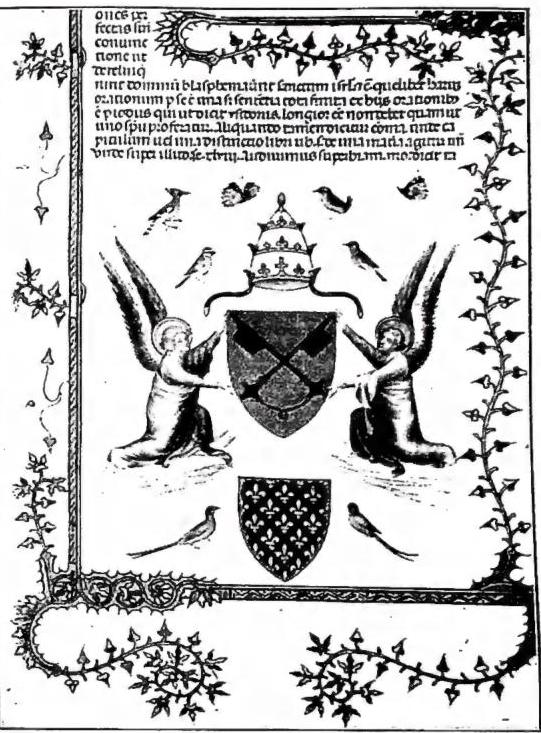
STATO PONTIFICIO — Coat of arms of the P. S. Miniature from the end of the 14th century, from vol. II of the Bible belonging to the Duke of Berry, as appears from the following annotation on fol. 437: • Cette bible est au duc de Berry et Dauvergne conte de Poitou • Vatican Library, cod. Vat. lat. 51, f. 1ᵉ.
They also set the sale prices, authorized or prohibited the export of agricultural products; they minted a special coin, the papalino, and fixed its exchange rate. A treasurer and a vice-treasurer administered the finances and collected the taxes, which came from numerous sources. A court of justice heard appeals from sentences handed down by the local magistrates. A marshal directed the police services, and a captain general commanded the army recruited from the feudal militias and the municipal militias. The Communes supplied arms and provisions, assumed the costs of constructing or repairing the city’s defensive walls, and watched over the safety of the lines of communication. The fortresses, scattered here and there throughout the territory of each province, were occupied by castellans. The organization of the administrative offices, though not very complex, was sufficient to ensure the sound management of local interests; nevertheless, like all institutions of the Middle Ages, it left room for arbitrary action, although the subjects of the Holy See had the recourse of appealing to it against the sentences handed down by the rectors.
In the political sphere, by contrast, the situation was highly confused, depending on whether the individual territories were directly or indirectly subject to the Church. In some of them the Holy See exercised power according to the feudal model: there were Communes that enjoyed a degree of semi-freedom and were unable to elect the podestà, while others, the larger ones, such as Bologna, Ancona, and Perugia, elected him themselves. To this must be added a large number of exemption privileges, granted too freely by the Holy See, which made it difficult for the governors to discharge their office. No less serious difficulties were created for them by partisan passions and struggles for predominance between barons and Communes. Beginning in the 13th century, the Communes asserted a jealous independence in relation to them; at the end of the 13th century and throughout the 14th, barons and fortunate adventurers established tyrannical regimes, to the detriment—
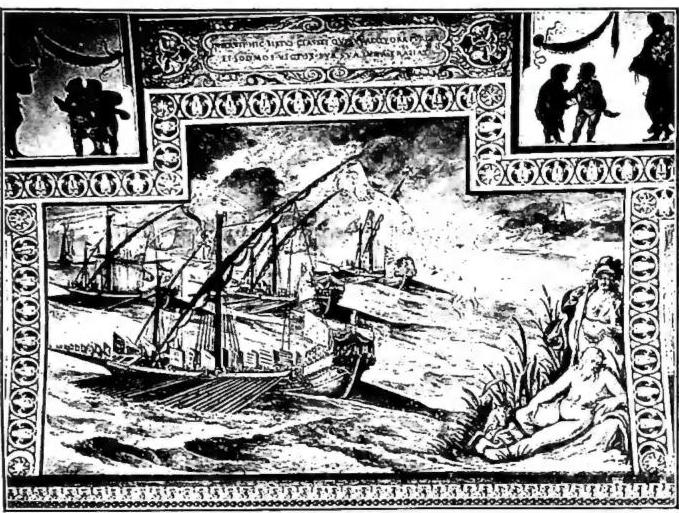
The external danger was no less serious: the Republic of Venice, the Visconti of Milan, and Florence, openly or covertly, aimed to usurp the lands of the Church; and there were also the ambitions of the King of the Romans and of the Angevins of Naples to be reckoned with.
In 1308, Venice, which aspired to exploit exclusively to its own advantage the river routes of transit toward upper Italy, occupied Ferrara with the consent of Francesco d’Este. But through the intervention of Clement V, it had to abandon the conquest (17 Feb. 1313).
If the expedition to Italy of the Emperor Henry VII (1311–13) brought nothing but material damage to Rome, where his troops and those of the King of Naples, vicar of the Holy See, confronted one another in bloody battles, the entry into the city of Louis of Bavaria (7 Jan. 1328) caused the inhabitants to defect; their example was followed by numerous cities of the Patrimony of St Peter and of the Marches. The withdrawal of the German army (1330) enabled John XXII to triumph over the schism of the antipope Pietro di Corvaro and Benedict XII to eliminate it completely. But political pacification proved far more difficult to achieve. Benedict XII, according to his own statement, abhorred war, and believed that he could restore the profoundly disturbed order, especially in Romagna and the Marches, through conciliation and the suppression of abuses perpetrated by apostolic agents. Yet while the constitutions issued to promote the proper administration of the Papal States unmistakably bear the mark of wisdom, the remonstrances, reproaches, and threats of spiritual or temporal penalties directed against the nobles of Romagna proved ineffective.
What, by then, remained of the supremacy of the Holy See? Giovanni de' Manfredi was master of Faenza; the Malatesta tyrannized over Rimini, Pesaro, Fano, Fossombrone, Ancona, Osimo, Senigallia, Jesi, and Ascoli; Francesco Ordelaffi boasted of having seized Cesena, Bertinoro, and Meldola... Worse still: the Pepoli sold Bologna to Giovanni Visconti (16 Oct. 1350). The numerical inferiority of the papal troops obliged Clement VI to grant the vicariate to the powerful lord of Milan for a period of twelve years (28 Apr. 1352). In Rome, the revolution of 20 May 1347 had brought Cola di Rienzo to power, while that of 26 Dec. 1351 transferred power into the hands of Giovanni Cerroni; at the same time, Giovanni di Vico sought to seize the Patrimony of St Peter.
In 1353 Innocent VI entrusted the difficult task of remedying such a lamentable state ALBINO (v.). This man of genius succeeded in bringing all the rebels to obedience, reconquering Bologna, and providing the Italian populations with a legislative code which, apart from some subsequent additions, would remain in force until 1816. Instead of crushing the vanquished by force of arms, he generously pardoned them and bound them to the Church by genuine and advantageous ties. Urban V was then able to make his entry into Rome (16 Oct. 1367), only to return to Avignon in September 1370.
The restoration of the papal monarchy, subsequently accomplished by Gregory XI, as well as the prestige gained by the Pope through the successful outcome of the war waged against Bernabò Visconti (1375), aroused the jealousy of Florence, which aspired to seize Tuscany. The cities and boroughs of the Papal States, discontented with the delayed return of the Pontiff to Italy and with the conduct of his officials, did not withstand the intrigues of Florence and raised the banner of revolt; and when the war known as that of the Eight Saints broke out, the Church lost the dominions so laboriously reconquered (Nov. 1375–76). Breton bands hired by Gregory XI eventually reduced the rebels to impotence, and Florence, struck by the interdict that ruined its commerce, signed the Peace of Sarzana (1378).
With the Great Western Schism, the struggles grew fiercer: Urban VI and Clement VII thought to end their dispute by force of arms. Against the Breton and Gascon bands commanded by Luigi di Montjoie, Urban VI opposed the Italian Company, commanded by Alberico da Barbiano (Apr. 1379). On 17 and 20 April, Clement VII, sacrificing the Papal States, granted to Louis I, Duke of Anjou, the Ferrarese, the Bolognese, Ravenna, Romagna, Massa Trabaria, the March of Ancona, Perugia, Todi, and even the Duchy of Spoleto, on the condition that he conquer them within two years. He retained for himself only the Patrimony of St Peter, Campania, the Marittima, the county of Sabina, and Rome. But the agreement with Louis of Anjou did not work, and the “Kingdom of Adria” did not arise because its essential clause—that it be conquered against Urban VI—was not carried out.
The fortunes of the war turned in favor of the Roman Pope; the garrison of Castel S. Angelo capitulated through hunger (27 Apr. 1379), and Alberico da Barbiano, victorious at Marino (30 Apr.), entered Cisterna, Rocca di Papa, and Marino. But Onorato Caetani, Count of Fondi, confirmed by Clement VII as rector of the Campagna and the Marittima, thought only of enlarging his sphere of influence. Giordano Orsini occupied the Alban Hills; Francesco di Vico repulsed the troops sent against him to wrest Viterbo from him and prepared to expand his domains in the Patrimony of St Peter. At Ravenna, Cesena, and Ancona, the castellans openly or secretly negotiated with Clement VII. The most formidable adversary of Urban VI, Rinaldo Orsini, Count of Tagliacozzo, fought successfully for six years with the aid of condottieri, until his tragic death (14 Apr. 1390) made possible the recovery of Orvieto and the Duchy of Spoleto. In 1408, the fortunes of the Papal States were seriously compromised by the entry into the Vatican (25 Apr.) of the King of Naples, Ladislaus of Durazzo, ostensibly to uphold the cause of Gregory XII, but in reality out of pure political self-interest: the capture of Perugia revealed his true intentions and compromised him. Florence, alarmed by his progress and adhering to the obedience of Alexander V, the Pope of the Council of Pisa, organized a punitive expedition, with the support of Louis II of Anjou, to drive Ladislaus from Rome. Once the undertaking had succeeded, the Republic had to be rewarded by the grant of Romagna (22 Apr. 1410), and on 25 June 1412 a treaty had to be concluded with the King of Naples, granting him Perugia, Ascoli, Viterbo, and Benevento. Neapolitan troops continued to occupy Rome for a long time, so that Martin V (11 Nov. 1417), the undisputed pope, had to reside in Florence for two years.
A phenomenon of primary importance arose from the disorders of the Great Schism: the Communes won autonomy and wrested from the popes, deprived of financial resources and political authority, a kind of municipal charters that secured their independence and enabled them to deal with the Papacy as an equal power, elect their own magistrates, mint money, and hire troops. More than this: Città di Castello, Fermo, Ascoli, Bologna, and others obtained the vicariate in temporal affairs in return for the payment of an annual census. These concessions, granted only on a temporary basis, were renewed upon their expiration, always because of financial difficulties.
In the Campagna and the Marittima, the less important communes had to fear the interference of the barons. From the heights of their fortresses, perched on the mountains, the nobles controlled the countryside and thus established principalities. In the Marche of Ancona and in the Romagna there were very numerous vicariates, more or less extensive, possessed by the Montefeltro, the Malatesta, the Polenta, etc. Alberto d’Este obtained the city and county of Ferrara in perpetuity (23 June 1389). In short, in the fifteenth century, the popes were no longer masters in their States, or were so only nominally; and beginning with Eugenio IV they recognized the need to re-establish their authority. The principal architects of the restoration of temporal power were Alessandro VI and Giulio II.
The nepotism that clouded the memory of Alessandro VI had an unexpected result. BORGHESIA (v.) dreamed of creating a powerful state for himself in central Italy; for this purpose, it was necessary to bring about the fall of the vassals established in the Romagna, the Marche, and the Campagna. Indeed, by every means, he succeeded in subduing the vassals and proudly assuming the title of duke of Romagna, Urbino, Senigallia, and Perugia (January 1503). But the death of Alessandro VI (18 August 1503) brought about his downfall, and the Church inherited his conquests. Giulio II had decided to free his States from the unjust usurpers; after recovering, with the assistance of Luigi XII, king of France, the lands usurped by Venice, he turned against his ally, and as early as 1510 announced his intention of fighting him; then he placed himself at the head of a strong army and recovered Bologna.
Under Leone X, Francesco Maria della Rovere, from whom the Pope had taken the Duchy of Urbino, took the field again in 1517 and easily regained his dominions. Toward the end of the sixteenth century, when the dynasty of the Este family died out, Ferrara returned under the direct rule of the Holy See; a few decades later, the same occurred with the Duchy of Urbino upon the extinction of the Della Rovere. Meanwhile, the institution of legates and vice-legates, already sketched out in the fourteenth century, became the general rule (v. LEGAZIONI).
In the eighteenth century, the French travelers who visited the Pontifical State unanimously testified that the populations lived happily under an essentially paternal regime. This is not to say that everything was perfect: by the admission of Pio VII, there was no administrative uniformity; judicial power depended upon a multitude of particular or privileged tribunals, whose jurisdictions overlapped and conflicted with one another; all attempts at reform had failed because of the clash of private interests and attachment to ancient customs (motu proprio of 6 July 1816, in Bullarii continuatio, XIV, Rome 1849, p. 47).
The problem of the existence of the Pontifical State arose with the French Revolution. Under the pretext of avenging the Bassville (v.), Bonaparte entered Bologna on 19 June, and on the 23rd imposed an armistice there, which entailed the occupation of the legations of Bologna and Ferrara and of the citadel of Ancona. When negotiations for a peace treaty, expected in the short term, failed through the fault of the Directory, the Treaty of Tolentino (17 February 1797) consecrated the loss “in perpetuity ... of the territories known under the name of the legations of Bologna,
(Int. Giordani)
PAPAL STATES — Decree by which the French general, Governor of Rome, returned to the President of the Pontifical Ecclesiastical Academy, Mons. Giuseppe Cardoni, part of the Academy’s Palace, occupied by French troops (12 July 1849) — Rome, Archives of the Pontifical Ecclesiastical Academy.
“Ferrara and Romagna.” Umbria and several cities of the Marches remained occupied by the troops of the French Republic until the complete payment of an enormous war contribution.
DUPHOT, LÉONARD (v.), during a deliberately provoked clash between reformers sympathetic to the French and papal troops, gave rise to a new French invasion: on 15 February 1798 the Republic was proclaimed, and Pius VI was dragged into exile.
When Austria subsequently compelled the invader to withdraw, it demanded to retain the legations for itself, while the king of Naples occupied the territory extending from Rome, which was included, to Terranova (November 1799). The two governments withdrew only after the French counteroffensive; but the Treaty of Lunéville (9 February 1801) provisionally assigned the Legations to France. The Treaty of Florence (28 March) freed the Holy See from the Neapolitans.
On 25 March 1814 Napoleon I restored freedom to the august prisoner because, among other reasons, he was anxious to thwart the designs of Gioacchino Murat, king of Naples, upon the papal domains. Austria, in fact, in order to have the Emperor’s brother-in-law among the allied sovereigns, had guaranteed Murat, by secret agreements (11 and 14 Jan.
(courtesy of Mons. A. P. Frutze)
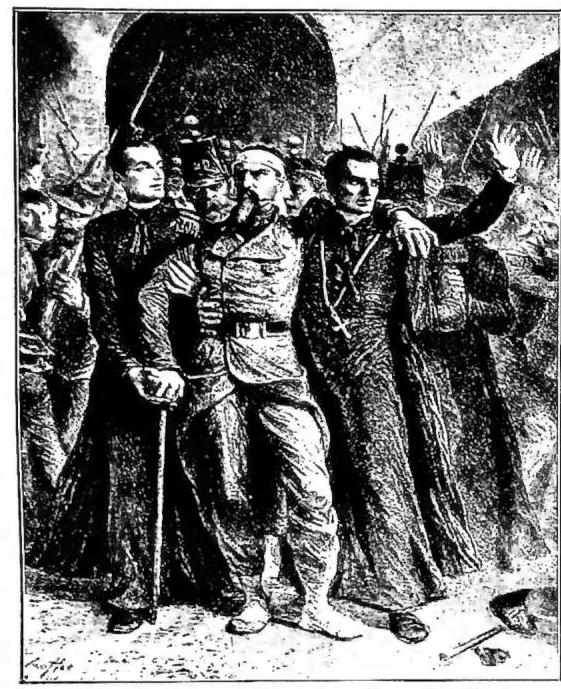
PAPAL STATE - Mons. de Mérode, Mons. Luquet, and Villiers de l'Isle Adam rescue some wounded French soldiers during the siege of Rome in 1849. Print from a painting by Raffet. Rome, copy of the Institute for the History of the Italian Risorgimento.
1814), “a purchase, calculated on the basis of 400,000 inhabitants, to be made at the expense of the Roman State” (cf. H. Weil, Le prince Eugène et Murat, III, Paris 1902, pp. 614–19; attached document no. XLVI).
Having returned to Rome after many vicissitudes and despite Murat’s opposition, the Pope learned the outcome of the negotiations begun in Paris following the fall of the French Empire. Article VI of the Treaty of 30 May 1814 specified: “Italy, apart from the borders of those countries that will fall to Austria, shall be composed of sovereign states”; and among the latter, in Article II of the annex, there appeared only the Kingdom of Sardinia! (L. Neumann, Recueil des traités et conventions conclus par l'Autriche depuis 1763, II, Leipzig 1856, pp. 466–74).
Cardinal Consalvi, entrusted with the negotiations with the allied sovereigns, on 23 June 1814, in a note of protest to all the great powers, demanded “the full enjoyment of all the dominions of which the French Revolution had deprived the Holy See” (cf. Ch. van Duern, Correspondance du card. Hercule Consalvi avec le prince Clément de Metternich, 1815-23, Louvain 1899, pp. 33–40). During the Congress of Vienna, everyone vied with one another in contending for the spoils of the Holy See; and its most dangerous adversaries were precisely Austria and Murat. A memorable skirmish then took place between Consalvi on the one side and Talleyrand and Metternich on the other. The allies were unanimous in maintaining the validity of the cession of the legations stipulated in the Treaty of Tolentino, and considered themselves the legitimate holders of the whole of the Napoleonic conquests in Italy. After “days of martyrdom,” in the cardinal’s expression, Article 103 of the Definitive Treaty (9 June 1815) restored to the Church Pontecorvo and Benevento, the legations of Ravenna, Bologna, and Ferrara, with the exception of the part of the Ferrara territory situated on the left bank of the Po, the Marches with Camerino and their dependencies (L. Neumann, op. cit., II, p. 713).
Following the execution of the Treaty of Vienna, which encountered the greatest difficulties on the part of Austria and the court of Naples, Pius VII, by a motu proprio of 6 July 1816, promulgated a Statute for the Papal States (Bull. rom. continuatio, XIV, Rome [1849], pp. 47–79, and the particular regulations required by the Edict, pp. 83–196) and established seventeen legations, divided into three classes: first class, or legations: Urbino and Pesaro, Ravenna, Forlì, Bologna; second class: Frosinone, Viterbo, Perugia, Macerata, Fermo, Ancona, Spoleto; third class: Benevento, Rieti, Civitavecchia, Camerino, and Ascoli. The legation of Ferrara remained outside the classification. The district of Rome, with its own organization, included the surroundings of the city and the governments of Subiaco and Tivoli. The four legations were entrusted to cardinals or, by exception, to prelates bearing the title of vice-legate; the others were headed by delegates, who had to be prelates. Each delegate was assisted by a Consultative Council, composed of members chosen by the Pope, and exercised authority over all the governors in his jurisdiction, who were likewise appointed by the sovereign. The municipalities were administered by a gonfaloniere, with the assistance of elders. The civil and penal codes underwent a profound reform. The cadastre, finances, public education, the army, and the police were reorganized. The laity deplored their exclusion from the highest offices, such as those of legates and delegates. Two Edicts, of 5 October 1824 and 21 December 1827, introduced changes in the administrative division of the Roman State, which was divided into thirteen delegations. The code of civil procedure was simplified (Bullorii Romani continuatio, XIV, Rome 1849, pp. 128–255; XVII, ibid. 1855, pp. 113–291).
The reforming work carried out by Pius VII under the inspiration of Cardinal Consalvi was partly neutralized by Leo XII. The populations deplored the suppression of certain provisions of the Napoleonic Code, the poor administration of the finances, the unjust distribution of land, and partiality in the judiciary. And since discontent was almost universal in Italy, sects such as the Carbonari developed; they professed a violent hostility toward absolute monarchies and drew their members from all social classes. They also found support in the Papal States, and on 4 February 1831 revolutionary disturbances broke out in Bologna, rapidly spreading through Romagna, the Marches, and Umbria; an army commanded by General Sercognani marched on Rome. Gregory XVI, who did not possess sufficient military forces, appealed to Austria. General Krabowski entered Bologna on 21 March, and on the 26th the insurgents capitulated. This occupation by Austria secured its hegemony in Italy, where it already possessed Lombardy-Venetia. The European courts therefore worked to bring it to an end. On 21 May 1831, a Memorandum was presented to the Court of Rome (cf. the text in Rina del Piano, Roma e la Rivoluzione del 1831, Inada 1931, with unpublished documents, p. 343), proposing a series of administrative reforms capable of ensuring public tranquility and restoring the motu proprio of 6 July 1816. The Pontiff did not accept the disguised imposition represented by the Memorandum, and, promising appropriate reforms, induced the Austrians to withdraw from the Papal States (15 July).
These highly complex and important administrative reforms represented a development of Consalvi’s work and were gradually implemented throughout the pontificate, but too often, because of partisan passions, they pleased neither the liberals nor the absolutists. Meanwhile, in order to impose their initial application and restore the authority lost in the legations, a papal army took the offensive (18 January 1832); but, after defeating the rebels in the action of the 20th, it could not prevent a general uprising of the population, and the Austrians, called in to assist, re-entered Bologna on the 28th; on 23 February, several French battalions seized Ancona. Foreign troops thus maintained order in the Papal States until 4 December 1838.
A new factor was added: Mazzinian propaganda for the ideas of freedom, independence, and national unity, centered on the organization of “Young Italy.” An attempted coup in Rimini in 1845 made the imminence of the danger clear. Moderate liberals and neo-Guelphs, who recoiled from the revolutionary actions preached by Mazzini, demanded constitutional reforms more suited to the tendencies of the time: Gli ultimi casi di Romagna, a pamphlet published in 1846, aroused considerable resonance in Europe. Its author, Massimo d’Azeglio, declared himself a supporter of constitutional monarchy and did not conceal his sympathies for the King of Sardinia, Carlo Alberto, destined, according to his predictions, to carry out the great work of liberation from the foreign yoke.
Well informed about the legitimate ambitions of his contemporaries, who were “tormented by the fever of reforms and innovations,” Pius IX was intent on satisfying them. He thus hoped to isolate the Mazzinian party and prevent it from achieving the creation of a republican unity in Italy. He began with the customary act of clemency: the decree of amnesty (16 July 1848) promised pardon to those exiled by his predecessor, to deserters, and to those condemned for political crimes (cf. Atti del Sommo Pontefice Pio IX, part 2, I, Rome 1857, pp. 4–7 and A. Mercati, In margine all'amnistia concessa da Pio IX, in Aevum, 24 [1950], pp. 103–32). A whole series of useful reforms received almost universal approval, with the exception of Metternich. But the Fundamental Statute for the temporal government of the States of the Holy See, which established a kind of constitutional regime, though one greatly mitigated (14 March 1848), became a stumbling block (cf. Atti, cited above, I, pp. 228–38). The prudent measures adopted disturbed the partisans of the former order, displeased those eager for innovations, and satisfied only the moderates. The refusal to participate in the war of independence against Austria aggravated the situation; nor did it succeed in restoring order through the energetic hand of Pellegrino Rossi. The revolution that followed in Rome upon the assassination of this minister (15 November 1848) induced the Pope to go to Gaeta, in Neapolitan territory (24 November), in order to safeguard his religious liberty. Thus the extremists prevailed over the neo-Guelphs and the moderates. A constituent assembly radically settled the Roman Question: Article 1 of the decree, voted during the night of 8–9 February 1849, declared that the Papacy “had in fact and in law forfeited the temporal government of the Roman State,” and Article 3 that “the form of government of the Roman State shall be pure democracy and shall take the glorious name of the Roman Republic” (cf. G. Spada, Storia della rivoluzione di Roma, III, Florence 1870, pp. 201–5).
Before returning to his States, Pius IX had a reform edict and a decree of amnesty published (12 September 1849; cf. Atti, cited above, I, pp. 286–94). In place of political liberties, the process of administrative innovations was resumed and intensified through excellent measures; these nevertheless appeared as a reaction against the liberal measures adopted, more or less spontaneously, in 1848. Despite this, thanks also to the presence of foreign troops, calm lasted in the Papal States until 1859. Many, however, thought that it was merely an apparent calm. The true sentiments of the innovators in the legations manifested themselves openly when war broke out between Piedmont and Austria. As soon as the Austrians stationed in Bologna had departed (12 June 1859), these men, in agreement with those from the Marches, Orvieto, and Perugia, sent emissaries to Turin to reach an understanding with the king of Sardinia.
(courtesy of Monsignor A. P. Frutaci)
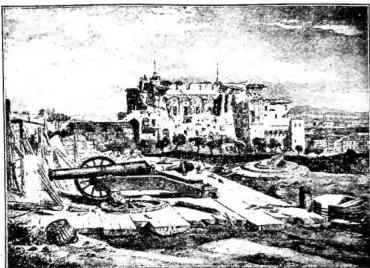
PAPAL STATES — Villa Savorelli on the Janiculum (siege of Rome in 1849), engraving by Domenico Amici.
The offer was not immediately accepted for fear of displeasing Napoleon III. But when Cavour received assurances that Europe would adopt a policy of non-intervention, taking as a pretext the disturbances that he himself had secretly fomented in Umbria and the Marches, he demanded that order be restored there; consequently, the Sardinian regiments entered the Papal territory, overcoming the resistance of the small Papal forces at Castelfidardo (18 Sept. 1860). A royal decree of 17 Dec. made the annexation of the Marches and Umbria to the Kingdom of Sardinia effective (cf. Traités publics de la Maison de Savoie, VIII, pp. 913-915). The Holy See retained only the delegations of Civitavecchia and Viterbo, that of Velletri and Frosinone, as well as the environs of Rome.
The proclamation of Vittorio Emanuele as king of Italy (17 March 1861) and the speeches delivered in Parliament by Cavour (25-27 March) constituted an open threat to the future of Rome. Several attempts at conciliation made from 1860 to 1862 led to nothing, while the small Papal States, reduced to a territory that was for the most part uncultivated, struggled to survive. The Convention of 15 Sept. 1864, signed with France, stipulated the gradual withdrawal of the French troops, to be replaced by promptly constituted Papal forces (H. von Srbik, La Convenzione segreta tra l'Austria e la Francia del 12 giugno 1862, in Rivista storica italiana, 3 [1937], pp. 1-60). These forces, reinforced at the last moment by a new French expeditionary corps, achieved, after more than a month of fighting against Garibaldian columns, the decisive victory of Mentana (3-4 Nov. 1867). But in 1870 the departure of the French brigade that had remained in Rome, caused by the outbreak of the war with Germany, and the consequent defeat, left the royal government free to act, and on 20 Sept., after five hours of steadfast resistance, Rome capitulated by order of the Pontiff. - Vedi tavv. LXXXVII-LXXXVIII.