FERMO, ARCHDIOCESE of. – City and archdiocese in the province of Ascoli-Piceno (Marche). It extends over 1,392 sq. km. and has a population of 225,340 inhabitants, almost all Catholic. It has 152 parishes with 327 churches, 322 diocesan priests and 73 religious priests; a seminary.
The first bishop of the Church of Fermo, Fabio, according to the most reliable evidence, belongs to the sixth century: 580–98 (Gregorii M. Epistulae, IX, 52, in MGH, Greg. Reg., II, p. 77); but the origins of the Church are earlier and, according to Harnack (Missione e propagazione del cristianesimo, Italian translation by O. Marrucchi, 2nd ed., Turin 1945, p. 512), an episcopal Church already existed in the third century. Nevertheless, what a late local tradition relates concerning the martyrdom and deeds of SS. Alessandro and Filippo, regarded as the first bishops of F. in that same century, does not seem acceptable; the origins of Christianity in Picenum are likewise assigned to this same period.
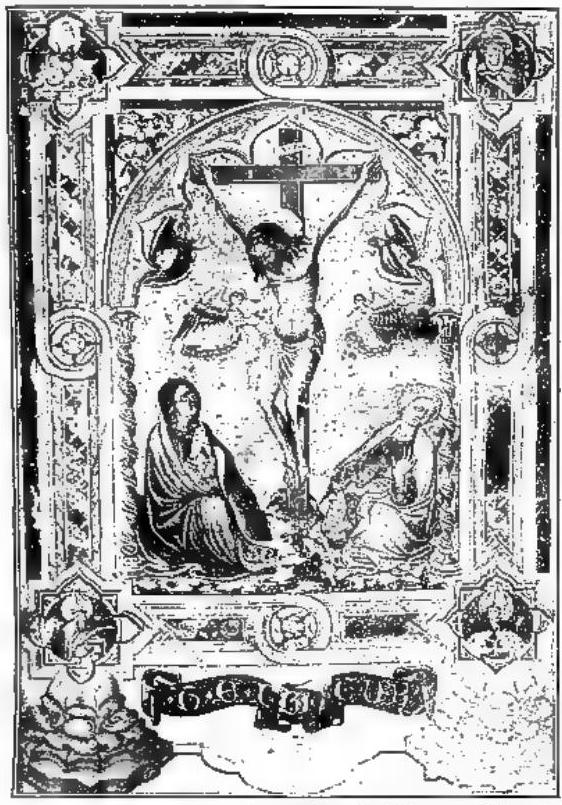
FERMO, ARCHDIOCESE of. – Crucifixion at the beginning of the Last Supper of the Mass. Fifteenth-century miniature – Fermo, Cathedral Treasury.
Church of F. was governed by Bishop Udalrico (1057–73), a correspondent and sincere friend of St. Pier Damiani (Epistulae, 4, 9: PL 144, 311–18); but, during the most heated phase of the struggle between Henry IV and Gregory VII over the see of Fermo, an imperial bishop was intruded (Gualfarango [?]: Regist. Greg., III, 10: PL 148, 440).
Later, in the disputes between Church and Empire in the twelfth century, the Church of F. suffered terrible reprisals at the hands of Frederick Barbarossa: the city was sacked and the Cathedral burned and destroyed by the forces of the imperial chancellor Cristiano of Mainz on 21 September 1176. In the thirteenth century, as the Franciscan movement spread throughout the Marches more than elsewhere, a Franciscan community was established at F. in 1240 under Bishop Filippo (1229–50); around the same time, the communities of the Dominicans and Augustinians originated in the city. The bishops, who for some time (1217–33) had held the effective principality of F., also assumed its title in the fourteenth century.
The diocese was conferred in 1424 upon the senior prelate Domenico Capranica, later created cardinal by Martin V (Eubel, II, 611), and again, in commendam, in 1430, although he never resided there. For a certain period the diocese remained with prelates of the Capranica family (Niccolò, 1458; Geolamo, 1475–78, etc.) in commendam and was administered through a vicar. During the Catholic reform movement, the history of the Church of Fermo acquired importance and splendor. Bishop Lorenzo Lenti, promoter of various reforms in the diocese, was sent as Pius IV’s extraordinary envoy to the court of France in 1561 (Pastor, VII, pp. 177, 460). From 1571 to 1577, Cardinal Felice Peretti was perpetuus Firm. episcopatus administrator et princeps; he implemented various reforms and founded the seminary. Having become pope (Sisto V), he raised the Church of F. to metropolitan status with the bull Universi Orbis of 24 May 1589. The original extent of the diocesan territory, which included that of the extinct Churches of Potenza (Potentia in Picenum), Falcone (Palerio), Corridonia (Pansulae) and Civitanova (Cluvatum Vicus), had gradually been reduced by the creation of the new dioceses of Macerata, under John XXII in 1520; Ripatransone, created by Pius V in 1571; and Montalto, Tolentino and Sanseverino, by Sisto V in 1586. In raising the see of F. to metropolitan status, Pope Sisto V assigned to it as suffragans the Churches of Macerata and Tolentino, Montalto and Ripatransone, and Sanseverino. The history of F. is connected with that of the Papal States. After the Lombard invasion (c. 580), in which the Church of Fermo suffered immense destruction (L. Duchesne, Les échecs d’Italie et l’invasion lombarde, in Mélanges d’arch. et d’hist., 25 [1903], pp. 96–97), the city remained under their rule and was the seat of a duchy (Lib. Pont., I, p. 496). From Charlemagne’s conquest, when it became a march in the tenth century, until the time of Gregory VII (Lib. Pont., II, p. 289), and later, having merged with the inconsulency [*inconsulenza*] (twelfth–thirteenth centuries), it belonged, at least nominally, to the Papal State, to which, with interruptions, it remained faithful amid the turbulent disputes between Church and Empire in the thirteenth century. After the Papal State was reorganized by Cardinal E. Albornoz, Giovanni Visconti da Oleggio, lord of F., was rector of the March (1561), and the city became the seat of the general Curia. In 1598 Boniface IX founded the University there, which came to an end in the year 1826. F., subsequently subjected to the rule of the Sforza and of the local tyrants (Eufreducci), returned in the sixteenth century to the dominion of the Holy See, which governed it through cardinal-nephews and vice-governors until the French occupation. In 1816, restored to the Papal State, it became the seat of a delegation, and in 1860 it was annexed to the Kingdom of Italy.
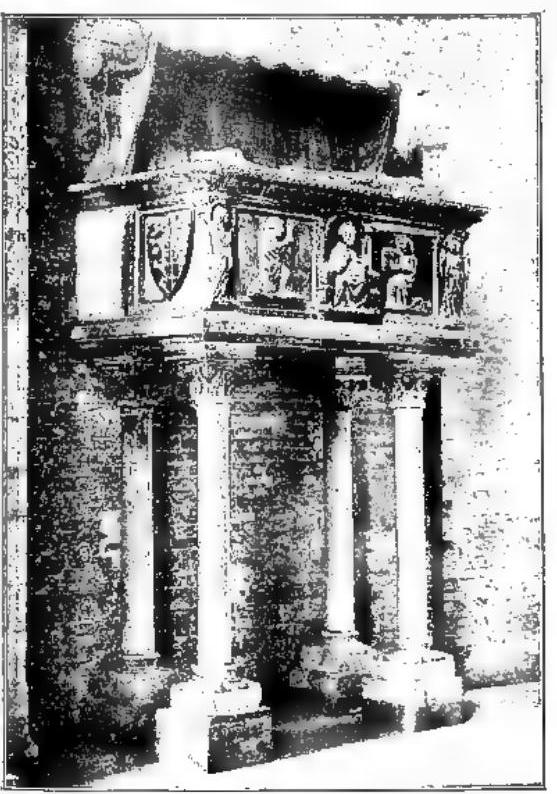
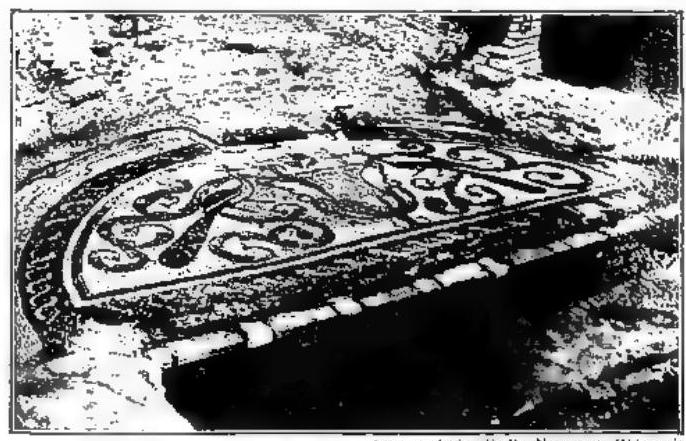
MONUMENTS. — The Cathedral, following the recent excavations (1934–38), constitutes the most imposing sacred monument and encloses within its walls the remains of all the structures that succeeded one another there. Of the early Christian basilica: the pavement mosaic of the apse (two stylized peacocks and a cantharus in the middle), dating no later than the sixth century; sections of pavement mosaic in the nave; and remains of the perimeter walls, with the following dimensions: 22.60 m in length and 13.30 m in width. The remains of the second basilica, dedicated to the Virgin and destroyed in 1176, are visible in the crypt, recently arranged and adapted for this purpose. The Cathedral was rebuilt, dedicated to Maria Assunta, and completed about 1227 by the architect Giorgio da Como. Of this Gothic structure, the monumental façade, with its portal and rich bas-relief decoration, and the bell tower have survived; remains of columns belonging to this third building are visible in the excavation area. Archbishop Minnucci, under the direction of Cosimo Morelli, restored and radically altered it (1789), and in that form it has come down to us.
The imposing interior is decorated in chiaroscuro. In the Chapel of the Sacrament is a valuable bronze tabernacle with bas-reliefs, the work of G. Lombardi. The crypt contains a Christian sarcophagus from the fourth century (Wilpert, Sarcofagi, I, p. 119, pl. 116, no. 3). The Cathedral treasury possesses a precious illuminated manuscript: the Messale de Firmonibus, commissioned by Bishop Giovanni IV de Firmonibus (1412–21). Among the numerous churches of artistic interest, the following should also be mentioned: S. Zenone, a Romanesque building (1171) with a decorated portal; S. Pietro, restored and attributed, according to an inscription in Gothic characters on the side portal, to 1251; S. Francesco, erected on the site of the ancient chapel of S. Leone, when the Franciscans first settled in F. in 1240 (Wadding, Annales, III, p. 42). An important and successful restoration of the apse is in progress. S. Domenico, erected in 1233 and radically renovated in the interior. S. Agostino, from the thirteenth century, profoundly altered in the interior according to a design by Fra' Vincenzo Rossi, an Augustinian (1730–38): the holy Thorn is venerated in the church. Important restoration work and the uncovering of frescoes have recently been carried out (F. Maranesi, Gli affreschi in S. Agostino di F. [Quaderni d'arte, 3], Fermo 1941); S. Filippo, consecrated in 1607 through the efforts of the Fathers of the Oratory, who settled in F. about 1580. It is notable for the rich decoration of its altars and for its paintings: Rubens’s Notte (F. Maranesi, La pala Rubensiana di F. [Quaderni d'arte, 4], Fermo 1942); Lanfranco’s Discesa dello Spirito Santo. It preserves the body of the blessed Antonio Grassi of F. The Sanctuary of the Madonna del Pianto, erected in 1675, restored in the last century, and recently enlarged. It venerates the image of S. Maria del Pianto, a sculptural work of 1612 by Sebastiani, protectress of the city and archdiocese. Other Marian sanctuaries in the diocese are Maria S.ma dell’Ambro (Montelottino) and S. Maria a Mare. The palace of the Civic Library houses the Lapidary Gallery, the Picture Gallery-Museum, and the Municipal Archive, where the Liber episcopatus sive inca episcoporum Firm, Eccl., a thirteenth-century parchment codex, no. 1050, is preserved. The Chapter Archive is preserved at the Cathedral, and the duly arranged Curial Archive in the Archbishop’s Palace.