
FABRIANO, DIOCESI of. — The history of the city and territory of F. is linked to that of the Church of Camerino, to whose extensive jurisdiction F. belonged from its origins throughout the medieval period, until the eighteenth century. In 1728 Benedict XIII established it as an episcopal see, but united it aeque principaliter with Camerino. Later, in order to eliminate all dispute, Pius VI, by the bull Saque factum est of 8 July 1785, made it autonomous and at the same time erected the episcopal see of Matelica, uniting it aeque principaliter with F.; the two dioceses had a single bishop until the present day. The bishop resides in F. The diocese as a whole extends over 322 sq. km., with a population of 38,000 inhabitants, all Catholics, distributed among 43 parishes, with 63 diocesan priests and 33 religious, and one seminary; 7 male religious communities with 56 professed members, and 16 female communities with 166 professed members (1949).
Numerous monastic foundations that flourished during the period of the rule of the Church of Camerino belong to the city and diocese of F.: S. Maria in Campo, eleventh century; S. Salvatore di Val di Castro, around the eleventh century, where St. Romualdo died (St. Pier Damiani, Vita di s. Rom., 69: PL 144, 1005); S. Angelo, thirteenth century; S. Biagio, in the city, of the Order of the Camaldolese, and S. Vittore delle Chiuse, near Pierosara, on the right bank of the Sentino: the monastery first belonged to the Benedictines, then to the Congregation of S. Croce of Fonte Avellana, and was suppressed by Innocent VII in 1405; the ancient documents preserved there date from the tenth century (R. Sassi, Due documenti capitali su le origini del monastero di S. Vittore delle Chiuse, in Rassegna marchigiana, II [1930], pp. 335–53); finally, S. Maria d'Appennino, eleventh century (R. Sassi, Le carte di S. Maria d'Appennino, in Studia Picena, 5 [1929], pp. 77–122). Later the Silvestrine religious established themselves there, in the thirteenth century; their superior general was the venerable Andrea di Giacomo da F. (1298–1326), as well as the Franciscans (R. Sassi, Un documento per la storia francescana di F., in Atti e memorie d. r. Deput. d. storia patria per le Marche, 5ª serie, 4 [1941], pp. 57–66) and the Dominicans.
Like its religious history, the civil history of F. is known for the period of the late Middle Ages. Having arisen as a free commune after the year 1000, the city later fell under the rule of the Chiarelli, who governed it as vicars of the Holy See until the fifteenth century, when their tyranny was ended with the extermination of the entire family (the Ascension massacre of 1435 at S. Venanzo). The subsequent history of the city and territory has greater prominence in the sixteenth century; in 1520 its governor was Cardinal Giulio de' Medici (Clement VII; R. Sassi, L'umanista camarte Varino Favorino governatore di F., in Studia Picena, 10 [1949], pp. 65–95); subsequent events followed those of the Papal States until the annexation of 1860.
MONUMENTS. – F. possesses a notable group of artistic churches: S. Lucia, of which a large part of the fourteenth-century construction remains (ca. 1360)—apse, left side, and bell tower (R. Sassi, Chiese artistiche di F., in Rassegna march., 7 [1928], pp. 45–53); in the chapel of S. Orsola and in the adjoining convent there are extensive frescoes of the Fabrianese school from the thirteenth to the fifteenth centuries; among the precious panels preserved there is a Madonna with Child by Fr. Ghissi; the Cathedral dedicated to S. Venanzo: the primitive temple was decreed, together with its cult, by the Chapter and people of Camerino (ca. 1046); its characteristic polygonal apse remains, and frescoes of the local school are preserved in rooms between it and the choir; S. Agostino, rebuilt in 1768, with a portal and frescoes from the fourteenth century; in the surrounding territory, the temple of S. Vittore delle Chiuse is among the finest Romanesque monuments in the Marche region. The churches belong to the Baroque period, owing to transformations carried out for the most part in the seventeenth century: S. Niccolò, originally from the thirteenth century (R. Sassi, Chiese artistiche
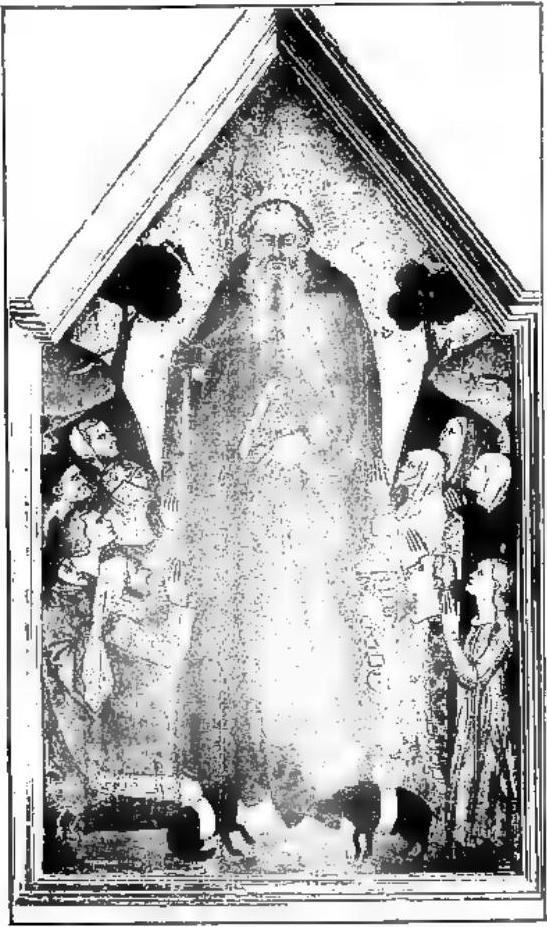
(phot. Deb. fot. 1922)
The native city of Gentile da F. had a flourishing school of artists (thirteenth–fifteenth centuries) of Giottesque tradition, dominated by the painter Allegretto Nuzi (1315–73): the most notable collection of his panels, together with other valuable works, is preserved in the Civic Picture Gallery (L. Serra, La Pinacoteca civica e il Museo degli arozzi di F., Fabriano 1921). The Municipal and Chapter Archives of S. Venanzo possess valuable material concerning medieval and monastic history. – Vedi tav. LXIV.
BIBL. P. Fr. Kehr, Italia Pontificia, IV, Berlin 1909, pp. 123–25; Cappelletti, VII, p. 633 ff.; L. Serra, L'arte nelle Marche, Pesaro 1929; B. Molaioli, Guida artistica di F., Fabriano 1937; Cottineau, I, cols. 1007–08. Serafino Prese