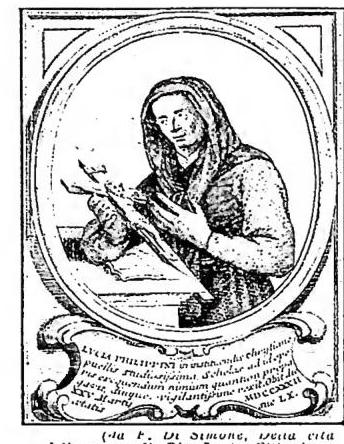
LUCIA, saint and martyr. - Venerated throughout the Church, she suffered martyrdom at Syracuse during the persecution of Diocletian on 13 December 304. The most ancient and authentic document of the cult paid to her is an inscription found in the cemetery of St John at Syracuse in 1894; it dates from the early 5th century and refers to a certain Euschia who died “τῇ ἑορτῇ τῆς Κουρίας μου Λουκίας” [on the feast of my Lady Lucy].
Her cult soon spread beyond the borders of Sicily. Her feast is already recorded in the Sacramentarium Gelasianum (Reg. 316) and in the Sacramentarium Gregorianum (Pad. D. 47) on 13 December; on the same date she is commemorated in the Martyrologium Hieronymianum. In the 6th century there existed at Rome, as well as at Syracuse, a monastery dedicated to her (St Gregory the Great, Reg. epist., VII, 36; XI, 15), and in the 7th century Honorius I (625–638) dedicated a church to her. Probably St Gregory the Great inserted her name, together with that of Agatha, into the Canon of the Mass, and about the same time her cult was introduced also into the churches of Milan and Ravenna. There her image was depicted in the famous procession of Virgins in the church of St Apollinare Nuovo. The marble calendar of Naples and the Greek synaxaries likewise commemorate her on 13 December.
The Passio, of which Greek (BHG, 995 ff.) and Latin (BHL 4992–5003) versions exist, composed between the 5th and 6th centuries, is a patchwork to be classed among the hagiographical legends written to extol the greatness of Christian virginity, although a certain primitive nucleus may be discerned regarding her examination before the tribunal. According to the Passio, Lucy was a young and wealthy Syracusan already betrothed to a fellow-citizen. Having gone to Catania to the tomb of St Agatha to beg for her mother’s cure, the saint appeared to her, assuring her that her prayer would be heard and foretelling her martyrdom. On her return home Lucy decided to remain a virgin; her betrothed therefore accused her as a Christian before the prefect Pascasius. The prefect summoned her to his tribunal, but threats and exhortations proved useless; he ordered the virgin to be taken to a brothel, yet neither men nor oxen could move her a single step. She was sprinkled with burning pitch, but the fire did not touch her; finally she was stabbed with a dagger. Before she died Lucy had time to foretell the coming peace that would come to the Church with Diocletian’s abdication, and to receive the Eucharist from the bishop’s hands. A church was then built over her tomb, soon becoming a pilgrimage centre and a source of miracles. Pascasius, on the other hand, was accused of plundering the province, taken to Rome and executed.
There are two traditions regarding Lucy’s relics. According to one, they remained at Syracuse until the 8th century, when Faroald, duke of Spoleto, having captured Syracuse, took them to Corfinium (= Pentima) in Abruzzi. There they remained for over two centuries, and in 969 were transferred to Metz by Bishop Theodoric at the emperor Otto’s behest. In 1042 an arm was allegedly given to Emperor Henry III, who presented it to the monastery of Luitburg. According to the other version, Lucy’s relics were transferred from Syracuse to Constantinople in 822 by George Maniakes to save them from Saracen devastation. When the city was taken by the Crusaders in 1024, they were allegedly brought to Venice and placed in the monastery of St George. In 1280 they were transferred to a church dedicated to Lucy, except for an arm which remained in St George’s; this arm was later transferred to the church of St Geremia by Pius IX in 1860.
Lucy is generally invoked as the protector of sight and against all eye diseases and blindness. In iconography she is usually represented holding a dish containing a pair of eyes. Thus, of the whole legend of the saint’s martyrdom, the episode that has most impressed popular imagination is that of her tearing out her eyes and sending them on a dish to Prefect Pascasius, who had fallen in love with her because of the brilliance of her gaze. This episode, however, is not found in the Passio and was inserted later into Lucy’s life from the legend of another Lucia (cf. Moschus, Pratum spirituale, 60: PL 74, 178). Some think that the connection of Lucy with the representation of eyes may have been suggested by the martyr’s name: Lucia = light, hence invoked in eye diseases which use light to see. Indeed in the Middle Ages a kind of eye-salve was simply called “santalucia”.
The sword thrust into the neck, sometimes replaced by a dagger, is a definitive indication of martyrdom: it appears in two panels in the National Museum in Munich, in the monastery of Messkirch in Karlsruhe, etc. Thus also in a panel by Holbein the Elder in Prague. Sometimes the sword leans against the book, as in a painting by Jacopo di Michele Gera in the Palazzo dei Priori in Volterra. Another specification of martyrdom, but widespread only in Germany, is that of flames rising from below to envelop the Saint, as found in Cologne in a panel from a private collection of the local school and in a panel by Holbein. Naturally there exist other representations that do not conform to these schemes: in the panel by Borgognone in Bergamo the two eyes are placed on the point of the sword. Flandrin in a panel in the church of St-Vincent-de-Paul in Paris and the Angelico in a reliquary of Santa Maria Novella place a crown in her hands. Moreover, in German-speaking countries, where individual depictions of the Saint date only from the late 15th century, the Saint usually wears a large open cloak in front and long garments gathered at the waist. A large altarpiece by Palma the Elder, for the altar of the church of Santa Lucia in Venice, then depicts her apotheosis. The martyrdom of the Saint is depicted in the Menologion of Basil II (976–1025) preserved in the Vatican Library, in an hagiographic codex of the 12th century in the Wallerstein Library in Bavaria, and in a Passionario of the Stuttgart Library, of the same century, in miniatures of the Arsenal Library in Paris, in numerous predellas of altarpieces, and above all in that admirable one by Domenico Veneziano of the altarpiece of Santa Lucia de’ Magnoli, formerly in the Friedrich Museum in Berlin, in which one sees the Saint kneeling, struck by the executioner, while the Emperor from the balcony of the Palace gives the order for the beheading.
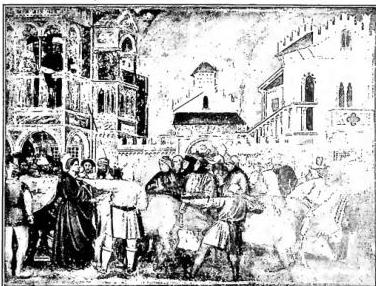
Numerous also are the scenes of the legend. Of these, to limit ourselves only to Italy, one may recall those painted by a Giottesque master in the cloister of the Benedictine monastery of Resca Valle on the island of Veglia in Dalmatia, by a 14th-century fresco painter in Empoli, by a pupil of Gentile da Fabriano in an altarpiece in Fermo. But of all, the most important are the apse frescoes of the church of Santa Maria delle Grazie in Offida, by a follower of Allegretto Nuzi, and the cycle in the Oratory of San Giorgio in Padua, by Avanzo (ca. 1380), in which, in four scenes unfolding against the backdrop of a marvelous complex of Gothic architecture, one observes the Saint led before the judges who stand on the loggias of the Palace, the miracle of immobility despite the fact that six oxen goaded by the executioners attempt to drag her, the martyrdom, which unfolds in three architectural compartments in its various phases of torture by fire, immersion of the naked Saint in boiling oil and wounding by the sword, and finally the deposition of her body in the tomb, before the Dudmo, amid a pious cortege of religious and faithful, while at the windows of the religious building, above a small loggia, she appears receiving Communion. Of particular beauty and narrative felicity is the panel by Lorenzo Lotto in the Pinacoteca of Jesi, where scenes of the life of the Saint are represented.
Eugenio Battisti
FOLKLORE. — The cult of St. Lucy is centered in her native city, Syracuse, where on 13 December a solemn procession makes its way to the country church built on the site of the saint’s martyrdom. The saint is widely celebrated throughout Sicily with festivals and processions: on that day the faithful abstain from eating bread, limiting themselves to legumes, vegetables, chickpea fritters, and caccia (soaked and cooked wheat mixed with other legumes).
(photo: Alimari)
In many Italian cities (for example, in Bologna) a large fair is held on 13 December, marking the beginning of the Christmas season and already displaying Nativity figurines, toys, and sweets. In Trentino and elsewhere (Tyrol, Bohemia, etc.), St. Lucy performs the same role as St. Nicholas or Befana: it is believed that on the night before her feast she passes by the houses of good children on her donkey laden with gifts, leaving toys and sweets, as well as a small switch.
Before the Gregorian calendar reform, St. Lucy marked the shortest day of the year, a fact still recalled in a widespread old proverb. Hence, on this day—and still today—forecasts for the new year are drawn: in various regions not only of Italy (Sicily, Calabria, Apulia, Abruzzo, Julian March) but also of France, Silesia, the Carpathians, and Russia, the prognostications of the kalends begin on 13 December rather than at Christmas or New Year. They consist in holding that the weather on each day from St. Lucy’s Day to Christmas will correspond to the weather of each month in the coming year. Thus, girls draw horoscopes to learn who their future spouse will be.
Expressions of popular devotion to St. Lucy include ex-votos in wax or silver foil shaped like two eyes, or amulets in various metals of the same form, or even small loaves called “the eyes of St. Lucy.” In many places a strict fast is observed on the vigil, and it is believed that those who keep it will see their future spouse in a dream that night. There is also a widespread belief that on St. Lucy’s night spirits and witches are unusually active, and various means are employed to ward them off. In Croatia, a cornmeal cake is baked for men and livestock, with the idea that it will protect them from the bite of mad dogs.
The legend of the saint has inspired poetic compositions and folk songs. A poem in sestinas was published by De Bartholomaeis from ms. Ambros. 95 sup. (see bibliography); a story in ottavas is preserved in old popular prints at the Marciana Library in Venice; a narrative song in