
CANON OF THE MASS. - The word canon, having entered ecclesiastical lexicon, has been used since the 6th century to denote the most solemn part and the essential formula of the Eucharistic rite.
CONTENTS:
I. Meaning
II. General character and traditional schema
III. The primitive Canon
IV. The Roman Canon and its author
V. The principal reconstructions of the ancient Roman Canon
VI. The secrecy of the Canon
VII. The Preface
VIII. The intercessory prayers
IX. The conservatory prayers
X. The offering of the victim
XI. The second reading of the diptychs
XII. The final doxologies
XIII. The Saints of the Canon.I. MEANING
More than a fixed and invariable group of prayers, the word seems to signify a rule for the consecration of the Eucharist. In this sense, it is first found used in St. Gregory the Great: orationem dominicam mox post canonem dici statuistiis (Epist., IX, 12). However, in 538 Pope Vigilius, in his letter to Profuturus, employs a nearly identical expression: canonicae precis textum. The name Canon is nothing but the abbreviation, in use in the 5th-6th centuries, of Canon actionis, that is, rule of action and of prayers; the current form Canon Missae derives from the Gregorian Sacramentary and has ultimately prevailed. In liturgical tradition, other terms are not lacking to indicate the same thing. It is called: prex, oratio oblationis, praecatio, praedicatio, benedictio, actio sacrificii, mysterium, anaphora, etc. The Eastern liturgies have numerous versions, but generally employ a typical formula. The Roman liturgy has only one, the Canon, common also to the Ambrosian liturgy; variable is only the first part of the prayer, the Preface, and in some circumstances the Communicantes and the Hanc igitur. The Gallican and Visigothic liturgies changed all the various parts, except for the narrative of the Eucharistic institution.II. GENERAL CHARACTER AND TRADITIONAL SCHEME
The Canon of the Mass is nothing other than the liturgical development and dramatic reproduction of what Jesus accomplished at the Last Supper. In essence, it is ideally connected to the great Hallél (v.) recited by the head of the family during the Jewish Passover banquet, preserving precisely its external framework of a blessing hymn. However, a new concept has been inserted and developed within this framework: that of the Redemption wrought by Christ. The fundamental idea of the prayer, in its numerous traditional formulas, is therefore thanksgiving (εὐχαριστία), which has given its name to the entire rite—or rather, to the sacrifice of Jesus. This content remained strikingly clear and immutable in the progressive differentiation of the various liturgies. Examined closely, the development of this theme presents itself as divided into two parts, though coordinated with one another: the laudative thanksgiving, from which the entire Canon takes its beginning (the Preface), and the sacrificial thanksgiving, which concretizes this concept in the strictly termed Eucharistic oblation.
III. THE PRIMITIVE CANON
The newly composed hymn of blessing appears to have been left free in the earliest times to the celebrant who could improvise it; certainly, it was treated variously in written formulas. Nevertheless, it reproduced a common foundation of ideas, logically linked in an organic plan of strictest unity. The primitive Canon was, in fact, a single composition that unfolded harmoniously from the Sursum corda to the final doxology, before the fraction. In its grand simplicity, it resounded as a hymn of praise and thanksgiving to the Trinity, whose divine Persons and the actions carried out by each for the redemption of the world were glorified. In commemorating particularly the works attributed to the Son, the narrative of the Last Supper was recounted, and the words of Consecration were repeated. Finally, the Lord was prayed to look with favor upon the sacrifice and to send down upon it the power of the Holy Spirit, who ratifies the work of Jesus and validates its fulfillment. The original schema can thus be summarized in the following points: thanksgiving for creation and redemption, narrative of the Supper, anamnesis, epiclesis, doxological conclusion. Such was the literary rhythm of the primitive Eucharistic hymn, as can be seen not only in St. Justin, but also in the present-day Eastern anaphoras and the oldest formulas we possess, from those of the 4th century—the Canon of Serapion of Thmuis, and the anaphoras of the Apostolic Constitutions, the Testamentum Domini, and the Deir Balyzeh papyrus—to that preserved in the Apostolic Tradition of Hippolytus, according to the Latin recension of the Verona palimpsest (218-35). On this latter text, the attention of liturgists has long been focused, especially since Cagin believed he had identified a common archetype from which the various preces of the liturgies derived. Today, these present no slight differences in the two main groups of Eastern and Western liturgies, and even within the families belonging to the same group. The learned monk, through a keen process of elimination and comparison, thought he had succeeded in establishing a formal unity that, if not precisely the original, was at least very close to II. Composed in Greek and inspired by the theme of prayers then in circulation, the prayer of the Traditio Apostolica of Hippolytus derives its exceptional importance not only from its content and author but also from the fact that it is the oldest text of an hymnus eucharisticus to have come down to us, prior to interpolations or revisions. Stripped of all adventitious elements, the Roman Canon, as well as the Eastern anaphoras, substantially coincide with this venerable schema. Thus, prior to interpolations, one reaches a liturgical epoch in which all churches knew an anaphora consisting of a latreutic and Eucharistic hymn, of which the Preface and the epiclesis constituted the extremities, and the recollection of the Supper and the subsequent mysteries the center. The documents of this most ancient liturgical epoch, examined and compared by P. Cagin, are: the Verona fragments (ed. E. Hauler, Leipzig 1900, p. 106 ff.) in Latin; the Statuta Apostolorum (ed. J. Ludolf, Frankfurt am Main 1691) in Ethiopic; the Testamentum Domini (ed. E. Rahmani, Mainz 1899) in Syriac; the Liturgia Salvatoris (ed. J. Ludolf, Frankfurt am Main 1691) in Ethiopic; the Liturgia Apostolorum (ed. E. Renaudot, Paris 1716) in Ethiopic. These five documents, independent of one another, contain common parts and at times surprising coincidences. Since it is impossible to explain this agreement, one is compelled to trace back to a primordial Canon, unique in its fundamental schema, from which the subsequent recensions would derive. Cagin started from the presupposition that the "Liturgical Ordinance of the Egyptian Church" presents the oldest testimony of the apostolic tradition on the Canon; but his effort is rather artificial. It is not proven that the anaphora of Hippolytus truly preserved the pure apostolic tradition, given that no other texts from the same period have come down to us. Even without recognizing in it the apostolic anaphora, contemporary with the last years of the apostle Giovanni, as the French scholar would have it, the Canon of Hippolytus' Traditio marks a stage of capital importance in the genesis and formation of the Eucharistic prayer.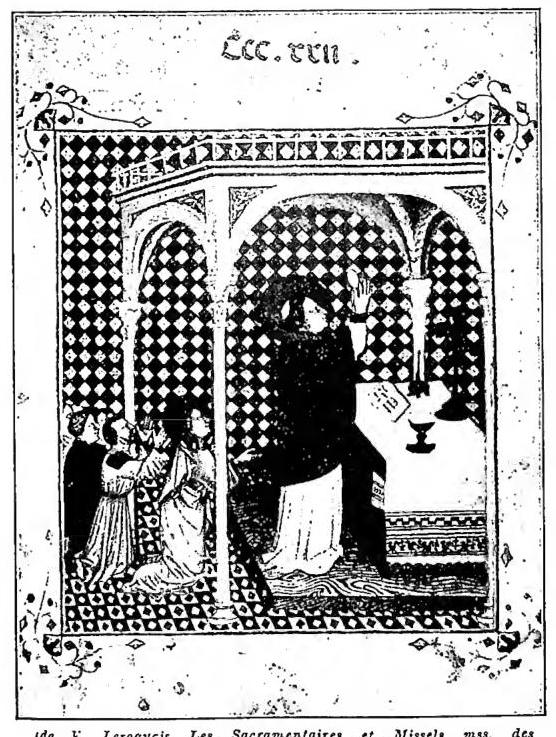
IV. THE ROMAN CANON AND ITS AUTHOR
The notable divergence of the Canon of the Roman Church from the anaphoras of the Greek liturgies and from the most ancient forms of the Eucharistic prayer has long been observed. In reality, it constitutes a distinct chapter in the history of the Mass. While not deviating from the traditional theme, it develops it with a singularity ofCANON OF THE MASS — Elevation of the Host at the moment of Consecration. Franciscan Missal and Book of Hours (1380). Paris, National Library, ms. lat. 757, f. 322.
in form, distinguishing itself literarily from any other prayer. In its entirety, it may date back to the 4th century, although for its composition the author drew upon local tradition and earlier documents. St. Justin, the Traditio Apostolica of Hippolytus, the fragments reported in the De Sacramentis, etc., constitute the entire literary documentation of the first six centuries on the Roman Canon. St. Justin, a witness to the liturgical usages of the Urbs, presents only a trace of the Canon of his time. The anaphora of Hippolytus, fundamentally Roman and composed perhaps to serve as a norm for the celebrant when its development was still freely inspired, has left but faint traces in the present Canon, which proceeds with a rather different rhythm. The passages from the De Sacramentis date only to the end of the 4th century and offer formulas that are noticeably developed and already distant from the primitive nucleus. By this date, the Roman text appears clearly delineated and composed in its principal elements. Between the 3rd and 4th centuries, therefore, our Canon received its substantial redaction. To fill this gap of over a century and attribute the reform to a specific author is to venture into the prehistory of the liturgy and confront nearly insoluble questions. Even in Rome itself during the 5th-6th centuries, the period of the composition of the Liber Pontificalis, little was known about the origins and author of the Eucharistic prayer. One was content with a "it is said," to the point that Pope Vigilius (538), writing to Profuturus of Braga, considered it ex traditione apostolica susceptum. St. Gregory the Great did not profess exaggerated esteem for it and regarded it as precem quam scholasticus composuerat, the work therefore of an anonymous man of letters (excluding, of course, the essential part of the consecration). A bold hypothesis by Morin would link this scholasticus to Firmicus Maternus (mid-4th century). Recent scholars have endeavored to dispel such uncertainties, indicating probable authors, but without solid results. Callewaert alludes to the work of St. Leo the Great (S. Léon le Grand et les textes du Léonien, Bruges 1948, pp. 87-125); characteristic is the opinion of Baumstark, who sees in the Roman Canon a translation from the Greek, based on concepts and grammatical peculiarities proper to the East. The Council of Trent (sess. XXII, cap. 4) states that it was composed by the Church, which ut digne reverenterque (sacrificium) offerretur ac perciperetur, sacrum Canonem multis ante saeculis instituit. The disparity of judgments can be harmonized by saying that the substance of the Canon comes from the Apostles (Vigilius); that its arrangement, however, is the work of the Church (Council of Trent); and that in the definitive redaction, total or partial, private individuals or those commissioned by the Roman pontiffs also had a hand (Gregory).
THE PRINCIPAL RECONSTRUCTIONS OF THE ANCIENT ROMAN CANON
A careful examination of the various parts of the Canon reveals profound revisions. Evidence of this lies in the very brief conclusions slipped here and there to disconnect the different prayers and further underline their disjunction. Thus, it not only no longer represents the primitive Eucharistic prayer but does not even exactly reflect the type of Canon from the 4th century, the probable period of its composition. The various retouchings of the Eucharistic hymn, the new insertions, and especially the diaconal prayers—which, where there was no deacon, had to be recited by the celebrant himself—have diluted the text of the first anaphora, now scattered throughout the Canon of the Mass. Particular account must be taken of the developments that occurred between the 5th and the end of the 6th century, when the Roman prayer assumed a new form due to the suppression of very ancient elements and the addition of new formulas. In vain, for example, would one seek today in the surviving text an explicit epiclesis, to which Pope Gelasius clearly alludes in 496, writing to Elpidius. The text now possessed can only be established from manuscripts dating at most to the 7th–8th centuries. It is certain only that the last revisions, attributed to Gregory the Great, occurred around 600, and that in Rome the Canon may be considered definitively fixed at the beginning of the 7th century.
1) According to C. Bunsen, the Roman Canon, compared with the consecratory prayers of Milan, Gaul, and Spain, represents the product of a more recent period, characterized by greater simplicity and brevity, in contrast to the florid and rhetorical style of other Western churches. The Leonine and Gelasian Sacramentaries would be documents of this simple Roman style, established in the mid-4th century, between Silvester and Damasus, when the last resistances of the Greek language in the liturgy fell in Rome. The insertion of the dittici, whose reading passed from the deacon to the celebrant, and the revisions of the prayers of oblation gave the Canon its current form, that of a disordered collection of texts. Thus, the Memento of the living would be a kind of parenthesis, a marginal formula in the Canon recited by the deacon; consequently, the Communicantes would logically connect to the Te igitur, giving the first word—otherwise almost incomprehensible—a meaning of communion and unity with the Pope and the hierarchy. The addition to the Hanc igitur, attributed to St. Gregory the Great, would not have been limited to the phrase diseque nostros in tua pace disponas but would have included the entire second part of the oration, which would therefore have originally formed a single unit with the subsequent prayer Quam oblationem.
Bunsen’s primary merit lies in having distinguished the diaconal prayer from the strictly priestly formulas, thus paving the way for solving the intricate problem of the intercessory prayers in the Roman Canon.
2) F. Probst, a convinced proponent of the theory of the evolution of Roman euchology, seeks the first source of our Canon in Book VIII of the Apostolic Constitutions. There, according to him, the ancient liturgy—una, sancta, catholica et apostolica—must be found. Later, under the auspices of St. Damasus, it underwent notable revisions in the Urbe; in particular, the various stations and ecclesiastical feasts were linked to the Eucharistic rite, which until then had been foreign to the unfolding of the liturgical year. From him originated, along with the collects, secrets, and postcommunions, the prefaces as well; with the consequence, however, of isolating the first part of the Eucharistic hymn from the consecration. The empty space between the Trisagion and the account of the Last Supper was filled with extraneous pieces, the various intercessory prayers. Probst’s theory remains uncertain and does not appear satisfactory; but he could propose it because, in his time, only Book VIII of the Apostolic Constitutions was known from the entire primitive liturgical literature.
3) P. Cagin deserves credit for the bold attempt to trace the origins of the Roman text even further back, almost to the threshold of the so-called apostolic liturgy. Through ingenious comparisons between the Roman formulas and the corresponding ones of Gaul and Spain (which, contrary to the opinion of Duchesne and other eminent liturgists, he assigns to an identical original stock, in turn linked to the ancient liturgical source of the Egyptian Church), he sought to demonstrate that the texts harmful to the conceptual continuity of the Roman prayer are found in certain documents placed outside their natural position. Restored to their original place, they receive a more exact and logical meaning. Thus, the two Memento and the Communicantes should be placed before the Preface, in the offertory zone, where the Gallican Mass has placed ab immemorabili the solemn reading of the dittici. The Hanc igitur and the Quam oblationem can be considered transitional formulas, corresponding to the Gallican Post-sanctus; the Te igitur would be a kind of substitute epiclesis, or prayer of offering, to be recited after the Consecration, similar to the Oratio post pridie of the Gallican liturgy; the Nobis quoque peccatoribus, on the contrary, would have been found after the Pater, as an embolism thereof.
Cagin’s highly personal solution has left scholars perplexed and has proven practically untenable. In the time of Innocent I (401–17), the intercessory prayers—
BIBL.:
Per le varie ipotesi sulla formazione del C. romano: C. Bunsen, Analecta Ante-Nicaena, Londra 1854; F. Probst, Liturgie der drei ersten christlichen Jahrhunderte, Tubinga 1870; P. Cagin, L'Eucharistie, Parigi 1912; V. JALABERT, LOUIS, Les Sacramentaires et Missels manuscrits des bibliothèques publiques de France, Parigi 1924; Id., Les Sacramentaires et Missels, Parigi 1915, album, tav. 55. — A. Baumstark, Liturgie comparée, Chevetogne 1939; J. A. Jungmann, Missarum Sollemnia, Vienna 1948; M. Righetti, Manuale di Storia Liturgica, Milano 1949.
A. M.
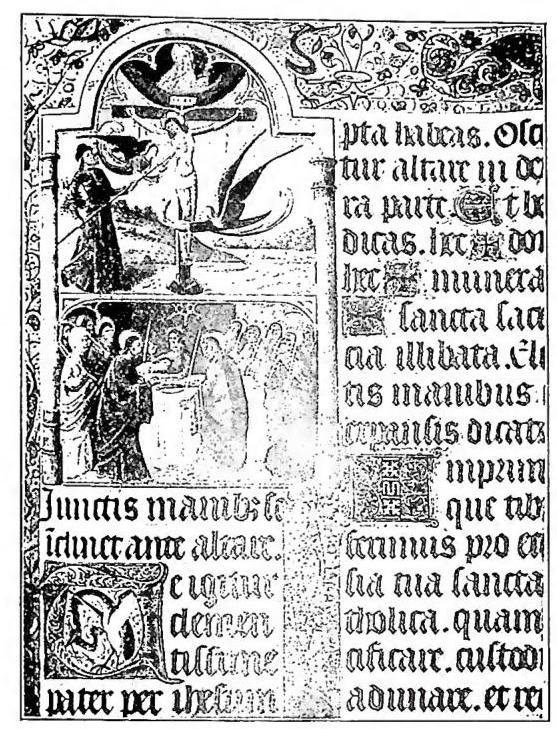
CANON OF THE MASS - Beginning of the Canon with a miniature depicting the Crucifixion and the consumption of the Paschal Lamb during the Last Supper. The Apostles stand with staffs in hand according to the Mosaic prescription of Ex. 12, 11: Paris Missal (15th century) - Paris, Mazarine Library, ms. 412, f. 5.
Intercessory prayers and the diptychs had already been placed within the Canon for some time, more or less in their current position. It cannot be excluded, however, that Rome originally aligned on this point with the Gallican usage.
4) A more significant change to the Canon in the 5th-6th centuries was proposed by P. Drews. He argued that the Supplices marks the place of the ancient Roman epiclesis, originally in conformity with the Eastern ones; however, the Te igitur, the Communicantes, and the Memento of the living would have moved to their current position from another place they previously occupied after the Supplices. The Canon would thus have begun with the prayer Hanc igitur, while the various intercessory formulas were gathered after the Consecration. This transposition occurred after the pontificate of Innocent I (d. 417), probably through the work of Gelasius I (492-96), under Alexandrian and Milanese influences. The presence in Rome of Patriarch John Talaia at the end of the 5th century would have strongly influenced this revision and the Pope’s personal work, as he was a great protector of the Alexandrian exile.
5) The difficult question was re-examined from a new perspective by A. Baumstark, who argued that the author of the current Roman Canon was not Pope Gelasius but Gregory the Great. Using the aid of parallel Eastern anaphoras as a basis for reconstructing the ancient Roman prayer, he also believed that the Syrian liturgy, particularly that of Jerusalem, decisively influenced the Roman Canon. Later (perhaps under Leo the Great), the Alexandrian contribution made itself felt through the liturgy of Ravenna. The pre-Gregorian Hanc igitur, the Quam oblationem, most of the Supra quae, the Supplices, and parts of the Nobis quoque peccatoribus can be traced back to this source. Through this dual path, various prayers entered the Roman Canon, later systematized by St. Gregory.
Baumstark thus distinguishes three periods in the creation of the Roman prayer, concluding with the following logical order, which in his view must have existed in the ancient Roman Canon: a) Thanksgiving for creation (Vere dignum et iustum est...); b) The Sanctus without any prayer until the Consecration (the Hanc igitur and the Quam oblationem do not belong to the Roman Canon but were introduced by St. Gregory, transferring them from a liturgy distinct from the Alexandrian). The only link between the Sanctus and the narrative of the Supper is the Vere sanctus et benedictus, qui pridie quam pateretur... After the Consecration and the anamnesis (Unde et memores, and Supra quae), as in all the East except Alexandria, the great prayer of intercession finds its place, resulting in the following structure: the Te igitur (into which the epiclesis and a formula for obtaining the effects of Communion are inserted), the offering of the sacrifice for the Church and the hierarchy, the Memento of the living, the Communicantes, the Memento of the dead, and the Nobis quoque peccatoribus.
Despite the favor it found among some liturgists, Baumstark’s and Drews’ hypothesis clashes with precise historical data. Major transpositions in the Canon could not have been carried out by either Gelasius or Gregory. The former is practically excluded (though the Canon of the Stowe Missal, valuable for its archaisms, bears the suggestive title: Canon dominicus papae Gilasi) because otherwise, half a century later, Vigilius would not have affirmed in his letter to Profuturus that the text of the prex canonica had been preserved up to his time Deo propitio, ex apostolica traditione. Nor does Gregory the Great come into question. His biographer, Bede the Venerable, and the Liber Pontificalis, so attentive as to note even the small change to the Hanc igitur, would certainly not have overlooked a revision of such importance. Drews and Baumstark attach great value to the parallels between the Roman liturgy and the Eastern ones. But external similarities are not sufficient to establish secure derivations. Moreover, they can be naturally explained by the identical purpose for which the prayers are destined in the different liturgies; it is the necessity of expressing equal concepts that led to an equal or similar formulation of the text.
6) P. Batiffol adopted the path of the historical method, intending to let the texts and facts speak. For him, the Roman Canon is a primitive, homogeneous composition into which extraneous passages were introduced, such as, before the Consecration, the Communicantes and the Hanc igitur, and after the Consecration, the Memento of the dead and the Nobis quoque peccatoribus. The Canon of the 4th century, therefore, would not have known such additions and would date back to the time of Damasus and Leo the Great. To reach this conclusion, Batiffol took as his basis the text of the De Sacramentis (late 4th century), calling it substantially identical to the Roman one. Apart from the abbreviated citation made by the author of the De Sacramentis, justified by the specific purpose of his work, the texts of the two canons agree in the following elements: Quam oblationem; Qui pridie; Unde et memores; Supra quae; Supplices te rogamus. The Quam oblationem, however, would be a transitional formula, presupposing the «oblationes commendandae et nomina edicenda» (that is, the Te igitur and the Memento of the living), discussed by Pope Innocent I in his letter of 416 to Decentius of Gubbio. Having proven the substantial existence of our Canon from the most ancient times, the French scholar proceeded to trace the formation of the variable prayers. Thus, the Memento of the dead did not enter the anaphora until much later (8th-10th centuries). The Communicantes and the Nobis quoque peccatoribus, considering the date of the introduction of the cult of some of the Saints mentioned therein, cannot be earlier than the 6th century. The Hanc igitur, composed by St. Gregory, has its first origins in the time of Pope Symmachus. Removing these variable or extraneous pieces, the current Canon would be nothing other than that reported by the De Sacramentis and already existing in the 4th century. By drawing attention to this archaic text, Batiffol had the merit of laying a secure foundation for future studies on the subject and of putting an end to all the more or less extravagant hypotheses on the origin and ancient order of the Roman Canon.
BIBL.:
P. Drews, Untersuchungen über die sog. clementinische Liturgie, Tübingen 1906; A. Baumstark, Liturgia romana e liturgia dell'Esarcato, Roma 1904; Id., Comparative Liturgy, Westminster 1958; P. Batiffol, L'Eucharistie, Parigi 1927; Id., Leçons sur la Messe, Parigi 1919; E. Bishop, Liturgica Historica, Oxford 1918; L. Duchesne, Origines du culte chrétien, Parigi 1920; F. Cabrol, Les origines liturgiques, Parigi 1906; J. A. Jungmann, Missarum Sollemnia, Vienna 1948; C. Callewaert, Sacris Erudiri, Bruges 1940; V. MESSA; V. LITURGIA.
A. Raes
VI. SECRECY OF THE CANON
St. Justin, Dionysius of Alexandria, St. Augustine, the author of De Sacramentis (ca. 400), St. Caesarius of Arles, and others unanimously testify that the Canon was recited aloud in such a manner as to provoke the people’s cry of Amen at its conclusion. Rome could not have deviated from this general practice. The well-known episode of Melania’s death serves as authoritative evidence of this. The current secrecy of the Canon may be regarded as a repercussion of the Byzantine rite, which occurred very gradually. Already by the mid-4th century in the East, a sense of reverential fear had begun to inspire this part of the Mass, later surrounding the altar with curtains and even a wall (iconostasis) to separate the faithful from the priest. This aspect of Greek piety symptomatically coincides with the affirmation of the epiclesis theory. By the 6th century, the practice of reciting it in a low voice had become general in the East. A nearly identical sentiment, though still quite imprecise, had penetrated Rome by the 5th century, as evidenced by the interesting details in Pope Innocent’s letter to the bishop of Gubbio. Responding to a series of questions about certain liturgical divergences, the Pontiff employs very measured language, especially when referring to the Canon, whose content he does not wish to disclose: quae aperire non debeo; and he concludes with a general reservation: reliqua quae scribi fas non erat, cum adfueris, interrogati poterimus edicere; expressions that betray a strange preoccupation with secrecy, which is surprising in a private letter addressed to a bishop, in contrast to the freedom with which contemporaries elsewhere discuss these same mysteries. Certainly by the 7th century, the recitation of the Canon in Rome was already done in secret (Ordo romanus of Giovanni "Archicantor"; J. A. Jungmann, Praefatio und stiller Kanon, in Gewordene Liturgie, Innsbruck 1941, pp. 53-119).VII. THE PREFACE
The Preface (v. PREFACE), from the Latin praefari, is the introductory part of the Eucharistic prayer. Unlike modern usage, which designates by this name the entire text that solemnly prepares for the chanting of the Sanctus, the ancients called Praefatio only the brief initial dialogue between the priest and the people. In this restricted sense, the term is already used by St. Cyprian in the 3rd century; proof of the great antiquity of this invitation, which appears in all rites and can be considered one of the cornerstones of primitive liturgy. Its specific function is to prepare souls for the grand theme of the sacrificial prayer, simultaneously stirring them to recollection.VIII. THE INTERCESSORY PRAYERS
Intercession is a form of supplication for specific persons or intentions, which, having filtered into the Eucharistic prayer, has split into two parts—before and after the Consecration—while nonetheless participating in the dignity of the august rite. Essentially linked to the use of diptychs, it is ordinarily based on the concept of offering and may thus be related to the gifts presented by the faithful.1) The first part of it, the Te igitur, is intended for the "recommendation" of the offerings and of the Church militant, gathered around its head and hierarchy. The mention of the Pope and the bishop holds a special significance of ecclesiastical unity, particularly necessary in the Eucharistic celebration. The remembrance of civil authority appears already in the Canon of De Sacramentis, but it takes definitive form only in the 9th-10th centuries, without, however, constituting a constant rule, so much so that it no longer appears in the Missal of Pius V (1570). By apostolic privilege, such remembrance was preserved in Spain and the Austro-Hungarian Empire until their recent disappearance. To the aforementioned period may be traced the words omnibus orthodoxis atque... fidei cultoribus, which even literally betray a late addition. Though of different origin and content, the Te igitur thus presents a certain resemblance to the solemn litanic prayer or Oratio fidelium, from which it likely received its fundamental structure.
As it now stands, it may be considered almost a conclusion to the thanksgiving of the Preface, ideally connecting to the initial protocol. The igitur is its logical link, and the same invocative Pater and the incidental phrase per Christum Dominum nostrum recur.
2) The priest then prays for particular intentions. This is the special fruit of the sacrifice recommended in the Memento of the living. An ancient custom was to recite publicly the names of the offerers and of the persons for whom prayer was intended. These lists were written on tablets of wood or ivory, folded in the form of a book, and called by the Greek term "Diptychs" (v. DITTICI). The reading of such names, of very ancient origin, must initially have taken place in the offertory area. It is not possible to know when Rome transferred the diptychs to their current position; certainly in a remote era, since the aforementioned letter of Pope Innocent to the bishop of Gubbio (416) already places the Commendatio nominum within the Canon. Moreover, the insertion of such names is considered of extraroman origin, and the Gelasian Sacramentary prescribes that they be recited only in private Masses. The words pro quibus tibi offerimus vel qui tibi offerunt are also an innovation of the 9th-10th centuries, and many see in them a distinction between those present who offer and the faithful for whom the Sacrifice is offered. The reading of the diptychs, done aloud by the deacon, lasted until the 8th century.
3) It is now established that the Communicantes, with its list of twelve Apostles and twelve martyrs, headed by the Virgin Mother of God, does not belong at all to the primitive Canon but was inserted at a later time. Evidence of this is the violent rupture of the ideological line, which connects neither with what precedes nor with what follows, and the list of saints, which cannot be earlier than the 6th century, the period in which many of them received liturgical cult in Rome (v. below, n. XIII). Rome probably adopted the sanctoral diptychs in reflection of the usage established elsewhere, where the recitation of the names of martyrs, in whose honor the sacrifice was offered, entered into the intercession after the 4th century; thus, these names were occasional, at least in origin. Scholars have endeavored to determine the vague sense of the word Communicantes, which remains grammatically without a complement. Bishop, to render the disjunction with the preceding formula less jarring, proposes a different punctuation of the memento... pro spe salutis et incolumitatis suae. Tibi (the suffix que is missing in the best codices) reddunt vota sua aeterno Deo vivo et vero, communicantes et memoriam venerantes... Some manuscripts do not lack materially linking communicantes to the last words of the Memento. Schuster, instead, inclines to detach it entirely from the list of saints, referring it to the name of the pope with whom one was in communion: ...una cum famulo tuo papa nostro communicantes; sed et memoriam venerantes...; which solution, if it has the advantage of giving the participle the support of a finite verb tibi offerimus, encounters the major obstacle of skipping over the commendatio nominum. More logical would seem to link the word Communicantes with the preceding phrase of the Memento, which says qui tibi offerunt, to which the remembrance of the saints has been grafted, et memoriam venerantes, a remembrance that finds its reason for being in the very excellence of the Eucharistic rite. Without leaving the context, the two participles essentially form a single expression. The content of the prayer is thus obvious: in communion with the saints, divine aid is sought for their merits. The Communicantes is not so much a supplication as a commemoration. The participle would thus acquire the sense of commemorantes; a meaning that allows the brief embolisms, which on some principal solemnities are added to the text, not to be entirely isolated: ...et diem sacratissimum celebrantes...
4) The conclusion of the intercession is the formula Hanc igitur. Once it admitted many variants, as appears from the sacramentaries. This was indeed the moment in which the particular intentions of the faithful for whom the sacrifice was offered were expressed. It was not a fixed formula but was recited only on precise occasions, such as during baptismal scrutinies, ordinations, weddings, for the deceased, or for persons who, in certain circumstances, presented a special offering. From this perspective, it assumed a rather private and individual character. Only later (perhaps with Gregory the Great,
The phrase, whose number has been reduced (including the sentence disque nostros in tua pace disponas), receives a formulation of a general nature, which, because it is intended for the universality of the faithful, came to be almost a duplicate of the great intercessory prayer. Today, it has preserved its original character of particular recommendation in very rare cases: Holy Thursday, Easter, Pentecost (baptismal feasts), and in the Mass for the consecration of a bishop. The references contained in the memento for the particular intentions of the faithful: qui tibi offerunt hoc sacrificium laudis pro se suisque omnibus, pro redemptione animarum suarum, pro spe salutis et incolumitatis suae, have led some liturgists to suppose that here the concept of individual recommendation, expressed in the Hanc igitur, was later transferred and merged. This hypothesis is far from being proven.
IX. THE CONSECRATORY PRAYERS
Linked to the intercession is the formula Quam oblationem, which, however, marks the transition from the order of material offering to that of the Sacrament. In it, it is asked that the gifts presented be blessed and accepted in such a way as to become the Body and Blood of the Redeemer. The Roman text departs somewhat, revising and correcting it, from the archaic text of the De Sacramentis, which contains expressions conforming to the ancient tradition, particularly to the anaphora of Serapion. Recently, some have wished to see in it a kind of epiclesis of the Roman liturgy, forgetting, however, that its content already finds examples in some Secrets of the Gregorian Sacramentary and that the conjunction ut, intended to give it the appearance of a final preparation for the great mystery, is replaced by the more concrete pronouns quod in the text of the De Sacramentis and by quae in the Canon of the Stowe Missal.Up to this point, the liturgies have freely developed the general theme of the anaphora; among them, a symptomatic uniformity is now established. The narrative of the Last Supper is the only truly fixed element in the history of the Mass. Leclercq has gathered as many as 85 consecratory formulas from various liturgies, in which the agreement appears remarkable despite differences in times and places. The Roman text of the narrative, Qui pridie quam pateretur, substantially reproduces the biblical texts but with verbal modifications and additions intended to frame the consecratory formulas and derived in part from tradition. Particular is the incise mysterium fidei between the words of the consecration of the chalice. This addition is one of the distinctive features of the Roman Canon already expanded by the 6th century. Perhaps it is an interpolation of Gallican origin and probably was initially a ritual acclamation in some church or the deacon’s announcement to draw the attention of the faithful at the moment of Consecration. The consecratory formula is immediately followed by an elevation of the Body and Blood of Christ (v. ELEVAZIONE). Until the 12th century, the only elevation of the sacred species in the Mass was that which still concludes the Canon with the doxology. The current elevation is rather recent and seems to have arisen due to a controversy regarding the precise moment of transubstantiation debated at the University of Paris at the beginning of the 13th century. The elevation of the chalice came much later and can be said to have been introduced for the sake of symmetry; it became widespread only with the Missal of Pius V. It is well known how the « visio corporis Christi » enthused the faithful and formed one of the most cherished devotions of the late Middle Ages. From the 16th century onward, the practice of gazing upon the sacred species disappeared. Today, it shows signs of returning, thanks also to the invocation « Signore mio e Dio mio », indulgenced by Pope Pius X.
X. THE OFFERING OF THE VICTIM
The presentation to the Father of the holy victim logically finds its place after the consecration. The Canon may be said to be entirely contained in this offering. Despite the current divisions into paragraphs introduced by the rubrics, the three prayers that express its object form a single oration: three aspects of the same oblation. They partake somewhat of the immobility of the central rite; the movement of ideas is nearly identical in all liturgies. The consecratory rite concludes with the remembrance of Christ’s command to repeat the Eucharistic gesture: Haec quotiescumque feceritis... The Canon develops this thought, commemorating the principal mysteries of the life and death of the Redeemer in the prayer Unde et memores, known to liturgists as the “anamnesis” (v.). This may be considered the loftiest expression of thanksgiving to God, since it offers the only gift worthy of Him, de tuis donis ac datis. In the remembrance of these mysteries of salvation, the Church presents to the Father “the bread of eternal life and the chalice of perpetual salvation.” The text separately indicates the priestly college from the family of the faithful (servi tui sed et plebs tua), a precious vestige of the primitive custom of the Eucharistic celebration by the bishop surrounded by his presbyterate. The allusion to the prototype sacrifices of the Old Testament (Abel, Abraham, Melchisedech), placed within the formula of offering, is found in nearly all the Oriental liturgies of the 5th century. As Baumstark has demonstrated, its symbolism passed from one anaphora to another, becoming part of the Roman Canon as well (Supra quae). St. Leo the Great added the words sanctum sacrificium, immaculatam hostiam, thus highlighting the sacrifice of Melchisedech, which more than the others approximates the Eucharistic sacrifice. The concept of offering, expressed at this point of the anaphora, finds affinities and interesting references in certain “Secretae” of the Mass, notable for their explicit remembrance of the oblation of the victim. This has led some to suppose that in the latter, formulas and ideas once contained in the anamnesis were transferred. Such a metamorphosis, however, remains conjecture.The third part of the offering prayer (Supplices te rogamus) is the one that has most opened the field to discussion and research. Even eminent liturgists have wished to see in the mysterious angel, invoked to carry the holy oblation to the altar of heaven, either the Holy Spirit (Munus), or the Divine Word (magni consilii angelus), or a particular celestial spirit (the angel of sacrifice). In reality, it seems that nothing else should be seen there but the angelic ministry, which presents to God the tribute of adoration and thanksgiving of the Church, so that it may be not only a sacrifice pleasing to Him but also a fruitful sacrament for souls. The difficulty arises in part from the fact that the formula has undergone successive alterations, made who knows when and by whom. The comparison with the anaphora of Hippolytus and notably with the De Sacramentis is significant. The first phrase, in fact, is a prayer of offering (iube haec perferri), while the second is a petition for sanctification for those who are to communicate (ut quotquot ex hac altaris... sumpserimus), which in all other prayers finds its place in the epiclesis. There is no doubt, therefore, that an affinity exists between the epiclesis and the Roman formula Supplices te rogamus. The term epiclesis (= calling, appeal) originally signified the solemn invocation of the divine name over a person or thing, as if to draw down upon it the omnipotent power. In this sense, the entire Eucharistic Canon may be called an epiclesis. This generic meaning appears in Irenaeus in the 2nd century (Adversus haereses, IV, 18, 5), and shortly thereafter in Firmilianus, in his letter to St. Cyprian. Only in the 4th century, at the time of the Macedonian controversies, does the concept of a particular invocation of the Holy Spirit insinuate itself, so that He may transform the bread and wine into the Body and Blood of Christ. Thus in the Oriental liturgies; for in the West, the epiclesis was probably limited to a simple invocation of Paradise, perhaps for Trinitarian purposes. In this sense, the presence of an epiclesis in Rome is clearly documented by the letter of Gelasius I to Elpidius of Volterra. Objectively speaking, however, in the current formula Supplices te rogamus, where the ancient epiclesis was thought to be, there exists no mention of the Holy Spirit nor any point of resemblance with the Oriental conception. This demonstrates that the Roman Church attributed no consecratory power to the epiclesis, but only an impetratory value, so that the Holy Spirit, by His presence, may ratify the common offering, rendering it more pleasing to the Father and more profitable to the faithful.
XI. THE SECOND READING OF THE DITTICS
The return to intercessory prayers toward the end of the Canon is not original. Reconstructing this part of the prayer is difficult; the two formulas of the dittics likely also found their place in the Offertory section. Only conjectures can be advanced regarding their primitive arrangement and formulary. The introduction of the commemoration of the dead in this location is certainly late; it is absent in the oldest codices. Bishop and Andrieu explain its absence by the fact that in Rome, until the 9th century, the deceased were not mentioned in public Masses celebrated on Sundays or feast days. It is not improbable that initially, such commemoration was linked to the Hanc igitur, where the remembrance of the departed was occasioned by the offering presented for their suffrage. It thus had a private and adventitious character, far removed from that of the memento of the living. Its language still bears the fragrance of venerable antiquity and must be considered a reflection of cemetery epigraphy (praecesserunt...; signum fidei...; in somno pacis...; refrigerium...). The Nobis quoque peccatoribus is a kind of embolism of the memento of the dead; it continues, in fact, the intercessory prayer for the fruits of the sacrifice. The object of the supplication this time, however, is the celebrant himself and the offering college of presbyters, clearly designated by the classical expression of Christian antiquity: famulis tuis. It is, therefore, a specifically priestly prayer. Nevertheless, the illogicality of a new enumeration of the saints at this point in the Canon cannot be concealed. The very stylistic form of the oration, where the names of the martyrs have an entirely accidental placement, betrays something artificial. Such an enumeration does not constitute an orderly continuation of the list in the Communicantes, but is a supplementary addition, probably inserted here by Pope Symmachus at the beginning of the 6th century.XII. THE FINAL DOXOLOGIES
The great Eucharistic prayer concludes with a solemn glorification of the Trinity, one of the oldest elements of the Mass, composed of two independent phrases. The first part reprises the initial theme of the Canon, the glorification of the Father through Jesus Christ: per quem haec omnia...; yet its exact meaning remains debated. The significance of the entire formula depends on the varying connection of this phrase with the preceding texts. Several authors link the words haec omnia to ponem sanctum vitae aeternae et calicem salutis perpetuae (specifically indicated by the relative quae in supra quae propitio and by the demonstrative haec in Supplices te rogamus), thus referring the object of the prayer to the gifts of the Sacrifice themselves. However, the term omnia appears somewhat redundant if it merely designates the Eucharistic elements. The phrase may have undergone expansions and the influence of the blessing of the fruits of the earth, which in certain liturgical circumstances took place at this point in the Mass. The omnia was well-explained by the variety of gifts presented at the altar: sacrificial gifts and gifts of nature. The formulas of the ancient sacramentaries clearly specify this intention. Today, the sole remnant is the solemn blessing of the Oil of the Sick on Holy Thursday. The second part is the true final doxology (per Ipsum, et cum Ipso, etc.): the supreme and harmonious praise of all creation, which, united with Christ, in Christ, and through Christ, raises an eternal hymn of glory to the holy Trinity. The concluding amen represents the only intervention of the faithful in the Eucharistic prayer. It has its own history; as early as the 2nd century, the martyr Justin emphasized its great importance. It is the cry of the Christian people, expressing to God the fullness of their worship and giving thanks on behalf of all redeemed humanity. From this perspective as well—beyond its historical, eucological, and dogmatic elements—the Canon of the Mass stands as the most important literary monument of Western worship.XIII. THE SAINTS OF THE CANON
In the current Roman Canon, we find a twofold list of saints' names: the first after the Memento of the living, in the formula Communicantes; the second after the Memento of the dead, in the formula Nobis quoque peccatoribus.The two Memento were inserted into the Canon at least by the beginning of the 5th century. It is certain that Innocent I, in his well-known letter to Decentius, bishop of Gubbio (A.D. 416), urges this custom as something already existing (PL 20, 553).
The two Memento entered the Canon, as Innocent himself states in the aforementioned letter, to bring the names of the offerants closer to the central point of the sacrificial liturgy; their original place was immediately after the offering of the faithful, that is, at the reading of the dittici. To the names of the living and the dead, inserted in the dittici, were soon added the names of the deceased venerated as saints: hence the origin of the lists of saints. This usage originated in the East.
1. The saints of the Communicantes
The current list appears to be the result of an intelligent revision. It consists of 24 names, in addition to that of the Mother of God, who precedes them. The 24 saints are: 12 Apostles (with Paul, without Matthias) and 12 martyrs; of these, 6 bishops (5 of Rome, 1 of Carthage), 2 other ecclesiastics (Lawrence and Chrysogonus, the latter believed to be a priest), and 4 laypeople. It is commonly believed that the definitive redaction, in its current form, is due to St. Gregory the Great. The primitive Roman list (between the 4th and 5th centuries) was probably as follows: Mary, Peter, Paul, Sixtus, Lawrence, Cornelius, Cyprian. The apostles John and Andrew were liturgically venerated in Rome as early as the 5th century; during the 6th century, Thomas, Philip, and James were also included; in this same century, the other martyrs must have entered the Canon, and finally, the remaining apostles. No confessor entered the Roman Canon. The fact that this list of the 12 Apostles differs markedly from biblical lists attests, if there were any need, that it developed independently. The Church of Milan accepted (with the Roman Canon) also its list of saints, in the incomplete state in which it then was, around the beginning of the 6th century (cf. F. Savio, I dittici del Canone ambrosiano e del Canone romano, in Miscellanea di storia italiana, Torino 1905, pp. 4 ff.).Outside Rome, the list of saints in the Canon underwent various additions in the reception of the Roman liturgy, especially in the ancient Hispanic and Gallican liturgies. Generally, the national saints Hilary and Martin were added, as well as the Doctors (Augustine, Ambrose, Jerome), often also St. Benedict; moreover, names of local saints, so much so that these
names often allow the identification of the church for which the relevant liturgical book was used. The lists of saints sometimes grew to 20 or more names. Gregory III, referring to the monks of one of the monasteries of St. Peter in the Vatican who venerated many relics of saints, proposed to them a comprehensive formula for the commemoration of many saints, a formula that later entered, with variations, into the usage of other churches. The reform of St. Pius V definitively reduced the list of saints in the Communicantes to the fixed number of 24.
2. The saints of the « Nobis quoque peccatoribus ». — This second list also appears, at first glance, as the result of a conclusive redaction, the author of which was likely the same St. Gregory the Great. The list, in fact, begins with the name of John the Baptist, followed by 14 martyrs, 7 men and 7 women.
Without repeating here the very complex history of the final formulas of the Canon, it suffices to note that, in all probability, the Nobis quoque originally followed immediately after the Supplices, while the Memento of the dead forms a felicitous subsequent insertion, in conformity with the usage of reading the dittici of the dead.
In any case, it is useful to recall the parallel passages in the ancient Egyptian liturgy of St. Mark and the Coptic liturgy, which, in the corresponding prayer, place at the beginning the names of Mary, John the Baptist, and Stephen the protomartyr (F. E. Brightman, Liturgies eastern and western, I, Oxford 1896, pp. 128, 169). John the Baptist and Stephen certainly opened the primitive Roman list as well (early 6th century); they were followed in all likelihood by Peter and Marcellinus; Agnes, Cecilia, and Felicity, three Roman martyrs. Other saints venerated in Rome soon entered, such as Alexander, very probably the one of June 10 (later changed to Pope Alexander I); the two Sicilian women Agatha and Lucy, who enjoyed great veneration in Rome in the 5th and 6th centuries, and, in the Byzantine era, Anastasia. The name of Felicity, due to an easy combination, brought in the famous African martyr Perpetua, so that Felicity was later believed to be the homonymous African martyr. When and why Ignatius was inserted, liturgically little venerated at the time, is unknown; the last to complete the list were Matthias and Barnabas, evidently for the purpose of including all the apostles in the Canon itself. For this second list of saints, the observation made for the first can be repeated with regard to the Ambrosian Canon: reception of the Roman list in a still rudimentary state and autonomous perfection.
Even the second list of saints underwent the usual additions outside Rome, but to a much lesser degree. St. Pius V admitted into the Missal the complete Roman list of the time of St. Gregory the Great.