
INDULGENZE. – Indulgentia, indulgere, in the proper sense, denotes indulgence and condescension, in the various nuances of the idea. Imperial Roman historiographers use the word in the technical sense of remissio tributi or remissio poenae, concessions that emperors used to make on certain occasions. It was also used to denote an abolitio, a kind of amnesty, decreed on the occasion of happy public events. In the Carolingian period, i. was still employed as a technical term to indicate remission of penalties or taxes (thus in the Capitularia). In the Theodosian Code (l. IX, tit. 38, De indulgentiis criminum) it designates the remissions granted by Christian emperors, especially at Easter; indeed, Palm Sunday is called dominica indulgentia in many texts of the early Middle Ages (calendars, sacramentaries, various Comes [ceremonial books], etc.). As regards the matter of the remission of penalties, various terms are found that may also denote i. in the strict sense in which it is understood today, but which could—and in fact did—denote other similar or related ideas in those periods when the true i. began to develop. This imprecision of terminology has given rise to much confusion among scholars who have been less cautious in their research. For example, the words: absolutio, relaxatio, remissio, venia, condonatio, and indulgentia, may denote, in the eleventh to thirteenth centuries, both i. properly so called and, more often, the various forms of sacramental, penitential, and also extrasacramental remission. The latter is the true i. as it is understood today.
According to Catholic doctrine, i. is “the remission before God of the temporal punishment due for sins whose guilt has already been forgiven, which ecclesiastical authority grants from the treasury of the Church by way of absolution for the living and by way of suffrage for the dead” (can. 911).
SUMMARY:
I. History
II. Nature
III. Power to grant i. –IV. Classification
V. Requirements for the granting and gaining of i.I. HISTORY
In every historical case belonging to the centuries indicated above, one must examine carefully, whenever anyone speaks of i., whether it concerns a properly and strictly extrasacramental act, in order to determine whether one is dealing with an indulgence in the strict sense, or with another form of penitential remission.1. Precursors
Thus, for example, the readmission into the Christian community of the man anathematized by s. Paul (I Cor. 5:3; II Cor. 2:5) is not an indulgence in the strict sense, but a reconciliation. Such reconciliation flourished in the Church during the 2nd–4th centuries and took place especially through the intercession of martyrs or confessors of the faith, or even in danger of death; but essentially it concerned the readmission of penitents into the Church and to its spiritual benefits. The relaxatio sometimes encountered, for example at the Council of Epson (a. 517, can. 29), likewise consisted in replacing an earlier, more severe penance with a new and more lenient measure, abolishing the former. Such mitigations of penitential discipline became necessary as the times and social conditions of Christians changed. From the 7th century onward, the redemptio, originating in Ireland and England, came into use: a kind of commutation of penance, often excessively burdensome and intolerable, into less onerous works, such as prayers, almsgiving, and fasts, and even the payment of sums of money fixed according to the various kinds of offenses (tariff penance). But all this was applied within the sacrament of Penance to the penitent. One commutation also gave rise to the later genuine indulgences (in the strict sense), namely that carried out at the time of the Crusades (v. sotto), insofar as the confessor could impose upon the penitent the undertaking of a Crusade in place of the penances otherwise necessary for sacramental absolution. A true reduction of penance, though still on the occasion of the sacrament of Penance, appears as early as the 10th century, in connection with pious donations, pilgrimages, and similar meritorious works; these were always personal and individual reductions of penance. Above all, pilgrimage to Rome was regarded as a highly meritorious work, and thus greater leniency was shown in imposing penances upon a Roman pilgrim. Benedict III (853–58), at the request of Bishop Salomon of Constance, imposed upon a pilgrim guilty of fratricide a penance lighter than usual, intuitu peregrinationis. Similar examples are known under Nicholas I, Giovanni VI, Stefano V, and others. Bishops, too, were accustomed to impose upon pilgrims to sanctuaries or churches, out of regard for the pilgrimage itself, a penance lighter than that which they would otherwise have had to perform. From as early as the 11th century, similar indulgences also appear, but general ones, applicable to all who fulfilled the prescribed conditions. The rigor of public and tariff-based sacramental penance had become intolerable under the radically changed conditions of Christian society, and a means had to be found of tempering that rigor. Moreover, the possibility of supporting the numerous pious works so dear to the Middle Ages, by linking them with the imposition of a contribution as a condition for the remission of penalties, even outside the sacrament, paved the way for the indulgence as a means of remitting penalties outside the sacrament and independently of sacramental penance.2. Absolutio
Furthermore, during the 11th and 12th centuries the practice of the absolutio flourished in the West. Toward the end of the Carolingian period and thereafter, a kind of fear of sin spread throughout the medieval world, together with a veritable mania for seeking everywhere and on every occasion, and before every undertaking, an absolution—that is, for submitting oneself to a formula of prayer, deprecatory and also indicative, asking God to remit sins. Absolutions entered the liturgy (the Confiteor!), the Mass, and the Office, and were used on various other occasions, not only for the living but also for the dead, as a prayer on their behalf. Innumerable individual and general grants of these absolutions are known. They were used in convents on certain days and in cases of death (cf. Absolutio super tumbar, even today!); popes, bishops, and abbots granted them, and remission of sins was often promised in return for good works: this was an application of the biblical doctrine that good works merit grace. Absolutions of this type were rather solemn blessings, accompanied by an authoritative declaration of the merit to be attained. Synods and councils were closed with a solemn absolution and sermon (even today, in many places, the practice continues of the people reciting the Confiteor after the sermon, followed by the absolution); general absolution was given on Ash Wednesday and Holy Thursday; it was granted for meritorious works, for observing the «Tregua Dei», and so forth. All this contributed increasingly to giving concrete form to the institution of the indulgence in its proper, strict sense. At times it is difficult to decide whether, in a particular case, one is already dealing with a genuine indulgence or still with an advanced form of remission linked to Confession.3. The first genuine indulgences
It is certain that genuine indulgences, granted for almsgiving or for devout visits to churches, altars, and so forth, began to appear, though few in number, in the 11th century, and multiplied thereafter in the 12th century and later. Paulus (op. cit., V. BIBLICA., I, p. 138 sgg.) provides a chronological list of such indulgences up to the Fourth Lateran Council, a. 1215. The origin of this practice is found in northern Spain and France; for example, one day of fasting per week was remitted (for those who would otherwise have had to fast three or four days); it was the bishops who made such grants, often linking them also to pilgrimages and other works. From the second half of the 11th century, the popes followed this example as well; the first papal grant of this kind seems to have been that of Nicholas II (a. 1060), for Farfa, on the occasion of the consecration of the altars. Urban II granted the remission of one quarter or one seventh of the penance imposed in the sacrament, in return for the performance of certain good works. It was therefore a genuine partial remission, initially indicated as a fraction (1/2, 1/3, 1/5, 1/7, etc.); later, according to the time that would have been required to perform the public penance, as 1 day, 2, 3, 10, 20, or 40 days; finally, 1, 2, 3, and more years. The characteristic indulgence of 1 year and a quarantine is found during the 12th century. What was involved was penance, either public or private, imposed in the sacrament of Penance.An important kind of indulgence was that known as «of the Crusades», because it opened the way broadly toward the plenary indulgence. Paulus (op. cit., I, p. 195 sgg.) provides the complete and highly instructive list. Alexander II (1063) granted a remission of penalties to those who fought the Moors; Urban II, at Clermont (1095), in order to encourage Christians to undertake the First Crusade, declared that participation in the Crusade was equivalent to complete penance! Eugene III (1145) repeated the same declaration, while Gregory VIII introduced the innovation that the complete (plenary) indulgence could also be acquired by one who had himself replaced by another or who bore the expenses of a crusader. These indulgences were later also granted for the «crusades» directed against the Moors, the pagan Slavic peoples, the Albigensians, and others.
The plenary indulgence of the Crusade led to the idea of the jubilee plenary indulgence (v. GIUBILEO).
4. Letters of indulgence
The practice of granting indulgences is reflected in a multitude of documents by which they were conferred. The letters used by the Apostolic Chancery are very numerous; alongside them, however, from at least the 12th century onward, there are letters granting episcopal and cardinalitial indulgences, issued especially on the occasion of the dedication of churches and, later, as will be explained, to encourage participation in pious works.The letters of indulgence issued by bishops are divided into two major categories: simple letters and collective letters. The former are granted in the name of a single bishop, the latter in the name of several prelates who join together in order to give the grant greater scope. The latter are called collective letters. Delehaye, who made them the subject of a study, compiled a substantial regest of collective letters (cf. H. Delehaye, Les lettres d'indulgences collectives, Bruxelles 1928, pp. 53-67, 71-89, 91-98). Like bishops, cardinals had the right to grant indulgences and exercised it within the limits of their authority.
Here too one encounters two types of letters: simple and collective. Among the simple letters, a special place is occupied by the letters of nuncios and cardinal legates, on account of their historical interest in relation to the missions undertaken by them.
Meanwhile, while the practice of indulgences had already advanced considerably, theology and canonistic doctrine also began to take an interest in them. Abelard, for example, was decidedly opposed to the institution of indulgences. The early Scholastics disagreed among themselves and did not yet formulate a satisfactory doctrine of indulgences. Further developments were needed.
5. Plenary indulgences for those in danger of death and for the dead
For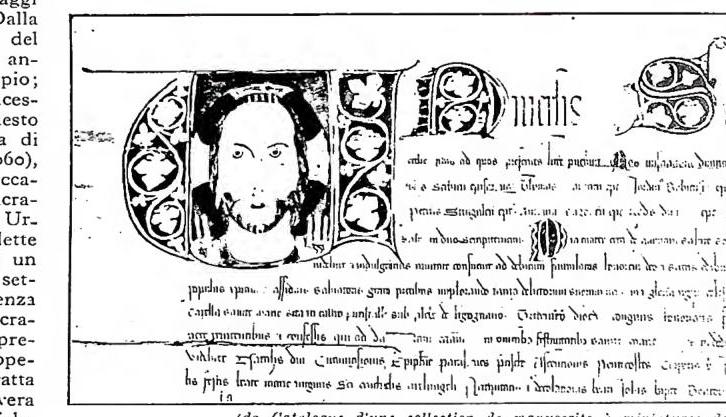
INDULGENZE — Collective letter of indulgences granted by several bishops to the chapel of S. Maria of Purgstall, diocese of Trento, Avignon, 28 March 1330.
individual: the election of a priest as confessor in danger of death is granted, with the faculty of applying the plenary indulgence.
But the faithful had already begun to apply the indulgences granted to them also to the souls of the dead. It can be established that around 1350 the practice of applying jubilee, Crusade, and «Porziuncola» indulgences to the dead was widespread. The ecclesiastical authorities, however, still did not grant such indulgences; there was nevertheless a practice of granting an indulgence to the living if they prayed for the dead. Only in 1457 did Calisto IV grant King Enrico IV of Castile a plenary indulgence for the living, and, for those who paid 200 maravedis for the Crusade against the Moors, an indulgence for the dead. But the bull remained unknown outside Spain, where, moreover, it caused no little astonishment. Sisto IV (1476) granted the cathedral of Saintes (France) a bull, valid for 10 years, with a plenary indulgence for the living and, «in modum suffragii», also for the dead—a bull that provoked lengthy disputes concerning the pope’s power to exercise jurisdiction beyond the grave; but the common doctrine moved toward explaining it through an act of suffrage offered to God, rather than through an act of jurisdiction, as in the case of the living. A difficulty was also encountered in determining the measure of the application of indulgences to the dead: whether the application took effect with certainty, or only according to God’s benevolent acceptance; the latter thesis prevailed.
As regards the general doctrine concerning indulgences, the principal difficulty lay in finding the reason why an indulgence could be granted. This was sought in the mercy of God, in the value of the Church’s prayers, and in the merits of the saints. Some thought it preferable to speak of a kind of substitution in the works of the Church militant, that is, a kind of compensation; but Ugone di Santo Caro O. P. (ca. 1230) instead proposed the idea of a treasury of merits at the Church’s disposal, constituted by the immense merits of Christ and the immeasurable accumulation of the merits of the saints: a thesis that subsequently prevailed and was solidly demonstrated by the great Scholastics, Alberto Magno and Tommaso d’Aquino, and that still constitutes the central point in the explanation of indulgences.
6. Esteem for indulgences. — One aspect of indulgences in the Middle Ages deserves special mention. The piety of the faithful knew how to esteem the value of indulgences, all the more because they were still relatively rare. On the other hand, medieval piety expressed itself in an innumerable quantity of particular devotions, confraternities, and craft associations, and all this gave occasion for continually requesting new indulgences, so as almost to permeate the whole of religious life with indulgences. The singing of the Salve Regina, the recitation of the Angelus (the first grant for the evening: Giovanni XXII in 1318, in 1327 for Rome), praying for the dead in cemeteries, visiting certain sacred images or relics, listening to a sermon, accompanying the Blessed Sacrament to the sick, on the feast of Corpus Domini and on so many other occasions, attending Mass, the celebration of patronal feasts, church dedications, anniversaries, visiting certain churches, altars, chapels, and shrines, and the gatherings of confraternities: so many things were enriched with indulgences, and the piety of the faithful sought ever new and more abundant indulgences. Hence the origin of the many falsifications. But there is more. Indulgences were attached to many works that were not merely good, but of public religious and civil utility. There is scarcely a church that was not built in part from the revenues of indulgences granted for its construction or restoration; the grand architectural and artistic activity of the Middle Ages is explained in no small part by this. Hospitals, leprosariums, hospices, and schools were likewise built with the aid of the revenues of special indulgences. Famous and well known is the construction of many bridges, even by confraternities, as well as of roads and communications. At times indulgences were even granted for land-reclamation works. This aspect of indulgences, as an effective vehicle of culture and civilization, deserves every praise.
7. Abuses. — But the granting of indulgences in connection with almsgiving unfortunately also gave rise to extremely deplorable abuses. Once an indulgence linked to a contribution for a certain work had been obtained, the quaestores were sent out to collect the alms. Unfortunately, the preaching of many collectors exceeded the dogmatic truth by far (through carelessness or cunning); some even dared to promise the liberation of damned souls from hell. But there was another aspect of indulgences linked to alms revenues. Kings and Catholic princes began to be permitted, initially on the occasion of the Crusades, to use a more or less considerable part of the revenues obtained through the alms given in order to enjoy the indulgences. Similar permissions were then broadly granted for many other enterprises, and the princes were not always particularly scrupulous. Worth noting is the indulgence for the construction of the new S. Pietro in Rome. The prince of Saxony-Wittenberg, later a great supporter of Luther, collected as many relics as he could in order to make use of the rich alms paid by those who visited them to obtain the indulgence. No one denies the existence of abuses, and, moreover, of serious ones. On the other hand, ecclesiastical authority attempted, perhaps not always with the necessary energy, to restrain the evil. Unfortunately, only after the fierce Protestant struggle against indulgences did the Council of Trent suppress the solicitation of alms for indulgences forever.
Already the IV Lateran Council (1251) had curbed certain abuses concerning indulgences and specified the extent of the grants, establishing no more than one year for the consecration of churches and anniversaries, and no more than 40 days for other occasions. But these limits were soon exceeded. Even in the Middle Ages, extraordinarily, falsified documents appeared granting indulgences beyond every measure, not merely for hundreds but for thousands of years.
8. Tridentine and post-Tridentine legislation. — The Council of Trent, following those of Lyons and Vienna, returned to the subject of indulgences, especially in view of the merciless war waged against them by the Reformers. In sess. 21, chap. 9, it suppressed the institution of the «questori», that is, the collectors of money for indulgences, which had caused so much harm because of the abuses that had become associated with it, and reserved the publication of indulgences to the Ordinaries alone; they could also, when necessary, collect any alms without any compensation. Finally, in sess. 25°, the celebrated decree de indulgentis was issued. After defining that the Church has the right to grant indulgences from Christ the Lord, it again approved the use of indulgences as christiano populo
maxime salutarem, once more abolishing every kind of solicitation of alms for indulgences, and ordered that the bishops seriously supervise every possible abuse in their own dioceses, denouncing it in provincial synods and to the Supreme Pontiff.
Un altro studioso, B. Poschmann, fondandosi sopra il materiale storico del Paulus, continuò l'investigazione soprattutto dal punto di vista della penitenza cattolica e della sua prassi attraverso i secoli, per meglio chiarire ancora la natura dell'i. e la sua, per dir così, legittimità, dimostrando che non è nata da elementi estranei alla prassi e dottrina della Chiesa sulla penitenza, ma che è conforme ad essa, anche se in apparenza si discostava da certe forme usuali nel suo tempo. Si citano subito le sue principali opere: Die abendländische Kirchenbusse am Ausgang des christlichen Altertums, Bonn 1928; Die abendländische Kirchenbusse im frühen Mittelalter, ivi 1930; Poenitentia secunda, ivi 1940; Der Ablass im Lichte der Bussgeschichte, ivi 1948. Nella trattazione dell'argomento si inserti nel 1932 J. A. Jungmann, con la sua poderosa opera: Die lateinischen Bussrten in ihrer geschichtlichen Entwicklung, Paderborn 1932. Altre opere interessanti di una certa importanza sono: A. Gottlob, Kreuzabläse und Almosenablass. Eine Studie über die Frühzeit des Ablasswesens, Stoccarda 1906; E. Göller, Der Ausbruch der Reformation und die spätmittelalterliche Ablasspraxis, Friburgo 1917; H. Delchaye, op. cit. (5 articoli estratti dagli Anal. Boll., 44 [1026], 45 [1027], 46 [1028]). L'opera fondamentale pratica sulle i. è: Die Ablässe, ihr Wesen und Gebrauch, pubblicata la prima volta dal p. F. Beringer, Paderborn 1860, continuata da J. Hilgers e finalmente da P. A. Steinen (15ª ed., 2 voll., ivi 1921-22). Lo Hilgers aveva anche pubblicato un suo studio: Die katholische Lehre von den Ablästen und deren geschichtliche Entwicklung, ivi 1914, nel quale volle riportare l'origine delle i. quanto più in dietro possibile, ma fu fortemente contrastato da Paulus. Nelle grandi enciclopedie francesi: E. Magnin, Indulgenzen, in DThC, VII, coll. 1594-1636; P. Galtier, Indulgenzen, in DFC, II, coll. 718-52; H. Leclercq, Indulgenzen, in DACL, VII, coll. 535-40; gli stessi autori confessano candidamente di aver attinto il materiale per le loro esposizioni dalle opere e dagli articoli di N. Paulus.
2. Letteratura ufficiale circa le i.: uno degli ufficiali della S. Congregazione delle I., il più sacerdote Telesforo Galli, pubblicò nel 1807 una Raccolta di alcune orazioni e più opere indulgenziate dai papi. Morto lui, un altro ufficiale, Luigi Prinzivalle, continuò la pubblicazione, molto stimata. Nel 1854 la 13ª ed. fu dichiarata autentica. Ma soltanto nel 1877 la Congregazione stessa pubblicò come opera sua la Raccolta, che ebbe la diretta approvazione del Sommo Pontefice. La 2ª e 3ª ed. si ebbe nel 1886 e nel 1898. Segui qualche appendice. Finalmente
(fot. Biblioteca Vaticana)
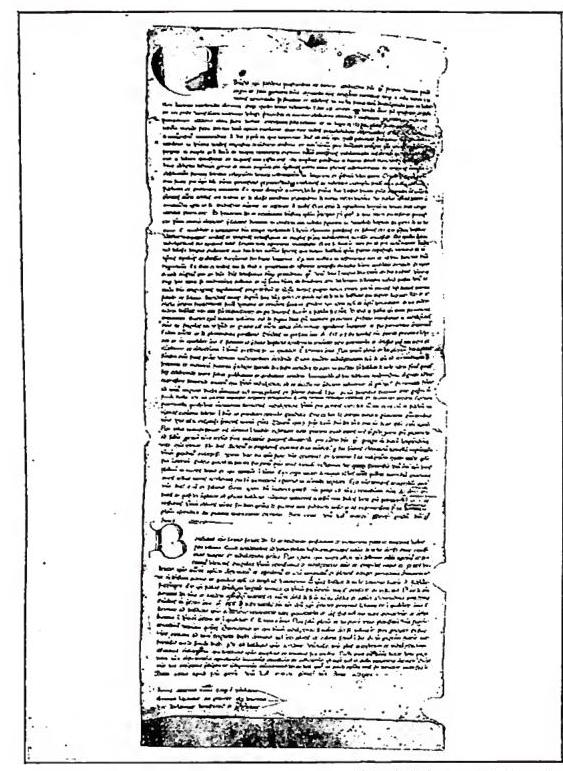
INDULGENZE — The circular letter of Silvestro, secretary of Bonifacio VIII, with a copy of the bull of the Jubilee of 1300 and the three well-known leonine verses concerning the Jubilee — Vatican Archives, Instr. Miscell. 313.
in 1928 a new collection was published, entitled: Preces et pia opera..., reissued in 1938, as the official work of the S. Peninszieria. The latest edition, in 1950, bore the subtitle: Euchiridion indulgentiarum. In 1883, moreover, the Congregation of the I. published, after careful preparation, a volume of the Decreta authentica S. Congregationis Indulgentiis Sacrique Reliquis praepositae, Ratisbona 1883, a documentary work of the first importance. A kind of supplement, though not official, was the collection Rescripta authentica S. Congr. Indulgentiis... praepositae by Fr. J. Schneider, S. J., there, 1883.
Giuseppe Law
II. NATURE
According to the teaching of the Church, every sin, even venial sin, leaves in the soul not only the state of guilt but also the state of punishment. Now the faithful person who confesses his sins or makes an act of perfect contrition with the intention of confessing obtains with certainty the remission of guilt and the remission of the eternal punishment that follows every grave fault, but does not always, or at least not completely, obtain the remission of temporal punishment, which may be remitted in this life through works of satisfaction and i., or will have to be remitted in the next life, in Purgatory. I. therefore is not the remission of eternal punishment, which is remitted together with guilt, nor the remission of either mortal or venial guilt. Still less can i. be said to be the remission of future sins, as some Protestants have taught: Pope Eugene IV explicitly declared this in a grant of i. in favor of the Congregation of S. Giustina (E. Amort, De origine indulgentiarum, Augsburg 1735, p. 136). I., rather, is an act of jurisdiction, which presupposes the state of Grace and is exercised, though in different ways, over the living faithful and the deceased. For the living, i. is granted by way of absolution, that is, remission through an act of judicial power, which entails a settlement, that is, a payment effected with the common goods of the Christian family (v. COMUNIONE DEI SANTI). To the deceased, i. is applied by way of suffrage: the deceased are no longer subject to the jurisdiction of the Church; therefore one cannot speak of judicial absolution, but only of suffrage, in the sense that the pilgrim faithful on this earth (homines viziores) perform a good work and, through the authority of the Church, offer the satisfactory merits of Jesus Christ to the Lord, praying Him to accept them in remission of the punishments that the souls in Purgatory must still undergo. This remission of punishment operates not only in the external forum, before the Church, but also in the internal forum, before God. In granting i., ecclesiastical authority draws upon the treasury of the Church, constituted by the satisfactory merits of Jesus Christ, to which those of the Virgin and the saints must be added. Every good work performed in the state of Grace, besides the meritorious element, which is inalienable and gives a right to a just reward, carries with it the satisfactory element, through which the temporal debt contracted by sin may be paid and which may also be transferred to others. This treasury is applied through the Communion of saints, by virtue of which the Church triumphant, the Church suffering, and the Church militant do not constitute three societies, but form one body, of which Christ is the head and the faithful are the members; these are so closely united by the bond of love that the goods of the community are as each person’s own and benefit individuals (I Cor. 12, 12–26).III. POWER TO GRANT I
It resides in the Church, in those to whom the power of the keys has been entrusted and who therefore, by divine right, govern the Church. This truth, defined by the Council of Trent (Denz-U, 989), is deduced from the words of Jesus Christ addressed to St. Peter: «I will give you the keys of the Kingdom of heaven... Whatever you loose on earth shall be loosed in heaven» (Mfr. 19, 19). If the Church can, in the Sacrament of Penance, cleanse the soul from the stain of guilt, she can certainly also free it from a lesser evil, namely, the state of punishment.IV. DIVISION
Indulgences are divided into: a) plenary and partial. An indulgence is plenary if, according to the intention of the grantor, it remits the entire temporal punishment; it may, however, be plenary totaliter or relative, according to the dispositions of the person who gains it (can. 926). A plenary indulgence, unless expressly stated otherwise, may be gained only once a day, even if the prescribed works are performed several times (can. 928 § 1); if it may be gained several times in one day, it is called toties quoties. Among plenary indulgences toties quoties, the best known is that of the Porziuncola, granted for 2 August. The daily plenary indulgence, which is usually granted for a visit to a church, is to be understood in the sense that it may be gained on any day, but only once during the year (can. 921 § 3). Jubilee (v.) is a plenary indulgence enriched by the Roman Pontiff with particular privileges, and differs from other plenary indulgences because of the solemnity with which it is granted and the privileges that accompany II. These external circumstances are intended to deepen the dispositions of the faithful and thereby to make the remission of all temporal punishments more certain, subjectively. It must therefore be held that the Jubilee is not superior to other plenary indulgences quod effectum, but only quod effectum (cf. F. L. Ferraris, Prompta bibliotheca canonica, IV, Montecassino 1848, p. 280). A partial indulgence is one that remits only part of the temporal punishment; unless expressly stated otherwise, it may be gained as many times a day as the prescribed work is performed (can. 928 § 2); b) personal, real, and local, according as they are granted directly to persons or classes of persons, e.g., religious; or are attached to the use of particular sacred objects, e.g., medals and rosaries; or are granted for a visit to a specified sacred place; c) perpetual or temporary, according as they are granted without any limitation of time or are restricted to a certain number of years; d) indulgences for the living, for the dead, or for both the living and the dead. For certain personal indulgences attached to membership in Catholic Action, Confraternities, and the Ters'ordini, V. the respective entries. Likewise, for certain principal local indulgences (e.g., Via Crucis, privileged altar, Porziuncola, etc.), and real indulgences (e.g., those attached to the various Crowns, V. CORONA; to the Scapulars, V. SCAPOLARE; to medals or similar objects, V. AGNUS DEI; MEDAGLIA, etc.).V. REQUISITES FOR THE GRANTING AND GAINING OF INDULGENCES
On the part of the grantor, it is required that he possess legitimate authority: for the distribution of the goods of a society, such as indulgences are with respect to the Christian family, belongs to those who preside over that society. A just and legitimate cause is also required: for he who is entrusted with granting indulgences is not a squanderer but a dispenser of the Church’s treasury.On the part of the recipient, it is required (can. 925): a) that he be baptized. Only those who are members of a society can share in its goods: one becomes a member of the Church through Baptism; b) that he be in a state of Grace, at least when he performs the last prescribed work: as long as guilt remains, there can be no remission of punishment; c) that he be a subject of the grantor (but if the grantor is the bishop of a diocese, all those who are within his territory may also gain the indulgence: can. 927); d) that he have at least a general intention of gaining the indulgence; it is not necessary for this intention to be actual or virtual: habitual intention is sufficient; e) that he fulfill all the conditions. Those commonly imposed for gaining plenary indulgences are: Confession, Communion, the recitation of some prayer according to the intention of the Supreme Pontiff, and a visit to a church or public oratory, or, for those who legitimately use them, to a semipublic oratory.
When Confession is prescribed, it must also be made by those who have no awareness of any mortal sin; it may, however, be made within the eight days immediately preceding the day to which the indulgence is attached, or within the following eight days. When, moreover, indulgences are attached to several exercises (triduums, septenaries, novenas), Confession may also be made within the eight days immediately following the completion of the exercise. Furthermore, in the latter case Confession is not obligatory for one who communicates almost every day with a right intention, even if he abstains once or twice a week; nor for one who habitually goes to Confession at least twice a month. Confession prescribed for gaining the Jubilee or indulgences granted in the manner of a Jubilee is excepted from this privilege (can. 931). Communion must be sacramental; spiritual Communion is not sufficient. Communion received as Viaticum and also Easter Communion are valid (except in the case of the Jubilee or indulgences in the manner of a Jubilee). It is sufficient for it to be received on the eve of the day to which the indulgence is attached, or during the octave following II. In the case of indulgences granted for triduums, etc., what was said concerning Confession applies likewise to Communion. It is not necessary for Communion to be received in the church whose visitation is prescribed for gaining the indulgence. With a single Communion, several plenary indulgences granted for the same day may be gained, provided the other conditions prescribed for each of the indulgences one wishes to gain are fulfilled (can. 931). When prescribed, a visit to a church may be made from noon on the eve until midnight of the day established for the indulgence (can. 923). One is required to approach the prescribed place with the general or implicit intention of honoring God. If the place to be visited is not specifically prescribed, persons living in a religious house, colleges, boarding schools, hospitals, etc., and those assigned to their care or service, may gain the indulgences by visiting the chapel of the Institution, in which they fulfill the Sunday obligation (decree of the S. Apostolic Penitentiary of 20 Sept. 1933, AAS, 25 [1933], p. 446). The prayer must be at least partly vocal and not merely mental (can. 934 § 1), and may be chosen freely if there are no special prescriptions. To satisfy the clause «according to the intention of the Supreme Pontiff», the recitation of a Pater, Ave, and Gloria is sufficient (decree cited, ibid., p. 446); but in the case of the indulgence of the «Pardon of Assisi», or of toties quoties indulgences, for which the visit to a church is required, 6 Paters, Aves, and Glorias must be recited, and no other prayer, even a longer one, may be substituted (decree of the S. Apostolic Penitentiary of 5 July 1930, AAS, 22 [1930], p. 363). It should be noted that the prayers may be recited alternately with a companion, or followed mentally when they are recited by another (can. 934 § 2); the mute may gain the indulgences by joining the faithful who pray and raising his heart to God; and they may recite the prayers mentally, expressing them through their customary gestures or following them in a book with their eyes (can. 936). Finally, indulgences attached to invocations and aspirations may be gained by everyone through mental recitation alone (decree of the S. Penitentiary of 7 Dec. 1933; AAS, 26 [1934], p. 35). When for a reasonable cause one cannot hold in one’s hand an indulgenced Rosary or Crucifix, the indulgences may be gained if one carries the indulgenced object on one’s person (decree of the S. Penitentiary of 9 Nov. 1933; AAS, 25 [1933], pp. 502–13).
For the Jubilee indulgence, V. GIUBILEO. For various other apostolic and non-apostolic indulgences, V. the respective entries: ATTO EROICO DI CARITÀ; BENEDIZIONE; CROCE, V. IGNAZIO DELLA CROCE.
BIBLI: E. Amort, De origine, progressu ac fructu indulgentiarum, Augusta 1735; I. B. Bouvier, Traité dogmatique et pratique des indulgences, des confrères et du jubilé, 10e ed., Parigi 1855; P. Moccheggiani, Collectio indulgentiarum theologice, canonice et historice digesta, Quaracchi 1897; G. Grimaud, Ordo des indulgences pleuaires approuvé par la S. C. des Indulgences, Parigi 1904; L. Fanfani, De indulgentiis, Torino 1926; A. Lépicier, Le i.: loro origine, natura e svolgimento, Vicenza 1931; J. Lacau, Précieux trésors des indulgences, 10e ed., Torino-Roma 1932; Theologia Mechliniensis, Tractatus de indulgentiis, 5e ed., Malines 1933; G. Demaret, Indulgences à l'usage de tous les fidèles suivies d'une manuel de piété, Parigi 1940; A. Legrand, Florilegium seu fasciculus precum et indulgentiarum, 3e ed., Bruges 1941; V. Heylen, Tractatus de indulgentiis, 6e ed., Malines 1945; S. De Angelis, De indulgentiis. Tractatus quoad earum naturam et usum, 2e ed., Città del Vaticano 1950. Serafino De Angelis