
SCHOLASTICISM. - In its broadest sense, it denotes "medieval philosophy," and, in a more precise meaning, that doctrinal movement which proposes a systematic conception of the world and of man in accordance with Revelation and faith.
SUMMARY:
I. Notion
II. Division and characteristics
III. Medieval Scholasticism
IV. The "second" Scholasticism
V. Neo-Scholasticism.I. NOTION
In its first chronological meaning, Scholasticism encompasses that complex of doctrines that asserted themselves in the Christian schools of Europe between the end of the Patristic era and the beginning of the Renaissance: when the latter is understood as a reaction to Scholasticism and the onset of the modern era. As for its content, Scholasticism represents the victorious affirmation of Christianity in the field of human culture: first, insofar as all branches of knowledge cultivated by classical antiquity entered the higher schools promoted by the Church, developed and transmitted to the West particularly by the flourishing Arab culture of the East and the Mediterranean; second, insofar as the entire edifice of knowledge was oriented toward the transcendent conception of truth and life, preparing an ever greater penetration or development of theological truth. Consequently, in terms of method, Scholasticism asserted itself, on the one hand, in philosophy, through a greater and more direct adherence to the reality of nature and the exercise of speculative reflection as such, and, on the other hand, in theology, through a positive assimilation of the principles and results of speculation for the presentation, formulation, and defense of revealed dogma. Therefore, compared to classical thought, which developed outside of faith and thus remained imprisoned in the immanence of human reason, as well as to the Patristic era, primarily concerned with safeguarding the integrity of dogma from heretical attacks, Scholasticism represents the positive terminal moment of the "reconciliation" of reason with faith.It is this harmony of the two spheres of nature and Grace: of reason and faith, which holds human consciousness in tension within the historical situation created by Revelation, that constitutes the characteristic or the result of medieval culture. This harmony was largely prepared by Patristics, and thus Patristics and Scholasticism are the two complementary and continuous moments of the same Christian consciousness advancing toward a fuller
SCOLASTICA – Physica by Aristotle. End of Book VI and incipit of Book VII with annotations and completion – Vatican Library, cod. Urb. lat. 206, f. 75ᵉ (1240-54).
In this sense, the methodological core of Scholasticism lies in the "positivity" of the relationship between reason and faith, and this in a twofold sense: first, insofar as reason can "lead" to faith, that is, prepare man's adherence to the object of faith and clarify the meaning of the terms of the object itself; and second, insofar as faith, in turn, assists reason in its most arduous moments, fills its gaps, explicates its demands, and satisfies the aspirations it is unable to fulfill on its own. It is in this sense that Scholasticism sought to realize, albeit within the inevitable limits of any human endeavor, the most complete form of Christian knowledge. The accusation leveled against Scholasticism by humanists and Protestants of "darkness" (cf. L. Varga, Das Schlagwort vom «finsteren Mittelalter», Baden-Vienna-Lipsia-Brünn 1932) has been refuted by modern historiography, which has also rediscovered periods of authentic humanism in that era (12th century), and such has been recognized in Thomism itself for its defense of the ontological consistency of the finite, particularly of human intelligence and freedom.
II. DIVISION AND CHARACTERISTICS
Based on the principal methodological criterion, which is the harmony between reason and faith, three phases can be distinguished in medieval scholasticism: a) the preparatory (immediate) phase, encompassing the laborious period of the 7th to 12th centuries; b) the apogee, with the great systems of the 13th century; and c) the decline, which unfolds in the 14th and 15th centuries. This is followed by two revivals of scholasticism: d) first, in the Baroque era, primarily through the contributions of Italy and Spain; and e) later, toward the end of the 19th century, also as a result of the encouragement by Leo XIII, who put an end to the doctrinal chaos in which much of Catholic schools were mired.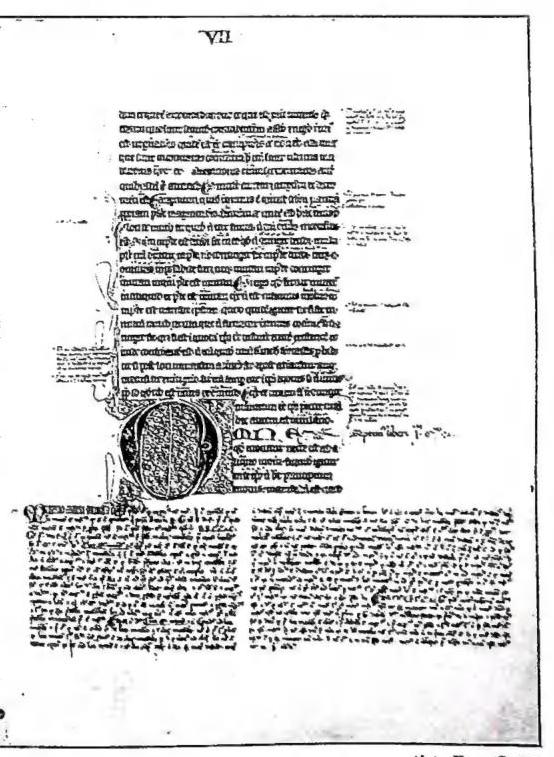
In particular, wishing to specify the importance of this characteristic of scholasticism, it can be said that it involves three moments corresponding to the very nature of philosophy (and of natural knowledge in general), of theology as such, and of their relationship, in which the ideal of the medieval man is realized—as for Greek civilization, the θεωρητικός βίος and the καλοκαγαθία were the ideal of the Greek man. De Wulf indicates the following characteristics for the first two moments. a) In philosophy: the demand for "scientific rigor" in the organization of the various fields and objects of knowledge, in the determination of the methods proper to each science, and in the adequate systematization of the knowledge thus obtained. The decisive moment and the "critical point" in this regard in the development of scholasticism was the discovery of Aristotle, with the assimilation of his doctrines in logic, physics, metaphysics, and ethics. b) In theology: as a consequence of the progress achieved in philosophy, theology also gradually tends to present itself in scientific form, according to a logical and coordinated distribution of the various treatises, following a rational procedure appropriate to the arguments through the rigorous syllogistic form and the division of the material into parts, questions, and articles that subject individual problems to the test of evidence to clarify them in their respective conceptual transparency (cf. M. De Wulf, Hist. de la philos. médiév., 6th ed., Louvain 1938 ff.; introd., Italian trans. by V. Miano, II, Florence 1944, p. 11 ff.). c) In man, finally, scholasticism achieves, at the cost of harsh struggles, the "reconciliation" precisely of reason and faith; it was the particular merit of Cardinal Ehrle to have grasped this conclusive moment and to have described it in its fundamental points, which are the respective independence, each in its own field, of reason and faith (philosophy and Revelation) and their mutual encounter, which led to a doctrinal expansion of both fields (Fr. Ehrle, Die Scholastik und ihre Aufgabe in unserer Zeit, Freiburg im Br. 1933, Italian trans. Turin 1935, p. 25 ff.).
From this perspective, decisive from the point of view of method and thus of the result itself, scholasticism unfolds a complete cycle of development that patristics—lacking, from both the philosophical and theological points of view, a systematic conception—could not have had: Abelard, V. ANSELMO, Hugh of Saint Victor already in the 11th–12th centuries knew the magisterium of the use of reason in theology, which the 13th century would bring to perfection, and this constitutes the positive advancement, not the pitfall, of Christian doctrine (as claimed by Fr. Overbeck, Vorgesch. und Jugend der mittelalterlichen Scholastik, ed. C. A. Bernoulli, Basel 1917, especially p. 226 ff.).
In modern thought, by contrast—from the first shocks of humanism and secular Renaissance, which took shape with the absolute immanence of the Enlightenment (v. ILLUMINISMO) and idealism (v. IDEALISMO), to the epigones of contemporary Marxism and atheistic existentialism—reason absorbs theology and Revelation. Modern thought, in the heterodox development that has dominated it, knows Christianity and Revelation but interprets both "within" its own development, as a shadowing or as a stage (imperfect, of course) of such development, which has by now fulfilled its historical function. On the one hand, therefore, modern thought has a direct relationship to scholasticism and to Christian thought in general insofar as it conceives the relationship of man to God in a positive form (cf. Hegel's praise of Catholic theologians against Protestant fideism in Philos. der Religion, ed. G. Lasson, Leipzig 1925, p. 256 ff.); on the other hand, in its fundamental positions, it is the explicit antithesis of scholasticism due to the dissolution it effects of the infinite as the totality of the dialectical development of the finite. This entails the negation of that transcendent sphere—
(photo: Esc. Ceti.)
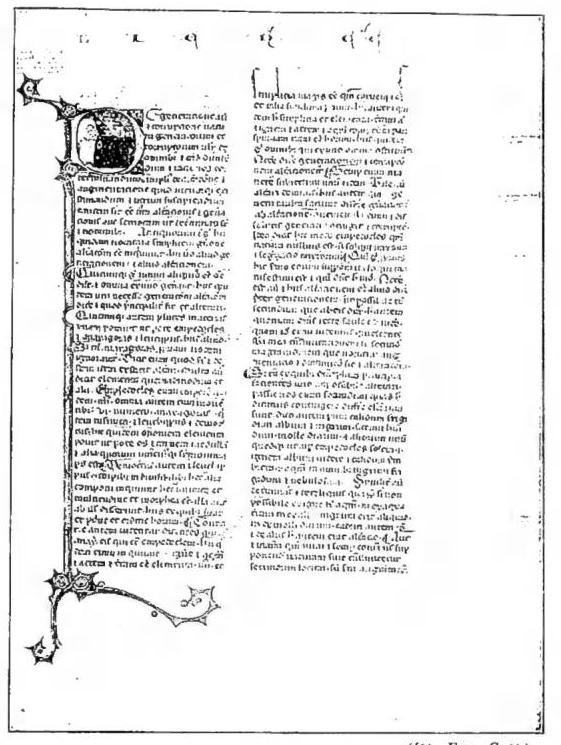
SCHOLASTICA - Incipit of Aristotle's Liber de generatione et corruptione, with interlinear and marginal annotations and corrections. Vatican Library, cod. Vat. lat. 2083, f. 157r (1284).
the transcendent sphere of faith, to which, according to S., reason leads as a propaedeutic, whereas for idealist rationalism, faith and religion are a preliminary and imperfect stage, proper to the common people and imaginative thought, compared to the absolute dominion of reason that unfolds in philosophy (cf. Hegel, op. cit., intr.; ed. cit., p. 7 ff.).
III. MEDIEVAL SCHOLASTICISM
It can be admitted that the rapid development and unchallenged dominance of Scholasticism in medieval Europe were also the cause of its principal defects, which become more evident beginning in the 14th century: the almost deliberate barbarism of language, due to the abandonment of the study of the classics; the multiplication of useless and insipid questions; the invasion of logical subtleties into metaphysical reflection; the lack of historical-critical sense in the use of texts... This favored the proliferation of schools that battled for centuries over questions often of little or no doctrinal significance, so that Scholasticism first failed to notice the revolution proclaimed by modern philosophy and then, exhausted as it was, was unable to comprehend it or contain its impetus. Nevertheless, every objective researcher must also agree that when Scholasticism is considered in its most salient figures—such as S. Bonaventura, S. Alberto Magno, S. Tommaso d'Aquino, and, for the heterodox tendency, Sigieri di Brabante—it ranks among the most substantial historical realizations of the universality of Christian truth. In its principles and even in the variety of its tendencies, it constitutes a valid point of reference for any inquiry into the fundamental problem of human existence, which is precisely the harmony between faith and reason, and offers a source of inspiration not yet exhausted for urging man to scrutinize the problem of being and to clarify the enigma of his ultimate destiny. Historians agree in dividing medieval Scholasticism into three periods: the preparation or "early Scholasticism" (Frühscholastik), the realization or "high Scholasticism" (Hochscholastik), and finally the decline or "late Scholasticism" (Spätscholastik). This division has its own justification from both the methodological and critical-doctrinal points of view.1. The preparation or early Scholasticism. – This period spans the time from the end of the ancient world (5th-6th centuries) to the 13th century. From the patristic era emerge as "masters" of Scholasticism S. Agostino (v.), the pseudo-Dionigi, and Boezio (v.) as ecclesiastical sources; but strictly philosophical doctrinal sources also assert themselves, such as certain Platonic dialogues (Phaedo, Meno, fragments of the Timaeus with the great Commentary on the same dialogue by Calcidius), especially Aristotle's Organon in the translation and commentaries of Boezio, and other minor sources like the Neoplatonist Mario Vittorino, Porphyry, Macrobius, and Apuleius (cf. M. De Wulf, op. cit., § 28: the treatment is by A. Pelzer). From this indication emerges the character of this early Scholasticism, which can be identified in the prevalence of Platonism (or Neoplatonism) in content and in the tendency toward the dialectical procedure of subdivisions and distinctions in method. Evidently, the process is long and arduous and subject to doctrinal crises, often very serious, that have direct repercussions on dogma itself (controversies on predestination, the Trinity, the Incarnation, the Sacraments, especially the Eucharist) which provoke ecclesiastical intervention. In the 9th century, the Neoplatonic speculation (inspired by the pseudo-Dionigi) of G. Scoto Eriugena (v.) suddenly stands out almost as a separate block, which falls under suspicion of pantheistic innovation and is condemned for the doctrine of predestination (Denz-U, 320 ff.). In the 11th century, Berengario di Tours (v.), who, trusting too much in the play of dialectics, compromises the doctrine of Eucharistic transubstantiation, incurring the condemnation of various Councils (Vercelli 1050, Rome 1050, Poitiers 1074, and Bordeaux 1080; Denz-U, 355). Dialectics also gets the upper hand with Roscelino (v.) and arouses the indignation of S. Pier Damiani (v.). The most notable figure of this period is S. Aosta (v.), who is the first systematic theologian to proceed from the data of Scripture and ecclesiastical magisterium to theological reflection and contemplation with a Platonic-Augustinian background, following the motto that appears in the title of the Proslogion (ed. is of chap. 1: PL 158, 227 BC: ... «Credo ut intelligam») and remained for all orthodox Scholasticism: Fides quaerens intellectum. The 12th century is known for the flourishing of schools of grammar and logic and is characterized by an unexpected and sudden development of the arts and letters of the Trivium and Quadrivium, in which the School of Chartres stands out with Clarembaldo d'Arras (v.), Guglielmo di Conches (v.), BERNARDO DI S (v.), and Teodorico di Chartres, and Bernardo di Tours, a contemporary of Teodorico, also called Silvestris; Guglielmo di Champeaux (v.), G. di Salisbury, and Gilberto de la Porrée stir up the controversy of the universals; finally, Abelardo (d. 1142) presents the first scientific methodology of Christian theology, strongly opposed by the mystic S. Bernardo. At the same time, in the Parisian monastery of S. Vittore, the first treatises of systematic theology and mysticism take shape (Riccardo [v.] and Ugo di S. Vittore [v.]). The end of the century witnesses a fervor of translations of Greek and Arabic texts, especially in Toledo, Palermo, and Naples, which provide the foundations and materials for the great leap of the following century.
a) The entry of Aristotle. – This will provoke the most important revolution in Christian thought in the West—
(Int. Enc. Uatt.)
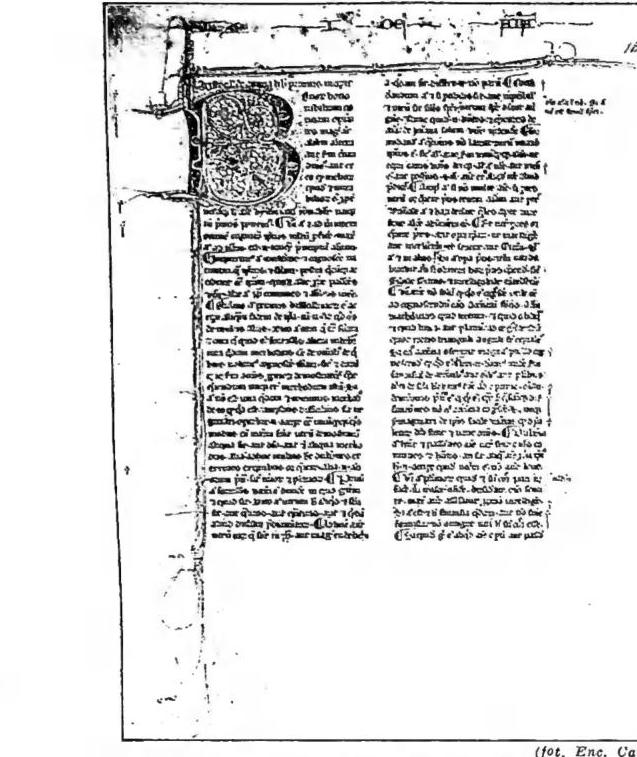
SCHOLASTICA - Incipit of Book I of Aristotle's De anima - Vatican Library, cod. Borgh. 127, f. 163f (1296).
in the West, particularly through the work of St. Thomas, but its beginnings were highly contested. The Council of Paris in 1210, in addition to condemning the pantheism of Amalric of Bena and David of Dinant (v.), prohibited the reading of Aristotle's new works: « Nec libri Aristotelis de naturali philosophia nec commenta legantur Parisiis publice vel secreto, et hoc sub poena excommunicationis inhibemus ». The prohibition was repeated in the Statutes of the University of Paris of 1215, drafted by Robert of Courçon, papal legate, who expressly distinguished between the philosopher's books on logic, which were permitted, and the recently introduced works, which were prohibited but without mention of excommunication: « Non legantur libri Aristotelis de metaphysica et de naturali philosophia nec summe de eisdem » (Chart. Univ. Paris., ed. Denifle-Chatelain, Paris 1889, vol. I, no. 20, p. 78 ff.). An even more significant phase occurred with the personal intervention of Gregory IX, who, while in two letters (7 July 1228, 13 April 1231) had renewed the previous prohibitions, ten days later (23 April) established a commission of three theological members (William of Auxerre, Stephen of Provins, and Simon de Alteis) to purge the incriminated books of errors: « ... et libris illis naturalibus qui ex certa causa in Concilio Provinciali prohibiti fuere, Parisiis non utantur, quousque examinati fuerint et ab omni errorum auspiciere purgati ». However, the Commission, for various reasons—especially the death of its head, William of Auxerre (3 November 1231), and the complexity of the task itself—does not appear to have achieved any results. Meanwhile, the situation seemed to resolve itself; many indications reveal that Aristotle's new books were studied and commented upon almost everywhere without particular restrictions. This is attested, toward the second half of the century, in the Statuta artistarum nationis Anglicanae de artibus and by the most complete collection of the Statutum of the Faculty of Arts of 19 March 1255, where the following are listed without reservation among the books of study: « ... physica, metaphysica, liber de animalibus, liber coeli et mundi, liber primus metherorum, liber de anima, liber de generatione, liber de sensu et sensato, liber de memoria et reminiscentia », in addition, of course, to the books on logic and the « Ethica quantum ad quatuor libros », that is, the Ethica nova and the Ethica vetus (cf., for the question of conciliar prohibitions, which resurfaced in a letter from Pope Urban IV to the University of Paris on 13 January 1263, and their relationship with the cited Statuta, M. Grabmann, I divieti ecclesiastici di Aristotele sotto Innocenzo III e Gregorio IX, Rome 1941, pp. 7 ff., 113 ff., and 132. Grabmann did not have time to complete his research, and perhaps the only plausible solution to the contrast between the prohibitions and the Statuta remains that of Cardinal Ehrle, according to whom the attitude of ecclesiastical authority in these prohibitions was one of « prudent expectation »: the ecclesiastical prohibitions ceased and lost their validity through desuetude, as their purpose and the situation to which the law referred had ended (Fr. Ehrle, L'agostinismo e l'aristotelismo nella s. del sec. XIII, in Xenia Thomistica, III, Rome 1925, pp. 521 and 538).
b) The principal schools of high Scholasticism. - The entry of Aristotle into Western Christendom provoked reactions of various kinds. Some, especially among theologians and not only within the Franciscan Order but also in the early Dominican school, wary of any novelty, continued to adhere to tradition and did not intend to depart from the doctrine of St. Augustine; others, however, resolutely proceeded along the new path and welcomed Aristotle's vision of the world into the Christian synthesis. For the sake of nomenclature, following the studies of Fr. Ehrle and P. Mandonnet, it has been agreed to designate the two contrasting tendencies with the terms Augustinianism and Aristotelianism.
Augustinianism. In this tendency, St. Augustine remains the principal master, though not the exclusive source (it should also be noted that he is the common source for the other masters of this period as well, only his doctrines are incorporated into types of metaphysics of different inspiration). The metaphysics of the Augustinian tendency proceeds rather—and certainly consolidated itself—from the exaggerated realism of Neoplatonic type, and its principal source is the great metaphysical dialogue Fons vitae Avicebron (v.), translated at the end of the 12th century Gundisalvi (v.), who disseminated its doctrines in the treatises De Anima, De divisione philosophiae, De immortalitate animae, De processione mundi, etc. (cf. the substantial observations of E. Gilson, in Mediaeval studies, II, 1940, pp. 23-27). This doctrinal tendency is already clearly visible in the first Franciscan masters, e.g., Alexander of Hales (v.), but it consolidated especially through the work of St. Bonaventure and his disciples (Matthew of Aquasparta, Vital du Four, Peter John Olivi). From the letters of John Pecham, his disciple and rival of St. Thomas in Paris, the vivacity of the opposition between the two tendencies and the main points of controversy are well known: in a letter of 1 June 1285, the doctrines of St. Augustine are mentioned (« ...quidquid docet Augustinus de regulis aeternis et luce incommutabili [or the doctrine of illumination], de potentiis animae [identity of soul and faculties], de rationibus seminalibus inditis materiae et consimilibus innumeris »); in another letter of 7 December 1284, the thesis that caused the greatest uproar in the anti-Thomist polemic unleashed by this school is touched upon, namely, the unity of the substantial form in man: « In homine existere tantummodo formam unam... », whereas the traditional doctrine firmly upheld the plurality of forms, which seemed necessary to explain the condition of Christ's Body in the tomb and the diversity of man's various operations (cf. for the complete text of the letter: M.-H. Laurent, Fontes vitae s. Thomae Ap., fasc. vi, Saint-Maximin Var 1937, p. 639 ff., esp. p. 644 f.). The true metaphysical origin of this latter doctrine, however, was the thesis, taken wholesale from Avicebron, of universal Hylomorphism (v.), according to which every creature, being finite in its being, is composed of matter and form: bodies of « corporeal matter » and spirits of « spiritual matter » (cf. E. Kleineidam, Das Problem der hylomorphen Zusammensetzung der geistigen Substanzen im 13. Jahrh. behandelt bis Thomas von Aquin, Lilienthal 1930, p. 7 ff.). The second Franciscan school, led by Duns Scotus (v.), remained faithful to the spirit of Augustinianism but elaborated metaphysical problems with greater adherence to the Aristotelian text, which was interpreted preferably in the line of Avicenna (the great critical edition of the works, directed by Fr. C. Balić [Rome 1950, so far 2 vols.], will allow the genuine thought of the « Doctor subtilis » to be distinguished from the additions or deductions of his disciples).
Averroist Aristotelianism. The claim of absolute fidelity to the Aristotelian text was certainly the program of the "Commentator" par excellence, as Averroes (v.) was called, and from him it passed in the second half of the 13th century to a group of skilled masters of the Faculty of Arts in Paris who, under the pretext of interpreting Aristotle, aroused serious concerns for Catholic orthodoxy. This School was called "Averroism" (Averroyei, secta Averroyca), and its fortune depended largely on having had at its head a Siger of Brabant (v.). The principal and direct antagonist of Averroism was St. Thomas himself in the opuscule De unitate intellectus contra Averroistas (of 1270); he did not hesitate to qualify Averroes as a corrupter of Aristotelian thought: « ... qui non tam fuit Peripateticus, quam philosophiae peripateticae depravator » (ed. L. W. Keeler, Rome 1936, p. 38). The culminating episode is the repeated condemnation by the Bishop of Paris, Étienne Tempier, on March 7, 1277, of as many as 219 theses (cf. the text in M.-H. Laurent, Fontes..., ed. cit., pp. 598-614), most of which were inspired by the new philosophy whose proponents, however, professed themselves believers insofar as, in the realm of faith, they submitted to revealed doctrine even if it appeared contrary to what reason demonstrated (theory of the "double truth"). The explicit appearance of Averroism does not seem to predate 1265, the year in which polemical reactions began; its history extends throughout the Middle Ages until the Renaissance, where the Averroist strand appears particularly visible and represents, with its cumbersome baggage of distinctions, the most stubborn and decadent form of Scholasticism (B. Nardi has identified not a few exponents of this revival of Averroism;
BIBL.:
Per l'aristotelismo tomista: M. Grabmann, Die Aristoteleskommentare des Hl. Thomas von Aquin, in « Sitzungsberichte der Bayer. Akad. der Wiss. », Philos.-hist. Abt., 1940, H. 3; F. Van Steenberghen, Aristote en Occident, Louvain 1946; J. Weisheipl, The Development of the Doctrine of the Agent Intellect in the Franciscan School of the XIII Century, in « Franciscan Studies », 13 (1953), pp. 123-159; per l'averroismo: P. Mandonnet, Siger de Brabant et l'averroïsme latin au XIIIᵉ siècle, Louvain 1908-1911; F. Van Steenberghen, La philosophie au XIIIᵉ siècle, Louvain 1966; B. Nardi, Saggi sull'aristotelismo padovano dal sec. XIV al XVI, Firenze 1958.
(C. Giacon)
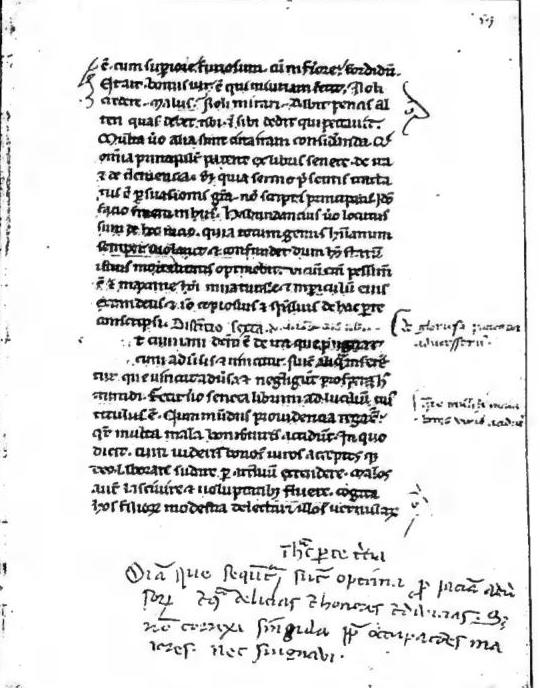
SCHOLASTICISM - Part III of the Moralis philosophia by R. Bacon. End of chapter 9 and beginning of chapter 10, with autograph annotations by the author - Vatican Library, cod. Vat. lat. 4295, f. 53° (ca. 1267).
the same Pico della Mirandola, Alessandro Achillini, Tiberio Bacilieri, Antonio Mirandolano, Tagliapietra...). The successor of Siger in the leadership of the movement, Giovanni di Jandun (v.), aligned himself in metaphysics with the Franciscan school (e.g., for the doctrine of the plurality of substantial forms; cf. In ll. XII Metaph. Quaestiones acutissimae, Venice 1560, II, q. X, col. 152). In political philosophy, Padova (v.), in the Defensor pacis, upheld the separation of Church and State: in this way, a long process of erosion of the principle of Europe's spiritual unity, which had dominated the Middle Ages through scholasticism, was concluded, and the doctrine of the modern State began.
3. The decline or late scholasticism - This designation is historically improper because scholasticism still dominated during the 14th and 15th centuries: for the most part, it was engaged in the anti-Thomist polemic conducted by secular Enrico di Gand (v.), but especially by the Franciscan Order, in which the old Augustinian school declined and the new one arose with Duns Scotus, who followed in the footsteps of the aforementioned Enrico (cf. Io. Duns Scoto, Opera omnia, I, Rome 1950, Disquisitio historico-critica, p. 160 ff.). This struggle of Enrico and Scotus against Thomism had been prepared by the Correctorium fratris Thomae of G. de la Mare, which had provoked from the Dominicans the rich literature of the Correctoria corruptorii... that take their title from the first word: «Quare», «Circa», etc. Egidio Romano (v.), who was considered a defender of the Angelic Doctor, attacked him on many points, especially in theology (cf. G. Bruni, Egidio Romano e la sua polemica antitomista, in Riv. di filos. neosc.*, 26 [1934], p. 239 ff.). However, the reason for this vast opposition to Thomism seems to lie not so much in contingent rivalries as in the innovative nature of the Angelic Doctor's doctrines, in the face of which there was a felt obligation to return to the substance of traditional positions: thus, it does not seem inappropriate to designate
A beneficial consequence of the search for concreteness by the nominalist «via moderna» (but already present in the preceding scholasticism, e.g., in R. Kilwardby; cf. M.-D. Chenu, Aux origines de la science moderne, in Rev. des sciences philos. et théol., 29 [1940], p. 206 ff.) was the ferment it aroused for scientific inquiry: G. Buridano (v.), N. Oresme, Alberto di Sassonia (v.) should be recalled. Though observation and calculation in the modern, i.e., Galilean, sense were still distant, motion was studied from a strictly physical standpoint, and an important part was given to the quantitative treatment of qualities. Physical reality was seen as subject to measurement, so that the first hints of infinitesimal and algebraic calculus emerged, as when Oresme enunciated the principle: «Omnis res mensurabilis imaginatur ad modum quantitatis continuae» (De uniformitate, Paris, Bibliothèque nationale, cod. lat. 7371, fol. 18°, in M. De Gandillac, Le mouvement doctrinal du IXe au XIVe siècle, Paris 1951, p. 461). Careful investigations in this field, especially thanks to P. Duhem, have shown that the 14th century already possessed the concepts of «volume» and «mass», albeit with uncertainty and fluctuations; «movement» was considered as an magnitudo intensiva or «variable magnitude», and N. Oresme attempted a graphic representation of it, which, though not yet Cartesian analytic geometry, constituted in some way a surprising anticipation and distant stimulus. In Buridano, moreover, one finds a notion of «absolute and mathematical time», that is, freed from any dependence on motion and the thinking consciousness, as it would be explicitly defined four centuries later by Newton (cf. A. Maier, Scholastische Diskussionen über die Wesensbestimmung der Zeit, in Scholastik, 26 [1951], p. 554). The very concept of «function», certainly not in its modern formulation, which dates only to the end of the 17th century, was clearly outlined, e.g., in the Tractatus proportionis of 1322 by T. Bradwardine (v.) and his followers (cf. A. Maier, Der Funktionsbegriff in der Physik des 14. Jahrh., in Divus Thomas (Frib.), 24 [1946], p. 147 ff.). For this reason, Buridano and his school have rightly been presented as «precursors of Galileo», even if it must be acknowledged that this scholasticism, entirely imbued with fervor for the knowledge of experiential reality, remained entangled in the mass of individual findings, without rising through induction to general laws. The consequence was that the results, certainly notable, achieved by these scholastics fell into oblivion without any direct influence on the new physics of the 16th century, which rediscovered them anew on its own (cf. A. Maier, Das Problem des Kontinuums in der Philos. des 13. und 14. Jahrh., in Antonianum, 20 [1945], p. 368). In any case, the path taken was notable: those results, which discredited Aristotelian physics, undoubtedly fermented the restlessness that drove modern science onto its new course.
BIBL.:
Per la storia generale: M. De Wulf, Histoire de la philosophie médiévale, 6ª ed., Lovanio-Parigi 1934-47, 3 voll.; F. Ueberweg, Grundriss der Geschichte der Philosophie, II, Die patristische und scholastische Philosophie, 12ª ed. a cura di B. Geyer, Berlino 1951; E. Gilson, La philosophie au moyen âge, Parigi 1944; id., History of Christian Philosophy in the Middle Ages, Londra-New York 1955; M. Grabmann, Geschichte der scholastischen Methode, Friburgo in Br. 1909-11, 2 voll.; id., Mittelalterliches Geistesleben, Monaco 1926-56, 3 voll.; P. Mandonnet, Siger de Brabant et l'averroïsme latin au XIIIe siècle, Lovanio 1908-11, 2 voll.; B. Nardi, Saggi sull'aristotelismo padovano dal sec. XIV al XVI, Firenze 1958; id., Studi su Pietro Pomponazzi, Firenze 1965; F. Van Steenberghen, La philosophie au XIIIe siècle, Lovanio 1966; A. Maier, Studien zur Naturphilosophie der Spätscholastik, Roma 1951-58, 5 voll.; M.-D. Chenu, La théologie au XIIe siècle, Parigi 1957; id., Introduction à l'étude de saint Thomas d'Aquin, Parigi 1950; J. Koch, Durandus de S. Porciano O. P., Münster 1927; id., Die Ars coniecturalis des Nikolaus von Kues, Colonia 1956; E. Bettoni, Il processo astrattivo nella concezione di G. Duns Scoto, Milano 1954; G. Leff, Bradwardine and the Pelagians, Cambridge 1957; id., Gregory of Rimini, Manchester 1961; P. Duhem, Le système du monde, Parigi 1913-59, 10 voll.; A. Koyré, Études galiléennes, Parigi 1939; C. Michalski, Les courants critiques et sceptiques dans la philosophie du XIVe siècle, Cracovia 1925; L. Baudry, La querelle des futurs contingents (Louvain 1465-1475), Parigi 1950; E. A. Moody, The Logic of William of Ockham, Londra 1935; id., Truth and Consequence in Mediaeval Logic, Amsterdam 1953; H. Elie, Le complexe significabile, Parigi 1936; J. A. Weisheipl, The Development of Physical Theory in the Middle Ages, Londra 1959.
A. Maier
Finally, another merit of this late Scholasticism—one that redeems it not a little from the epithet of "decadent"—mysticism (v.) achieved in the 14th and 15th centuries in the northern countries, particularly in the Low Countries and Germany. Just as the shift toward physico-mathematical knowledge, mentioned earlier, was caused by weariness with the exasperating dialectical disputes that set the various schools against one another, sparking rivalries and divisions even in the external life of Christendom, so too was the rise of mysticism. The mystical current emerges within all the schools of Scholasticism. The Franciscan Order had its master in St. Bonaventure himself, who gave substance in his mystical works to the tumultuous aspiration that had manifested in his religious family after the death of St. Francis. In harmony with theological tradition, Franciscan mysticism is predominantly affective and orients its devotion toward the Passion of Christ. The most savory fruit of medieval mysticism, the De imitatione Christi, seems to resist all attempts to uncover its author and remains outside any school (v. IMITAZIONE DI CRISTO). Dominican mysticism developed especially in Germany with Meister Eckhart (v.) and his disciples G. Tauler (v.) and Bl. Suso (v.), CAUSA (v.), who form the so-called "Rhenish school." In its wake follow the great Ruysbroek (v.) and perhaps also the anonymous author of the Theologia deutsch, said to be from Frankfurt ("der Frankfurter"), so dear to Luther. In this mysticism, the intuitive and contemplative element prevails, clearly derived from Neoplatonism (Proclus or Pseudo-Dionysius), in the aspiration to penetrate the boundless sea of divine wisdom. Its characteristic doctrine is that of the "scintilla animae" (die Füncklein der Seele. Cf. H. Wilms, De scintilla animae, in Angelicum, 14 [1937], p. 194 ff.; H. Hof, Scintilla animae..., Lund-Bonn 1952). Well-known is the controversy stirred not so much by Eckhart’s theological writings as by his preaching, which brought the orator before an ecclesiastical tribunal and led to his condemnation in the bull In agro dominico of March 27, 1329 (Denz-U, 501-29; critical edition in: M. H. Laurent, Autour du procès de Maître Eckhart, in Divus Thomas [Piacenza], 39 [1936], pp. 435-44). Yet the problem of Eckhart’s orthodoxy is far from resolved. While Denifle’s (v.) reduction of Eckhart’s thought to pure Thomism cannot entirely satisfy—since Thomism by that time had already taken on many nuances—the claim that Eckhart was a founder of modern pantheism must be deemed anachronistic and exaggerated. The citation of Hegel (Religionsphilosophie, ed. G. Lasson, Leipzig 1923, I, p. 257) is insufficient to support it, especially since Hegel does not appear to have known the Dominican’s thought beyond superficial acquaintance (the aforementioned citation seems taken from Fr. V. Baader!). Even if one were to demonstrate the existence of a continuity of motifs in German spirituality from Eckhart and his school to the heterodox mysticism of Sebastian Franck, Valentin Weigel, Böhme (v.), and through them to idealist pantheism (cf. G. Della Volpe, Eckhart o della filosofia mistica, Rome 1952, p. 232 ff.), this at most attests to a climate of vague spiritual affinity and does not yet prove a rigorous derivation of doctrines.
BIBL.:
H. Wilms, De scintilla animae, in Angelicum, 14 (1937), p. 194 sgg.; H. Hof, Scintilla animae..., Lund-Bonn 1952; M. H. Laurent, Autour du procès de Maître Eckhart, in Divus Thomas (Piacenza), 39 (1936), pp. 435-44; G. Della Volpe, Eckhart o della filosofia mistica, Roma 1952.
IV. THE SECOND SCHOLASTICISM
This term, too, which denotes the Scholasticism of the 16th-17th centuries, is conventional: Humanism and the Renaissance did not extinguish Scholasticism but limited and confined it mostly to ecclesiastical, especially theological, schools. Moreover, both remained connected by many threads to the problems and spiritual interests that had always nourished, albeit within the diversity of approaches, the various systems (or viae) of Scholasticism.The disintegration of Scholasticism reached a true chaos during its period of decline, of which the writings of the time—brought to light by the most expert specialists (Denifle, Ehrle, Mandonnet, Grabmann, Glorieux, Pelster, Pelzer...) through library research—are an impressive testament. This disorientation must undoubtedly be linked to the struggle against Thomism; its most characteristic theses, such as moderate question of universals (v.) with the doctrine of the agent intellect and abstraction, the concept of potency, and the distinction between essence and act of being, were the first to be abandoned. The probative value of demonstrations concerning the substantial union of soul and body, the immortality of the soul, and the existence of God was denied, making them exclusive objects of faith. No internal force could halt the decline: only with the storm of the Reformation, whose connection with nominalism—after Denifle’s studies—is generally acknowledged (cf. F. Vignaux, Luther commentateur des Sentences, Paris 1935), was the importance of unifying the spiritual forces of Christendom understood.
The significance of this truly providential "rebirth" of Scholasticism lies primarily in the guiding role that the thought of St. Thomas began to assume for Catholic schools. The principal architect of this belated yet necessary recognition of the Angelic Doctor’s doctrinal work was the Dominican Order. However, the doctrinal contribution of the Society of Jesus (founded with the explicit purpose of countering heresy) must also be remembered, as it sent many of its best students to the Universities of Paris and Salamanca to study under the most celebrated Dominican masters. It was around these centers that the new Christian spring blossomed, bearing fruit in the Council of Trent (1545-63).
1. The Dominican School
It can be said that, after some phases of uncertainty—evident in the heated polemics between Dominicans and the dual fronts of Scotists and nominalists in the 14th century—the doctrinal synthesis of the Angelic Doctor was affirmed within his Order with greater fidelity to its original inspiration. In the first half of the 15th century, the monumental Defensiones theologicae D. Thomae Aquinatis by the Toulousan G. Capreolus (v.) appeared: the work’s peculiar value lies in its demonstrated knowledge of nearly all the Angelic Doctor’s writings and in the firmness of its polemic against the legion of Thomism’s adversaries (v. the list in vol. I of the new edition edited by C. Paban-T. Pègues, Tours 1900, pp. xxiii-xxv). In the second half of the century, Domenico di Fiandra stood out for his great commentary on metaphysics (Quaestiones metaphysicales: there is an edition from Bologna, 1570). In it, the qualities of Capreolus (who is cited) emerge, along with a marked sympathy for St. Albert the Great, which has led some to posit a connection with the so-called "Albertist school," promoted by secular masters in the first half of the century (cf. G. Meersseman, Gesch. des Albertismus, fasc. 1: Die Pariser Anfänge des Kölner Albertismus, Paris 1933; fasc. 2: Die ersten Kölner Kontroversen, Rome 1935), though it had no lasting influence. Domenico’s dependence on the secular master Giovanni Versor or Versorius seems clearer, as the latter, in his commentaries on Aristotle, shows great favor toward the doctrine of St. Thomas (cf. L. Mahieu, Dominique de Flandre. Sa métaphysique, Paris 1942, p. 23 ff.). The great revival of Thomism had two centers of expansion: Italy and Spain. The foremost Italian Thomists are considered Cardinal Gaetano, Francesco Silvestro da Ferrara (known as Ferrariensis), and a profound but independent thinker, C. Javelli, who fought not only against Scotus and his school but also against Pomponazzi (especially Javelli). The Scotist school was strong in Italy with A. Andrea (d. 1320) and Trombeta (a direct adversary of Gaetano in Padua), while the Augustinian school had risen in the 15Egidio da Viterbo (v.) and in the first half of the 16Seripando (v.), who played a significant role in the Council of Trent. However, the largest share of this Scholastic revival seems to belong to Spain, thanks to the Dominican masters who distinguished themselves in Salamanca, such as Fr. de Vitoria, Mancio, Pietro and Domenico Soto (v.), D. Bañez (v.), and Giovanni di S. BADIA, TOMMASO (v.). Positive theology CANTO (v.) with his now-classic treatise De locis theologicis.A special mention is deserved (for Spain) for the work contributed to the revival of Scholasticism in the Thomist direction by the Carmelite Order. While in the 14th and 15th centuries it had followed an eclectic approach, choosing as its master the Englishman Giovanni di Bacontorp, of Averroist tendencies, in the 16th century it adopted integral Thomism, producing two extensive Cursus of philosophy and theology that perhaps better than any other works of the time reflect the character of this "second Scholasticism."
2. The Jesuit School
While the Dominicans remained tasked with investigating Thomistic doctrines in the fullness of their synthesis, the masters of the Society of Jesus became the principal architects of the diffusion of Scholasticism in the 16th century across Europe’s major universities. The founder, St. Ignatius (v.), in his solid, albeit belated, theological formation, had understood that the doctrine of St. Thomas constituted the strongest bulwark against the errors of the Reformation. He thus ordained that the Order should faithfully adhere to the teachings of the Angelic Doctor: « In theologia legatur Vetus et Novum Testamentum et doctrina scholastica divi Thomae » (Constitutions, part 5, chapter 5). ACQUAVIVA, GIULIO (v.) reiterates the injunction: « Nostri omnino s. Thomam ut proprium doctorem habeant eumque in scholastica theologia teneant »; yet it is followed by a declaration that would have decisive consequences for the doctrinal orientation of the Society: « Non sic tamen s. Thomae adstricti esse debere intelligantur, ut nulla prorsus in re ab eo recedere liceat, cum illi ipsi, qui se thomistas maxime profitentur, aliquando ab eo recedant » (in Fr. Ehrle, Die Scholastik..., Italian trans., Turin 1935, p. 47, n. On St. Ignatius’s position regarding St. Thomas, cf. P. Mandonnet, Sur le thomisme des premiers temps de la Compagnie de Jésus, in Rev. thomiste, 22 [1914], p. 667). The Jesuit masters who most distinguished themselves, and whose doctrine is now inseparable from any discussion concerning the problems of Scholasticism, TOLEMAIDE (v.), Pereira, Fonseca, Molina (v.), Vasquez (v.), ARAGONA (v.), Suárez (v.), Bellarmine (v.), MARIANO, (v.). The Cursus Conimbricensium of the Coimbra Jesuits, compiled under the direction of Fr. Fonseca, holds a notable place. It introduces the innovation—already adopted by Fonseca in his great commentary on the Metaphysics—of placing Aristotle’s Greek text at the beginning of the commentary itself. While the Jesuit orientation may be described as “moderate Thomism,” it is not difficult to identify, case by case, how these masters of the Society abandon St. Thomas on key theses of the theory of knowledge, metaphysics, psychology, and so on, adhering instead to positions already familiar from his Augustinian or nominalist adversaries. Thus, while Suárez’s great respect for St. Thomas cannot be denied, his divergences from Thomistic metaphysics are not few. What particularly distinguished the Jesuit current was the field of jurisprudence, where Suárez, Bellarmine, and Mariana made contributions that lie at the foundation of modern law. The celebrated controversy De auxiliis divinae gratiae, sparked by Molina (v.) with his Concordia liberi arbitrii cum gratiae donis (1595)—which set the Dominican Order and the Society at bitter odds—is in itself a clear indication of the eclectic and independent direction assumed by the new school. Another merit of the Jesuit Ratio studiorum was the return to the study of Greek and Latin classics, which effectively fostered not only the rebirth of “Christian humanism” but also precision and clarity in the exposition of doctrines.3. Protestant Scholasticism of the 17th–18th Centuries
Though Luther (v.) frequently launches invectives against Thomism and the Scholasticism inspired by Aristotle, alongside him Melanchthon (v.) defends the necessity of employing philosophy in the defense of Christian truths and the advantage of recourse to Aristotle himself. And although he placed Cicero nearly on the same level as the Philosopher, there is no doubt that his philosophy may be called a true “Aristotelianism” (cf. P. Petersen, Gesch. der aristotelischen Philos. im protestantischen Deutschland, Leipzig 1921, p. 106). Alongside Melanchthon, proponents of Scholasticism may be said to include E. Sarzern (1501–59), Georg Major (1502–74), Jakob Camerarius (1500–74), Jodocus Willich (1501–55)..., though the humanistic tendency still predominates. It is precisely in the following century that Protestant Scholasticism unfolds with unexpected richness, as evidenced by the recent research of Max Wundt and H. E. Weber. Initially, for example, in Cornelius Martini, who from 1592 was a professor in Helmstedt, one observes a faithful adherence to the Aristotelian text with evident Thomistic influences, while in the 18th century—particularly in metaphysics—the influence of Suárez’s Disputationes metaphysicae becomes visible (cf. M. Wundt, Die deutsche Schulmetaphysik des 17. Jahrh., Tübingen 1939, especially p. 171 ff.). A similar movement occurred among Lutheran Reformed theologians: for them, as for orthodox Catholic Scholasticism, the will is preceded by the intellect, and the movement of love by knowledge of being, so that there exists a speculative knowledge of God (Theologia naturalis), which is a prerequisite for the knowledge of God’s “saving will” as revealed in Revelation. The limit imposed on the natural knowledge of God is expressed by these Protestant theologians, as in Catholic Scholasticism, through the doctrine of analogy (v. cf. H. E. Weber, Reformation, Orthodoxie und Rationalismus, Gütersloh 1951, p. 19 ff). This Scholastic-inspired thematic has not been without influence on modern philosophy, first on Descartes—as Gilson has demonstrated—and later on Spinoza, Locke, and Leibniz (v.) and the Wolffian school. A methodical study of modern philosophy would show how it is often variously contained and stimulated by themes and concepts derived from Scholasticism in its principal currents, but especially those of nominalism and mysticism.BIBL.:
P. Mandonnet, Sur le thomisme des premiers temps de la Compagnie de Jésus, in Rev. thomiste, 22 (1914); Fr. Ehrle, Die Scholastik und ihre Aufgaben in unserer Zeit, trad. it., Turin 1935; P. Petersen, Geschichte der aristotelischen Philosophie im protestantischen Deutschland, Leipzig 1921; M. Wundt, Die deutsche Schulmetaphysik des 17. Jahrhunderts, Tübingen 1939; H. E. Weber, Reformation, Orthodoxie und Rationalismus, Gütersloh 1951. - G. M.
V. NEOSCHOLASTICISM
In the period from the end of the 18th century to the first half of the 19th century, Catholic schools faced one of their gravest dangers: in France and Italy, Cartesianism, dynamism (v.), sensism (v.) had infiltrated according to prevailing tastes. In Germany, Romanticism, in opposition to the Enlightenment, had rediscovered the universality of medieval art and religiosity (F. Schlegel). Novalis exalted the Catholic Middle Ages as the triumph of Europe’s spiritual unity, advocating, against Protestant schism, the "renewal of a single Christendom and a supranational visible Church" (cf. Die Christenheit oder Europa, in Ges. Werke, V, ed. C. Seelig, Zurich 1945, p. 34). Yet Catholic schools lacked a precise doctrinal direction; the great A. Möhler of Tübingen initiated a return to patristic sources, while Staudenmeyer engaged deeply in criticism of Hegelian panlogism. However, explicit negative judgments on scholasticism were voiced from various quarters, and concerning concessions to modern philosophy were made by figures such as Frohschammer, Hermes, Günther, Bolzano, and the Romantic Deutinger (cf. J. Fellerer, Die Stellung Martin Deutingers in der Geistesgeschichte des 19. Jahrh. als Grundlegung f. seine Auffassung vom Verhältnis von Philos. und Theol., Bonn 1940). This disorientation led to the Church’s condemnation, under Gregory XVI and Pius IX, of a continuous series of theological and philosophical errors: Lamennaisianism, traditionalism (v.), ontologism (v.), along with all the nuances of secularism and liberalism. Among the earliest studies of scholastic texts, one must recall Cousin’s (v.) studies and edition of Abelard, as well as A. Jourdain’s monograph on the Latin translations of Aristotle (Paris 1819; 2nd ed. 1843).The official entry of Neoscholasticism into Catholic schools is to be seen in Leo XIII’s encyclical Aeterni Patris; yet this decision was the culmination of multiple and arduous efforts. Schematically, following Masnovo’s studies (Il neotomismo in Italia, Milan 1923), its beginnings can be traced to the work Buzzetti (v.), who conceived the restoration of scholasticism as a return to Thomism. Possibly influenced by some Roman priests exiled during the Napoleonic occupation and by the former Spanish Jesuit B. Mazdeu, he had been formed especially on the celebrated manual of the Dominican Roselli and must have also known Goudin (cf. A. Masnovo, op. cit., p. 196; P. Dezza, Alle origini del tomismo, Milan 1940, p. 25). His students, Sordi (v.), later entering the Society of Jesus, drew to the new direction Fr. Taparelli d’Azeglio (v.) and others, sparking particular enthusiasm among young people in Naples. However, the movement was suppressed by higher authority, and the new direction also faced opposition at the Roman College in Rome, TONGIORGI, SALVATORE (v.) Secchi (v.) prevailed. The first Thomism within the Society of Jesus advanced cautiously in the second half of the century, thanks to the journal La civiltà cattolica, founded by Fr. Curci (whose Memorie are a precious source of that struggle), and the higher school of philosophy of the Lombard-Venetian province (now Aloisianum), which had in Fr. Mauri (1849–1923) the principal author of the Cursus Forquidiensis of philosophy. In this second half of the 19th century, one must also place the intense activity of Fr. Liberatore (v.), who, having moved from eclecticism to Thomism (cf. A. Masnovo, op. cit., p. 29 ff.; P. Naddeo, Le origini del neo-tomismo e la nuova scuola napoletana di G. Sanseverino, Salerno 1940, p. 11 ff.), with the reworkings of his Institutiones logicae et metaphysicae, followed by studies on knowledge and the human composite, along with his activity as a writer in La civiltà cattolica, greatly contributed to the affirmation of Thomism in Roman circles.
But the prince of this revival is SAN SEVERO (v.). Once he grasped the vital importance of Thomism, also thanks to Baron Vincenzo di Grazia, he devised a comprehensive plan of work that included the founding of a Thomistic academy (1846; it became in 1874 the first Academy of St. Thomas), which held regular meetings at the University of Naples, the publication of the academy’s disputes and original studies in the journal Scienza e fede (founded by him in 1840), where the Jesuits Sordi, Liberatore, and others also wrote, and of a collection of modern works, the Biblioteca cattolica. Above all, he gathered around himself in the school of the Naples Seminary a large group of talented and courageous young men who assisted him in this bold undertaking and continued his work into the first decades of the 20th century, such as N. Signoriello, S. Calvanese, G. Portenova, G. Prisco (v.), and S. Talamo (v.). The principal fruit of this unparalleled organizer was the Philosophia christiana cum antiqua et nova comparata, of which seven substantial volumes were published (beginning in 1852), representing barely half of the projected work (Signoriello published a valuable compendium [3 vols.] of the entire work, which was translated into various languages). The fruit of twenty years of tireless preparation, this work has no equal in Buzzetti’s production, for the clarity and depth of its discussion, its historical information on antiquity, Christian scholasticism, and even modern philosophy, with abundant references in the original modern languages. Pelzer rightly observes that "elle n'a pas encore été refaite dans la néo-scolastique contemporaine" (Les initiateurs du néo-tomisme contemp., offprint, Louvain 1911, p. 22). What is astonishing in this man is his vast and direct knowledge of modern English, French, and German philosophy. On pp. 132 ff. of vol. I, he expounds the idealism of Kant, Fichte, Schelling, and Hegel (of the latter, he cites the great Logic and the Encyclopedia in the original text). He also knows, though seemingly at second hand, the left-wing Hegelians Fr. Strauss, B. Bauer, L. Feuerbach, and the French right of Michelet, Leroux, Quinet... (op. cit., p. 147). Sanseverino praises the work begun by La civiltà cattolica in defense of scholasticism and rejoices that even in Germany accusations against scholasticism are being abandoned, and men arise who openly defend "philosophiam scholasticam, eo praesertim modo quo ab Aquinate exornata atque ad sacras disciplinae accomodata fuit" (op. cit., p. 153), such as Fr. KLEUTGEN, JOSEPH (v.), Julius Stahl, and Jakob Clemens. Liberatore hailed Sanseverino’s work as the "triumph of the cause of scholasticism" (op. cit., p. 18). The flame was now lit and would not be extinguished. Beyond the Jesuits of La civiltà cattolica, in which Fr. Cornoldi (1822–92) played a notable ROSMINIANI (v.), scholasticism inspired by sound Thomism was defended in Udine by Prof. Di Giorgio, in Turin by G. Audisio, in Perugia by G. Pecci (brother of Leo XIII), in Bologna by Prof. Battaglini, in France by figures such as Chieco, Possé, Grandelande, Sauvé, and Thuault; in Germany, alongside Kleutgen, Stöckl (v.) stood out for its scope and diligence in historical and doctrinal research.
G. M.
Even in Rome, the direction desired by the Aeterni Patris (v.) overcame the last resistances in ecclesiastical institutes. The Roman College counts among the most active supporters of Neo-Scholasticism, besides Cornoldi, M. de Maria and V. Remer (1843-1910), P. De Mandato (v.), and P. Geny, authors of valuable manuals of Thomist orientation, while the Spaniard G. Urráburu (1844-1904) wrote a monumental synthesis of philosophy inspired by Suárez. L. Billot (v.) and G. MATTIUSSI, GUIDO (v.) gave great impetus to speculative problems, the latter’s Thomism influencing the doctrinal direction of the Pontifical Gregorian University (its organ, the Gregorianum, 1920 ff.), continued by C. Boyer (b. 1884) and P. Dezza (b. 1901). At the Apollinare, later the Pontifical Lateran University, Neo-Scholasticism encountered lively opposition from Francesco Segna (later cardinal), but was decisively followed by theologians P. R. Tabarelli (d. 1900) and L. Buonpensiere (d. 1929). A vigorous impulse was given to Neo-Scholasticism at the Urban Athenaeum of Propaganda Fide in theology by Fr. Satolli (v.), A. LEPIDI, ALBERTO (v.), and P. Parente (b. 1891), and in philosophy by B. Lorenzelli (1853-1915), later cardinal. The journal Euntes docete is the organ of the Faculties of Theology, Philosophy, and Missiology (1948 ff.). The glorious College of St. Thomas at the Minerva, founded in 1577 and transformed in 1909 into the Pontifical Angelicum Institute, became a promoter, as the vanguard of the Dominican Order’s doctrinal mission in Rome, of traditional Thomism, in which distinguished themselves Cardinal T. Zigliara (v.), A. GEPIDI (v.), T. Pègues (v.), E. UGONOTTI (v.), A. Zacchi (v.), R. Garrigou-Lagrange (b. 1877), and M. Cordovani (1883-1950). The Dominican Athenaeum’s organ is the journal Angelicum (1923 ff.).
In Italy, in 1921, the Catholic University of the Sacred Heart arose in Milan through the initiative of Father A. Gemelli, O.F.M. (b. 1878), and Dr. Necchi (v.), aiming to demonstrate the modern vitality of traditional thought in the face of lingering positivism and the idealism of Croce and Gentile, then dominant in Italian culture. Particularly valuable contributions, both in theoretical and historical research, were made by E. Chiocchetti (1880-1951), A. Masnovo (b. 1876), F. Olgiati (b. 1885), G. Bontadini (b. 1903), M. Campo (b. 1892), L. Pelloux (b. 1906), S. Vanni-Rovighi (b. 1908), and C. Mazzantini (b. 1895). Rector Father Gemelli founded and directs the Laboratory of Experimental Psychology, dedicated especially to the study of perception and psychotechnics; it publishes the series Contributi dei laboratori di psicologia and the Archivio di psicologia, neurologia e psichiatria (1940 ff.). Closer to the Louvain school, Monsignor G. ZAMBONI, GIUSEPPE (v.) and U. A. Padovani (1894) in Padua promote the integration of philosophia perennis into modern thought, with Padovani contributing particularly to the treatment of moral and religious problems. Inspired by the defense of Thomism is also the philosophical activity of N. Petruzzellis (b. 1910). The Rivista di filosofia neo-scolastica, founded in Florence in 1909 by A. Gemelli and G. CANCELLO (v.), was later taken over by the Catholic University of Milan and is the principal organ of Italian Neo-Scholasticism. Notable are the commemorative volumes on Kant (1924), Hegel (1931), Cardinal Cajetan (1932), Spinoza (1934), Descartes (1937), Malebranche (1938), and the jubilee volume for the journal’s 25th anniversary (1934).
Active centers of Neo-Scholastic study also include the Aloisianum in Gallarate, where the "Centro di studi dei filosofi cristiani," promoted by C. Giacon (b. 1900), holds its seat and annual conferences, and the Pontifical Salesian Athenaeum in Turin, with Faculties of Theology, Philosophy, and Pedagogy (publishing Salesianum, 1941 ff.). Special mention goes to the Alberoni College in Piacenza, which oversees the publication of Divus Thomas (3rd series, 1924 ff.), the first journal to champion Neo-Scholasticism. In Belgium, the decisive affirmation of Neo-Scholasticism owes much to the work of Cardinal D. MERCIER, DÉSIRÉ (v.), who, at the behest of Leo XIII, founded the "École de philosophie de St Thomas" in Louvain, later becoming the "Institut supérieur de philosophie." This institute became an international center of studies, particularly in the fields of theory of knowledge, psychology and philosophy of science, history of philosophy, and social sciences. Notable figures include D. Nys (1859-1927), M. De Wulf (v.), C. Sentroul (1876-1933), A. Pelzer (b. 1876), L. Noël (b. 1876), R. Kremer (1887-1934), L. de Raeymaeker (b. 1895), F. van Steenberghen (b. 1904), A. Mansion (b. 1882), and A. Michotte, who directs the Institute of Psychology. The organ of the Louvain School was the Revue de philosophie néoscolastique (1898; from 1946, Revue de philosophie de Louvain). Also in Louvain, the work of Father J. Maréchal (v.), promoter of an approach between Thomist gnoseology and Kantian principles, and the fruitful research on medieval thought by the Benedictine Abbey of Mont César under the guidance of D. O. Lottin (b. 1880) deserve mention.
In the Netherlands, Neo-Scholasticism also enjoys vigorous life: first promoted by Thomists J. V. de Groot (1848-1922), J. T. Beysens (1864-1945), and J. H. Hoogveld (1878-1943), its center is now the Catholic University of Nijmegen. Chairs of Scholastic philosophy have been introduced in the state universities of Amsterdam, Leiden, and Utrecht. The principal organ of Dutch and Flemish Neo-Scholastic activity is the Tijdschrift voor Philosophie (1939 ff.), published by the Flemish Dominicans in Louvain. The Jesuit College of St. J. in Valkenburg publishes Scholastik (1926 ff.).
In France, Neo-Scholasticism gradually established itself in the Catholic Faculties of Lyon (1875), Angers (1875), Toulouse (1877), Strasbourg (1875), and especially at the Catholic Institute of Paris (1875), founded by Monsignor M. d'Hulst (d. 1896), where Thomists A. Sertillanges (v.), A. Blanche (b. 1874), Peillaube (d. 1937), and J. Maritain (b. 1882) distinguished themselves. The Institute publishes the Revue de philosophie. French Dominicans have two study centers around the journals Revue thomiste (1893 ff.) and Revue des sciences philosophiques et théologiques (1907 ff.), while French Jesuits publish the Archives de philosophie (1929 ff.). In the history of Scholasticism, the research of P. Mandonnet (1858-1940), G. Théry (b. 1891), and academician E. Gilson (b. 1884), who founded the "Institute of Medieval Studies" in Canada, holds a prominent place. Notable historical studies have also been contributed by A. Forest (b. 1898), P. de Gandillac, P. Vignaux (b. 1904), and P. Glorieux (b. 1892).
In Germany, on the theoretical side, G. KLEUTGEN, JOSEPH (v.), C. Gutberlet (v.), and A. Stöckl stand out, while decisive contributions to the history of Scholasticism have been made by K. Werner (d. 1888), Cl. Baeumler, G. von Hertling (d. 1919), M. BAUMGARTNER, ALEXANDER (v.), B. Geyer (b. 1881), J. Koch (b. 1885), M. GRABMANN, MARTIN (v.), F. Ehrle (v.), and F. Pelster (b. 1880). A master of medieval historiography was the Dominican E. Denifle (v.), who discovered the unpublished works of Eckhart and published, with E. Chatelain (1851-1933), the Chartularium Universitatis Parisiensis. The principal organ of German Neo-Scholasticism is the Philosophisches Jahrbuch. An important center of German Neo-Scholasticism was the Jesuit College of Maria-Laach (which published Philosophia Lacensis, 1897 ff.), succeeded by the "Berchmanskolleg" in Pullach (Munich), which began publishing the series Mensch, Welt, Gott (Freiburg im Breisgau, 1938).
In Austria, the activity of the University of Innsbruck, which publishes the series Philosophie und Grenzwissenschaften (1929 ff.) directed by Austrian Jesuits, deserves mention. The University of Salzburg has a more open orientation, where A. Mayer and D. Feuling taught. In natural philosophy, A. Mitterer (b. 1887) distinguished himself.
BIBL.:
For general orientation: M. Grabmann, Die Geschichte der kath. Theologie seit dem Ausgang der Väterzeit, Friburgo in Br. 1933; id., Geschichte der scholastischen Methode, 2 voll., Friburgo in Br. 1909-11; F. Ehrle, Der Kampf um die Lehre des hl. Thomas von Aquin in den ersten 50 Jahren nach seinem Tode, in Xenia thomistica, Roma 1925, III, p. 1-67; J. Koch, Die Ars coniecturalis des Nikolaus von Kues, in Cusanus-Texte, Heidelberg 1927; E. Gilson, Le Thomisme, Parigi 1919; id., La philosophie au moyen âge, Parigi 1922; id., History of Christian Philosophy in the Middle Ages, Londra 1955; M. de Wulf, Histoire de la philosophie médiévale, 3 voll., Lovanio 1934-47; A. Masnovo, Da Guglielmo d'Auvergne a S. Tommaso d'Aquino, Milano 1930-46; G. von Hertling, Geschichte der kath. Philosophie, Friburgo in Br. 1925; B. Geyer, Die patristische und scholastische Philosophie, Berlino 1928; J. de Ghellinck, Le mouvement théologique du XIIe siècle, Bruges 1948; P. Mandonnet, Des écrits authentiques de S. Thomas d'Aquin, Friburgo 1910; id., Siger de Brabant et l'averroïsme latin au XIIIe siècle, Lovanio 1908-11; F. Stegmüller, Geschichte des Molinismus, Münster 1935; R. Garrigou-Lagrange, Le sens commun, la philosophie de l'être et les formules dogmatiques, Parigi 1909; id., Dieu, son existence et sa nature, Parigi 1914; J. Maritain, Distinguir pour unir ou les degrés du savoir, Parigi 1932; id., Les degrés du savoir, Parigi 1932; A. Sertillanges, S. Thomas d'Aquin, Parigi 1910; id., La philosophie morale de S. Thomas d'Aquin, Parigi 1916; L. Noël, Notes d'épistémologie thomiste, Lovanio 1925; id., Le réalisme immédiat, Lovanio 1938; J. Maréchal, Le point de départ de la métaphysique, 5 voll., Lovanio 1922-47; A. Forest, La structure métaphysique du concret selon S. Thomas d'Aquin, Parigi 1931; P. Rousselot, L'intellectualisme de S. Thomas, Parigi 1908; E. Chiocchetti, La filosofia di B. Varisco, Milano 1910; id., Il realismo critico di A. Masnovo, Milano 1926; F. Olgiati, L'anima di S. Tommaso, Milano 1923; id., Il concetto di giuridicità in S. Tommaso d'Aquino, Milano 1943; G. Bontadini, Saggio di una metafisica dell'esperienza, Milano 1938; S. Vanni-Rovighi, S. Tommaso d'Aquino, Brescia 1945; C. Mazzantini, Metafisica, Torino 1938; U. A. Padovani, Storia della filosofia, Milano 1946; id., Il problema della morale, Milano 1941; N. Petruzzellis, Il problema della filosofia cristiana, Napoli 1940; C. Giacon, La causalità del sapere, Padova 1941; id., Il divenire e l'immutabile, Padova 1942; A. Gemelli, La psicologia dell'orientamento professionale, Milano 1945; id., Introduzione alla psicologia, Milano 1947; G. Zamboni, Il problema della conoscenza, Brescia 1935; id., Il problema della certezza, Brescia 1940; L. de Raeymaeker, Philosophie de l'être, Lovanio 1946; F. van Steenberghen, Ontologie, Lovanio 1946; A. Mansion, Introduction à la physique aristotélicienne, Lovanio 1945; A. Michotte, La perception de la causalité, Lovanio 1946; P. Vignaux, Justification et prédestination au XIVe siècle, Parigi 1934; id., Nominalisme au XIVe siècle, Parigi 1948; P. Glorieux, Répertoire des maîtres en théologie de Paris au XIIIe siècle, Parigi 1933-34; J. Koch, Durandus de S. Porciano O. P., Münster 1927; M. de Gandillac, Valeur du temps dans la pédagogie spirituelle de Jean Tauler, Parigi 1928; id., La philosophie de Nicolas de Cues, Parigi 1942.
G. B.
In the United States of America, neo-Scholasticism has its principal center at the Catholic University of Washington, which publishes The New Scholasticism (1927 onward) and promotes the American Catholic Philosophical Association, which annually publishes a volume of Proceedings. Neo-Scholasticism also inspires the teaching at the numerous American universities run by the Jesuits (Fordham, Georgetown, Marquette, St. Louis, where the journal The Schoolman [1924 onward] is published), while the Dominicans direct the journal The Thomist (1900 onward).
In Spain, neo-Scholasticism is part of the program of the faculties directed by the Dominican and Jesuit religious orders (Salamanca, Comillas, etc.) and plays a significant role in the program of the Consejo Superior de Investigaciones Científicas in Madrid; dependent on it is the Instituto Luis Vives de Filosofía, which publishes the Revista de Filosofía.
In Latin America, neo-Scholasticism is taught in many universities in Argentina and in the Catholic universities of Brazil, Colombia, and Chile. In England, the activity of "Stonyhurst College" S.J. and the Dominicans of Oxford should be noted (cf. for a general overview of contemporary neo-Scholasticism, La situation actuelle de la philosophie parmi les catholiques dans les divers pays, Utrecht-Brussels, n.d. [1948]).
The new period of neo-Scholasticism, having overcome its phase of consolidation, is characterized by three fields of research: a) the historical study of the ancient masters of Scholasticism conducted directly on manuscript sources; b) the updating in light of scientific progress, thus distinguishing the genuine theoretical substance of Scholasticism from the now-superseded theories of Aristotelian physics; c) the deepening of the critical problem of knowledge. The results gathered in these fields have not always found Catholic scholars in full agreement, but some points seem to have been established: in history, a more precise understanding of the differentiation of the various directions of Scholasticism, with particular respect to Thomism; in the sciences, a deeper understanding of the meaning of the hylemorphic theory in relation to modern physics and biology; in the theory of knowledge, a greater comprehension of the demands of modern philosophy regarding the spontaneity of knowledge and the contribution that the subjectivity of the finite spirit brings to the proper forms of human knowledge and thought (v. TOMMASO D'AQUINO).
---
SCOLASTICA, santa - Position of the alabaster urn containing the relics of St. Benedict and St. Scolastica, discovered beneath the high altar of the abbey church on August 1, 1930 - Montecassino.
3. Systematic bibliographic repertory in: V. van Steenberghen, Philos. d. Mittelalters, Bern 1950, limited to the most significant studies. C. Giacon, Il pensiero crist. con particolare riguardo alla s., Milan 1943; systematic bibliography by Vernon J. Bourke, Thomistic bibliogr. 1920-40, St. Louis (Missouri) 1945; for complete bibliographic information, one must consult the journals of scholastic philosophy and theology: in particular, the Bulletin of the Rech. de théol. ancienne et méd. curated by the Abbey of Mont César in Louvain, and the Répertoire bibl. of the Rev. de philos. de Louvain; G. A. De Bric, Bibl. philosophica 1934-45, I, Utrecht-Brussels 1950. For Thomism and related matters: P. Mandonnet - J. Destrez, Bibl. thom., Kain 1927; continued by the Bull. thom. (Le Saulchoir, Étiolles).
4. Sources. A good part of medieval texts remains unpublished, but the production of the most important authors is now known. Already in the PL, the last section is reserved for the edition of medieval texts that extend up to P. Lombard. Critical editions in the collections: Archiv für Literatur u. Kirchengesch., founded in 1885 by E. Denifle and F. Ehrle (5 vols.); Beitr. z. Gesch. d. Philos. u. Theol. des Mittelalters, Münster in W. 1892 ff. (founded by Cl. Baeumker; up to 1952, 37 vols., plus three supplementary volumes). Collections of texts: Biblioth. francisc. scholast. medii aevi, Quaracchi (Florence) 1903 ff.; Les philosophes belges, 15 vols., Louvain 1901 ff.; new collection: Les philosophes médiévaux, ibid. 1948 (so far 2 vols.); Florilegium patrist., directed by B. Geyer and Jo. Zellinger, Bonn 1914 ff.; Opuscula et textus historiam Ecclesiae eiusque vitam atque doctrinam illustrantia, Series scholast. et myst., Münster in W. 1926 ff. (founded by M. Grabmann and F. Pelzer); M. Grabmann, Mittelalterl. Geistesleben, 2 vols., Munich 1926; Arch. d'hist. littér. et doctrinale du moyen âge, directed by E. Gilson and G. Théry, 18 vols., Paris 1926 ff. Information on manuscript sources: P. Glorieux, Répertoire des maîtres en théol. de Paris au XIIIe siècle, ibid. 1933; id., La littérature quadrimétrique de 1260 à 1326, ibid. 1935; Orbis Romanus, Bibliot. di testi mediev., Milan 1938 ff.; Mediaeval Studies, Toronto 1939 ff., 13 vols.; J. De Ghellinck, Le mouvement théol. du XIIe siècle, Brussels-Paris 1948; F. Stegmüller, Repertorium commentariorum in Sententias P. Lombardi, Würzburg 1948; A. Pelzer, Répertoires d'incipit pour la littér. latine, philosoph. et théolog. du moyen âge, in Rev. d'hist. eccl., 43 (1948), pp. 495-512. For early Neo-Scholasticism, the anthology by P. Dezza, I neotomisti ital. del sec. XIX, 2 vols., Milan 1942, is useful. On the Louvain school, V. L. De Raeymaeker, Le card. Mercier et l'Institut supérieur de philos. de Louvain, Louvain 1952. On the relations between Scholasticism and modern thought: E. Gilson, Études sur le rôle de la pensée médiévale dans la formation du système cartésien, Paris 1930 (conciliatory); P. Garin, Thèses cartésiennes et thèses thomistes, ibid. 1930 (polemical). On the current organization of Neo-Scholastic teaching, cf. De L. Raeymaeker, Introduct. à la philos., Louvain 1938, pp. 167-84. Cornelio Fabro