
NICCOLÒ CUSANO. - Cardinal, philosopher, and humanist scientist, born at Cues (Trier) in 1401, died at Todi on 8 Aug. 1464. His real name was Nicolaus Criffis (Krebs = “crab,” a figure later adopted in his cardinalitial coat of arms).
Having graduated in law in Italy, he returned to his native country, staying for a long time in Cologne, where he was able to discover quite a number of manuscripts of ancient Greek and Latin works, including above all a manuscript containing previously unknown comedies of Plautus (cod. Vat. lat. 3870). He was therefore associated with the most renowned humanists of his time: Card. Albergati, Tomaso Parentucelli (later Niccolò V), Aurispa, Traversari, and Enea Silvio Piccolomini (later Pio II). He took part in the Council of Basle, at first as an advocate of the thesis defending the superiority of the council over the pope; he subsequently adopted the opposing thesis, which he never again abandoned and of which he became a staunch defender. He was at Constantinople as president of the embassy sent by the Council to promote the union of the Greek Eastern Church with the Latin Church. The result of the embassy was the Council of Florence, where the union was ratified. A close friend of Card. Cesarini, the Pope’s legate to the Council, N. C. dedicated to him his principal work, De docta ignorantia, written during the return journey from Constantinople. Appointed cardinal in 1450, he was sent by Niccolò V as legate and apostolic visitor to Belgium, Bohemia, and Germany; always opposing everything that conflicted not only with the faith but also with ecclesiastical discipline, which was not always respected at that time. This work appears all the more important inasmuch as it was carried out almost on the eve of the “Reformation.” He sought to combat Hussitism in Bohemia. If at the Council of Basle N. C. had been an advocate of a kind of compromise, established in the Compactata, but never recognized by the Holy See, he later reacted vigorously against the increasingly heterodox spirit prevailing in Bohemia. At the advice of Pio II, he sought to combat Islam in the doctrinal field through the work Cribratio Alchorani.
In 1452 N. C. was elected to the see of Bressanone. There he found himself confronted by Sigismondo d’Asburgo, Count
of Tyrol, who wished to extend his dominion against the bishop’s rights, including territorial rights. Above all, he found himself opposed by the enemies of the papacy, as they had revealed themselves at Basle. He suffered persecution, personal insults, and imprisonment. The struggle, which threatened to become extremely serious, was ended through the intervention of Pio II by a compromise imposed also by the grave threat hanging over Europe after the fall of Constantinople into the hands of the Turks. Although he remained bishop of Bressanone by right, C. was summoned to Rome by the Pope as his vicar. In Rome too, C., a man of irreproachable morals, found himself, because of his indomitable intransigence, in conflict with the way of life of certain authorities, including ecclesiastical ones. He died a few days before Pio II. He left all his possessions for the advancement of the hospital at Cues which he had founded and endowed with a precious
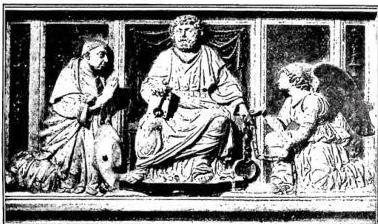
library and with his manuscripts. He was buried in Rome in S. Pietro in Vincoli, where he has a monument, the work of A. Bregno.
The most significant works of N. C. are: De docta ignorantia, in which he expounds his system of metaphysics, centered on the disproportion between the creative Infinite of God and human reason; De coniectoris, which develops the solution of the epistemological problem; Idiotae libri quattuor, in which the problem of knowing is again addressed insofar as it is translated into a directive for life; it also deals with the problem of the sciences, especially in the fourth book, entitled De staticis experimentis; De beryllo, in which the criterion of learned ignorance is compared to a lens (beryl), through which alone the reality of things may be affirmed, things which find their ground of being in the infinite; De ludo globi, in which the travail of thought in the conquest of truth is compared to the effort to reach, with a ball, the center of a device made up of nine circles arranged in a spiral.
(phot. Almari)
NICCOLÒ CUSANO - Cardinal N. C. kneeling before St. Peter. Work by Andrea Bregno (1456). Detail of the monument—Rome, Basilica of St. Peter in Vincoli.
…being. Yet such immobile repose, that is, the actual infinity of God, in which every difference is annulled and oppositions coincide (coincidentia oppositorum), is not granted to human beings to attain. “Learned ignorance” is precisely the knowledge of the limit of human thought. This ignorance is “learned” (the expression is already found in St. Augustine and St. Bonaventure), because its rationale is clearly seen in relation to the fact that man is other than God, and therefore other with respect to absolute Unity. This otherness, which does not posit itself, is, among all the explications of absolute Unity, the one most similar to God; and it is more similar because, although lacking the power of conferring being for the purposes of existence, which belongs to God alone, it is nevertheless capable, for the purposes of knowledge, of reconstructing the creative rhythm of contraction and explication, from unity to multiplicity, until it surpasses every distinction in the concept of infinity proper to the intellect. In this way distinctions still compatible with reason are surpassed, just as reason surpasses distinctions of a sensory order. This process of unification appears transparently in mathematical procedure: the regular polygon, which reason defines as different from the circumference, is intellectually identified with it if the number of its sides is assumed to be infinite. Thus, in the interests of knowledge, man’s epistemological process retraces, by an ascending route, that ontological rhythm which, by a descending route, is actualized from absolute Unity to the multiplicity of realities. God’s actual infinity is in fact contracted in the world, which contains it only potentially; and, in turn, the universe is contracted in every finite being, in every one of its parts, which is therefore implicitly the whole.
In accord with these metaphysical conceptions are the cosmological and scientific doctrines of N. C., who conceived scientific inquiry as the process of becoming aware of the rhythm of being-conferring as it is concretely actualized in reality. The potential infinity of the world and of things prevents us from stopping at a fixed limit or at a determined center of the cosmos. The world can have neither a center nor a periphery, because, in order to have these, it would have to stand in relation to something external by which it would be limited, and would no longer be the entire world. Thus the Ptolemaic conception of the spheres centered on the earth, as the center precisely of a finite cosmic system, gives way. Every point in the infinite is a center, and since everything moves, the earth too moves in infinite space. C. also applied himself to the solution of mathematical problems, such as that concerning the ratio between circumference and diameter, the surface of the cycloid, and the squaring of the circle. As a geographer, he was the first to draw a map of Europe; a friend of Paolo Del Pozzo Toscanelli, he took an interest in the spherical form of the earth. He presented his studies in mechanics in the work De statici experimentis, so highly esteemed by the scientists who came after him, including Descartes and Kepler.
There is no doubt about the purity of N. C.’s intentions, as is also demonstrated by the numerous speeches and homilies in which the steadfastness of his faith fully emerges. He was certainly opposed to Aristotle, tending rather toward a conception of a Neoplatonic character. Certain of his ideas, therefore, detached from the general orientation of the system, could easily lend themselves—as in fact happened (one need only think of Giordano Bruno, his great admirer)—to pantheistic interpretations. Bruno, indeed, betrayed the spirit of “learned ignorance,” insofar as it is an affirmation of transcendence, by identifying the infinity of God with cosmic infinity. The scientific views of N. C. influenced the development of science in Galileo, Descartes, and Kepler.