Machine translation of the 1948–1954 Italian original. The original text is authoritative.
BRESSANONE, DIOCESI of. - In Alto Adige, in the province of Bolzano. The city, at 560 m. above sea level, lies in a sunny basin where the Rienza joins the Isarco.
In the second half of the 6th century, we find among the Breuni—a Romanized people living in the Roman province of Raetia Secunda above Trent—a bishopric centered at Sabiona (near Chiusa on the Isarco) that was dependent on the metropolitan of Aquileia. It is difficult to say when Christianity was first introduced into the territory of Alto Adige and its tributaries and the Inn. The first bishop of whom we have record is a Materninus, followed by Ingenuinus, who is known for his role in the Three Chapters schism during its most acute phase at the end of the 6th century, and for the good memory he left in a land plagued by invasions. After 591, there is no further news of Sabiona and its bishops, but it is highly probable that the succession was not interrupted. In 769, in a document of Tassilo, Duke of Bavaria, and then in 770 at the Synod of Dingolfing, a bishop named Alim appears—probably of Celtic origin—who is connected with the Bavarian episcopate; at that time Sabiona was certainly not dependent on Aquileia. When, on 20 April 798, Pope Leo III established the metropolitan see of Salzburg, Sabiona became one of the suffragan sees dependent on II. Scant information survives for the 9th century. On 13 September 901, Louis, son of Emperor Arnulf, granted Bishop Zacharias possession of Pristina-[Prichsna]-Brixen, i.e., Bressanone. Around 975, Albuino appears as “bishop of the church of Sabiona and Bressanone,” who enjoyed the favor of Emperors Otto II and Henry II and, through donations, exchanges, and purchases, greatly expanded the importance of his church in the valleys of the Isarco, Rienza, and Inn, as well as in Carinthia, Bavaria, and Carniola, where on 10 April 1004 he received from Henry II possession of Veldes. Albuino died on 5 February 1006 after having built his cathedral at Bressanone with a chapter school. Among his immediate successors, the best known is Poppo, elected pope in 1048 under the name of Damasus II, who died on 18 August of that year. At Bressanone, in June 1080, a council of bishops was held at which a sentence of deposition was pronounced against Gregory VII (see below: CONCILIO di B.). In 1179, Frederick Barbarossa granted the bishops the dignity of princes of the empire, but their power was much limited by the ascendancy of the counts of
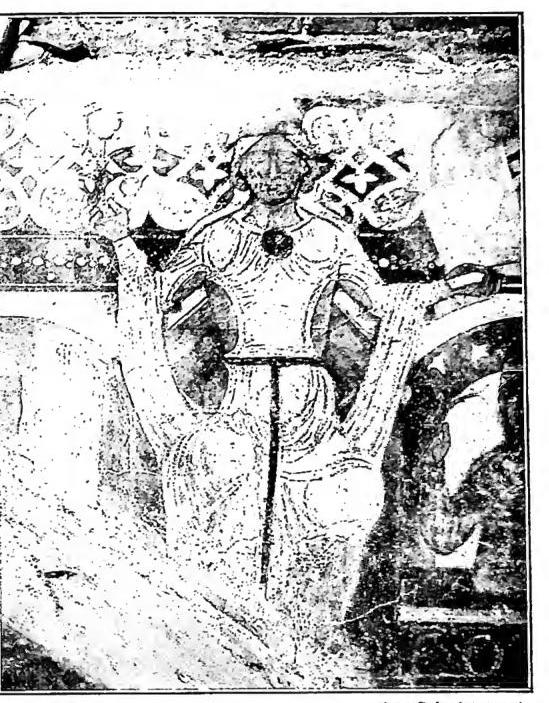
BRESSANONE — Fresco on the ceiling of the church of S. Maria (13th century).
Tyrol, and with these particularly the celebrated Cardinal NICHOLAS OF CUSA had to contend; he was bishop of B. from 23 March 1450 to 16 August 1464. Political events led in 1805 to the secularization of the principality; in 1818 the diocese was given a new circumscription, enlarged in the Tyrol with territories belonging to the dioceses of Constance, Chur, Augsburg and Salzburg, and as a consequence on 16 June 1819 the vicariate general of Feldkirch in the Vorarlberg was established. After the Great War, following the Treaty of St-Germain (1919), the vicar general of Feldkirch was constituted Apostolic Administrator for the entire part of the bishopric remaining in the Austrian Republic (9 April 1921), and then on 12 December 1925 the Apostolic Administration of Innsbruck was established under a titular bishop; while from 25 April the bishop of B. had already passed under the direct jurisdiction of the Holy See.
The entire diocese, according to the ancient frontiers, in 1925 numbered 488–532,000 souls with 508 pastoral districts; of these, 394,722 depended on Feldkirch-Innsbruck.
The diocese of B. now has an area of approximately 4,279 sq km and a population of about 100,000 inhabitants, almost all Catholic, with 137 parishes, 244 diocesan priests and 121 regular clergy (1948).
Numerous religious institutes arose through the centuries within the ancient boundaries of the diocese: particularly notable for its importance, at Innsbruck, is the Jesuit college “Canisianum,” which also maintains the theological faculty at the university of that city.
BIBL.: L. Santifaller, Das Brixner Domkapitel, Innsbruck 1924–25; id., Die Urkunden der Brixner Hochstifts-Archive ibid. 1929; D. Oschinsky, Die Urbare des Bischofs von Brixen im 13. und 14. Jahrhundert, Breslau 1938; K. Haid, Brixen, in LThK, II, cols. 564–67 and A. Sparber, s.V. in DHG, X, cols. 610–12 (with bibliography); id., Das Bistum Sabiona, Bressanone 1942. Pio Paschini
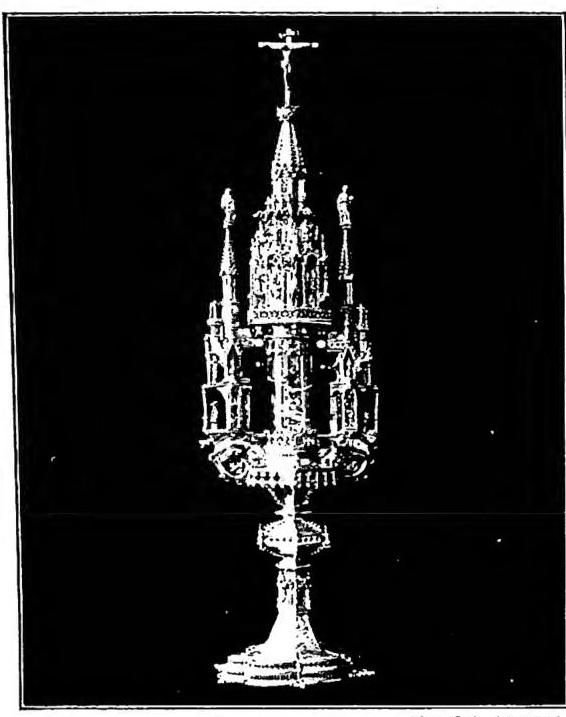
BRESSANONE – Gilded metal reliquary (15th century).
Cathedral Treasury.
ART. — Bressanone is one of the most important artistic centres in the Alto Adige. It preserves numerous medieval, Renaissance and Baroque buildings. The Cathedral (S. Michele) dates from the 13th century, but its interior was entirely renewed in the 18th century according to a design by Giuseppe Delaia, and its façade was completed in 1790 by G. Pirchstaller. The bell towers retain elements of the original construction. In the cloister, founded in the 13th century and later modified in the 14th, there are paintings from various periods between the 14th and 16th centuries depicting scenes from the Old and New Testaments. Adjoining it is the baptistery of S. Giovanni with frescoes from the 13th and 14th centuries. Byzantine-style frescoes from the 13th century are also found in the attic of the Collegiate Church. In the diocesan museum there is a most interesting collection of Alto Adige art and the cathedral treasury, with reliquaries and sacred vestments, among which the chasuble of Bishop Ermanno (1140–64), a Byzantine textile of the 12th century, is of particular value. Other noteworthy features include several ancient churches, such as that of SS. Ermanno and Gottardo, the Bishop-Prince’s palace, begun in the 13th century and remodelled several times, and the Renaissance Pfander house. Not far from Bressanone is the ancient Novacella convent, which contains a chapel (S. Michele) dating from the 11th century, a Gothic cloister and a rich library.
BIBL.: L. Weingartner, Die Kunstdenkmäler Südtirols, Vienna 1923; P. Toesca, Storia dell’Arte, Torino 1927, pp. 1030–1140. Emilio Lavagnino
CONCIL OF BRESSANONE — By order of Henry IV, King of Germany, a few German bishops and a few from Italy, including Cardinal Hugh Candidus and Henry, Patriarch of Aquileia, gathered at Bressanone on 25 June 1080 (the Conciliabulum of Bressanone) to deliberate on the excommunication and deposition of Pope Gregory VII, then reigning. This was done after examining the accusations brought against the pope by the king’s lay and clerical supporters: 1° that he had usurped the papal see through simony; 2° that he had subverted order and peace in the Church and the empire; 3° that he had called into question the Catholic faith regarding the Body and Blood of Christ, as Berengar of Tours, his former teacher, had done.
To replace Gregory VII on the papal throne, Guibert, Archbishop of Ravenna (v. CLEMENT III, antipope), was elected. Guibert had already been excommunicated and deposed by a Roman council in 1078 for his irreligious life and disobedience to the Holy See. This election was a retaliation for the sentence of excommunication and deposition pronounced by Gregory VII against Henry IV in the Roman council of 7 March of the same year, declaring him a rebel and enemy of the Roman Church.
The illegality of Clement III’s election is beyond doubt: it contravened the decree of Nicholas II (1059) because only one cardinal had taken part in the election, and neither the Roman clergy nor the people had been consulted. To bolster the twofold decision of the conciliabulum, Peter Crassus, a jurist from Ravenna loyal to the king, composed a pamphlet in which he opposed the canonists’ arguments with principles of Roman law—a new weapon that would be used with success in future conflicts.
BIBL.: MGH, Constitutiones, I, p. 120; Hefele-Leclercq, V, 1, pp. 269-72; P. Kehr, Zur Geschichte Wiberts von Ravenna (Clement III), in Sitzungsberichte der preuss. Akad. der Wissenschaften, Phil.-hist. Klasse, Berlin 1921, pp. 355-68, 973-88; A. Fliche, La réforme grégorienne, II, Louvain 1925, pp. 383-85; III, ibid. 1937, passim; E. Voosen, Papauté et pouvoir civil à l'époque de Grégoire VII, Gembloux 1927; O. Francabandera, Guiberto arcivescovo di Ravenna ossia Clemente III, in Atti e Mem. della R. Deputaz. di st. p. per le prov. di Romagna, 4ª serie, 25 (1935), pp. 39-70. Giovanni Soranzo
Cite this article
“BRESSANONE, DIOCESI DI.” Enciclopedia Cattolica, vol. III (1949), p. 67. Azione Romana digital edition, https://azioneromana.com/article/bressanone-diocesi-di.