
TRENT, ARCHDIOCESE of. - Provincial capital city and, since 1946, of the Trentino-Alto Adige region. The archdiocese comprises the province of Trent and more than half of the province of Bolzano. It covers an area of 9,856 km² with a population of 633,997 inhabitants, of whom 631,000 are Catholic, distributed across 439 parishes served by 1,129 diocesan priests (of whom 268 are German-speaking); approximately 575 regular priests; 2,280 nuns. Male religious houses number 86; female, 264. The archdiocese possesses a Theological Seminary in Trent and two Minor Seminaries (Trent and Tyrol: cf. Ann. Pont. 1953, p. 429).
A city of Gallic or Raetian foundation, permanently occupied by the Romans around 37 B.C. and included in the tenth Augustan region: Venetia et Histria. After the fall of the Western Empire, it passed under the dominion of Theodoric and the Byzantines. From 569, it was the seat of a Lombard duchy; under the Carolingians, the March of Trent was part of the Kingdom of Italy, but in 952 Otto I incorporated it into the Germanic Empire, of which it remained a part until 1803. During the Napoleonic period, it passed to Austria (1803-1805), then to Bavaria (until 1810), then to the Kingdom of Italy (until 1816), and finally, for over a century, back to Austria. Since 1918, it has been reunited with the Italian state.
Ecclesiastically, the diocese was until 1751 suffragan of Aquileia, then of Gorizia (a dependence never recognized by the bishop of Trent), from 1772 to 1825 immediately subject to the Holy See, from 1825 to 1920 suffragan of Salzburg, and from 1920 immediately subject to the Holy See, which in 1929 elevated it to an archiepiscopal see without suffragans.
Legend attributes the foundation of the episcopal see to the Aquileian saints Hermagoras and Fortunatus, disciples of St. Mark. In reality, no Christian records survive from the first three centuries. The episcopal see was established in the 4th century (the first known bishop, Jovinus, and the second in the list, Abundantius, living in 381). The third bishop was St. Vigilius (v. Vigilio), who died in 400 or 405, completed the evangelization of the territory, and sealed his missionary work with martyrdom. His relations with St. Ambrose (PL 16, 982) and St. Simplician (PL 13, 549-52) linked the Church of Trent with Milan, but in the early decades of the 5th century, the diocese found itself within the metropolitan organization of Aquileia (v. Aquileia). Along with Aquileia, the diocese of Trent was involved in the schism of the Three Chapters and returned to communion with Rome at the end of the 7th century. Among the bishops of the first millennium, Eugippius (6th century) is particularly noteworthy, to whom the expansion of the sepulchral church of St. Vigilius and the arrangement of his relics are attributed.
Emperor Conrad II, in 1027 (according to some, already Henry II in 1004), by donating the counties of Trent, Bolzano, and Val Venosta to the Church of Trent, created the temporal principality of the bishops of Trent, whose boundaries differed in various points from those of the diocese. In the 12th century, the beneficial influences of the reform of ecclesiastical life also made themselves felt in the territory of Trent: the Benedictine abbey of St. Lawrence in Trent and the monasteries of Augustinian Canons Regular of St. Michael all'Adige and Augia (near Bolzano) were founded. The principal promoter of this reform, Bishop Altmann (1124-49), was also the initiator of the present Cathedral, which he consecrated in 1145 in the presence of the patriarch of Aquileia, Pellegrino. In the struggle over investitures, the prince-bishops of Trent sided with the Emperor and subsequently generally with the Ghibellines. The most flourishing period for the principality was under Bishop Federico Vanga (1207-18), who consolidated civil power, promoted agriculture and the systematic exploitation of mines (the Mining Statute is famous), expanded and adorned the Cathedral, and reorganized the registration of documents (Codex Vangianus). The policy of Frederick II led to a kind of temporary secularization. Later, a long series of exhausting struggles began with the counts of Tyrol, who evolved from advocates into effective masters of the principality: the Compacts of 1363 and 1454 and the series of German bishops of the 14th and 15th centuries sealed this evolution. Humanism took root in Trentino under Prince-Bishop Giovanni Hinderbach (1466-86), who enjoyed the confidence of Aeneas Sylvius Piccolomini (later Pius II) and Nicholas of Cusa (v. Niccolò Cusano). The city owes its social reorganization and architectural renewal, which later made it a worthy seat for the Council, to Bishop and Cardinal Bernardo Clesio (v. Bernardo Clesio, 1514-39). After Bernardo Clesio, for over a century, members of the Madruzzo family (v. Madruzzo) governed the Church of Trent: Cardinals Cristoforo, Lodovico, Carlo Gaudenzio, and Bishop Carlo Emanuele (d. 1658). In particular, Lodovico and Carlo Gaudenzio were active in applying the decrees of Trent in the diocese and in establishing the seminary. Franciscans, Somaschi, Carmelites, and Jesuits took up residence or built new convents in the diocese during this period. The last prince-bishop was Pietro Vigilio de Thun (d. 1800). During the vacancy following his death, the ecclesiastical principality was definitively secularized in favor of the House of Austria.
The boundaries of the diocese were expanded in 1785 and 1818 with the addition of Valsugana and Primiero (previously belonging to Feltre), Merano and Val Venosta (previously under Chur), the deaneries of Fassa, Chiusa, and Castelrotto (previously under Brixen), and other minor territories. The episcopal mensa and Cathedral Chapter were newly endowed in 1818 by the Emperor of Austria, who in turn received the right to nominate new bishops. The Emperor of Austria recognized the title of prince for the bishops of Trent, which was later reconfirmed by the Italian government in 1926. The bishops of the 19th century, F. X. Luschin von Ebengreut (1823-34), the servant of God Giovanni Nepomuceno de Tschiderer ([v.] 1834-60), and Benedetto de Riccabona (1861-79), had to struggle tenaciously against Josephinism and the systems it introduced: their action helped prepare and then implement the agreements formalized between the Holy See and Austria in the Concordat of 1855. Under Bishops Eugenio Carlo Valussi (1886-1903) and Celestino Endrici (1904-40), there was a notable revival of Catholic social activity, while the national question presented new and difficult tasks for pastoral care.
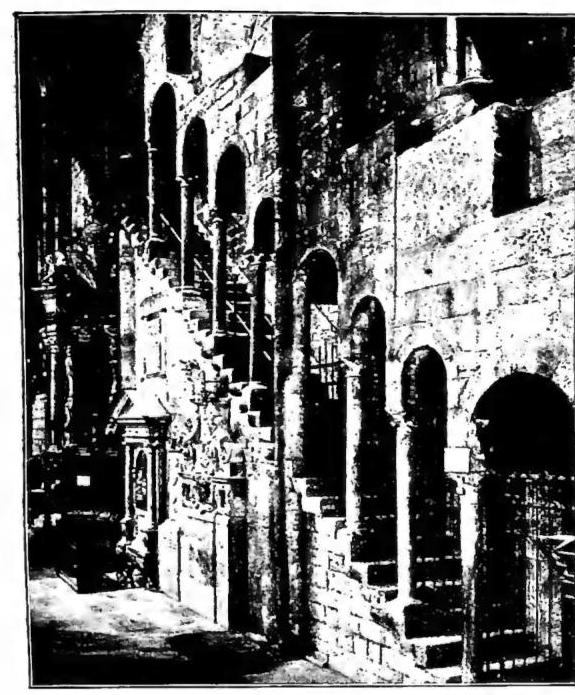
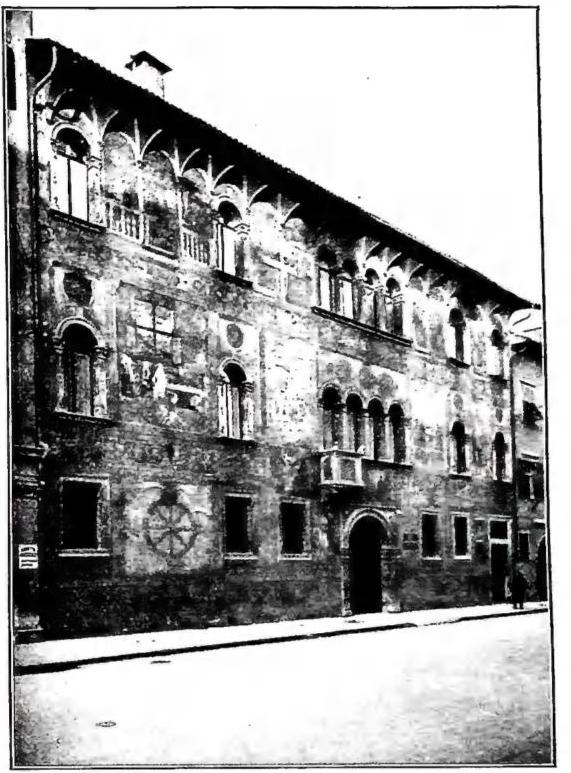
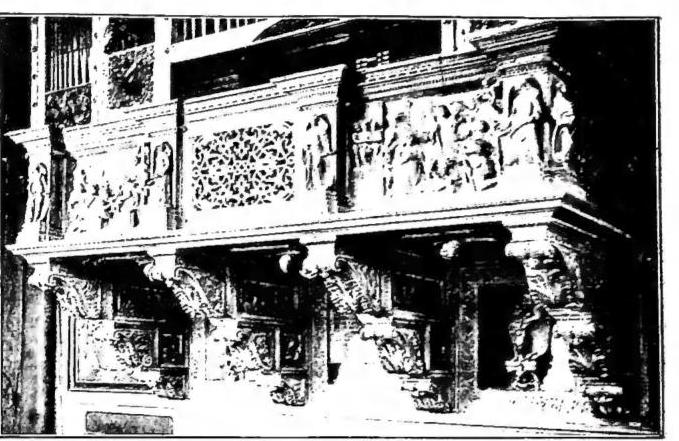
Principal Monuments. - The Romanesque Cathedral, which stands on the tomb of the patron St. Vigilius, is the work of Comacine masters. Externally, it is characterized by the development of Romanesque galleries, the large rose windows of the transept and façade, and the refinement of the apses adjacent to the nearby castle. Inside, the two long stair ramps carved into the wall, the frescoes of the transept (14th century), and the tombstones of the prince-bishops are particularly noteworthy. Here, the Council of Trent held its solemn sessions. Santa Maria is the ancient parish church of the city. The current Renaissance building is the work of Antonio Medaglia (1520). In 1562-63, it served as the hall for the general congregations of the Council. The Romanesque church of St. Lawrence is all that remains of the ancient Benedictine abbey, later transformed into a Dominican convent, a hospice for celebrated theologians during the Council. The church of St. Francis Xavier is the work of the Trentino Jesuit Andrea Pozzo. The Buonconsiglio Castle was, from the 13th to the 19th century, the residence of the prince-bishops. Expanded in various eras, its most splendid part is owed to Cardinal Bernardo Clesio, who called renowned artists to decorate II. Finally, in the city, the convents and palaces that hosted distinguished figures of the Council should be remembered: the convents of St. Mark, St. Francis, the Holy Trinity, and the palaces of Thun, Geremia, Alberti Colico, Migazzi, Roccabruna, Salvadori, etc.
BIBL.:
E. Cessi, Storia della città di Trento, Trento 1933; L. Santifaller, Das Brixner Domkapitel in seiner persönlichen Zusammensetzung im Mittelalter, Vienna 1924; G. B. Rossignoli, Il principato vescovile di Trento, Trento 1930; A. Segarizzi, I vescovi di Trento, Trento 1907; A. von Brandis, Geschichte der Landeshauptleute von Tirol, Innsbruck 1850; A. Sparber, Die Bischöfe von Brixen, Brixen 1936; Concilium Tridentinum. Diariorum, actorum, epistularum, tractatuum nova collectio, ed. Görres-Gesellschaft, Freiburg i. Br. 1901 ss.; Monumenta conciliorum generalium seculi decimi quinti, ed. Görres-Gesellschaft, Vienna 1857-96; Acta et decreta sacrosancti oecumenici Concilii Tridentini, ed. Görres-Gesellschaft, Freiburg i. Br. 1870-74; Annales Ecclesiastici, ed. O. Raynaldus, Lucca 1752-56; Italia Sacra, ed. F. Ughelli, Venice 1717-22; Rerum Italicarum Scriptores, ed. L. A. Muratori, Milan 1723-51; Codex Wangianus, ed. F. Huter, Innsbruck 1952; Fonti per la storia della regione tridentina, ed. Istituto Storico Italiano per il Medio Evo, Rome 1951 ss.; Tridentum, rivista, Trento 1898 ss.
A. M. ZIEGLER
Igino Rogger
IL CONCILIO di T. - Il Concilio di T., XIX ecumenico, ebbe luogo, con varie interruzioni, dal 1545 al 1563, e fu celebrato per ribattere gli errori contro la fede propalati dei «riformatori» protestanti e per promuovere una riforma della disciplina ecclesiastica.
1. Antecedenti
Quantunque Leone X con la bolla Exsurge Domine del 15 giugno 1520 avesse già condannato 41 errori di Martin Lutero, tuttavia il movimento di defezione da lui creato non era affatto cessato. Già dopo l'interrogatorio subito in Augusta presso il card. Tommaso De Vio, Lutero il 28 nov. 1518 aveva appellato dal Papa al Concilio universale e aveva poi rinnovato l'appello il 17 nov. 1520, in seguito alla pubblicazione della bolla Exsurge. Questi due appelli, però, non erano altro che mosse procedurali e, conforme alla bolla Execrabilis di Pio II in data 18 genn. 1460, erano invalidi e privi di efficacia giuridica.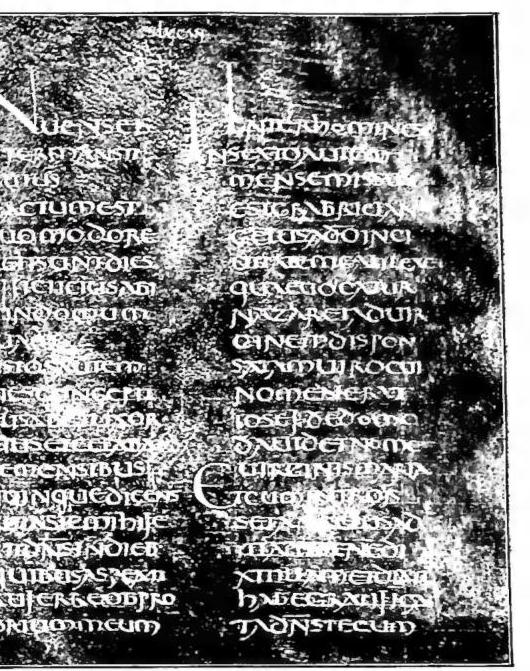
(fot. Soprintendenza ai Monumenti e Gallerie, Trento)
TRENTO, ARCTIODICES di - Pagina dell'Evangelario purpureo (secc. IV-V) contenente la vecchia versione latina, «testo africano» (cod. e palatinus). Vangelo di S. Luca 1, 22-30 - Trento, Castello del Buon Consiglio.
preoccupazioni a Roma, perché i luterani sotto la parola «libero» intendevano «libero dal Papa» e miravano specialmente a sciogliere i vescovi dal loro giuramento di fedeltà al Pontefice, il quale sarebbe stato, così, costretto a comparire in certo modo come parte in causa davanti al giudizio del concilio; e sotto il termine «cristiano» si nascondeva la richiesta che i laici, e in modo particolare i principi, fossero ammessi al concilio accanto ai prelati e con pari autorità. La richiesta, poi, mantenuta ostinatamente anche in seguito, che cioè il concilio dovesse radunarsi in una città tedesca - si faceva il nome, tra le altre, di Colonia, Magonza, Strasburgo, Costanza, Ratisbona - esponeva il concilio al pericolo di soggiacere alla pressione dell'opinione pubblica, apertamente favorevole a Lutero.
Una svolta verso il meglio si ebbe soltanto allorché il successore di Clemente VII, Paolo III (1534-49), diede il primo posto nel suo programma di governo al concilio e alla riforma. D'accordo con l'Imperatore, che nel suo ritorno dall'Africa gli aveva fatto visita a Roma, il Papa,
(fot. R. Renzi)
TRENTO, ARCIDIORESI di - Scalinata laterale dell'interno del Duomo, che porta al campanile (inizio del sec. XIII) - Trento.
con la bolla Ad Dominici gregis curam del 2 maggio 1536, indisse per il 23 maggio 1537 un Concilio generale a Mantova per la distruzione degli errori e delle eresie, per la riforma dei costumi e per il ristabilimento della pace fra i principi cristiani. Ma i protestanti tedeschi, uniti nella Lega smalcaldica, opposero il 24 febbr. 1537 un brusco rifiuto all'invito di partecipare al Concilio. Più sfavorevolmente ancora operò il fatto della nuova guerra scoppiata tra Carlo V e Francesco I, e questi si rifiutò di permettere ai prelati francesi il viaggio a Mantova. Quando poi lo stesso duca di Mantova, Ferdinando Gonzaga, richiese al Papa la formazione di un corpo di guardia di cinque o seimila uomini per la sicurezza del Concilio, questo venne prorogato una prima volta al 1° nov. 1537, poi al 1° maggio 1538, con sede, però, a Vicenza. Ma quando i cardinali legati, nominati il 20 marzo 1538, Lorenzo Campeggio, Giacomo Simonetta e Girolamo Aleandro, comparvero nella città il 12 maggio 1538, non vi trovarono che pochi prelati. Allora, in vista dell'imminente Congresso di pace a Nizza, l'apertura del Concilio fu di nuovo prorogata al 6 apr. 1539; finché la suspensio ad beneplacitum, promulgata dal Papa il 21 maggio 1539, non seppellì per sempre il progetto del Concilio mantovano.
Le trattative per l'unione, che l'Imperatore allora avviò direttamente con i protestanti tedeschi, rimasero senza effetto, nonostante la partecipazione del card. Contarini alla Dieta di Ratisbona del 1541. Tosto il Papa riprese il piano del Concilio e con la bolla Initio nostri huius pontificatus del 22 maggio 1542 intimò il Concilio per il giorno di Ognissanti dello stesso anno, da tenersi nella città di T., per la quale il nunzio Morone aveva ottenuto il consenso degli Stati tedeschi. Ma anche questa seconda indizione del Concilio non riuscì, perché il Re di Francia, poche settimane dopo, il 10 luglio 1542, dichiarò guerra all'Imperatore. Nonostante la presenza, a T., dei tre cardinali legati, Parisio, Morone e Pole, non arrivarono in quella città, nello spazio di sei mesi, che dieci vescovi. Perciò il 29 sett. 1543 il Concilio dovette di nuovo essere sospeso.
Solo il 18 sett. 1544, con la pace conchiusa a Crépy tra Carlo V e Francesco I, fu finalmente libera la via per una terza indizione del Concilio. In un articolo segreto del Trattato di pace, l'Imperatore obbligava il Re a cessare l'opposizione, mantenuta fino allora, verso il Concilio e a darvi la sua adesione. Ora il Papa con la bolla Laetare Jerusalem del 22 nov. 1544 indiceva il Concilio universale per il 15 marzo 1545, da tenersi nuovamente a T.
2. First Period (1545-47). - On 22 February 1545, the Pope appointed his legates to the Council: Cardinals Giovanni del Monte, Marcello Cervini, and Reginaldo Pole. Although the first two made their entry into T. on 13 March, it was still not possible to set the opening date, for, aside from the Bishop of T., Cardinal Cristoforo Madruzzo, only two external prelates were present: Bishop Sanfelice of La Cava, appointed commissioner of the Council, and Bishop Tommaso Campeggio of Feltre. Despite these unpromising beginnings, the Council did take place this time, because in the summer of 1545 an agreement had been concluded between the Pope and the Emperor that silenced, at least temporarily, the misunderstandings and mistrust that had long persisted between the two heads of Christendom. The Emperor, in fact, had decided to break the insufferable power of the Schmalkaldic League by force of arms, and the Pope promised financial subsidies and military aid for the war. Once victory was achieved, the Emperor intended to compel the Protestants to participate in the Council, hoping in this way to restore the unity of the Church.
The Emperor’s inadequate military preparation delayed the execution of this grand design until the spring of 1546. Nevertheless, the Pope had the Council opened on the third Sunday of Advent, 13 December 1545, to prevent the prelates who had arrived in T. during the summer and autumn from leaving the city again. At the opening session in the choir of the cathedral of T., in addition to the three legates and Cardinal Madruzzo, there were present 4 archbishops, 21 bishops, 5 generals of religious Orders, 42 theologians, and 8 jurists. The inaugural sermon was delivered by the Minorite Cornelio Musso, Bishop of Bitonto. The first weeks were devoted to preparing a work programme and determining the procedural rules of the Council. The right to vote, in addition to bishops, was granted only to the generals of Orders and the representatives of an entire monastic congregation, e.g., the Benedictine Congregation of Monte Cassino, but not to individual abbots or the procurators of absent bishops. Since the Pope wished the controversial doctrines to be addressed first, while the Emperor desired that reforms begin immediately, a compromise was reached on 22 January 1546, at the proposal of the Bishop of Feltre, to treat dogma and reform simultaneously. The discussion of dogmatic matters generally proceeded in this order: the "theologi minores" were presented by the legates—who throughout the Council reserved for themselves the exclusive right of proposition—with a list of Protestant errors concerning a specific topic of Catholic doctrine; these errors were debated by the theologians in the so-called "Congregations of Theologians," which prelates with voting rights could attend, though not obligatorily; the articles to be condemned were then presented to the prelates with voting rights in the "General Congregations" and discussed until the decree received majority approval. The initial subdivision of the General Congregation into three classes, each under the direction of a legate, was abandoned after the V session. The solemn sessions served solely for the publication of the decrees thus prepared. As for the decrees concerning reform, the first instance—that is, discussion in the Congregations of Theologians—did not take place. Angelo Massarelli served as secretary of the Council during all three periods of the sessions.
After publishing in the II session (7 January 1546) the decree De modo vivendi et aliis in Concilio servandis, and in the III (4 February 1546) establishing the Niceno-Constantinopolitan Creed as the common foundation for all Christians, the Council, in the IV session (8 April 1546), laid the groundwork for all future discussions. Not only, as Luther wished, was Holy Scripture to serve as the source of Revelation, but Apostolic Traditions were also to be accepted "pari pietatis affectu" as the books contained in the canon of Holy Scripture (including the deuterocanonical books). Furthermore, to counter the abuse of rejecting dogmatic proofs drawn from the common Latin version—that is, the Vulgate—under the pretext that it was defective in some points, the Vulgate was declared authentic in the same session; by this, the Council did not intend to disapprove of the study of the original biblical languages, Hebrew and Greek.
To elevate the theological formation of the clergy, the Council, in the V session (17 June 1546), decided to establish lecturers in Holy Scripture in cathedral and collegiate churches, as well as in suitable convents and monasteries. After a lively dispute between the Ordinaries and the Mendicant Orders, the granting of preaching faculties was precisely defined, and parish priests were obliged to preach to the people every Sunday and feast day. The decree on original sin defined, against Luther’s doctrine—which held its essence to be concupiscence, remaining as sin in man even after Baptism—that through Baptism original guilt is remitted and all that has the true and proper nature of sin ("totum id quod veram et propriam peccati rationem habet").
Luther acknowledged only two, or respectively three, of the Church's seven Sacraments (Baptism, Eucharist, and, with certain limitations, Penance); but even more, he emptied and distorted the very concept of Sacrament. Therefore, in its VII session (3 March 1547), the Council addressed the definition of the essence and the septenary number of the Sacraments, and to the 13 canons on the Sacraments in general, it added 14 on Baptism and 3 on Confirmation. At the same time, it promulgated a reform decree prohibiting the accumulation of multiple bishoprics or benefices with cura animarum on a single person.
3. The Transfer of the Council to Bologna (1547-1548) and the Return to Trent (1551-1552)
Immediately after the VII session, the Council's work was abruptly interrupted—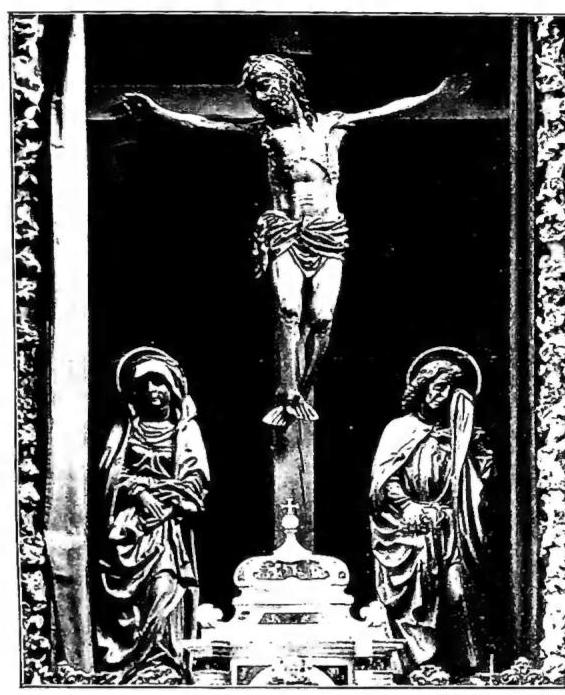
(fot. R. Renzi)
His successor, Julius III, who had previously presided over the Council, already on 14 November 1550, with the bull Cum ad tollenda, ordered the return of the Council to Trent and set its reopening for 1 May 1551 (XI session) under the presidency of Cardinal Marcello Crescenzi, appointed legatus a latere and first president, assisted by the Archbishop of Siponto, Sebastiano Pighino, and the Bishop of Verona, Luigi Lipomano, as co-presidents. A portion of the bishops who had remained in Trent in 1547 were still present. Nevertheless, the actual work did not begin until after the XII session (1 September 1551), when a greater number of prelates arrived, and discussions resumed at the exact point where they had been interrupted in March 1547, that is, on the Sacrament of the Eucharist. Thanks to the preparatory work already done in Bologna, it was possible, in a relatively short time, to define in the XIII session (11 October 1551), against the spiritualism or symbolism of the Swiss reformers Zwingli and Oecolampadius, the doctrine of the real presence of Jesus Christ in the Eucharist, and—against Luther's doctrine of impanation and ubiquity—the doctrine of Transubstantiation.
The following XIV session (25 November 1551) defended the Catholic doctrine on auricular confession, the judicial character of the priest's absolution in the Sacrament of Penance, the necessity of satisfaction, and furthermore, the sacramental nature of Extreme Unction. The parallel reform decrees regulated the order of appeals in ecclesiastical tribunals, the intervention of the Curia's authority against punishable bishops, the rights and duties of bishops in admitting candidates to Ordination, in overseeing the clergy, and in conferring benefices subject to the right of patronage.
(fot. R. Renni)
TRENTO, ARCIDIOCESI di - Crocifisso del Concilio (15th century). Trento, Cathedral.
At the preparation of these decrees, for the first time, numerous bishops and theologians from Germany and the Low Countries took part. The archbishops of Mainz, Cologne, and Trier, who were also prince-electors of the Empire, were present; at the XV session (25 January 1552), 14 bishops from German-speaking territories participated, 10 residential and 4 suffragan. The University of Louvain was represented by the dean of the Faculty of Theology, Ruard Tapper, and other theologians; among the retinue of the Rhenish electors were Giovanni Gropper, Everardo Billick, and Ambrogio Pelargo; among the Spanish theologians, Melchior Cano stood out. France was absent; and already the envoy of Henry II, Amyot, had formally protested against the Council in the XII session. For the first and last time, envoys and theologians of the German Protestants appeared at Trent; first those of the elector Joachim II of Brandenburg, who had previously declared his acceptance of the Council's decrees, and also the envoys of Duke Christoph of Württemberg and the elector Maurice of Saxony, and, as envoy of the city of Strasbourg, Johann Sleidan, historian of the Schmalkaldic League. However, since all of them not only demanded a broader safe-conduct than that granted in the XIII session and an extension of the dogmatic discussions until the arrival of their theologians—Philip Melanchthon was also on his way to Trent—but also insisted that all the dogmatic decrees published up to that point be re-examined and that the superiority of the Council over the Pope be proclaimed, all negotiations with them failed. To this already extremely tense situation in Trent, an unexpected politico-religious event brought a rapid end: the elector Maurice of Saxony, allied with France, turned against the unarmed Emperor, who was then in Innsbruck, and also endangered the security of the Council. Therefore, in the XVI session of 28 April 1552, the suspension was decided, and despite the protests of many Spanish bishops, the Council dissolved.
During the years 1552-54, Julius III considered enforcing a portion of the Tridentine reform decrees through a major reform bull, in order to counter certain aspirations that had arisen in Spain and Portugal, which sought, on their own authority, to implement the conciliar reform decrees, which, lacking papal confirmation, had no juridical value. But the death of the Pope on 23 March 1555 prevented the plan from being carried out and the reform bull from being published. His successor, Marcellus II (card. Cervini, former legate to the Council), lived too briefly to consider reconvening the Council. Nor could Paul IV, who succeeded him and intended to implement ecclesiastical reform through a Commission gathered in Rome and later expanded into a Council, succeed in putting his plan into practice. Meanwhile, the German Protestants obtained formal recognition from the Empire through the Peace of Augsburg.
4. Third Period (1561-63)
Only Pius IV, with the bull Ad Ecclesiae regimen of 29 November 1560, was able to convene the Council at Trent for the third time. However, while the first two periods had been closely tied to Germany and under the influence, at times very strong, of the Emperor, the impetus for this third resumption now came from France. There, Calvinism had already taken hold under the reign of King Henry II, and after his death, under his successors Francis II and Charles IX, it had made such great progress, thanks to the indecisive policy of the queen mother Catherine de' Medici, that the danger of defection by France was no longer so distant. Now, a universal Council would counter the plan for a national Council, especially dangerous in a Gallican France, and would strengthen the position of the Catholic party, whose leadership was in the hands of the brothers Francis and Charles of Guise. In Germany, the invitation to the Council was delivered by the nuncios Delfino and Commendone; but neither the Catholic princes nor the bishops could bring themselves to depart for the Council, due to the threatening attitude of the Protestants, who, for their part, at the Assembly held in Naumburg from 20 January to 6 February 1561, once again sharply rejected every invitation.On 14 February 1561, the Pope appointed as legates the cardinals Ercole Gonzaga and Giacomo Puteo, the latter of whom, due to illness, never assumed office, and added others on 4 March, chosen from among the new cardinals: Girolamo Seripando, Stanislao Hosio, Ludovico Simonetta, and finally also his nephew Marco Sittich of Hohenems. Although Seripando and Gonzaga had already been in Trent since 16 April 1561, the fluctuating situation in France (Assembly of the Clergy at Poissy, August-September 1561), the contrast between the Spanish idea that the Council should be considered a continuation of the previous sessions, and the Emperor's and France's view that, out of regard for the Protestants, it should appear as an entirely new Council, delayed its opening throughout that year. Only the arrival of Cardinal Simonetta, the Pope's confidant, on 9 December 1561, gave the signal for the true opening, which took place on 18 January 1562 with the relatively numerous participation of 111 prelates with voting rights (XVII session).
Since the envoys of Emperor Ferdinand I opposed the resumption of discussions on the sacrifice of the Mass, interrupted in 1552, because this would have highlighted the Council's continuity, which they did not want, the Council devoted itself primarily to the reform of the Index librorum prohibitorum (XVIII session of 26 February 1562) and to the granting of a safe-conduct to the Protestants, which had not yet been implemented. On 11 March, the legates finally presented to the Council 12 articles of reform, at the head of which—despite the delayed decree of the VII session—stood the enforcement of the bishops' duty of residence. A minority, composed of Spanish bishops and imperial and Italian ones, considered the only effective means to compel residence to be a Council decision by which bishops would be obliged to reside in their dioceses by divine right (de iure divino). The majority rejected this solution, as in their view it diminished the Pope's primatial right; a part referred the decision to the Pope on 20 April 1562. While the minority's opinion found favor with Cardinals Seripando and Gonzaga, the majority found support in Cardinal Simonetta and in Rome. On 11 May, the Pope censured the conduct of the first two legates and ordered that the question of the residence obligation be postponed. The consequence was a serious crisis of confidence both on the part of the legates and among the "ultramontanes." After two fruitless sessions (the XIX of 14 May and the XX of 5 June 1562), the Council resumed its activities on 6 June, when Cardinal Gonzaga, who had already offered his resignation to Rome, promised to discuss residence in conjunction with the topic of Holy Orders.
In the XXI session of 16 July 1562, the decree on the use of the Eucharist could be issued, which, against the Protestant doctrine of the necessity of Communion under both Species, defined the doctrine that Jesus Christ is whole and indivisible under each Species. However, the decision regarding the practical question of whether to accede to the request made by the Emperor and the Duke of Bavaria to grant, with certain precautions, their subjects the Communion of the chalice (Communio sub utroque specie) was referred to the Pope in the following session. This XXII session of 17 September 1562, after a lively discussion on the sacrificial character of the Last Supper, constituted with the decree on justification the most important doctrinal decision of the entire Council. In a decree comprising 9 doctrinal chapters and 9 canons,
The Council of Trent provided the Church with a twofold response to the "reform" of Luther, Calvin, and Zwingli: 1) through its dogmatic decrees, it authoritatively established what constitutes Catholic doctrine; negatively, in the canons that condemn the errors of the innovators; positively, in the doctrinal chapters that precede the canons in many decrees. Thus, the teaching of doctrine in preaching and catechesis, but especially in the scientific field of theological controversies, acquired a secure doctrinal foundation; the extensive works of Bellarmine and his successors are premised on the dogmatic decrees of Trent. 2) Through its reform decrees, the Church countered the Protestant "reform," based on false foundations, with a Catholic reform that, building on the reform efforts already undertaken in the late Middle Ages, was to gradually penetrate ever broader spheres of ecclesiastical life and ultimately restore to the Church the strength to reconquer, in the "Counter-Reformation," vast territories it had lost. This success, however, was made possible only because the Papacy energetically took the implementation of the Council into its own hands and prevented its decrees from remaining a dead letter.
---
(photo: Museo del Duomo)
(photo: Enc. Catt.)
the procedure for the appointment of bishops (informative process); chapter 2 prescribes the regular convocation of provincial and diocesan synods; chapters 3, 9, and 10, the visitation of dioceses. The dogmatic decree of the same session defines the sacramentality of Matrimony; and the celebrated decree Tametsi, appended to it, made the validity of marriages dependent on their being celebrated in the presence of the proper parish priest and two witnesses; while it declared invalid the clandestine marriages, which until then had only been prohibited.
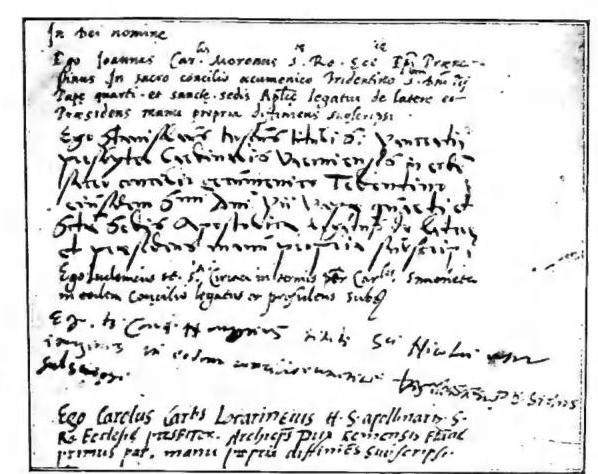
Although the Spanish ambassador, Count Luna, sought to prolong the Council, it was decided to hold the concluding session in mid-December. And so, on the 1st of the month, news arrived in Trent that the Pope was gravely ill. The final session (sess. XXV) was therefore brought forward to 3 December. It issued the doctrinal decrees on Purgatory and Indulgences, on the cult of the saints, their relics, and images. A vast reform of the religious Orders provided new foundations for the law of religious, regulating in a new manner the admission of new candidates, the formation of novices, studies, and enclosure. A further reform decree contained, among other things, a chapter on cardinals. Instead, the "reform of princes" desired by some bishops, that is, a stance against the encroachments of the secular arm, was set aside. At the end of the session, which had lasted two days and in which all the decrees of the Council were read once more, Cardinal di Lorena acclaimed the Pope, the Emperor, and all the promoters of the Council. The secretary, Angelo Massarelli, who had held that office throughout its duration, ensured that the decrees were subscribed by all present. Thus, we have the signatures of 199 archbishops and bishops, 7 abbots, 7 generals of Orders, and 19 procurators of absent bishops.
The implementation of the Council began with the confirmation of all its decrees without exception and without modifications (as certain circles within the Roman Curia would have desired) by Pius IV on 26 January 1564, first orally and then with the bull Benedictus Deus, dated the same day but published only on 30 June 1564. Since the bull prohibited any publication of commentaries on the decrees and reserved their authentic interpretation to the Holy See, the Pope consequently, on 2 August 1564, established a commission of cardinals to respond to any questions and oversee the observance of the decrees, from which the S. Congregatio Concilii later developed, and which still exists today. On 13 November 1564, a brief summary of the conciliar doctrine was published: the Confessio Fidei Tridentina, and its profession was imposed on all bishops, members of cathedral chapters, professors, and university doctors. Earlier, on 24 March 1564, the Pope had put into effect the Index librorum prohibitorum, prepared at Trent, which, in addition to the alphabetical list of prohibited books, also contained ten general rules. The Catechismus Romanus, also already prepared by the Council and conceived primarily as a theological manual for parish priests, appeared under Pius V in 1566; the Breviarium, revised at the Council’s behest, in 1568; the reformed Missale Romanum in 1570; the revision of the Vulgate, desired by the Council, was published under Sixtus V (1590) and subsequently under Clement VIII (1592).
But even more important was the fact that the popes, beginning with Paul IV and especially Pius V and Gregory XIII with their successors, energetically committed themselves to ensuring that the decrees were officially published in individual nations and dioceses and were observed. The official edition of the Tridentine decrees, edited by Paolo Manuzio, was officially communicated to bishops worldwide; in Germany, it was brought by St. Peter Canisius. The popes’ primary concern was the establishment of seminaries for the clergy, the implementation of pastoral visitations—alongside which apostolic visitations took place in various regions of Italy—and finally, the convocation of provincial and diocesan synods, in which ecclesiastical discipline was regulated according to Tridentine reforms. In this regard, St. Charles Borromeo stands as a magnificent example with his activity in the ecclesiastical province and diocese of Milan; as early as 1565, the Venetian ambassador Giacomo Soranzo wrote that he had achieved "more profit in the Roman Curia than all the decrees of the Council together." The great religious orders adapted their constitutions to the Council’s decrees; as early as 1564, the Dominicans, the Hermits of St. Augustine, and the Carmelites did so in their respective general chapters in Bologna, Milan, and Rome; and in 1570, the Cistercians followed. Given the close union of State and Church, it was of the greatest importance for the implementation of the Council that States also accept its decrees on their part. The Italian princes and the King of Poland accepted them unconditionally; King Philip II of Spain and the governor of the Netherlands, Margaret of Parma, only after lengthy deliberations and with the clause: "saving royal rights"; the Catholic Swiss Cantons also imposed restrictions. Meanwhile, Emperor Maximilian II and the French Crown refused to accept them as legally binding. Only after decades of struggles with parliaments imbued with Gallican ideas did the French bishops generally accept the Tridentine decrees at the Assembly of the Clergy in 1615; in these struggles, the first traces of a historical penetration of the Council emerge. In Germany, no such common act by the bishops took place; but the example of zealous bishops, such as Julius Echter of Würzburg, Daniel Brendel of Mainz, and others, together with the activity of papal nuncios like Ninguarda, Porcia, and Gaspare Gropper, ensured that the Tridentine spirit also penetrated there.
The implementation of the Council of Trent was neither rapid nor uncontested, nor complete. The entire 18th century was still filled with struggles over the validity of the Tridentine decrees and the assimilation of particular law to the ius commune created by the Council, which modified medieval canon law in no fewer than 250 places. Particularly in Spain and Germany, cathedral chapters opposed the suppression of exemptions and the restriction of archdeacons’ rights. Many dioceses did not have seminaries for the clergy until the 17th century, and some only in the 18th. From the prohibitions against uniting multiple bishoprics in one person, many dispensations were granted in Germany in favor of princes of the Habsburg and Wittelsbach houses to engage these dynasties in the defense of threatened territories. Nevertheless, it remains firmly established that the Council of Trent is the greatest reforming Council in the history of the Church and that the Papacy, through its convocation and implementation, extraordinarily increased its influence over the peoples. The Council could not prevent the later emergence of great controversies over the efficacy of Grace (the so-called Molinist question) or attritionism. The doctrine on the Church and the primacy of the pope, which were not defined at the Council, were later thoroughly discussed until the Vatican Council put an end to Gallican, Febronian, and episcopalist doctrines. All Protestant efforts to revise the doctrinal decisions in favor of Union in a new Council necessarily failed in the face of the infallible character of the decisions of faith. How great, then, was the influence on the formation of ecclesiastical piety and Christian art is a subject that still awaits further research. - Vedi tavv. XLVII-XLIX.
FONTI: l'ed. uff. dei decr., curata da Paolo Manuzio, Roma 1564; la migliore rist. con una scelta delle dichiarazioni della S. Congr. del Conc., per E. L. Richter-F. Schulte, Lipsia 1853. J. Le Plat, Monum ad histor. Conc. Trid. patiss. illustr. spectantia, 7 voll., Lovanio 1781-87; A. Theiner, Acta genuina SS. Conc. Trid., 2 voll., Zagabria 1872, prima, ma imperfetta ed. dei processi verb.; Concilium Tridentinum. Diariorum, actorum, epist., tractatum nova coll., ed. Soc. Goertes., finora 12 voll., Friburgo in Br. 1901-50, in 4 divisioni: 1. Diarii, ed. da S. Merkle, vol. I (1901); cf. H. Lenner, in Gregorianum, 15 [1934], p. 573 sgg.; vol. II (1911); vol. III, 1 (1931). 2. Atti; vol. IV (1904), ed. da St. Ehse; preistor. e processi verb. fino al 4 febbr. 1546; V (1911), ed. St. Ehse proc. verb. fino alla trasla.; vol. VI, ed. Th. Freudenberger; processi verb. del periodo bolognese; vol. VIII (1919), ed. St. Ehse; 1561-17 sett. 1562; vol. IX (1924) ed. St. Ehse; fino alla confirmaz. 3. Lettere, ed. G. Buschbell, vol. X (1916), 1545-47; XI (1937) 1547-52. 4. Trattati, vol. XII (1930), ed. V. Schweitzer; 1521-47; vol. XIII, parte 1° (1937), ed. H. Jedin; 1547-62. - La corrisp. dei legati durante l'ult. periodo 1561-63 è edita da J. Susta, Die Röm. Curie und das Trient. Conz. unter Pius IV., 4 voll., Vienna 1904-14; lett. importanti del card. Gonzaga al suo nipote a Roma e viceversa sono pubbl. da G. Drei in Arch. Soc. rom. di st. patria, 40 (1917), pp. 205-45; 41 (1918), pp. 171-222; Arch. st. parmense, 17 (1917), pp. 185-242; 18 (1918), pp. 29-143; H. Jedin, Krisis und Wendepunkt des Trient. Konz., 1562-63; Die wenstdecht. Geheimberichte der Bisch. Gualterio V. VITERBO, DIOCESI DI. Karl Bermanens, Würzburg 1941; C. M. Abad, Das Memor. del b. Juan de Avila, inéd. para el Conc. de T., Comillas 1945; id., Ultimos inéd. extensos del b. J. de Avila, ivi 1950. Delle pubblicaz. più antiche di fonti sono ancora da consulare: J. Pogiani, Epist. et orat., ed. H. Lagomarsini, 4 voll., Roma 1756-62; [L. Morandi], Monum. di varia letter, tratti dai manoscr. di L. Beccadelli, 3 parti, Bologna 1797-1801; H. Grisar, J. Layne disputat. Trident., 2 voll., Innsbruck 1886; Lett. degli oratori e di vesc. spagn. nella Collecio de docum. inéd. para la hist. de España, 9 (1846) e 98 (1891); per quelle degli oratori dell'Imp. cf. Th. Sickel, Zur Gesch. der C. V. T., Vienna 1872.
STUDI: STORIA GENERALE: P. Sarpi, Ist. del Conc. Trid., Londra 1619; ed. crit. di G. Gambarin, 3 voll., Bari 1935; P. Sforza Pallavicino, Ist. del Conc. di T., 2 voll., Roma 1656-57; la migliore ed. di A. M. Zaccaria, 6 voll., ivi 1792-99; P. Richard,
(Ist. R. Renzi)
PRIMO PERIODO: Dscr. septem priorum sess. Conc. Trid. sub. Paulo III Pont. Max. ex autogr. A. Massarelli hic photot. recuto, ed. St. Kuttner (Washington 1945), con import. introduz. sulla stor. del testo dei decr.; A. González Palencia-E. Mele, Vida y obras de Don Diego Hurtado de Mendoza, 3 voll., Madrid 1941-43; H. Jedin, G. Seripando, 2 voll., Würzburg 1937; K. D. Schmidt, Studien zur Gesch. des K. V. T., Tübinga 1925; A. Maichle, Der Kanon der bibl. Bücher u. das K. V. T., Friburgo 1929; W. Koch, Der auth. Charakter der Vulg. im Lichte der Trient. Konzilsverhandl., in Tüb. Th. Quartalschr., 96 (1914), p. 401 sgg., 542 sgg.; 97 (1915), p. 225 sgg., 529 sgg.; R. Draguet, Le Maître louvainiste Driedo, inspirateur du décr. de Trente sur la Vulg., in Misc. hist. A. De Mayer, II, Lovanio 1946, pp. 836-854; S. Muñoz Iglesias, El decr. Trid. sobre la Vulg. y su interpret. por los teol. del siglo XVI, in Estud. bibl., 5 (1946), pp. 137-169; J. Rainer, Entstehungsgesch. der Trient. Predigterformdschr., in Zeitschr. für kath. Theol., 39 (1915), pp. 256-317; A. Allgeier, Das Konz. V. T. und das theol. Studium, in Hist. Jahrb., 52 (1932), pp. 313-39; W. Koch, Das Trient. Konzilsdekret. de peccato originali, in Tüb. Th. Quartalschr., 95 (1913), pp. 430-
450, 532-64; 96 (1914), pp. 101-23. Quanto al decreto sulla giustifica, importanti i voti finora sconosciuti pubbl. da J. Olazár: Nuevos docum. trident. sobre la justi. in Arch. Teol. Granad., 12 (1949), pp. 161-330; H. Rüchert, Die Rechtfertigungslehre auf dem Trid. Konz., Bonn 1925; E. Stakemeier, Glaube u. Rechtfertigung, Friburgo in Br. 1937; id., Der Kampf um Augustin auf dem Trident., Paderborn 1937; V. Heynck, Der Anteil des Konzils, Andreas de Vega G.P.M. an dem erst. amt. Entwurf des Trient. Rechtfertigungsdehr., in Franz. Stud., 33 (1951), pp. 49-81; E. A. Stakemeier, Das K. V. T. über die Heilsgewissheit, Heidelberg 1947; V. Heynck, Das Votum des Generals der Konvent., B. Costacciaro, vom 26. Nov., 1948 über die Gnadengewissh., in Franz. Stud., 31 (1949), pp. 274-303, 350-95; P. Hörger, Conc. Trid. de necessitate baptismi doctrina in decr. de tuttificat., in Antonianum, 17 (1942), pp. 193-222, 269-302.
BOLOGNA E SECONDO PERIODO: L. Carcereri, Il Conc. di T. dalla trasla. a Bologna alla sopent., Bologna 1910; Th. Freudenberger, Der Kampf um die radikale Abschaffung der Stolgebühren während der Bologn. Periode des Trient. Konz., in Münch. Theol. Zeitschr., 1 (1950), pp. 40-53; V. Heynck, Contritio vera. Zur Kontrov. über den Begriff der contritio vera auf der Bologn. Tagung des Trient. Konz., in Franz. Stud., 33 (1951), pp. 137-79; C. Erdmann, Die Wiedereröffnung des Trient. Konz. durch Julius III., in Quellen u. Forsch., 20 (1928), pp. 338-317; J. Birkner, Die Akten des Trient. Konz. für die zweite Tagungsperiode unter Papst Julius III., ibid., 29 (1938-39), pp. 279-311; id., Kard. M. Crescentius, in Röm. Quartalschr., 43 (1935), pp. 267-85; F. Cavallera, L'interpréta. du chap. VI de st Jean, in Rev. d'hist. eccl., 9 (1909), pp. 687-709; id., Le décret du Conc. de T. sur la pénit. et l'extr. onction, in Bull. de litt. eccl., 1923, pp. 277-97 con continuaz. fino all'anno 1938; C. Costant, Concession à l'Allemagne de la Comm. sous les deux espèces, 2 voll., Parigi 1923; H. Jedin, Ein span. Epilog zur zweiten Tagungsperiode des K. V. T, in Gregorianum, 31 (1950), pp. 100-13; id., Kirchenreform u. Konzilsgedanke 1530-39, in Hist. Jahrb., 54 (1934), pp. 401-31.
TERZO PERIODO: St. Ehses, Die letzte Berufung des Tr. Konz. durch Pius IV., in Festschr. G. V. Hertling, Kempten 1913, pp. 139-162; H. O. Evennett, The Card. of Lorraine and the Counc. of T., Cambridge 1930; B. Chudoba, Las relas. de las dos cortes Habsburguesas ecc., in Bolet. de la Acad. de hist., 103 (1933), II, pp. 297-368; G. Eder, Die Reformvorschläge Ferdinands I. auf dem Trient. Konz., Münster 1911; H. Jedin, La politica conciliare di Cosimo I., in Riv. st. ital., 62 (1950), pp. 345-74, 477-96; L. Prosdocimi, Il progetto di Riforma dei principi al Conc. di T., in Aeum, 13 (1919), pp. 3-64; J. Birkner, Das K. V. T. u. die Reform des Kardinalskolleg. unter Pius IV., in Hist. Jahrb., 52 (1932), pp. 340-55; H. Jedin, Zur Vorgesch. der Regulareureform Trid. Sess. XXV., in Röm. Quartalschr., 44 (1936), pp. 231-81; id., Il tipo ideale di vesc. sec. la riforma catt., Brescia 1930; M. Alonso, El sacrif. eucarist. según el Conc. Trid., Madrid 1929; E. Jamouille, L'unité sacrificielle de la Cène, la Croix et l'Autel au Conc. de T., in Eph. theol. Lov., 22 (1946), pp. 34-69; G. B. da Farnese, Il sacram. dell'Ordine nel periodo preced. la sess. XXIII del C. d. T., Roma 1946; F. Garcia Guerrero, El decr. sobre la residencia de los obispos en la terc. asamblea del Conc. Trid., Granada 1942; L. Castano, Pio IV e la Curia Rom. di fronte al dibattito trid. sulla residenza, in Xenia Plana, Roma 1943, pp. 1939-75; H. Jedin, Das K. V. T. u. die Anfänge der Kirchenmatriheln, in Zeitschrift der Savigny-Stiftung für Rechtsgesch., Kanonist. Abt., 32 (1943), pp. 419-94; id., Entstehung und Tragweite des Trient. Dehr. über die Bilderverehrung, in Tübinger Theol. Quartalschr., 116 (1935), pp. 143-88, 404-29; id., Das K. V. T. u. die Reform der liturg. Bücher, in Eph. lit., 59 (1949), pp. 5-48.
EFFETTI E SIGNIFICATO: Pastor, VII-IX; C. Sanchez Aliseda, La doctr. de la Iglesia sobre los semin. deste T. hasta nuestras dias, Granada 1942; E. Mâle, L'art relig. après le Conc. de T., Parigi 1932; G. Schreiber, Der Baroch und das Trid., in Weltkonzil (cit.), II, pp. 381-425; K. Weinmann, Das K. V. T. und die Kirchenmusik, Lipsia 1919; K. G. Fellerer, Das Trid. und die Kirchenmusik, in Weltkonzil, II, pp. 447-62; G. Getto, La lettre. acct. e mist. in Ital. nell'età del C. Trid., in Contrib. alla stor. del C. d. T. (cit.), pp. 51-77; J. G. Mayer, Das K. V. T. und die Gegenreform, in der Schweiz, 2 voll., Stams 1901-1903; V. Martin, Le Gallicanisme et la réforme cath., Parigi 1919; F. Wilcox, L'introd. des décr. du C. de Tr. dans le Pays-Bas et dans la principauté de Liège, Lovanio 1929; H. Jedin, Il significato del C. di T. nella stor. della Chiesa, in Gregorianum, 26 (1946), pp. 117-36.