
STRASBURGO, DIOCESI di. – Diocese and city situated in France at the confluence of the Bruche and the Ill, between the Vosges and the Rhine, from which it is 4 km distant, at the junction of the Marne–Rhine and Rhône–Rhine canals. The diocese currently comprises the two civil departments of Haut-Rhin and Bas-Rhin. Out of a total population of 1,215,490, in 1935 there were 893,899 Catholics, 262,437 Protestants, 20,684 Israelites, and 39,470 persons who had not declared their religion.
In 1952, over an area of 8,294 sq. km., there were 1,200,000 inhabitants, of whom 890,000 were Catholics, with 1,198 priests incardinated in the diocese, distributed among 725 parishes. The regular clergy was represented by 20 male orders and congregations and 37 female congregations. It is directly subject to the Holy See. Important pilgrimage centers are Mont Sainte-Odile (where Herrad of Landsberg lived [v].), the basilica of Marienthal, and Trois-Épis.
A strategic point of great importance, on the borders of two civilizations, S. has a turbulent and complex history; of Celtic origin (Ptolemy, II, IX, 9), it later became a Roman fortified camp with a colony in the first century A.D.; in 357 Julian the Apostate fought the Alemanni there; in 453 the city was sacked by the Huns; in 498 it was occupied by Clovis; Eticho, Duke of Alsace, established the “curtis regia” near S. at Königshoffen. In the
sixth century the bishop Arbogast had a church dedicated to the Virgin built, which was replaced by a basilica in the Carolingian age, when the city flourished through its trade throughout the Frankish Empire. In 842 the sons of Louis the Pious took the famous Oath of S. In 870, with the Treaty of Meerssen, Alsace was taken from Louis the German and in 925 was united with the Holy Roman Empire; but in 982 S. detached itself from the Duchy of Alsace and came under episcopal authority during the time of Bishop Erchembald. In 1262 the burghers of S. freed themselves from this authority, the bishop moved to Saverne, and S. became a free imperial city, with an aristocratic constitution that became democratic in 1339. After the Treaty of Frankfurt (1871), Alsace and S. were united with Germany as imperial territory; the city became French again at the end of the 1914–18 war; it was de facto annexed to Hitlerite Germany in 1940 and returned to France on 23 November 1945.
There are no traces of Christianity before the fourth century, and until the seventh century there are only a few vague indications: Bishop St. Amand is mentioned at the Councils of Sardica (343) and Cologne (346). The bishop St. Arbogast (673–78) is well known; his successor Florentius (678–93) founded the convent of St. Stephen (its first abbess was St. Attala). In 728 the abbeys of Muhrbach and Ettenheimmünster were founded. With the assistance of Charlemagne, Bishop Eddo introduced the reform of Boniface and founded the Chapter. During the Investiture Controversy the bishops of S. sided with the emperor Henry IV. The civil territory of S. was constituted around 1244–60. John II (1353–65) was a very pious bishop, but his successors did not follow his example, which explains the ease with which the Lutheran Reformation penetrated. John IV (1569–1592) initiated the Counter-Reformation movement by calling the Jesuits to Molsheim; under him the dispute over the Grand Chapter took place in 1583. After S. returned to France, Catholic influence grew increasingly stronger under Bishop Franz Egon of Fürstenberg (1663–82). From 1704 until the Revolution in 1789, four cardinals of the Rohan family succeeded one another, the last of whom, René, was involved in the Affair of the Queen’s Necklace.
The symbol of the city remains the Cathedral, a jewel and compendium of medieval architecture and sculpture. Of the three-naved basilica of the seventh century, no trace remains. The present building was begun in 1015 under Bishop Werner I, and traces of that period remain in the crypt and transept. The choir, dome, and two arms of the transept belong to the Romanesque architecture of the period 1176–1245. The three Gothic naves, with seven bays, were built between 1252 and 1275. The carved stone episcopal throne was erected in 1485 in honor of the celebrated preacher Geiler of Kaysersberg. The stained-glass windows belong to various periods from the twelfth century onward. The façade was begun in 1277 by Erwin de Steinbach and carried up to the level of the splendid rose window. In 1318, through a modification of the original plan, a third level was added; the only tower, on the north, 142 m high, a true work of stone lace, was completed in 1449. The Cathedral is rich in celebrated Gothic sculptures, among which are the Madonna and Child, the struggle between the vices and the virtues, and the wise and foolish virgins. In the Middle Ages S. was a notable center of culture; Godefroy of S. flourished there in the twelfth century, as did Closener in the fourteenth century, the author of a chronicle in German; later it became an active center of humanism (Wimpfeling, Brant). Despite the efforts of the Catholics, including Geiler of Kaysersberg, the Lutheran Reformation was rapidly established there through the work of Zell, Bucer, and Capito, supported by Sturm, the founder of the Academy. In 1529 the Mass was abolished and the convents suppressed. After the conquest of Alsace, of which S. was not a part, this city was annexed in 1681 by Louis XIV, who restored the Cathedral to Catholic worship. During the ancien régime the noble Chapter of S. was very powerful and had 24 canons and 24 prebendaries. During the Revolution, from 1791, the see of S. was occupied by a constitutional bishop (Brendel), while the clergy remained faithful to Rome.
Other notable churches are: St-Pierre-le-Vieux, from the fifteenth century; St. William, from the thirteenth century, with fifteenth-century stained-glass windows; St. Stephen, in the Romanesque style, from the end of the twelfth century, but largely ruined by bombardment; St. Thomas, from the thirteenth and fourteenth centuries. The present episcopal palace dates from the eighteenth century; characteristic buildings include the Kammerzell House, from the fifteenth century; the covered bridges with their medieval towers; the Rohan Palace, etc.; particularly noteworthy is the Archaeological Museum in a fourteenth-century building. Since 1949 S. has been the seat of the Council of Europe. The University of S. has two faculties of theology, one Catholic and the other Protestant.
The diocese of S. possesses numerous artistic centers, rich in religious and secular historical memories. The following may be noted: Colmar, prefecture of the department of Haut-Rhin, an artistic city in the Alsatian plain with about 100,000 inhabitants. It is first mentioned in Notker the Stammerer, a monk of St. Gall, in the work De bellis Caroli Magni, II, 5 (genitium Columbrense). It was the birthplace of the painter and engraver Martin Schoengauer (1440–1488); of Conrad Pfeffel, director of the Colmar military academy (1736–1809); of the chemist Haussmann; and of the sculptor Bartholdi. The collegiate church of St. Martin, known as the Cathedral of Colmar, owes its origin to a chapel dedicated to St. Martin, founded in the ninth century by the abbey of Münster in the Vosges Valley (a charter of 823 with privileges granted by Louis the Pious). In the thirteenth century the chapel was converted into a choir, and a transept with Romanesque pillars was added, forming the oldest part of the present building; in the fourteenth century a three-naved Gothic basilica was added, the work of the architect Master Humbert, together with the present choir, the work of William of Marburg.
The Dominican convent known as “Unterlinden” (S. Johannis sub titis) was built between 1252 and 1289; devastated during the French Revolution in 1793, it was converted into a museum in 1849, with paintings by Schoengauer and Grün in the central nave; the Archives and Public Library are preserved there. The Protestant church was established in 1575 in the former Franciscan church, dating from the thirteenth century and containing fifteenth-century stained-glass windows. Of artistic note are the former customs house, known as the Kaufhaus, a fifteenth-century Gothic building, and the eighteenth-century Palace of Justice.
Haguenau, a subprefecture of the Bas-Rhin near the great state-owned forest of the same name, owes its origin to a hunting lodge, transformed into a palace by Emperor Frederick Barbarossa (1152–90); in 1255 Haguenau became an imperial city and later the capital of the Decapolis. The church of S. George was erected in the 12th century by the Hohenstaufen; the nave is Romanesque, the choir and transept Gothic. The 14th-century church of S. Nicholas preserves an octagonal tower from the Romanesque period.
Saverne, situated at the foot of the Vosges, on the canal between the Marne and the Rhine, preserves the former Palace of the Bishops of S., built in 1780 by Cardinal-Prince de Rohan, but now reduced to use as a barracks; it also has a church displaying vestiges of constructions from the 13th–15th centuries, with a five-story tower from the 12th century; a 12th-century castle is now used as a museum. At Wissembourg, in the Bas-Rhin, near the 13th-century Gothic church, there remain ruins of the 7th-century Benedictine abbey. The small wine-producing town of Egisheim takes pride in having been the birthplace, in 1002, of Brunone di Dabo, Leone IX (v.).
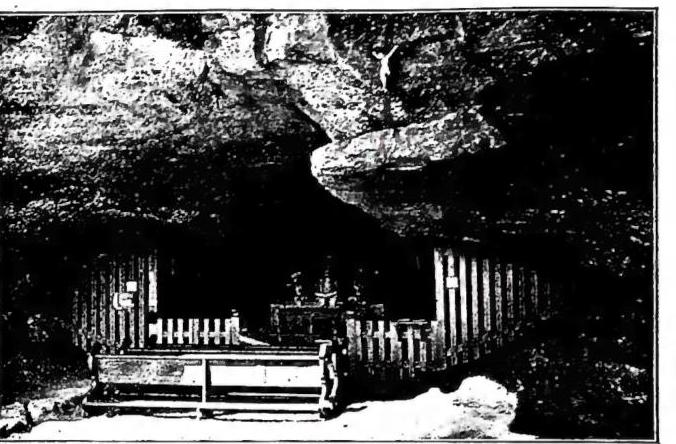
STRASBURGO, DIOCESI di - Grotto of S. Vitus (alt. 380 m., depth 24 m., width 10 m.) near Saverne, a pilgrimage destination since the 15th century.
186–203; Cottineau, II, cols. 2063–64). In the diocese, three parish churches have been elevated to the dignity of minor basilicas: in the Bas-Rhin, the Basilica dedicated to the Blessed Virgin at Marienthal; in the Upper Rhine, the Basilica of the Sacred Heart at Lutterbach and that of the Blessed Virgin at Thierenbach. - Vedi tavv. XCVIII-XCIX.