
STRATIGRAPHY. – Stratigraphy, also called stratigraphic geology or historical geology, reconstructs the chronological order in which materials were deposited on the earth’s surface, and correlates the remains of terrains situated even at great distances, dismembered by erosion or displaced by tectonic movements (v. TETTONICA; GEOLOGIA).
The end of the astral or pre-geological phase of the earth (characterized by the predominant effect of forces operating within the geode) and the beginning of its historical or geological phase are generally identified with the formation of the first solid crust (lithosphere) and with the beginning of its evolution through the action of exogenous agents—that is, with the initiation of the first sedimentary cycles. Life must have appeared shortly thereafter as well; its earliest representatives, however, have not been handed down in fossilized form, both because the oldest sediments underwent vigorous metamorphism almost everywhere and because, in all likelihood, the first organisms did not possess parts capable of being preserved as fossils (v. PALEONTOLOGIA).
I. ABSOLUTE AGE AND RELATIVE AGE OF GEOLOGICAL FORMATIONS
For the absolute age of the earth and of its astral phase, V. UNIVERSO. As regards the determi-(courtesy of C. Mazia)
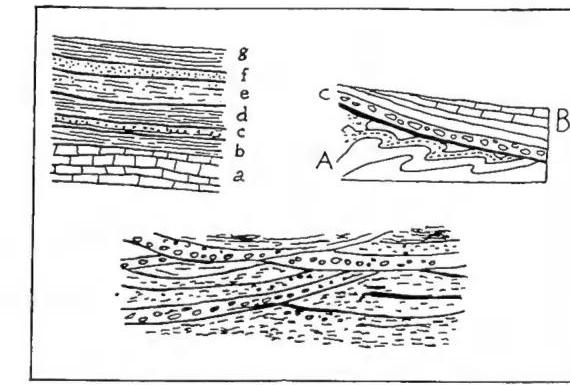
STRATIGRAFIA - Fig. 1. - Series of conformable strata (a, b...f, g). Fig. 2. - Stratigraphic unconformity between formations A and B; c, transgressive conglomerate. Fig. 3. - Cross-bedding.
tion of the absolute age of the geological phase of the earth and of its subdivisions (eras, periods, etc.: V. table), some methods serve exclusively for the chronology of the more recent formations (Pleistocene and Holocene), whereas others apply indiscriminately to all the preceding geological periods. Among the former, going back through time, one may cite the method of “dendrochronology” (counting the annual rings of trees and interpreting them), which in certain regions has made it possible, in the absence of other data, to establish reliable dates reaching back more than 3,000 years; the method known as “radiocarbon dating,” developed by American scholars in recent years, by which historical, protohistoric, and prehistoric formations have been dated, for the time being back to approximately 20,000 years ago; the interpretation of postglacial climatic phases through the analysis of post-Pleistocene “varves” over a period covering approximately the last 15,000 years; finally, the correlation between established astronomical cycles and the alternation of glacial and fluvial phases (“Milankovitch curve”), the latter method having made it possible to determine, although it is not yet known with what degree of certainty, the absolute chronology of the entire early Quaternary (Pleistocene) over a span estimated at approximately 600,000 to one million years (v. 1000) (fig. 4).
Among the methods developed on the basis of highly varied criteria for determining the absolute chronology of eras and periods preceding the Quaternary, those that may be classified as paleontological (the presumed constant rate of evolution of certain animal groups), geological (assessment of the rate of sedimentation, weathering, etc.), geochemical (the presumed constant increase in the salinity of the oceans), and geophysical (the duration of the earth’s cooling) have generally yielded either erroneous or unreliable results, especially when generalized. Conversely, methods based on the phenomenon of radioactivity (v. RADIOATTIVITÀ; TERRA, età della) have proved valuable in providing data for absolute chronology. Recently, a new radioactive method of geochronology known as the “rubidium-strontium” method has been perfected. It is based on the radioactivity of a natural isotope of rubidium (Rb 87; mean life approximately 60 - 10⁸ years), which in its radioactive decay generates a stable atom of strontium (Sr 87); the radiogenic-strontium-to-rubidium ratio is then determined in minerals containing rubidium. This method has confirmed, in various cases, the geochronological data obtained by the lead method, which remains the most important method.
The lead method has revealed unexpectedly long durations for the geological eras and periods, measurable in hundreds of millions of years. Thus, the beginning of the Tertiary era is dated to approximately 70 million years ago; while durations of 130 and 310 million years, respectively, must be assigned to the Secondary and Primary eras: the beginning of the Cambrian period would therefore date back 510 million years. An even greater duration must be attributed to the Precambrian era: the age of the two oldest minerals known to date, a uraninite and a lepidolite, both originating from a Canadian pegmatite, measured respectively by the lead method and by the rubidium-strontium method, has been assessed concordantly at 2.1 × 10⁸ years! And this, logically, is a minimum limit for the duration of the geological age of the earth, still far below, as various considerations suggest, its maximum value, which still eludes direct measurement but which, according to Holmes, should be around 3,350 - 10⁸ years!
For the geologist, it is above all important to establish relative age, that is, the position occupied by a stratum or formation within a stratigraphic series. These investigations are based on the following general criteria: stratigraphic, lithological, and paleontological, in addition to the use of certain indirect methods.
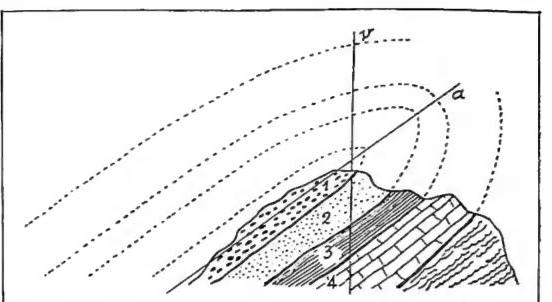
The stratigraphic criterion, which appears to be the most spontaneous, assumes that, of two or more regularly superimposed strata that have not undergone major dislocations, the one lying above is more recent than those beneath II. This principle of “superposition” can be applied with certainty wherever the order of succession has remained unaltered (fig. 1). If, instead, the pile of strata forms part of an overturned fold, their order is reversed in the lower part of the fold (inverted limb), where, from top to bottom, one passes from the older to the more recent terrains (fig. 5). Other complex cases belong to particular tectonic styles (v. TETTONICA), such as nappes, diapiric folds, etc.
The lithological criterion uses comparison of the petrographic nature of two or more strata, correlating those that display identical characteristics in this regard. It can provide excellent results if applied with due reservations, especially in regions having close geological affinities, one of them being of known chronology; it can also be applied in regions that are very close to one another. But it is known that a given lithological type is not exclusive to a particular geological age; while, on the other hand, two contemporaneous rocks formed a short distance apart may display very different petrographic characteristics. It was once thought that crystalline rocks (gneisses, granites, etc.) were the oldest, whereas it was later established that they could have formed at any age. Application of this method therefore requires great caution.
The paleontological criterion is safer, since it is based on fossils, which are the remains of organisms that lived in the past and were deposited while sedimentation was taking place (v. PALEONTOLOGIA). It was possible to establish that many fossil species were present in localities far distant from one another, and that some of them occupied exclusively corresponding stratigraphic positions, thus documenting the correlation of the terrains in which they are contained: hence also the designation of index fossils. But it is of the utmost importance to ensure that, after their initial deposition, the fossils have not undergone erosion, transport, and redeposition (“reworked” fossils), which in that case indicate an age earlier than the true one.
Indirect criteria. - At times, the age of a geological formation can be inferred indirectly, a procedure that is particularly important when fossils are absent or, if present, are unusable because they are species of no stratigraphic value (persistent fossils, ordinary fossils). Thus, a geological formation intercalated between two others of known age will have a date falling between that of the upper formation and that of the lower one. Indirect criteria, based chiefly on the action of contact metamorphism, are also used with regard to endogenous rocks, both in relation to one another and to sedimentary rocks. It is evident that an igneous rock is more recent than another rock that it has metamorphosed; that a vein is more recent than the rocks it traverses; whereas, if a flow or vein of igneous rock is overlain by sediments that show no traces of metamorphism, the latter are evidently more recent. In certain cases, another way of determining which of two strata or series of strata is more recent is based on the “direction of sedimentation” of the strata themselves, since, for example, a coarse-grained sediment is older
\( ∴ m = frac{3}{11} \)
\( ∴ m = frac{3}{11} \)
which pass into others in the order of superposition, with increasingly fine grain. The position of the fossils of fixed benthos can also provide useful indications regarding the original order of succession of strata; thus, the apices of the archeocyathid cups planted on the same surface of a stratum indicate that the older strata are found on that side.
II. CONCEPT OF “FACIES”
In following a stratum at the surface, one often notices changes in lithological composition and in the nature of the fossils. These different lithological and paleontological aspects presented by a single stratum are called facies, which reflect particular geographical and biological characteristics (habitat) of the place where sedimentation occurred. Thus, there are continental, lagoonal, and marine facies, and among the latter, littoral (or coastal), bathyal, and abyssal facies. Continental facies are characterized by terrestrial fossils, with sediments of eolian origin (dunes, loess), volcanic origin (tuffs), glacial origin (moraines), alluvial origin, and lacustrine origin (clays, sands, gravels, etc.). Among the lacustrine facies, particular importance is assumed by fossil fuels, generally attributable to a swamp or marsh environment. Except in particular cases, continental facies do not attain very considerable thicknesses. The remains of continental organisms may be terrestrial (subaerial, aerial, subterranean) or aquatic (fluvial, lacustrine). In lagoonal, estuarine, or deltaic facies, fossils of terrestrial and aquatic types are present, but generally adapted to special environments (fresh waters, brackish waters of varying salinity). Marine facies are characterized by both benthic fossils (fixed or mobile) and pelagic fossils (nektonic and planktonic); on the basis of habitat, they may be subdivided according to depth into: neritic facies (up to 200 m.), characterized by the numerical abundance of fossils of eurythermal organisms and by the predominance of terrigenous sediments (that is, transported by watercourses to the sea) and organogenic sediments, both from the accumulation of remains and derived from constructive activity (e.g., madreporic reefs); bathyal facies (200–1000 m.), of deeper sea, where muddy sediments predominate and the fauna is stenothermal; calcareous plankton (foraminifers, pteropods, etc.) predominates in warm seas and siliceous plankton (diatoms and radiolarians) in cold seas; abyssal facies (beyond 1000 m.), of a muddy environment where diatom, radiolarian, and foraminiferal muds (globigerine muds, etc.) still predominate down to depths of 5000 m., beyond which there are the “red clays,” composed chiefly of volcanic ash and cosmic dust. Rocks of marine origin, which among sedimentary rocks are the most extensive and thickest (brought upward by tectonic phenomena, they constitute the highest mountain ranges on Earth), are chiefly due to terrigenous, benthic, and planktonic contributions. Fossils peculiar to a given facies are called facies fossils. They are called(courtesy of C. Mazia)
STRATIGRAPHY — Fig. 4. — Curve of Milankovich radiation, expressed in millennia.
(courtesy of C. Mazia)
STRATIGRAFIA - Fig. 5. - Inverted succession of strata (from top to bottom, in the order 1, 2, 3, 4: inverted series), in a deeply eroded overturned fold. The dotted part completes the original overturned fold.
Two deposits that display the same facies are called isopic or isotopic; heteropic, if they have different facies, although they are contemporaneous; two deposits that formed in identical environments (in two lagoons, in two lakes, etc.) are isomesic, and heteromesic if they formed in different environments (in a lagoon and in a deep sea); two deposits that formed in the same “geographical province” (e.g., a marine sand and a continental volcanic tuff in the Mediterranean basin) are called isotopic, and heterotopic if they formed in two different provinces.
III. STRATIGRAPHIC ANOMALIES
If two or more strata deposited successively without interruption of sedimentation lie regularly one above the other, they are said to be conformable (fig. 1). Sometimes, however, after the deposition of a group of strata, the sea floor emerged because of a gradual or abrupt retreat of the sea (regression), that is, it entered a phase of continental conditions, during which its surface was variously eroded. If, after a certain period of time, this region is once again covered by the sea (transgression), the strata deposited there, even if they remain parallel to the older ones, are said to be unconformable (stratigraphic unconformity; fig. 2), whereas the absence of marine deposition constitutes a “sedimentation gap.” Deposits that regularly succeed one another in superposition or that lie between a transgression and a regression belong to the same sedimentation cycle.IV. STRATIGRAPHIC SCALE AND ITS DIVISIONS
By coordinating the results of paleontological studies and of sedimentary cycles, and taking into account all the regions of the Earth as well as other paleogeographical events of a general character, it has been possible to construct a succession of terms called the stratigraphic scale. The earliest attempt at chronological classification seems to be due to Lehmann (1756), followed by that of A. G. Werner (1789), based on lithological characteristics. However, before Werner, G. Arduino had established, as early as 1759, a geological classification divided into four orders, which he called primary, secondary, tertiary, and quaternary; these designations are still retained to indicate the four great eras: Paleozoic, Mesozoic, Cenozoic, and Neozoic. As regards northern Italy, they correspond fairly well to the actual stratigraphic succession of this region, as indicated by Arduino. At geological congresses, the nomenclature to be adopted for the divisions of the stratigraphic scale was established; its terms are group, system, series, stage, and zone, while the chronological equivalents are era, period, epoch, age, and hemera.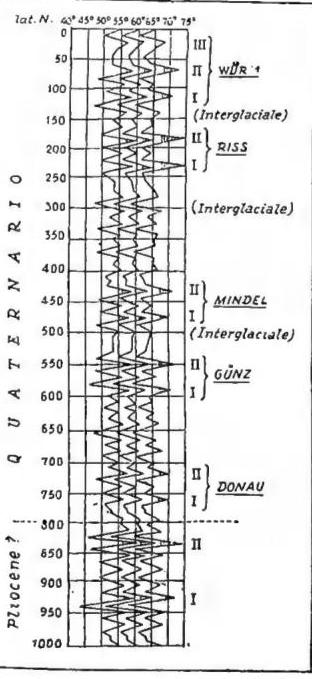
Geological periods may coincide, in certain localities, with great sedimentary cycles, bounded by partial retreats of the sea (the Pliocene, in the Italian Peninsula). For the minor divisions, although sedimentary cycles may correspond to them, the criterion of separation is increasingly based on characteristic fossils (genera, species, varieties). The “zone” is truly the paleontological unit: it may correspond to a single stratum and may be represented by a single species of characteristic fossil. Some periods (Carboniferous, Permian, Triassic), since their outcrops of both marine and continental origin are known over wide areas, have a dual division and nomenclature. Naturally, there is no region of the Earth in which a natural section displays the entire stratigraphic series, from the Archean to the present day; however, localities are known where the complete successions of an entire era or period are represented (the Paleozoic, in southwestern England; the Mesozoic and almost the whole of the Cenozoic in certain sectors of the Umbrian-Marchigian Apennines; the Devonian in the Meuse Valley, etc.). Finally, it should be recalled that geological periods derive their names either from geographical localities, sometimes Latinized, where the strata were first studied (e.g., Cambrian, from Cambria, the Latin name for Wales), or from the predominant or characteristic type of rock (e.g., Carboniferous, in western Europe, because of the presence of large quantities of fossil coal).