
TERRA, ETÀ della. — The methods used until a few decades ago to determine the age of the earth are now revealed to be entirely lacking in scientific rigor.
They were based mainly on the rate of deposition of sediments in an aquatic environment, or on the salinity of the present oceans, or on a calculation of the progressive cooling of the terrestrial sphere, or again on the rate at which exogenous agents erode mountain chains; the values obtained by these methods are much lower than those obtained today by other means. The first of the methods mentioned, already glimpsed in Herodotus, consisted in establishing, on the basis of phenomena currently obser-

The other methods are subject to equally obvious criticisms. Calculating the age of the earth on the basis of the salinity of the seas seeks to establish the time necessary for the rivers (assuming their global flow to have remained unchanged over time) to pour into the oceans quantities of salts sufficient to transform the primitive fresh waters into the present waters, whose average salinity is known. The study of the progressive cooling of the terrestrial sphere involves—as one of the numerous causes of error—the problematic knowledge of an initial temperature and of the amount of heat produced by the disintegration, still active, of radioactive elements disseminated at inaccessible depths.
The present methods for determining geological time, much more precise although subject to various causes of error, are based on the radioactive disintegration of uranium (especially of the two isotopes UI and AcU), which leads ultimately to the formation of radioactive lead (respectively of the two isotopes Pb²⁰⁰ and Pb²⁰⁷). Radioactive materials are contained in varying proportions in all rocks, and it is assumed that, from the moment when they were enclosed in the consolidating rock, the accumulation of the residual elements (helium and lead) began.
Since the initial quantity of uranium remains practically constant because of the slowness of the disintegration process (period = 4.4 × 10⁹ years), and since therefore the quantity of the final product formed each year may also be considered constant, by determining precisely the percentages of uranium and lead present together, the age of a rock in years can be calculated by the formula:
Age in years = frac{Lead (in grams)}{Uranium (in grams) × 1.3 × 10^{-19}}
in which 1.3 × 10⁻¹⁰ represents the quantity of lead (in fractions of a gram) generated in one year by one gram of uranium. The oldest rocks on which this method was tested proved to be close to two billion years old.
(fot. Emil)
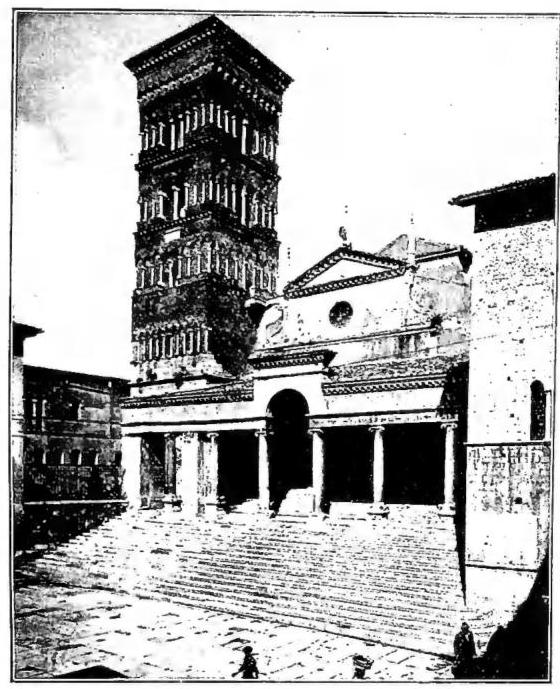
TERRACINA, PRIVERNO E SEZZE, DIOCESI di — Façade of the Cathedral, consecrated in 1074. The portico and bell tower date from the 13th century, with alterations made in the 17th century — Terracina.
abundant in the mica of igneous rocks, and caused by the development of helium; this method too yields values close to those provided by the lead isotopes.
The earth therefore has an age (from the time when a solid terrestrial crust formed to the present) of at least two thousand million years; of these, approximately 1500 are assigned to the Archeozoic era, in the more recent part of which the first traces of life appear; the remaining 500 million are divided according to the accompanying table.
| Duration of the geological eras in millions of years | |
|---|---|
| Quaternary or Neozoic Era | 0.5 — 1 |
| » Tertiary or Cenozoic Era | 50 — 60 |
| » Secondary or Mesozoic Era | 130 — 150 |
| » Primary or Paleozoic Era | 300 |
| » Archeozoic Era | 1300 — 1500 |
| Total approx. | 1800 — 2000 |
At present, however, these values tend to increase as a consequence of the improvement of research methods and the discovery of even older rocks: it therefore appears, from the most recent results, that the earth has an age (again, from the solidification of the terrestrial crust to the present) of no less than two and a half billion years.
For the age of the solar system, the galactic system, and the universe, V. UNIVERSO.