
BONIFACE, Saint, Martyr. — Apostle of Germany, born about 675 in Wessex, Britain. His family name was Wynfrith, and from childhood he felt the religious vocation, so that his parents allowed him to be educated in the monastery of Adescancastre (Exeter), whence he passed on to that of Nhutsselle (now Nursling). Having become a master in the cloister, he began to receive missions of trust and assignments that revealed his abilities.
It was the time when Irish and Gaelic monks were spreading throughout the world, and Wynfrith too was seized by the longing for the “peregrinatio pro Christo.” Around 716, with some companions, he set out to reach, at the least opportune moment because of the fierce pagan reaction to the Catholic preaching of Willibrord, the ports of Frisia. But upon arriving there, the hostility of the environment persuaded him to return to his monastery of Nhutscelle. Two years later, in 718, he set sail again; this time for Rome, to ask the Pope to be allowed, in obedience and with the support of the Church, to turn his work toward the conversion of the pagans. From Rome, where he was received by Gregory II, he departed with the name changed to that of the ancient Roman martyr B. (the change took place on May 14) and with a bull authorizing and recommending the work he was to undertake. From Thuringia, B. returned to the land that had already attracted his imagination and heart, Frisia. He found it in conditions much more receptive to his preaching, which he carried out in close accord with Willibrord, bishop of Utrecht and evangelizer of Frisia. In Hesse, where paganism was still unchallenged, he exercised his apostolate between 722 and 724, followed by a large harvest of conversions. Toward the end of 722 he was in Rome to report on the first results to the Pope, who consecrated him bishop, it seems on November 30 of that same year, entrusting him with the broadest instructions and recommendations. The first of these was for the powerful majordomo of the Frankish kings, Charles Martel. On this occasion B. pronounced the famous oath of fidelity to the Holy See, of which the text is still preserved (ed. Tangl, in MGH, Epistulae, XVI, pp. 28-29). Returning to Hesse, he resumed the struggle against idolatry; the felling of the oak of Donar at Geismar (near Fritzlar), with which he then built a small church dedicated to St. Peter, greatly contributed to the spread of the Gospel.
Adjacent to Hesse, and equally untouched by Roman civilization, Thuringia immediately drew the attention of the Saint. He spent ten years there, spreading among the people the word of that God whose zeal St. Kilian and a few other Irish or Frankish missionaries had not managed to make known. There he had to wage a fierce struggle against the ignorance of paganized priests, who from the outset had perverted the evangelizing work entrusted to them. In 731 Gregory III conferred on B. the dignity of archbishop, entrusting him with the task of establishing bishoprics in the more advanced regions of Germany in the faith. Between 734 and 735 the apostle extended his care as far as Bavaria, continuing the work of St. Rupert, who had been its evangelizer. In the autumn of 737 B. set out for Rome for the third time. He went there before undertaking what he considered his supreme mission, the evangelization of Saxony, to receive instructions directly from the Pope. But in Rome other tasks were entrusted to him: the ecclesiastical organization of Germany, for which Gregory III gave him full powers to ordain and consecrate priests and bishops, convene and preside over synods, and revise the constitutions of monasteries, nostrum agentum vicum, as the bull to the bishops of Bavaria and Germany puts it (Gregory III, Epistola 44).
Then B. reorganized the dioceses of Salzburg, Regensburg, and Freising in Bavaria and created that of Passau (738-39). The local clergy had to be purged; then, perhaps in 740, the first synod could be convened. The following year, 741, B. went on to organize the churches of central Germany: one diocese for Hesse, namely Bürburg (Bürberg); two for Thuringia: Würzburg and Erfurt. At the same time he established two more bishoprics to meet the growing needs of Bavaria: Neuburg and Eichstätt, near which stood the monastery of Heidenheim. In 744, B. provided for his greatest monastic foundation: the abbey of Fulda, from which would emerge the largest number of missionaries and which would become the beacon of German culture in the early Middle Ages. This foundation was the dearest to B., so much so that he wished to be buried there.
But as early as 742, following the death of Charles Martel and Gregory III, a new task had been entrusted to him: the reform of the Frankish Church, which was in decline because of the corruption of morals and the frequent interventions of kings and nobles, the dissipation of ecclesiastical goods, and the scarcity of councils. Where the strict subjection to the dynasty prevented active action by the central power of the Church, the new Pope, the Greek Zachary, turned to the now well-known zeal of the archbishop of Germany. His designation had been requested from the Curia by the majordomo of Austrasia, Carloman, who devoted himself entirely to the reform of the clergy and the convening of councils, drawing in his reluctant brother, Pippin the Short of Neustria. With B. present, solemn councils confirmed the subordination of the churches of Austrasia to the archbishop of Germany, the need to provide for the appointments to vacant bishoprics, the strict subjection of priests to bishops, the frequency of synods, and the education of the clergy, with regard to the restoration and respect of the hierarchy; while a series of measures were taken to restore discipline and to ensure the return to the Church of goods wrongfully seized. After deposing some guilty bishops—those of Mainz, Gewiliob of Neustria, Aldebert, and of Austrasia, Clement—overcoming difficulties and hostilities even within the clergy, B. completed his work by consecrating, at the behest of Pippin the Short, the archbishops of Reims, Rouen, and Sens.
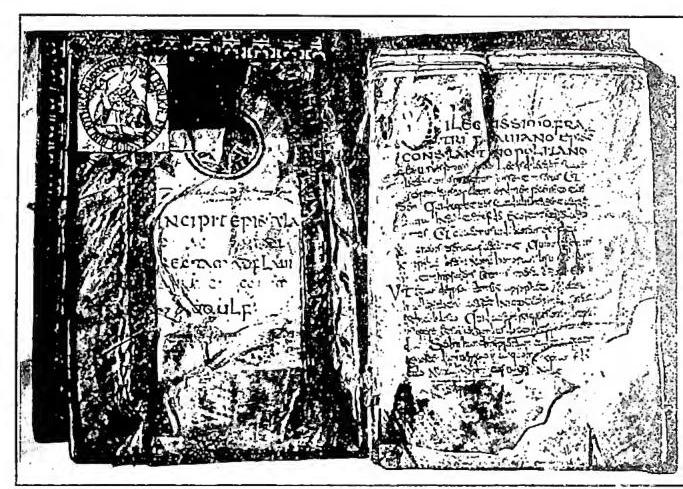
(per courtesy of the curia of Fulda)
BONIFACE, Saint — One of the three Codices Bonifatii of the library of Fulda, which the Saint is said to have raised above his head at the moment of martyrdom to ward off the fatal blow. Note the cut in the parchment at the top.
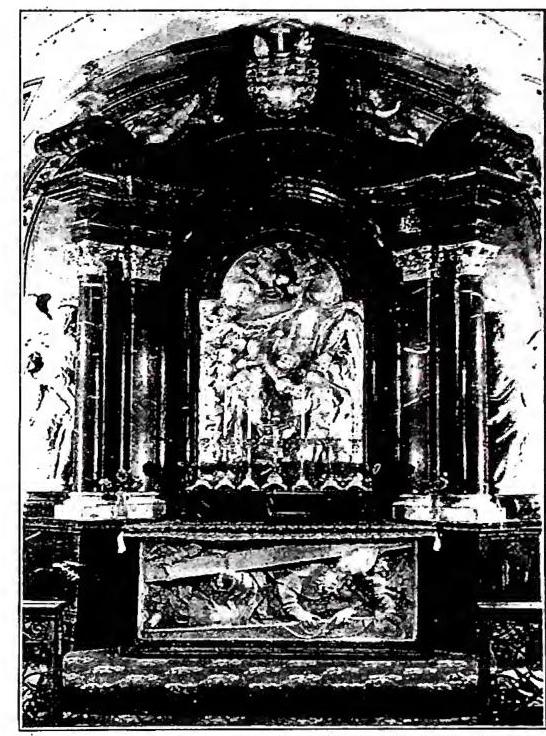
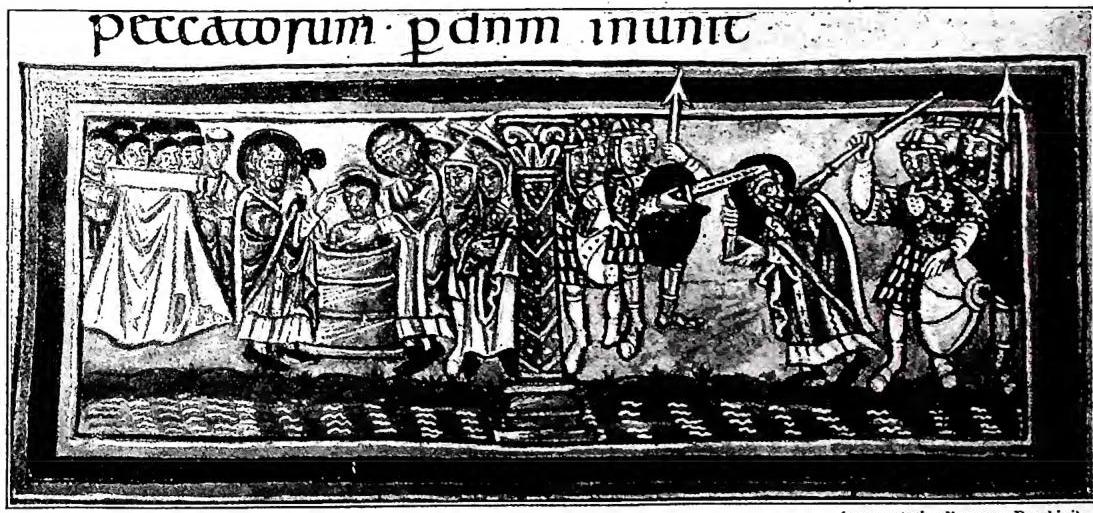
L'apostolo era ormai giunto al termine della sua vita. Dopo aver consacrato re, nel 750, Pipino il Breve, cui il ritiro dal mondo del fratello Carlomanno consentiva la riunione dell'Austrasia e della Neustria in un solo regno, e aver ottenuta dal medesimo la nomina del fedele discepolo Lullo a suo successore a Magonza, nel 752, B. tornava a concludere con la predicazione la vita in Frisia, là dove aveva avuto inizio la sua attività esemplare. Vi andava, ottantenne, nel presagio della sua fine, e sistemata con l'immediata soggezione di Utrecht alla S. Sede la questione insorta tra quel vescovato e quello di Colonia, si rivolgeva con pochi seguaci a condurre alla fede gl'idolatri della Frisia orientale, e là, mentre battezzava e cresimava i neofiti, fu massacrato con i suoi da una turba di pagani inferociti dalle sue pratiche, il 5 giugno 755. Trasportato prima ad Utrecht, poi a Magonza, infine a Fulda, le sue spoglie vi trovarono sepoltura, conformemente al desiderio dell'apostolo.
Figura tra le più grandi del periodo dell'espansione vittoriosa della fede, B. converti in massa la Frisia, l'Assia e la Turingia; compì la evangelizzazione della Baviera e della Germania centrale; dette un'organiz-
(per cortesia della curia di Fulda)
(per cortesia di mons. Paschini)