
PASSAVIA (PASSAU), DIOCESE OF. — A diocese in Bavaria, existing in its present extent only since 1817 and 1821, but in antiquity one of the most extensive dioceses in Germany and a first-rate missionary center.
The diocese has an area of 5,442 sq. km, with 497,535 Catholics and 52,512 non-Catholics; it comprises 267 parishes in 24 deaneries, with a seminary, and a large number of religious institutes of every kind; the religious Orders and women’s congregations are flourishing. The sanctuary of Altötting is particularly renowned, as is that of Halbmeile, dedicated to the Sorrowful Mother.
I. ANCIENT PERIOD
Very ancient settlements are found in the region, especially along the promontory formed by the confluence of the Danube and the Inn, where the Celtic Boii built Boiodurum. In 15 B.C., the Romans extended Rome’s frontiers as far as the Danube, and the Inn became the boundary between the provinces of Raetia and Noricum. Around 153, they built, on the right bank of the Inn opposite Boiodurum, the fortress that took the name “Batava castra,” after the cohort of Batavi stationed there. In the time of St. Severinus (d. 488), the garrison had moved to the principal settlement, by then called Batavis, while the former fortress retained its original name, Boitro. There were a church and two monasteries, but the ecclesiastical center was Laureacum (today Lorch), whose bishop contemporary with St. Severinus is also known: Constantius; the diocese extended as far as the Pannonian frontier. In 488 Batavis was destroyed by the Thuringians; Laureacum also disappeared, and the ancient Cathedral continued to serve as the mother church for the new settlement on the nearby hills, which later came to be called Enns.II. CAROLINGIAN PERIOD, FIRST MISSIONARY PERIOD
During the sixth and seventh centuries, the formation of the new Germanic states began to take shape, among them Bavaria, ruled by its own dukes, who from the middle of the eighth century came under Frankish hegemony. Batavis had become Bazzava and then modern Passau; Christianity was spread among the Bavarian populations by missionary bishops,without a fixed see, who founded various monasteries as centers of expansion. Only St. Boniface in 739 was able to establish a stable hierarchy, with Salzburg as metropolitan see, and four diocesan sees, including P., with a rather modest territory in present-day Bavaria, while to the east, toward present-day Hungary, the boundaries depended on the political fortunes of German power. After the missionary bishops Ercanfrido and Otcaro (of uncertain date), a certain Vivilone, ordained by Gregory III himself, became the first permanent bishop of the new diocese. He was a monk, and beside the cathedral of St. Stephen he erected a monastery of which the bishop was abbot of the monks. Only after 900 did Chapters of secular canons arise, and the separation between the bishopric and the Chapter take place. In 768 Duke Tassilone III brought from Trent the body of the missionary bishop St. Valentino, who became the patron saint of P., city and diocese. In 791 Charlemagne began, from the camp near Lorch, the war against the Avars and, after their complete defeat (796), established the eastern march, opening the way for P. to a missionary and civilizing penetration directed eastward along the Danube. Ludovico il Pio subsequently demarcated the areas of activity between Salzburg and P. The latter extended, apparently, as far as the Slovak territories, so that the bishop of P., Ermanrico (866–74), found himself in conflict with the Byzantine missionaries led by SS. Cirillo and Metodio. Then in 900, when Giovanni IX established an independent hierarchy in Moravia, the entire Bavarian episcopate, headed by Salzburg, protested to Rome; but soon all political, cultural, and ecclesiastical activity collapsed under the terrible Magyar invasions that for half a century seriously threatened Germany and Italy. Monasteries, churches, and inhabited centers in Hungary as far as the heart of Bavaria once again disappeared, and not all of them rose again.
III. MEDIEVAL PERIOD, SECOND MISSIONARY PERIOD
Once the Magyar invasions had been halted in 955, the eastern march was restored, at least in part, and subsequently extended toward Pannonia, forming under the rule of the Babenbergs (976–1246) the territory that was later to become Austria. At this same time P. had the most celebrated bishop in its history, Pilgrim (Pilgrim, 971–91), a learned and energetic man and a staunch defender of the rights (both real and presumed) of his see. A legend then widely circulated held that P. continued the ancient bishopric of Lorch, which had straightforwardly become an archbishopric and metropolitan see of Pannonia and had been transferred by Vivilo to P. because of the barbarian migrations. A fictitious list of bishops had also been compiled, headed by St. Maximilian of Celeia (4th century); and now, with the conversion of the Magyar people, Pilgrim claimed for his see the supposed metropolitan prerogatives of Lorch over all Pannonia, that is, Hungary. By means of forged documents, he had the imperial court recognize his rights over the monasteries that had been restored (Kremsmünster, St. Florian, St. Pölten, etc.). In 973 or 974 he asked Benedict VI to confirm his alleged metropolitan rights, but Archbishop Friedrich of Salzburg succeeded in thwarting Pilgrim’s efforts by securing confirmation of a single metropolitan for Bavaria and the eastern territories as far as Pannonia. Pilgrim, however, fabricated a series of imperial and papal diplomas to prove the continuation at P. of the (nonexistent) metropolitan see of Lorch (these are the celebrated «Passauer» or «Lorcher Fälschungen»), but without achieving his aim. In the meantime Pilgrim brought the Cathedral school to prominence, celebrated various synods in the most important places of the eastern march, and displayed remarkable activity in colonization and ecclesiastical foundations (churches, monasteries, cells, agricultural centers, etc.). In 985 he celebrated a synod at Lorch itself and had the relics of St. Maximilian, believed to have been archbishop of Lorch, transferred to P., where he is venerated as the second patron of the diocese. From Otto III, the bishop of P. received sovereign rights over certain territories of the diocese, as a result of which the bishop later became a prince of the Empire. The 11th–13th centuries were notable for P. as the most fruitful period for monastic and ecclesiastical foundations (the mother parishes) and for cultural penetration, always in cooperation with the nobility and especially with the margraves, dukes of Austria from 1156. Ottone of Lonsdorf (1254–65) introduced and promoted higher education and reorganized the administration; he was highly charitable and left the collection of the diocese’s documents in the Codex Lonsdorfianus (ed. in Monum. Boica, XVIII, 2, 40 ff.). At the same time, the Cathedral canon Alberto da Behaim (1260), a historian and a political-religious man of action with a broad sphere of influence, reworked the fabulous history of Lorch, making it almost the foundation of further new aspirations on the part of the bishops of P. One must bear in mind that most of P.’s territory belonged to Austria, then a country of great importance.Under Bishop Pietro (1265–80), Austria passed to the House of Habsburg, and later Vienna became the capital of the Empire; consequently, the Austrian rulers soon sought to make the capital and their lands ecclesiastically independent as well. In 1365 Rodolfo «lo Stifter» founded the first university in Germany at Vienna and obtained the elevation of Vienna’s mother church, St. Stephen’s, to a collegiate church. P. exercised its jurisdiction in the Austrian territories through an «officialis» (a kind of vicar general), until in 1469 Emperor Friedrich III succeeded in obtaining from Pope Paul II the erection of two modest bishoprics at Vienna and Wiener-Neustadt, much to P.’s dismay. During this period P. often had zealous and energetic bishops; synods were celebrated with some regularity; in 1513 Viguleo Fröschl published a diocesan Ritual.
IV. THE AGE OF THE «REFORMATION» AND THE «COUNTER-REFORMATION» UNTIL THE END OF THE ANCIENT DIOCESE
The history of the «Reformation» and the «Counter-Reformation» in the diocese of P. follows that of Bavaria in Austria (v.). The bishops all remained within the path of Catholic tradition: Volfango of Salm (1540–55) summoned the Jesuits (Fr. Bobadilla), founded a gymnasium at P., and introduced the catechism of St. Peter Canisius; Urbano of Treunbach (1561–98) strongly favored the Franciscans and especially the Capuchins, as the more popular order. The government of Vienna did everything possible to ensure that the see of P. was occupied by clergy of Austrian origin; this continued from 1598 until the end of the ancient diocese; indeed, for almost a century the bishops were actually archdukes (1598–1664), although they exercised a truly salutary and effective government in cooperation with the governmental authorities. Archduke Leopoldo founded in 1613 a college directed by the Jesuits; Archduke Leopoldo Guglielmo founded the Tridentine Seminary in 1638. The bishop Giuseppe Domenico of Lamberg (1723–61) was famous: he visited the diocese 199 times, established the Confraternity of Christian Doctrine on the model of that of Rome, and was made a cardinal in 1738. Under him, after lengthy disputes and conflicts, the metropolitan see of Vienna was erected, with a considerable enlargement of its territory (1728), as a result of which the diocese of P. lost a full third of its territory. In compensation, Lamberg ultimately obtained exemption from the metropolitan see of Salzburg and the pallium, though without the title of archbishop. Leopoldo of Firmian (1763–83), infected by the Enlightenment, like many other prelates, was nevertheless intent on spiritual benefit. Immediately after his death, Emperor Joseph II decreed in 1784 the end of P.’s jurisdiction over the Austrian territories and, with papal approval, erected the new bishoprics of St. Pölten and Linz as suffragans of Vienna. P.’s territory remained very small and wholly within Bavaria; the general secularization of 1803 also brought an end to the ecclesiastical sovereignty of the bishop of P., and the last prince-bishop, Leopoldo Leonardo Raimondo of Thun, withdrew to his personal estates in Bohemia, where he died in 1825, while the diocese was governed by the Chapter and a vicar.V. LA DIOCESI MODERNA
The Napoleonic upheavals obliged Bavaria to undertake a complete reorganization of the ecclesiastical jurisdictions, which was carried out in the Concordat of 1817. On 8 Sept. 1821 the bull delimiting the dioceses was published, by which P. received the eastern part of the(from F. Mader, Passau, Augusta 1885, pl. 11)
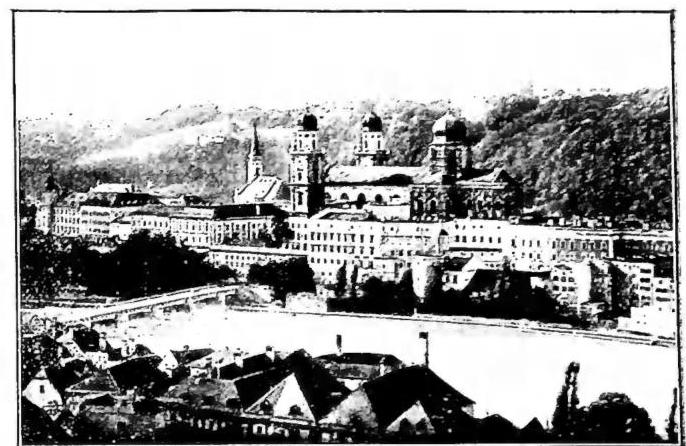
The cathedral of S. Stefano, after various alterations, appears as a Gothic structure (1407), rebuilt after the fire of 1622 with Baroque naves (Carlo Lurago) and extremely rich decoration (G. B. Carlone), possessing one of the most magnificent organs in Germany. The church of S. Severino, incorporating early Christian remains, dates back to the Carolingian period; the present building is from the 11th–12th century, with a Gothic choir. Above the Innstadt rises the sanctuary church of Mariahilf. The entire city, with its suburbs on the various banks, is extraordinarily picturesque.
BIBLI: the historical sources are found in MGH and in the official historical publications of Bavaria (Monum. Boica) and Austria (Fontes rerum Austriacarum. Urkundenbuch d. Landes unter d. Euns and Urkundend. d. L. ob d. Euns, all still in the process of publication), as well as in publications concerning the monasteries and the principal cities. V. also A. Hauck, Kirchengeschichte Deutschlands, the first 2 vols., Leipzig 1887 ff.; E. Tomek, Kirchengeschichte Österreichs, so far 2 vols., Innsbruck 1939–49; more concise, but with recent bibliography, A. Hauck, s. V. in Realenc. f. prot. Theol. u. Kirche, XIV, pp. 757–58, with a critical list of the bishops. Among the more specialized works: J. Rottmayer, Statistische Beschreibung des Bistums Passau, Passavia 1867, supplement, there 1888; F. Mader, Die Kunstdenkmäler der Stad P., Munich 1919; id., P., Augusta 1925; Fr.