
ADDOLORATA, DEVOZIONE alla. — A devotion commemorating the sorrows of the Virgin Mary during the various events of her earthly life. It has a solid foundation in the Gospel, and owes its origin to contemplation and meditation on the Passion of Christ. The documents from the earliest Christian period are, however, rare and vague. Beginning with Origen (who misinterprets the words of Simeon’s prophecy), most of the Fathers contain more or less explicit allusions to Mary’s compassion.
Only toward the end of the 11th century, prepared by ascetic literature, did it begin to assert itself in an increasingly clear and distinct manner. Special mention should be made in this connection of s. Anselmo (cf. A. Wilmart, Prières de Compassion, in Vie Spir., Supplm. [March 1928], p. 269; id. Auteurs spirituels et textes dévots du moyen âge latin, p. 506), Eadmer of Canterbury, Blessed Guerric, abbot of Igny, s. Amedeo of Lausanne, Honorius of Autun, Abbot Ogier, Arnold of Bonneval, and s. Bernardo (PL 183, 429 ff., 437 ff.). The Liber de Passione Christi et dolore et planctu Matris eius, although for a long time attributed to s. Bernardo, nevertheless belongs to another author, thus far unknown. From this time onward, in rituals, various offices, and collections of prayers, the sorrows of Jesus came in worship to be increasingly associated with those of Mary. An example is also found in s. Bonaventura’s Vitis mystica (chap. X) and in the various popular Laude of the 13th century, especially in Italy and Tuscany. This spontaneous devotional movement led, in 1233, to the institution of the Order of the Servants of Mary by the Seven Holy Founders, who, in the Legenda de origine Ordinis—a contemporary document—are presented as « Dominae nostrae praecipui amatores » (Monumenta Ord. Serv. B. M. V., I, n. 18,
p. 73). The black habit they wore was, according to the cited document, a mourning garment, intended to recall « the sorrow that the Virgin suffered in the most bitter Passion of her Son » (loc. cit., n. 52, p. 98). While the Franciscan devotional movement preferred to contemplate the joyful Mother in the manger, that of the Servites loved to focus on Mary sorrowing beside the Cross of her Son. It was precisely in the 13th century, in fact, that the first images of the A. appeared and some shrines dedicated to her began to arise, such as that of Marienthal, near Haguenau (in Lower Alsace). Very numerous, especially in that century, were compositions, in various languages, both in prose and in verse, entitled The Lament of the Virgin. Among these compositions, « Mary’s lament », contained in the Stimulus divini amoris of the Minorite friar Girolamo da Milano, falsely attributed to s. Bonaventura, deserves notice.
The determination of Mary’s seven principal sorrows dates from the 13th–14th century, as is shown by the manuscript of the Garstense Collection (Cod. Lincen C e II 6) and by other codices of that period, corresponding to the already established practice concerning the seven principal joys (cf. E. Mâle, L'art religieux de la fin du moyen âge en France, Paris 1908, pp. 118–40; A. Wilmart, op. cit., pp. 505–36). According to Benedict XIV and other writers, it was due to the Seven Holy Founders of the Order of the Servites.
The strange thesis maintained by H. Gaidoz scarcely deserves mention; according to it, the Seven Holy Founders supposedly drew their inspiration from an Assyrian cylinder (preserved in the British Museum) that passed from the East to the West during the Middle Ages, representing Istar, the goddess of war, seated upon a throne and surrounded by a trophy of weapons arranged in the shape of a fan behind her. This strange thesis was refuted by the Bollandist I. Delehaye (La Vierge aux sept glaives, in Anal. Bolland., 12 [1893], p. 338 ff.). Gaidoz replied in Mélisine (6, [1893], pp. 226–75), but with evident lack of success.
Stabat Mater (v.), by an uncertain author and generally attributed to Iacopone da Todi, dates from that period as well.
Toward the close of the 15th century, through the efforts of the priest Giovanni di Coudenberg, dean of S. Egidio of Abbenbroec (Holland) and later secretary to Charles V, the Confraternity of the Seven Sorrows of Mary arose in Flanders; it was approved by the Pope in 1495 (cf. Anal. Bolland., 12 [1893], p. 340) and subsequently propagated with great zeal in various parts of the world. To spread the cult of the A. ever more widely, the Servites have established, at various times, many pious practices, such as the Crown of the Seven Sorrows (16th century), the Pious Union for the Perpetual Cult of the Living Crown of the A. (founded in Florence toward the beginning of the 19th century), the pious exercise of the Via Matris (begun in Rome, in the church of S. Marcello al Corso, in 1836), the Month of September in honor of the A. (begun around the middle of the 19th century), the Seven Fridays in preparation for the feast of the A. (of recent origin), etc.
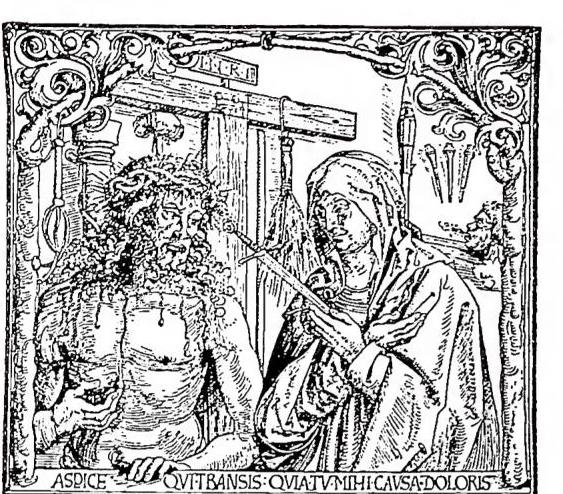
(propr. B. Degenhart)
ADDOLORATA — Woodcut by Wolf Traut (early 16th century).
Addolorata (1936), pp. 68–72; C. Berti, De cultu Septem dolorum s. Mariae, in Marianum, 2 (1940), pp. 81–86; E. Campana, Maria nel culto, I, 2nd ed., Turin 1943, pp. 260–90; I. Dissard, La Transfixion de Notre-Dame, in Etudes (1918, II), p. 2577 ff. Gabriele M. Roschini
ICONOGRAFIA. – The representations of the Mater Dolorosa go back to the conception of a compassio Mariae which, as it was understood by Greek homilies of the sixth and eighth centuries, St. Bonaventure, and other mystics, unfolds alongside the Passion of Christ. Already in miniatures from the end of the thirteenth century one sees the figure of the Virgin who, at the foot of the Crucified, displays her breast pierced by a sword, recalling Simeon’s prophecy (Lk 2:35); after the institution of the liturgical celebration of the Virgin’s sorrows (1423), similar figures appear, but with 5–7 swords in the breast, either as independent images or, at times, surrounded by representations of the seven sorrows (painting of ca. 1500 at Bruges, in Notre-Dame). Finally, in the highest spheres of art, the statues of the A. created by the polychrome Spanish sculpture of the Baroque period rise up (Juan de Juni, Hernandez, Cano [Soledad at Granada]). – Vedi Tav. XXIII.