
AGATHA, Saint and Martyr. — One of the most popular heroines of early Christian antiquity, martyred for the faith at Catania. The exact date of her martyrdom is uncertain: it is variously placed during the persecution of Decius, as commonly read in the texts of the Passio Agathae, or during that of Diocletian, as indicated by Aldhelm in his De laudibus virginitatis (ch. 42: PL 89, 142), and followed by the Martyrology of Bede, although the first hypothesis is generally preferred.
From the earliest times after her martyrdom, A. was the object of veneration in her native city, which jealously guarded the tomb of the martyr located in the suburb of Catania known as Hybla Maior, where Christian cemeteries with tombs of illustrious martyrs existed. An ancient Latin inscription discovered in Catania in 1730 records a certain « Julia Florentina pagana nata... fidelis facta », i.e., baptized at the age of eighteen months and twenty days, who died four hours later and was buried « pro foribus martyrum cum loculo suo per presbyterum », that is, near the tomb of the martyrs Agatha and Euplus (cf. Bull. di Arch. Crist., 6 [1868], p. 75; CIL, X, 2, no. 7112). Likewise, another Christian inscription, probably contemporary with the previous one, from the island of Ustica, mentions a certain Lucifera, who died on the feast day of St A. (cf. A. Ferrua, Epigrafia sicula pagana e cristiana, in Riv. di Archeol. Crist., 18 [1941], p. 237).
The cult of A. was not confined to Catania alone but soon spread to other Churches. Her name appears in the Martyrologium Hieronymianum on 5, 12, and 25 July, 5 October, and 6 December, in addition to the traditional date of 5 February, which is also recorded in the Carthaginian Calendar (ed. H. Lietzmann, in Kleine Texte, II, Bonn 1911, p. 6). Moreover, from the 5th century onwards, her name was included in the Canon of the Roman, Ambrosian, and Ravenna Masses (Sacramentarium Gelasianum, ed. Wilson, Oxford 1894, pp. 123, 260; F. Savio, Gli antichi vescovi d'Italia...: Milano, Firenze 1913, p. 923), and later also in the Mozarabic calendar (M. Férotin, Le liber Ordinum... Paris 1904, col. 454) and in the Greek Synaxaria (Synax. Constantinop., p. 445). Celebrated in a hymn falsely attributed to Pope Damasus (G. Ihm, Damasi Epigrammata, Leipzig 1895, p. 75), by Venantius Fortunatus in the poem De virginibus (VIII, 4), and by Aldhelm in De laudibus virginitatis (PL 89, 268), the popularity of the Sicilian saint is further confirmed by the large number of places of worship dedicated to her. Pope Gelasius mentions a basilica of the martyr « in fundo Caclano » (A. Thiel, Epp. Rom. Pont., I, Braunsberg 1868, p. 495); from the Liber Pontificalis we learn that Symmachus built another « in fundum Lardarium » (ed. Duchesne, I, pp. 262, 267). Besides many others whose names are now known only, such as S. Agata in Caput Africae, ad Colles Iacentes, in Diaconia, de Tempulo, trans Tiberim (cf. C. Hülsen, Le chiese di Roma nel medio evo, Firenze 1927, pp. 165-68), particularly noteworthy is that of S. Agata in Subura, commonly called dei Goti (C. Hülsen-C. Cecchelli, Sant'Agata dei Goti, Roma 1924), built around 470 by Ricimer, used for Arian worship and reconsecrated to Catholic worship by St Gregory the Great (Epp., IV, 19; Dialogues, I, III, ch. 30), who in 592 sent relics of the martyr to Capri (Epp., I, 51) and also dedicated to the saint a monastery he had built in Palermo, the « Lucuscanum » (Epp., IX, 20, 66, 82).
While the martyrdom and cult of A. are historically confirmed, no reliable details survive regarding the circumstances of her glorious death. The Passio S. Agathae (BHL 133-36; BHG 36-38), which has come down to us in three recensions—one Latin and two Greek—traces back to a common original from the first half of the 6th century, which cannot be relied upon. It appears to have been influenced by certain pagan rites of Sicily and also betrays classical reminiscences of the ancient history of the region. If traces of historical tradition have been inserted into the Passio, it is now impossible to distinguish them from the embellishments of the writer, who was concerned with composing an edifying romance rather than coordinating the data of the martyr’s tradition with any semblance of plausibility. The only element historically certain is the place of her martyrdom.
Patroness of Catania since antiquity, A. was often invoked during the dangerous eruptions of Etna; a patronage that in the Middle Ages was extended to all cases of fire. By an easy transition, it also explains why bell-founders in Italian and Alpine regions took her as their patroness. Indeed, during this period it was common to inscribe on bells the famous epitaph, which according to legend an angel would have brought inscribed on a stone used to cover the martyr’s tomb after her burial: « Mentem sanctam, spontaneam, honorem Deo et patriae liberationem ».
Mario Scaduto
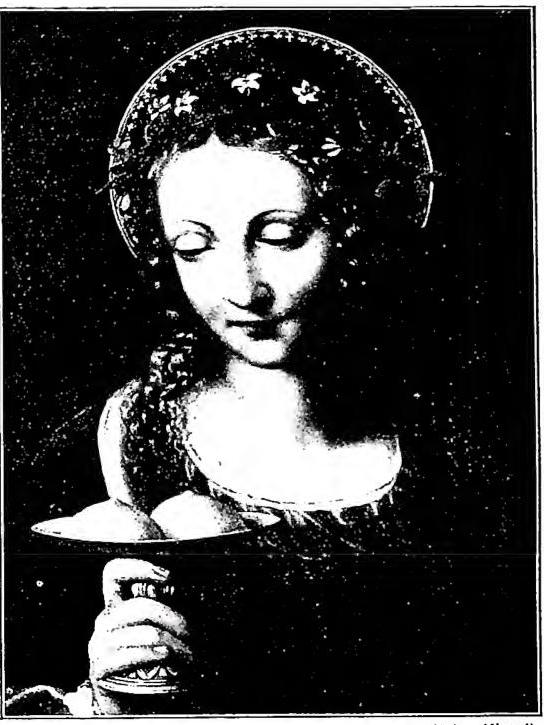
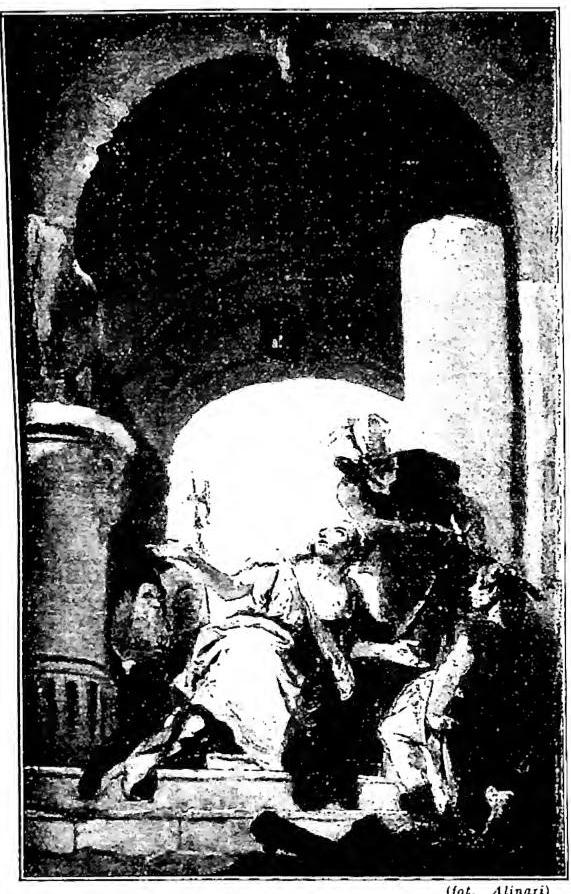
S. A. IN ART. — Up until the fourteenth century she was depicted only generically as a martyr. Subsequently she acquired two categories of individual attributes: the tongs, or more often a plate with her severed breasts, derive directly from the Passio; the lit torch, which first appears in a statue in St Stephen’s Cathedral in Vienna in the fourteenth century, together with a house in flames (Herlin’s panel of c. 1470 in St George’s, Dinkelsbühl), a candle or a loaf (almost exclusively in Swabian–German sculpture at the end of the fifteenth century) point to A. as a protector against fires. The spread of her cult, which ensured her frequent appearance in sacred conversations, means that her numerous images in the late-Gothic German altarpieces are matched at the same time by no small number of Italian depictions (Borgognone, Accademia Carrara, Bergamo; a copy after Luini, Rome, Galleria Borghese). Among the cyclical representations of the legend, already traceable in twelfth-century miniatures, noteworthy are those by Giulio Campi in the church of S. A. in Cremona; for the principal scene of the martyrdom, Michelangelo’s painting by Sebastiano del Piombo (1520, Florence, Pitti) and another by Tiepolo in Berlin.
Besides the “fercolo” or “bara,” the bier with the statue of the saint, dragged by the members of the confraternity of St A., who have replaced the ancient “barefoot penitents” and wear the “sacco,” a wide white tunic, characteristic of the solemn procession are the “cerei” or “candelore,” large wooden structures resembling an enormous candle adorned with lights, small flags, figures, and sculptures: they are carried on the shoulders by the various guilds, first among them that of the “rinoti” (a kind of market-gardeners). The illuminations, which accompany the procession and blaze out on all the façades of the houses along the endless route, are also one of the salient features of the feast, which is celebrated twice a year: on 5 February and towards the end of August, since on the 17th of that month the return of the relics of the saint to Catania took place.
Among the popular ceremonies that precede the feast, poetic contests are to be noted, in which songs (especially in ottave) are improvised in honour of the saint. According to oral tradition the virgin A. was a weaver of extraordinary beauty who, like a Christian Penelope, undid by night the cloth woven by day to put off the hated nuptials; from this episode some Sicilian proverbs have arisen. Thus, in relation to the other episode of her martyrdom, the saint is invoked by women suffering from breast ailments. And in certain villages where bread is made at home, it is customary to leave some pieces, which, from their shape, are called “minnuzzi di sant’Aâti.” Very characteristic is the procession held in honour of the saint in the republic of San Marino: it features a mystery play with maidens dressed as symbolic figures such as Faith, Religion, and Science.
AGATA, santa
La leggenda di s. A. ha dato origine a varie opere letterarie. Fra le più antiche è da ricordare il poemetto latino di Venanzio Fortunato (sec. VI), che canta le sue lodi in 21 strofe. Nel sec. XIII, Jacopone da Todi compose un laudario in onore della santa, e nel sec. XIV, il fiorentino Domenico Cavalca ne scrisse una vita in volgare. Nel Rinascimento, il Poliziano compose un poemetto latino in suo onore, e il Tasso, nella Gerusalemme liberata, la ricorda come esempio di virtù cristiana.
AGATA, santa
S. A. NELL'ARTE. — Il culto di s. A. ha dato origine a numerose rappresentazioni artistiche. Fra le più antiche sono da ricordare i mosaici delle basiliche di Ravenna (sec. VI), che la raffigurano con la palma del martirio e il libro, simboli della sua verginità e della sua fede. Nel Medioevo, la sua iconografia si arricchisce di nuovi elementi: le vengono attribuiti i seni strappati, che tiene in un piatto, e il ferro rovente con cui fu minacciata. Nel Rinascimento, la sua figura è rappresentata da artisti come Raffaello, il Luini, il Tiepolo, che ne hanno lasciato pregevoli opere. Fra le più note sono da ricordare la pala di Raffaello (1517, Catania, duomo), la copia dal Luini (sec. XVI, Roma, Galleria Borghese), e il martirio di s. A. del Tiepolo (sec. XVIII, Venezia, Museo Correr).
Nel Barocco, la sua iconografia si arricchisce di nuovi elementi simbolici: le vengono attribuiti il giglio, simbolo della purezza, e la colomba, simbolo dello Spirito Santo. Anche nella scultura, la santa è rappresentata in numerose opere, come il busto di s. A. del Bernini (sec. XVII, Roma, basilica di S. Pietro).