SAVIO, FEDELE

SAVIO, FEDELE. - Gesuita, storico, n. a Saluzzo il 31 genn. 1848, m. a Roma il 18 febbr. 1916.

SAVIO, FEDELE. – Jesuit, historian, b. at Saluzzo on 31 Jan. 1848, d. at Rome on 18 Feb. 1916.

Article illustration
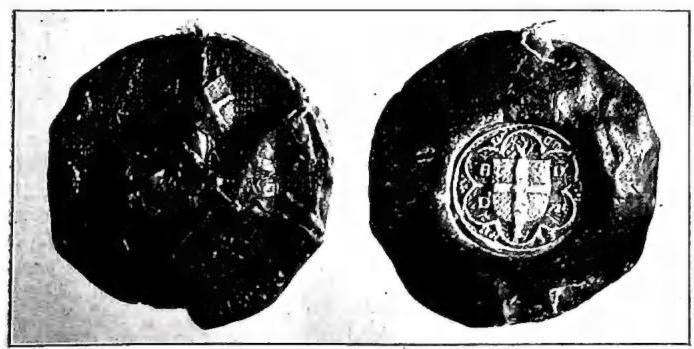
Savola, casa di – Large wax seal in green wax, with counter-seal in red wax of Count Edoardo, who reigned from 1323 to 1329. The equestrian figure and the counter-seal (zo[ul]sso[ue] cosese sabaub[ies]) bear the arms (a silver cross on a red field (in the seal the f

Having already been ordained a priest in the Order on 6 Nov. 1873, he taught history first at the College of the Visitation in Monaco-Principality, then at the Istituto Sociale in Turin; in the period 1893–94 he was attached to the writers of *La Civiltà Cattolica*; subsequently, returning to Turin, he devoted himself to teaching and to the publication of his works, until in 1906 he was called to the chair of ecclesiastical history at the Gregorian University.

His numerous historical works deal with the history of Italy and the history of the Church; among the former are to be noted: *Studi storici sul march. Guglielmo III di Monferrato ed i suoi figli* (Turin 1865); *I primi Conti di Savoia* (ibid. 1887); *Le famiglie della Rovere e Tana, pa-renti di s. Luigi Gonzaga* (Pisa 1890); *I conti di Ventimiglia nei secc. XI, XII e XIII* (Genoa 1894); among the latter, very numerous, are cited: *Dell'origine dell'abbazia di S. Michele della Chiusa detta la Sagra di S. Michele* (Turin 1888); *Il papa Vigilio* (Rome 1888); *Il papa Zosimo, il Concilio di Torino e le origini del primato pontifizio* (ibid. 1906); *Il 3° Centenario del card. Baronio*, Rome 1907; *La questione di papa Liberio* (ibid. 1908); *Nuovi studi sulla questione del papa Liberio* (ibid. 1911); *Punti controversi nella questione di papa Liberio* (ibid. 1911); *L'apparizione della Croce e la conversione di Costantino Magno*, Rome 1913; but above all the principal work: *Gli antichi vescovi d'Italia dalle origini al 1300, descritti per regioni*: I. *Il Piemonte*, Turin 1898; II. part 1°, Milan, Florence 1913; posthumous, part 2°, vol. I. Bergamo, Brescia, Como, Bergamo 1929; vol. II. Cremona, Lodi, Mantua, Pavia, ibid. 1932. To these may be added studies on the legends of St Syrus, of SS. Faustinus and Jovita; Nazarius and Celsus; Fidelis, Alexander, Carpophorus and other martyrs, etc.; and the school texts of *History of Italy* and *History of the Church* for higher and lower schools.

BIBL.: [L. Profumo], Necrologio in *Civ. Catt.*, 1916, 1, pp. 625–27; G. Celi, *Il p. F.S. e l'opera sua negli studioricci*, in *Civ. Catt.*, 1917, 1, pp. 678–91; II, pp. 34–49, 294–321 (separate offprint).

Cicastino Testore

SAVOIA, CASA di. – The House of Savoy appears in the history of western Italy at the beginning of the 11th century. Its earliest feudal lords are found in the Alpine valleys: on the eastern slope, in the Aosta Valley; on the western slope, in the valleys of Maurienne, Savoy, and even in the Viennois. The first representative of the dynasty is Count Humbert, later surnamed White-Hand. All attempts to trace his ancestors have failed; he was probably a feudatory linked with various feudal dynasties of the region. After the death of Rudolph III, last king of Burgundy (d. 1032), he assisted Emperor Conrad II in securing the kingdom by repelling the claimants. Thanks to his loyalty to the Empire, Otto, Humbert’s son, received from Henry III the governorship of the March of Turin and consent to marry Adelaide, heiress of the local marquessal house. Owing to the conflict between the emperors and the counts of Savoy, these latter soon encountered grave difficulties in retaining the March: relations between the Savoyards and the emperors of the House of Staufen were, throughout the 12th century, either cold or openly hostile. The counts of Savoy posed as absolutely independent and succeeded in allying themselves with the Houses of France and England, securing cordial support against the Empire.

The political crisis of the 13th century, arising from the struggle between Papacy and Empire, enabled the Savoyards to acquire notable importance in international relations, both between popes and emperors and between the kings of France and England. In their expansionist policy, three main directions emerge in the 13th century: in the Po Valley, on the Swiss plateau, and in the Rhone Valley. At first glance their policy appears to have a merely patrimonial character. In Italy they asserted their proprietary rights over all the territories that two centuries earlier had formed part of the March of Turin, of which they had retained only a few strongholds in the Susa Valley and between the Chisone and Pellice valleys; their aim was to reach Turin by overcoming the claims of the local commune, the bishop, and the marquess of Montferrat. Beyond the mountains, their programme was to transform slowly into a continuous and compact territorial possession that network of feudal rights, monastic and ecclesiastical protectorates already formed with the less openly avowed purpose of restoring Burgundian unity between the Rhine and the Rhone—a unity that only they could attempt from that Savoy which was the principal crossroads of routes. Thus for the Savoyards the Alps were not lines of demarcation but the true centre and focal point of their activities. Without resorting to arms, they entrusted their advance in the three theatres chiefly to a skilful policy of marital alliances, cessions, and infeudations by princes, bishops, and abbots; often relying on the voluntary submission of populations who saw in them not figures of cruel tyrants and exploiters but princes who were rough, simple, and ready to grant protection against violent princes and territorial disorder. Wherever the Savoyards encountered fierce resistance. In Italy, those lords descending from the Alps first faced opposition from the marquesses of Saluzzo and Montferrat, the counts of Piedmont of the House of Anjou, and later the Visconti of Milan. On the Swiss plateau, after the dukes of Zähringen, the counts of Savoy clashed with the counts of Kyburg and then with the counts of Habsburg. In the Rhone Valley the most tenacious opposition came from the Dauphins of Viennois. From Frederick II in Italy they obtained the two cities of Turin and Ivrea (1248): the possessions of the two Dora valleys tended to link up. The two cities were retaken, but recovered: Turin definitively in 1281, Ivrea several decades later. On the Rhone the Bresse was absorbed, and Lyon, though coveted by the monarchy of Paris, was eyed longingly. On the Swiss plateau they took root in Valais and Vaud, facing the Habsburgs. And all this was achieved despite inevitable family dissensions and the minorities of princes, often prolonged, such as those of Humbert III and Thomas I. In 1263 with Boniface, son of Amadeus IV, the senior line died out: the county passed successively to the younger brothers of Amadeus IV, Peter II, then Philip I. In 1285 the Savoyard inheritance was taken up by a nephew, Amadeus V, who detached the Piedmontese domains for his brother Thomas’s already deceased son, Philip, surnamed of Achaea for the principality brought to him in dowry by his wife Isabella of Villehardouin; thus he created for his brother Louis the county of Vaud. Three dynasties, therefore, three centres of activity and expansion.

When, in 1418, the Duke of Savoy unified all the domains of the House, the power of the House of Savoy demonstrated the progress made in little more than a century. Modest on the Swiss plateau around Lake Geneva, on the Rhône, the Dauphins of Vienne had been replaced by the kings of France, and the advance southward toward the sea to achieve the fortunate annexation of Nice seemed impossible. Instead, the expansion in the Po Valley was prodigious: the Marquises of Saluzzo and Monferrato were confined within the narrow boundaries of their old domains, the Visconti of Milan were pushed back to the line of the Sesia, and the domains of the Angevins had disappeared. The Savoyard State of Piedmont now included flourishing cities: Ivrea, Chieri, Biella, Mondovì, Cuneo, Fossano, and Savigliano. More than a State, it was a complex of cities and territories that obeyed the same Lord. Amedeo VIII (v.) in 1418 obtained from Emperor Sigismund the title of Duke and occupied a distinguished place among European princes; from the Duchy of Milan, he managed to obtain Vercelli and all its territory as far as the Sesia, and from there he looked toward the line of the Ticino and contemplated how to obtain the entire Duchy of Milan through adoption or succession. His abdication allowed him to offer himself to the Council of Basel as a candidate for the papal throne, and, having now become Pope Felix V (v.), he would be induced to serve the interests of his family and country in the matter of Milan.

By the mid-15th century, the process of fortune and development of the House of Savoy came to a halt. In France, the monarchy, having concluded the war with England, could resume its old policy of expansion in Italy. The Savoyards were too weak to resist alone; they relied on the Dukes of Burgundy, but after the collapse of the power of Charles the Bold, they had no more support. Amedeo IX left the government to his consort, Yolanda of France.

Article illustration
(from G. Gusti Camojoni, *Dic. araldico*, ed. Milan 1951, p. 271)

SAVOY, HOUSE OF — Great arms of the Kings of Savoy quartered for alliances, pretensions, and dominions, after 1718, resumed by Vittorio Emanuele I at the Restoration (1812), and preserved unchanged by Vittorio Emanuele II and his successors.

Article illustration
(from F. Capuino, *Il conte Ferde*, Tofino 108, pp. 11429)

SAVOY, HOUSE OF — The Madonna of Lausanne between the arms of Amedeo VI and the collar of the Knights of the Collar in its primitive form with the reverse. Drawing from 1382 in the act of establishment by Count Amedeo VI of a Mass in the cathedral of Lausanne.

The sons who succeeded him, Filiberto I and Carlo I, ascended the throne as minors with limited possibilities. In 1496 a new branch of the family came to power: Filiberto II, called the Landless, younger son of Ludovico. Dark years for Italy and for the Savoyards.

In 1536 Francis I resolutely decided to occupy the Duchy of Savoy so as to counterbalance Habsburg control of the Duchy of Milan. More to close the door to France’s access to Italy than out of affection for Charles V’s Savoyard nephew, he hosted the young heir of the House, Emanuele Filiberto, and supported his rights. Only after the Battle of Saint-Quentin, when France and Spain were reconciled, did the great captain recover his States, on the condition that he marry the aged Margaret of Valois, sister of Henry II. Contrary to expectations, from this union was born the continuer of the dynasty, Carlo Emanuele. Only then were the Savoyards secure in their possession of ancestral domains. The peace that reigned for several decades after the Treaty of Cateau-Cambrésis gave Emanuele Filiberto the opportunity to attend to the reconstruction of the State.

Among the Italian States, the Savoyards now asserted themselves with an authority and military strength that none had seen before.

The French Wars of Religion gave Carlo Emanuele I the means to resolve the problem of Saluzzo by exchanging the Bresse as stipulated in the Treaty of Lyon (1601). This was the first example of Savoyard territorial exchange policy with France to gain enlargements in Italy. Carlo Emanuele, however, failed to resolve the problem of Monferrato, though he did not hesitate to enter into war with Spain without any assistance. His heir, Vittorio Amedeo I, concluded the great conflict with an unhappy, though provisional, solution; by the Treaty of Cherasco (1631), he obtained part of Monferrato—Alba and Trino—but had to cede Pinerolo to France. The French thus recovered the gateway into the peninsula, and the Savoyards had to bite the bullet. This was the case during the two reigns of Vittorio Amedeo I (1630–37) and Carlo Emanuele II (1638–75), an age in which European conflicts barely touched the Italian peninsula. But the great wars that began in the last decade of the century brought Italian questions to the fore once more. Vittorio Amedeo II sought to exploit the possibilities to recover independence and resume expansionist designs, maneuvering between the warring parties. From the War of the Spanish Succession, he gained Alessandria and that part of Monferrato which his grandfather Vittorio Amedeo I had not obtained at the Peace of Cherasco; the Lomellina and Valsesia, so as to complete the territory of Vercelli; and Sicily with the royal title. He was then forced to exchange Sicily for Sardinia, easier to govern and to integrate into Savoyard domains. And the royal title had its importance.

Carlo Emanuele III continued his father’s work. The Wars of the Polish and Austrian Successions brought him the conquest of all territories as far as Lake Maggiore and the Ticino; south of the Po, possession of the Oltrepò Pavese allowed him to make contact with the Emilian duchies. Thus was this great State formed—a complex of lands called Piedmont, with its old name, which in the 12th century had set out from the Cottian Alps, and which now faced more than ever the problem of relations with Genoa. The Savoyard State’s balance was unstable after the Peace of Aix-la-Chapelle: the movement of ideas that manifested itself in Turin in the mid-18th century expressed this situation of uncertainty, of contrast between aspirations and present difficulties, the fear that the country’s real forces were not sufficient to sustain the edifice that Savoyard diplomacy and arms had constructed. And after 1748, the Savoyards confined themselves to neutrality under the weight of the Bourbon-Habsburg union, and when this broke apart during the period of the French Revolution, the Savoyards were sacrificed between the cupidity of revolutionary expansionism and the calculations of Austrian policy, eager to recover what the Savoyards had gained during the 18th century. Vittorio Amedeo III preferred the alliance with Vienna to submission to France: the result, after the heroic defense in the Alps, was the Armistice of Cherasco, then the abandonment of Turin and retreat to loyal Sardinia.

In 1814, Vittorio Emanuele I, returned to Turin, sought to restore dynastic tradition. But the problems of the 18th century reappeared. Even enlarged by Liguria, the Savoyard State could not remain—

Article illustration
SAVOY, HOUSE OF

Rape in the Past

After the conservative policies of Charles Felix (1821–31), the new branch of the House of Savoy-Carignano, which ascended the throne with Charles Albert, resumed the program of expansion along the Po Valley that had already been outlined by Piedmontese politicians in the eighteenth century. The idea of an Italian confederation had already shown its fragility when compared to Turin on the eve of the Revolution; in the discussions of the Risorgimento, precisely because it originated from Naples and especially from Rome, it was destined to encounter—and did encounter—all possible obstacles in Turin for evident dynastic and prestige-related reasons. Thus, the House of Savoy increasingly adopted in its policies the liberal and unitary program, which at least apparently aligned with the expansionist tendencies of the previous two centuries, ever since Charles Emmanuel I had appealed to all Italian forces against the foreigner. The policies of Charles Albert and later those of Victor Emmanuel II (q.v.) therefore appeared, more than they actually were, as the straightforward unfolding of a program that culminated in the construction of the Kingdom of Italy; so much so that after 1870 the Savoy monarchs at the head of the Italian state devoted their efforts to the organization of the nation’s political and social forces, implementing as far as possible the provisions of the constitutional charter established in 1848 by King Charles Albert. — See pl. CXXXI–CXXXII.

**

BIBL.:** For the origins of the dynasty, C. W. Previte-Orton, *The early history of the House of Savoy*, London 1912; F. Cognasso, *Umberto Biancamano*, Turin 1937 (discussion of theories). For the medieval period, I. Cibrario, *Storia della Monarchia di S.*, Turin 1840 and F. Cognasso, *Amedeo V, VI, VII, VIII*, in Enc. Catt., I, cols. 1023–26. For the modern period (18th century), E. Ricotti, *Storia della monarchia piemontese*, Florence 1861–69. For Savoyard foreign policy, F. Cognasso, *I Savoia nella politica europea*, Milan 1941, and more extensively, D. Carutti, *Storia della diplomazia della Corte di S. dal 1644 al 1773*, Turin 1875–80. Extensive bibliographical information in R. Moscati, *Direttore della politica estera sabauda da Vittorio Amedeo II a Carlo Emanuele III*, Milan 1941. For the period after 1814 see the work of N. Rodolico on Charles Albert (Florence 1930–43) and that of F. Cognasso on Victor Emmanuel II (Turin 1942). See also the conferences by various authors in *La Monarchia Piemontese*, Rome 1952. For a systematic bibliography on the Savoy see A. Manno–V. Promis, *Bibl. stor. degli Stati della Monarchia di S.*, I, Turin 1884. For sigillography and analysis of the Savoy see L. Cibrario–C. Promis, *Sigilli de’ principi di S. raccolti e illustrati*, Turin 1934; L. Rangoni Machiavelli, *Strenni della R. Casa di S.*, offprint from *Boll. Uff. della Consulta araldica*, 1931; id., *Titolatura dei conti di S.*, Rome 1931.

---

### EUGENE

He belonged to the cadet branch of Savoy-Carignano, founded by Thomas, Prince of Carignano, son of Charles Emmanuel I. Born in Paris on 18 October 1663, he was the son of Maurice of Savoy, Count of Soissons, and Olimpia Mancini, niece of Cardinal Mazarin.

Destined, as a cadet, for an ecclesiastical career, in 1683 he turned instead to a military life. Facing the hesitation of Louis XIV, he left Paris and joined the imperial army in time to take part in the liberation of Vienna from the Turks; he never again left imperial service. His qualities of cool composure and clear-sighted grasp of military situations earned him the esteem and trust of commanders. His career was rapid: in 1694 he was given command of imperial forces in Italy during the War of the League of Augsburg and intervened in Piedmont to aid his cousin Victor Amadeus II, Duke of Savoy; in 1697 he assumed supreme command of imperial forces in Hungary against the Turks, and the resounding victory at Zenta (11 September 1697) sealed his fame. In the War of the Spanish Succession he led imperial armies in Italy, winning the Battle of Turin (7 September 1706), and in Flanders, where he repeatedly triumphed at Oudenarde, Malplaquet, and Höchstädt in Bavaria. He then took part in the peace negotiations at Utrecht, displaying the same clarity and firmness. His particular merit was the Treaty of Rastatt in 1714. The resumption of war with the Turks recalled the prince to the Danube: in 1716 he won at Petrovaradin, in 1717 he captured Belgrade, and in 1718 concluded the Peace of Passarowitz. After 1720 he lived in Vienna, occupying the highest government offices and devoting his leisure to creating in his Belvedere Palace a great library and a remarkable collection of paintings, for his spirit was open to the enjoyment of letters and the arts. In 1733, with the outbreak of the War of the Polish Succession, despite his advanced age he resumed command of the army. He died in Vienna on 21 April 1736 and was buried in St Stephen’s. He left behind a great reputation among friends and enemies alike for his rectitude and his spirit of faith. He wished no family and avoided the storms of passion; throughout his life he knew only the love of duty.

**

BIBL.:** A. von Arneth, *Prinz Eugen von Savoyen*, 3 vols., Vienna 1858–64; I. Jori, *Eugenio di Savoia*, 2 vols., Turin 1934; H. von Srbik, *Aus Österreichs Vergangenheit*, Salzburg 1949, pp. 7–42.

Article illustration

---

### MAURICE OF SAVOY

Cardinal, third son of Charles Emmanuel I, Duke of Savoy, and of Catherine of Austria (Spain), born in Turin on 10 January 1595, died on 4 October 1657.

Destined for an ecclesiastical career, he received the red hat as cardinal-deacon from Paul V in 1607. He remained, however, at the court of Turin; in 1615, during the War of the Mantuan Succession, he served as lieutenant for his father in Piedmont; in 1618 he went to Paris to arrange in the name of his brother Victor Amadeus the marriage with Christine of France. In 1621 he settled in Rome, where he assumed the political dignity of cardinal-protector of France, and in 1630 he again went to Paris to finalize the peace agreements. In 1635, however, he switched to the Spanish party. After the death of his brother Victor Amadeus I, he joined with his brother Thomas, Prince of Carignano, in a struggle to wrest from their sister-in-law Christine the regency and tutelage of the new duke, Charles Emmanuel II, still a minor. To this end he concluded agreements with Spain and the Empire. The long civil war in Piedmont ended with an accord in 1642: having resigned the cardinalate, he married his young niece Ludovica, sister of Charles Emmanuel II, and was appointed governor of Nice. He had no children. In Turin he had built on the hill a magnificent villa (the so-called Villa della Regina, now the Institute of the Daughters of Military Personnel), where he founded the Accademia dei Solinghi.

The blessed and venerable members of the House of Savoy are treated under their respective names.

**

BIBL.:** G. Claretta, *La reggenza di Maria Cristina di Francia*, Turin 1868–69; R. Bergadani, *Carlo Emanuele I* (Collana Storica Sabauda), ibid. 1930; S. Foa, *Vittorio Amedeo I*, ibid. 1930.

Francesco Cognasso