
COSTANZA, MAUSOLEO di SANTA. — It was built by Costantina or Costanza, daughter of the emperor Costantino, as her mausoleum, when around 337 she settled in the praedium on the Via Nomentana (cf. F. Savio, Costantina figlia dell'imperatore Costantino Magno e la basilica di S. Agnese a Roma, in Atti dell'Accad. delle Scienze di Torino, 42 [1907], pp. 659, 732). Elements recently brought to light may confirm its use also as a baptistery. In a period distinct from that of the construction, the buttressed elliptical enclosure was added, delimiting a field for burials. Transformed into a church, it seems to have been restored in the time of Innocenzo III; Alessandro IV consecrated an altar there (1256). The artists of the Renaissance, who often depicted it in their drawings, regarded the building as a temple of Bacchus. At the beginning of the seventeenth century (1620) it was restored by Cardinal Fabrizio Veralli, who destroyed the remains of the dome’s mosaic.
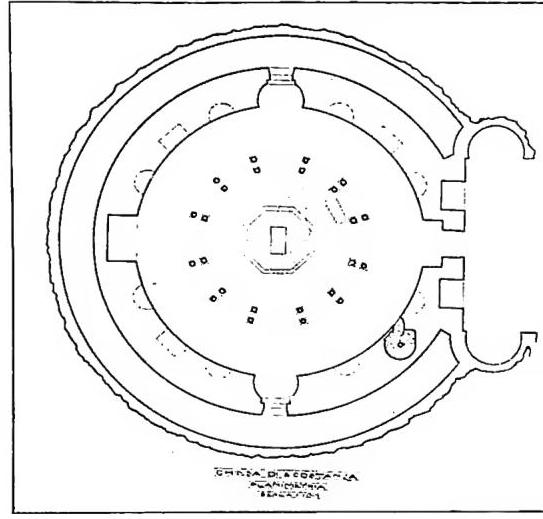
The construction is circular in plan, preceded by a forcipate atrium; twelve pairs of columns arranged radially and at somewhat irregular intervals, so as to suggest a cross, are connected by arches upon which rests the drum, with broad arched windows, and the dome. The latter has meridional brick ribs joined by a concrete mass. Between the central space and the perimeter wall runs an ambulatory
The interior of the mausoleum was splendidly decorated: the dome with mosaics perhaps representing scenes from the Old and New Testaments, and the drum with marble inlay; of both there survive only scant graphic records from the sixteenth century. The mosaics of the annular vault are preserved, although greatly altered by the restorations of the nineteenth century; various compartments reproduce geometric motifs or bands or circles derived from Roman mosaic pavements and from textiles, while others depend on litostrati of the asiroton type, though purged of all excessively stark realism; in still others there are vine scrolls with busts and vintage scenes, an evident allusion to the «vinea Domini». Similar scenes appear on Costantina’s porphyry sarcophagus, now in the Vatican Museum and originally from this very mausoleum. The mosaics, which are decorative in character, were still executed with an impressionistic taste and are either neutral in subject or contain vague allusions to the new religion. Those in the contemporary apses, however, are Christian in subject, with the «traditio legis» and the «traditio clavium», among the earliest examples of such subjects. — Vedi tav. XLV.