
COSMATI. - This generic designation includes the marble-workers active in Rome, in various localities of Lazio, and generally in central Italy, from the twelfth century to the early fourteenth, belonging to different families in some of which the name Cosma frequently recurs. Essentially, they were decorators who produced ecclesiastical furnishings such as ambons, ciboria, cathedrae, and plutei, combining a certain classicizing taste with the preference for colour disseminated by the Byzantines in southern Italy—that is, enriching their works with inlays of porphyry, serpentine, and bands of mosaics, while always leaving, unlike the Campanian or Sicilian marble-workers, ample scope to the white ground which frames and confines, restraining them, the coloured surfaces. In this respect they were refined decorators, since they maintained a living balance between the surface to be decorated and the polychrome ornament. When they turned to architecture, they did not concern themselves with the complex structural problems of the Lombards and, without troubling themselves with volumetric investigations, they sometimes raised their buildings in the most ancient churches lacking chromatic decoration (S. Maria di Falleri), with an innate taste for classicizing proportions, rhythmically disposing solids and voids and punctuating every monotonous recurrence of motifs with harmonious pauses.
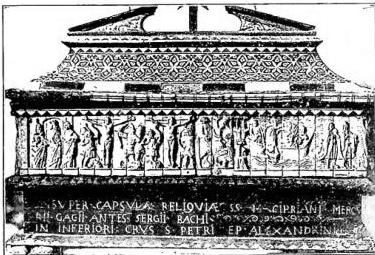
COSMA E DAMIANO, saints, martyrs - Ivory reliquary with scenes of the martyrdom of SS. C. and D., the work of Baldo degli Embriachi (fourteenth-fifteenth century) - Amalfi, chapel of the Choir.
The families and works are numerous. A marble-worker, Paolo, was active at Ferentino at the beginning of the twelfth century and had four sons (Giovanni, Pietro, Angelo, and Sassone), who together erected in Rome the ciborium of S. Lorenzo (1148), and subsequently those of S. Marco, SS. Cosma e Damiano, and SS. Apostoli (the latter three no longer exist), and, without Pietro, that of S. Croce in Gerusalemme. Nicola, son of Angelo, worked at Gaeta (probably not on the bell tower, as others believe), carved with the Vassalletto the candlestick of S. Paolo, erected the ciborium of S. Bartolomeo all'Isola, and finally worked at Sutri with his son Iacopo, of whom only imprecise evidence remains. Drudo de Trivio erected the ciborium of Ferentino, collaborated with Luca di Cosma on the plutei of Civitacastellana, and with his son Angelo on a ciborium at Lanuvio.
A marble-worker, Ranuccio, worked at S. Maria Maggiore in Tuscania, and his sons Pietro and Nicola on the portal of S. Maria in Castello at Tarquinia; Giovanni and Giuttone, sons of Nicola, at S. Andrea in Flumine at Ponzano and later on the altar and ciborium of S. Maria in Castello; other relatives of theirs also worked in various centres of Lazio.
COSMATI - Ambo in the cathedral of Terracina (13th century).
the pavement of the crypt of Anagni and completed the cloister of Subiaco.
Cosma di Pietro Mellini designed the chapel of the Sancta Sanctorum, in Gothicizing forms; he had three sons: Iacopo, a decorator of pavements; Giovanni, who executed various tombs at S. Maria Maggiore, at the Aracoeli, and elsewhere; and Deodato, who carved an altar of the Magdalene at the Laterano and the Gothicizing ciborium of S. Maria in Cosmedin.
Another great family of Roman marble-workers was that of the Vassalletto. Pietro collaborated on the ciborium of S. Paolo, the only entirely figurative work in Roman production; he executed an ambo at S. Pietro (1190), works not precisely identified at Segni (1185), and the schola cantorum of S. Saba, demonstrating more than any other, in the solidity of his carving, the assimilation of classical modes, partly also drawn from the decorative repertoire of the Etruscans. His masterpieces are the cloisters of S. Paolo fuori le mura and of S. Giovanni in Laterano, which he began alone and completed with his son Vassalletto: works of admirable balance in the rhythmic articulation of the piers, the felicitous proportions of the small arches, the refined elegance of the decoration, the firmness of the carving, and the liveliness of the colour distributed in mosaic veins upon the paired and ever-varied little columns, or condensed into discs and rectangles beneath the cornice carved with foliage and grotesque masks. With greater sobriety of colour and a more refined sense of proportion, the same marble-workers erected the portico of the basilica of S. Lorenzo fuori le mura.
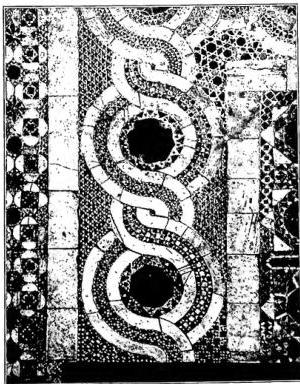
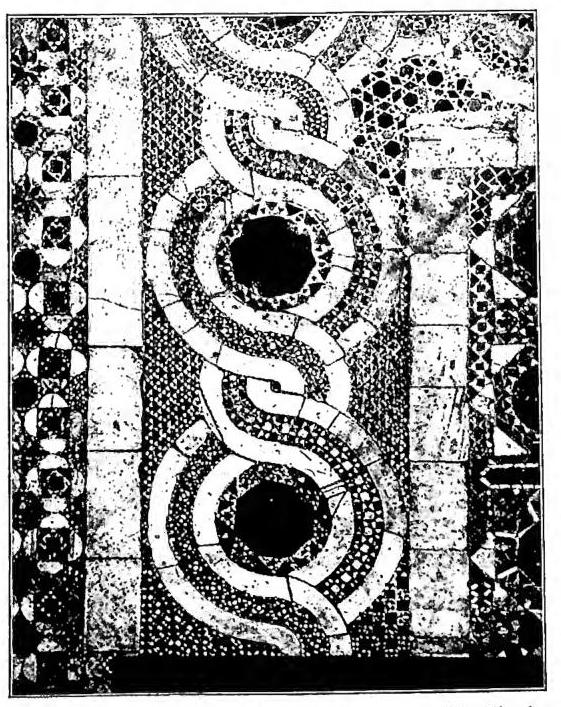
COSMATI – Floor in «opus sectile» (12th century).
Sassovivo near Foligno, Pietro Amabile, active in Umbria and Abruzzo. Many splendid works, distinguished by the use of broad colored elements that emphasize the architecture, are anonymous, such as, in Rome, the episcopal thrones of S. Balbina and S. Cesareo, the ambones of S. Clemente and S. Lorenzo, and the ambones and the schola cantorum of S. Maria in Cosmedin, where Pasquale marmorano signed the candelabrum. The enumeration could be extended to the floors, true carpets of precious color, in which the motifs continually vary with almost inexhaustible vivacity and imagination.
Educated in a taste for color that has distant origins in classical art, and which it is possible to see preserved in the early Middle Ages in rare fragments of paving, supported in this direction by their contacts with Byzantine art, which had a center of expansion near Rome in the abbey of Grottaferrata, the C., while preparing church furnishings, refined their art by looking to antiquity and not infrequently achieved masterpieces even in works of architecture. At times they anticipated a Renaissance vision, like the Florentine authors of S. Miniato al Monte, and subsequently, during the fourteenth century, underwent Gothic influences; called to work in the cathedral of Gurk (c. 1200) and even in Westminster Abbey in London, they certainly exerted an influence on that great sculptor Arnolfo and on Maitani when he was designing the façade of Orvieto Cathedral. Their decorative system continued to be used for floors in Rome until the threshold of the sixteenth century. – Vedi tav. XXXIX.