Machine translation of the 1948–1954 Italian original. The original text is authoritative.
TARQUINIA (formerly CORNETO TARQUINIA) and CIVITAVECCHIA, DIOCESE of — Dioceses and towns, the former in the province of Viterbo, the latter in the province of Rome. The diocese has an area of more than 595 sq. km., with a population of 67,649 inhabitants, of whom 66,949 are Catholics, distributed among 14 parishes, served by 23 diocesan and 29 religious priests; it has one seminary, 8 male and 16 female religious communities (Ann. Pont. 1952, p. 395).
I. TARQUINIA. — An ancient Etruscan city in the province of Viterbo, on a hill situated to the left of the Marta River. It fought against Rome between 358 and 351 B.C., but without success. It became a municipium and flourished during the Antonine period. Having lost its ancient splendour, it abandoned its former site on the level hill and moved to another plateau, taking the name of Corneto; it later became a commune and extended its territory towards the Tyrrhenian Sea. It was unsuccessfully besieged by Frederick II and defended itself behind its walls and 25 towers; in the fifteenth century it passed under the lordship of the Vitelleschi, especially under Cardinal Giovanni. The splendour of this family is attested by the sumptuous palace erected in 1436, now the site of the Museum. The bishops of T. are mentioned in the Roman Synods of the years 465, 487, and 499; whereas in the Synod of 504 the bishop of Gravisca appears. In the year 852 T. had been reduced to a pievé and incorporated into the diocese of Tuscania. On 5 December 1435, Eugene IV detached the territory of Corneto from the diocese of Viterbo and Tuscania, raised the church of S. Maria and Margherita to cathedral status, and united it with that of Monte Fiascone. Pope Pius IX united Civitavecchia with T. on 23 July 1854; it is immediately subject to the Holy See. In the Roman baths, inscriptions were discovered in 1829 attesting that they had been erected by the Dasumii Tullii in the second century A.D. In Rome, in the cemetery of Callistus, a Dasumia Quiriace was buried in the third century (G. B. De Rossi, Roma sotterranea, II, Rome 1870, p. 185 ff.); a Dasumius Tullius had his monument on the Via Appia «ad mil(iarum) prim(um)». Among the Christian inscriptions discovered in T. is one commemorating a deceased person in the year 419. Among
(fol. Fotocisiera - Torino)
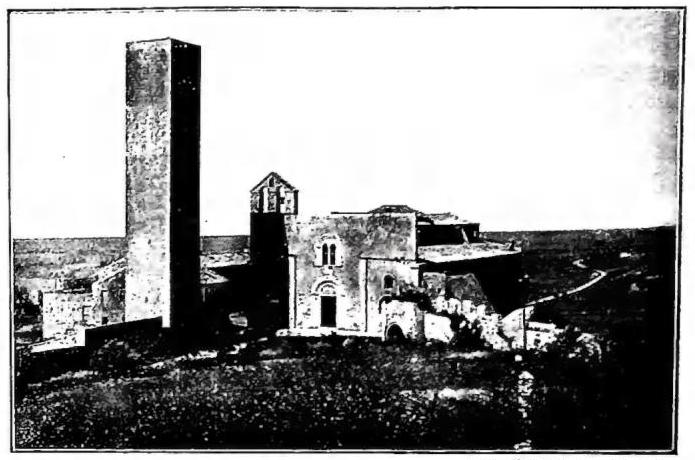
TARQUINIA and CIVITAVECCHIA, DIOCESE of — View of the church of S. Maria in Castello, begun in 1121 — Tarquinia.
the tombs of T., Christian terracotta lamps were found; built into the façade of the church of S. Giovanni is a fragment of a Christian sarcophagus with an orans and pastoral scenes.
The foundation stone of the church of S. Maria in Castello was laid in 1121; in 1143 the doors were ornamented and the work completed, as documented by the mosaic inscription on the door architrave; the persons placed in charge of the work on behalf of the people of T. were the prior Panvinio and the presbyter Giorgio; at that time the city was called Corneto. The marble worker Pietro, son of Ranucio, is also commemorated on the door. In 1168, under the prior Orso, the ciborium, the work of the two brothers Ottone and Guittone, was erected above the altar. The church was solemnly consecrated in 1208. Giovanni di Guittone was the author of the ambo for the Gospel (1209). The interior, which reveals Lombard influences, has three naves supported by pillars and arches, with an elliptical cupola damaged by the earthquake of 1819. The church also received a baptismal font, by an act of Honorius III dated 13 April 1221. Many epitaphs were placed in the pavement: one belonged to a girl named Cleopatra, another was set up by a Fl. Maximianus for an Aelia Silvina; however, they were brought, together with many others, by Roman marble workers of the twelfth and thirteenth centuries, whereas G. B. De Rossi considers the epitaph of an «Euticius confessor depositus 11 Kal. septembris in pace ✠» to belong to T. (Bull. arch. crist., 2nd series, 5 [1874], pl. 6).
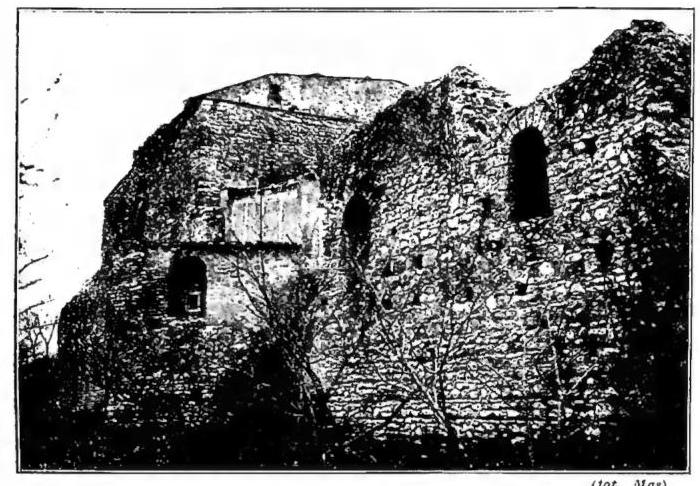
At the time of Albino and Cencio Camerario it was subject to the bishop of Tuscania (Liber censuum, ed. P. Fabre-L. Duchesne, I, Paris 1889, p. 56; II, ibid. 1905, p. 110), and the churches of S. Nicola in Corneto and S. Giovanni de Insula near Corneto are mentioned; in a rescript of Celestine III dated 23 May 1196, the church of S. Fortunata is recalled as dependent upon the abbey of S. Salvatore on Monte Amiata (Jaffé-Wattenbach, no. 17389). The church of S. Giacomo Apostolo, with a single nave, likewise reveals Lombard influences; that of S. Pancrazio dates from the thirteenth century; the S.ma Annunziata, now an orphanage, is of Cluniac type; S. Martino, S. Giovanni Gerosolimitano, and S. Salvatore also date from the thirteenth century; S. Francesco was rebuilt after the fire of 1642. Of considerable importance in the territory was the abbey of S. Maria de Minione (del Mignone), first mentioned in a privilege of the Emperor Louis II, who in 857 granted it to the monastery of Farfa; in the tenth century, however, it was contested by the monks of SS. Cosma e Damiano in mica Aurea in Rome (P. Fedele, Carte del monastero dei SS. Cosma e Damiano in Mica Aurea, in Arch. della Soc. rom. st. patria, 21 [1898], p. 476 ff.). The ruins of the castle of Countess Matilde di Canossa also remain. Recently the town resumed the name of T. Of great importance is the Etruscan necropolis, with tumulus tombs and the oldest underground chamber tombs (seventh–sixth centuries B.C.), containing a very rich series of frescoes dating from the sixth to the second century B.C. — Vedi tav. CXXVI.
BIBL.: G. B. De Rossi, I primitivi monumenti crist. di Corneto T., in Bull. arch. crist., 2ª serie, 5 (1874), pp. 81-118; id., Il pavimento di S. Maria in Castello di Corneto T., ibid., 2ª serie, 6 (1872), pp. 86-124; L. Duchesne, Le sedi episcop. nell'antico Ducato di Roma, in Arch. Soc. rom. di st. patria, 15 (1892), p. 48. For Etruscan T. V. M. Pallottino, T. (Monum. antichi dei Lincei, 36) Roma, 1936. For its history: L. Dasti, Natic. stor. archeol. di T. e Corneto, Roma 1878; P. Fr. Kehr, Italia Pontif., II, Berlino 1907, pp. 203-204. For the Palazzo Vitelleschi: P. Toesca, Il medioevo, Torino 1927, p. 581 ff. V. also: F. Guerri, Registrum cleri Cornetani, Corneto Tarquinia 1906. Enrico Josi
Cite this article
“TARQUINIA (GIÀ CORNETO TARQUINIA) E CIVITAVECCHIA, DIOCESI DI.” Enciclopedia Cattolica, vol. XI (1953), p. 1067. Azione Romana digital edition, https://azioneromana.com/article/tarquinia-gia-corneto-tarquinia-e-civitavecchia-diocesi-di.