
TARBES e LOURDES DIOCESE of. – City and diocesan see of the department of Hautes Pyrénées (southwestern France), situated on the left bank of the Adour. It has been united with Lourdes since 1912. The bishop resides at T. from April to November.
It has an area of 4,534 sq. km. and a population of 201,954, of whom 181,759 are Catholics, distributed among 488 parishes, grouped under the three archpriestships of T., L. and Lannemezan; it has 337 diocesan priests and 28 religious priests; a major and a minor seminary, 8 male and 92 female religious communities (Ann. Pont. 1953, p. 417).
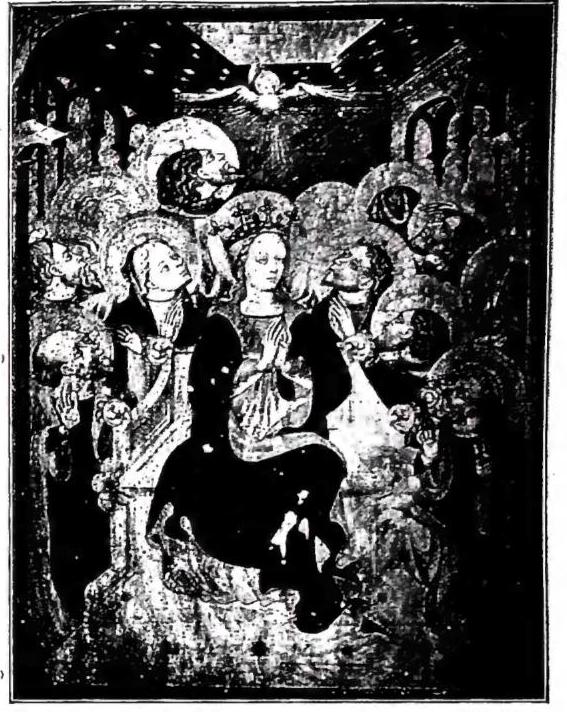
TARAZONA, DIOCESE of – La Diocesana dello Spirito Santo, Detail of the Retable of the Virgin of Hope (15th century) – Tudela, Cathedral.
and d’Aire. It was re-established by Pope Pius VII in 1817 with its present territory and as a suffragan see of Auch. By decree of the S. Congregation of the Council of 20 April 1912, b. Pius X established that, honoris causa, the bishop of T. should also assume the title of bishop of L. (AAS, 4 [1912], p. 338); Pope Benedict XV, by a bull dated 8 December 1917, granted the privilege of the sacred pallium to the bishop of T. and L. and to his successors, solely during ecclesiastical functions in the basilica of L. (AAS, 10 [1918], pp. 53-54). The patroness of the diocese is Notre Dame under the title of the Nativity.
The Cathedral, also called the See, is a building originally Romanesque that has undergone various alterations; the central nave is still Romanesque, with pointed vaults and a broad transept; the central apse is surrounded by two smaller apses; the high altar, with six columns of veined red marble from the Pyrenees, dates from the 18th century, as do the choir stalls and the wooden decorations of the nave. The baptismal font dates from the 13th century. Other churches are that of St. Teresa, or of the Carmelites, built in 1282, with a Gothic bell tower and renovated in the 15th century, and that of St. John, dating from the 18th century. The Museum of T. is located in the Massey Garden, founded in 1853; it contains archaeological and natural-history collections, sculptures and paintings; it is also home to the « Ecole des arts », founded in 1947, the headquarters of the Society « Les Amis des arts ». The cloister from the end of the 14th century of the former Cistercian abbey of St-Sever de Rustan has likewise been transferred to the same garden (Cottineau, II, col. 2889).
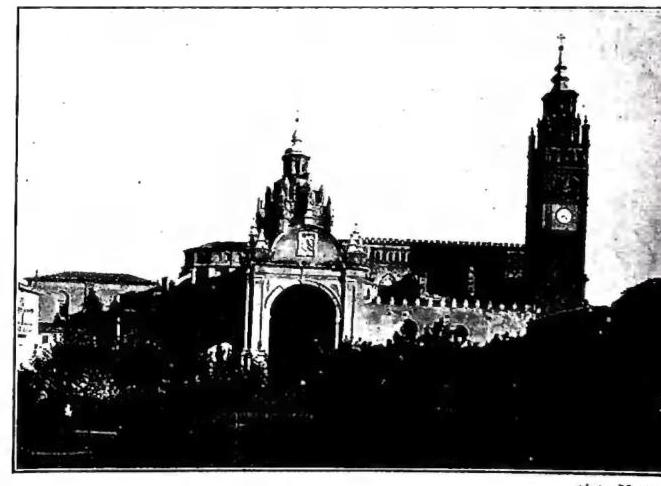
TARAZONA, DIOCESE of – Exterior of the Cathedral of Tarazona (13th-16th centuries).
Also in the same arrondissement is the ancient Benedictine abbey of St-Pé-de-Céneres, likewise dating from the 11th century; its church, dedicated to SS. Peter and Paul, was consecrated in 1096; the abbey passed to the Maurist Congregation in 1666 and was suppressed by the Revolution (L. Ricaud, L'abbaye de St-Pé, Mort et Résurrection, Bagnères-de-Bigorre 1912; Cottineau, II, cols. 2841-42). – Vedi tav. CXXV.