Machine translation of the 1948–1954 Italian original. The original text is authoritative.
TARANTASIA, DIOCESE of. — In the department of Savoie (France), with its episcopal see at Moutiers.
The diocese extends over more than 2,447 sq. km. in the arrondissement of Moutiers and partly in that of Albertville in the department of Savoie. It has a population of 52,340, of whom 50,000 are Catholics, distributed among 87 parishes forming 10 archpriesthoods. It has 112 diocesan priests and 13 religious priests (Assumptionists); it has a major and a minor seminary; 3 communities of men religious and 27 of women religious (Ann. Pont. 1953, p. 416). The diocese has the holy apostles Peter and Paul as its patrons.
The name of the diocese derives from Darantasia, the principal city of the region of the same name in the upper valley of the Isère; it is mentioned by Strabo and by Ptolemy, in the Itinerary of Antoninus and on the Peutinger Map, because it lay on the Roman road linking the valleys of the Rhône with the Val d’Aosta. This region came to be distinguished as upper, middle, and lower T. Moutiers owes its name to a monasterium founded in the 5th century; raised to the status of a diocese, it was at first under the metropolitan see of Arles, and subsequently under that of Vienne; in the 8th century it was raised to metropolitan status. In the struggle against the lords of Briançon, Humbert II, count of Savoie, intervened in 1097 and took possession of the entire region. The archdiocese became the metropolitan see of Savoie, with Sion, Aosta, and Moriana as suffragans; it was suppressed by the French Revolution and annexed to Chambéry; it was re-established as a simple diocese by Leo XII on 5 August 1825, as a suffragan of Chambéry. The first mention of the diocese occurs in a letter of Pope Leo I from 450, in which this see is placed under the archdiocese of Vienne (Jaffé-Wattenbach, no. 450). The first bishop was St. Giacomo (427–428), who had been a disciple of St. Onorato at Lérins; Sanctus was present at the Council of Epaona in 517: in his second homily, Avitus attributes to him the foundation at T. of a basilica of St. Peter; Marciano attended the Councils of Mâcon (581) and Valence (583); Baudomero attended the Council of Chalon-sur-Saône in 650; Andrea that of Lyon in 828; Teutramno attended the Council of Thuzey in 860: Gio-
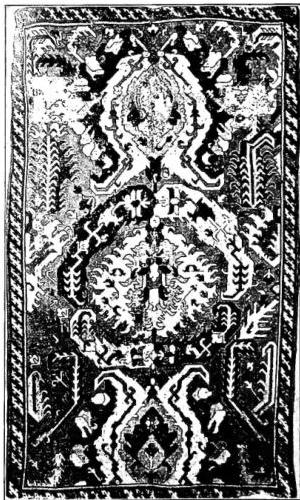
(from M. and V. Viale, Arazi e t. antichi, Turin 1921, pl. 110)
TAPPETO — So-called Armenian carpet with stylized dragons, from the Caucasus (18th century) — Genoa, Pietro Barbieri Collection.
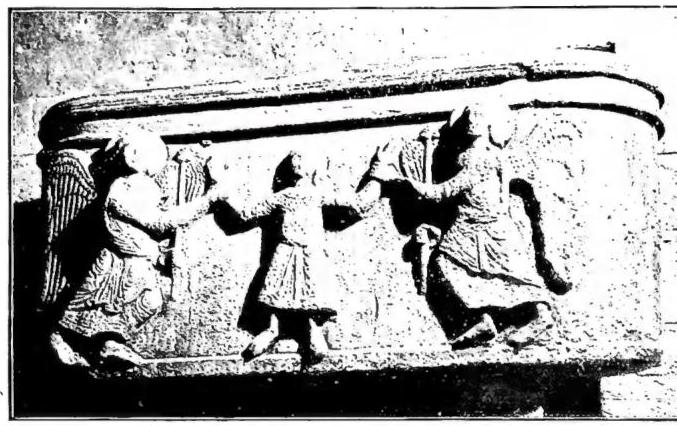
TARANTO, ARCHDIOCESE of — Medieval sarcophagus — Taranto. (photograph by De Vincensia)Giovanni VIII wrote to him in 878 (Jaffé-Wattenbach, no. 3150). Among the prelates of T. are also remembered St. Pietro I, around 1130, formerly a Cistercian abbot, as was Pietro II (1141–47), who established the charitable work of the Pain de mai; Rodolfo (1246–71) and Pietro III (1272–83), uncle and nephew of the Valdostan family Grossi; then Cardinals A. de Challant (1402–18; V. CHALLANT); J. D'Arces (1438–54); the two Della Rovere, Cristoforo (1472–78) and Domenico (1478–83), buried in Rome in S. Maria del Popolo; Germonio (1607–27), author of the Commentaria and the Acta Ecclesiae Tarentasiensis.
The cathedral, S. Pietro, repeatedly restored, preserves the crypt and choir from the ancient building, but the main nave dates from the 15th century; noteworthy are the group of the Pietà carved in polychrome wood; the episcopal chair is likewise carved in wood (15th century); the funerary monuments of Bishops Rochaix (1836) and Turinaz (1869); the portico dates from 1461. The Treasury is rich, with precious reliquary boxes in enamel, rock crystal, and carved wood, ivory statuettes, fabrics, etc. Attached to the Cathedral is the ancient archiepiscopal residence, with towers dating from the 14th century. The archbishops also possessed, near Tours-en-Savoie, the castle of Chautemerle (13th century).
A venerated shrine and destination of ancient pilgrimages is the church of Notre Dame de Briançon, restored in the 17th century. The Blessed Innocenzo V belongs to T. (v.). Pietro d'Aigueblanche, who was promoted in 1240 to the archdiocese of Hereford in England, also came from T. T. was annexed to France in 1860.
BIBL.: L. Duchesne, Fastes épisc. de l'ancien. Gaule, I, 2e ed., Parigi 1907, pp. 212 sgg., 243-45, 391, 769-71; H. Leclercq, Moutiers de Tarantasie, in DACL, XII, coll. 372-77; G. Pérouse, La Savoie d'autrefois, Chambéry 1933; Eubel, I, p. 474; II, p. 245; III, p. 308; IV, pp. 236-27; V, p. 368. Enrico Josi
Cite this article
“TARANTASIA, DIOCESI DI.” Enciclopedia Cattolica, vol. XI (1953), p. 1057. Azione Romana digital edition, https://azioneromana.com/article/tarantasia-diocesi-di.