
CHALLANT. – A powerful and illustrious feudal family of the Valle d’Aosta, probably originating from the marquises of Monferrato (11th century); from the counts of Savoy it received the viscountship of Aosta (late 11th century) and the lordship of Villa C. (13 April 1200), from which the family’s patronymic was derived, and from the abbots of S. Maurizio d’Agauno the investiture of the lordship of Graines (13th century), both situated in the Evançon valley. It relinquished the viscountship of Aosta in favor of Amedeo V (25 September 1295) and received from Amedeo VIII (15 August 1414) the hereditary comital title.
To it is owed the construction of the finest castles in the Aosta Valley and a substantial part of the works of art still existing in the Valley; it was a benefactor of the Church, not only in the Valley, but also in the numerous fiefs it possessed in Piedmont, France, and Switzerland.
This family, which later divided into five branches, reached the height of its fortune and glory in the 14th–16th centuries; thereafter, while continuing to hold a distinguished place among the nobility of the Savoyard States, it slowly declined until becoming extinct at the beginning of the 19th century. Mention is made here of some of its members, who exerci-
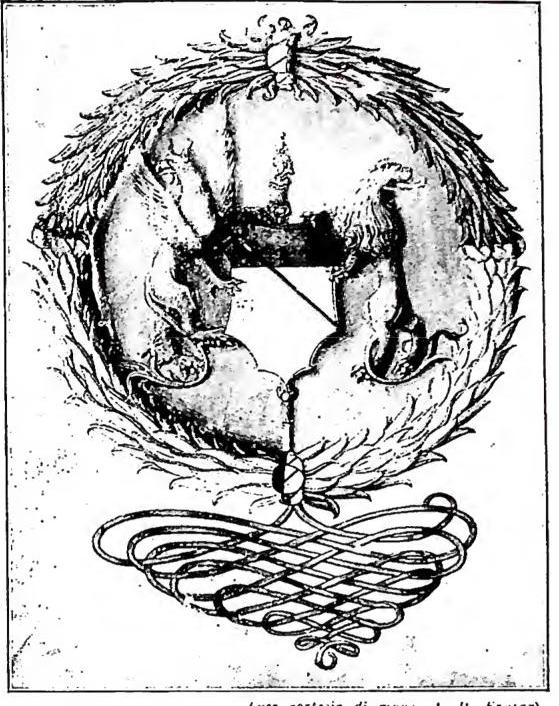
CHALLANT - Coat of arms of Prior Giorgio di C., with the bend charged with a golden ermine spot, the cadency mark of the C.-Varey. Missal of Giorgio C. (1499), owned by the counts Passerin d’Entreves-Aosta.
who exercised considerable political and religious influence, having attained the highest offices of the Savoyard state and of the ecclesiastical hierarchy.
(courtesy of mons. A. P. Frutaz)
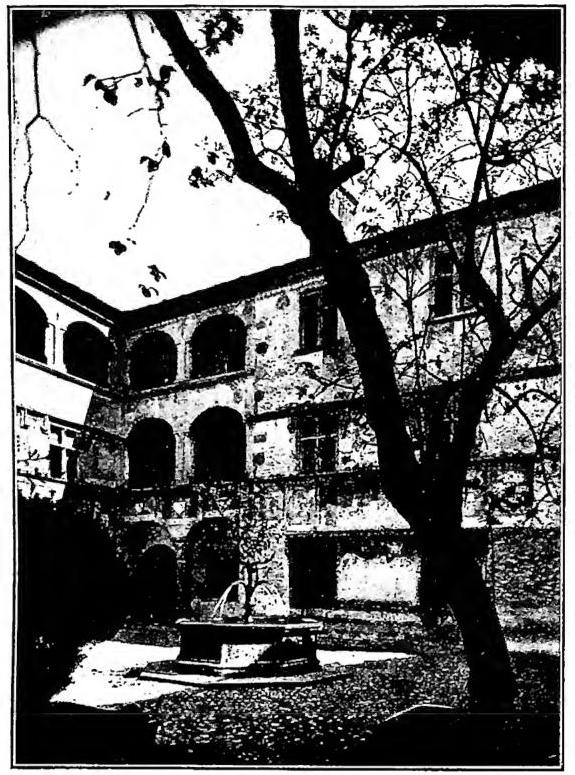
CHALLANT - Courtyard of the castle of Issogne. Wrought-iron fountain in the shape of a pomegranate tree (early sixteenth century).
archbishop of Tarentaise (3 Aug. 1404), papal legate to the court of France to induce it to obey Avignon; he took part in the conference of Livorno (June 1408) with the cardinals of Gregory XII, accepted the proposal for a general council, and returned to Benedict XIII, who repudiated the actions of his cardinals at Livorno; he took part in the Council of Perpignan (15 Nov. 1408–26 Mar. 1409), and, as president of the special commission, proposed that Benedict XIII go to the Council of Pisa or send ambassadors there with full powers to resign; he aroused the antipope’s anger, but managed to flee with his brother Guglielmo, bishop of Lausanne (Feb. 1409); in his capacity as metropolitan of Savoy, he convoked a synod and withdrew the region from obedience to Avignon; he appeared at the session of 10 June (1409) of the Council of Pisa, where he had to purge himself of the accusation of having supported Benedict XIII; after the convocation of the Council, he took part in the conclave for the election of Alessandro V, was released from every censure and reinstated in his benefices (1 July), read the decrees and proclaimed the closing of the Council (7 Aug.); he took part in the conclave for the election of Giovanni XXIII, of whom he became an ardent supporter; he was created cardinal priest of the title of S. Cecilia, chancellor and chamberlain; he fled Rome with Giovanni XXIII (June 1413), went with Cardinal Zabarella to the emperor Sigismund, who was in Lodi, to obtain his protection, and returned with the proposal for a Council to be convened at Constance, which Giovanni XXIII reluctantly accepted (July–Aug. 1413). The cardinal of C. entered Constance with a sumptuous retinue of 80 knights (23 Oct. 1414); throughout the Council he proved a supporter of Giovanni XXIII and of the Pope’s supremacy over the Council, but was charged with delivering the indictment against Giovanni XXIII (24 May 1415) and the decree of his condemnation (31 May 1415); he took part in the proceedings against Benedict XIII, who was condemned on 26 July 1417; he participated in the election of Martino V (8 Nov.
1417), and read the decrees of the Council, including the one that set the next Council for Pavia (19 Apr. 1418). He accompanied Martino V to Lausanne, where he was received by his brother Guglielmo (19 June 1418); having retired to Bulle, in the diocese of Lausanne, he died there on 13 Sept. of the same year and was buried in Aosta. GUGLIELMO, brother of the preceding, chancellor of Savoy (1404–1406), bishop of Lausanne (13 Aug. 1406–12 Mar. 1431); his political and religious activity was considerable; he founded the house of the Innocents (1419), a kind of small seminary, and, in his cathedral, the chapel of the Innocents, to whom he bequeathed his library and sacred furnishings. BONIFACIO I, brother of the preceding, accompanied Amedeo VI in the campaigns against Naples (1382–83), marshal of Savoy (1384–1418), secret councillor and intimate of Amedeo VIII (1405), delegate of the king of France to reconcile the dukes of Berry, Orléans and Bourbon and the counts of Armagnac with the king of Navarre, the dukes of Burgundy and Brabant, and the count of Nevers (Sept.–Dec. 1410), ambassador to Genoa (1378), Avignon (1379, 1411), Lombardy (1381), Naples (1381), Valais (1384, 1387), Paris (1394, 1398), Milan (1403), and France (1410, 1412, 1416); he died at Pierrechâtel on 26 Feb. 1426. AMEDEO, brother of the preceding, councillor of Amedeo VIII and frequently his ambassador, died in 1423. GIACOMO, son of the preceding, was frequently ambassador of the duke of Savoy; he met the antipope Felice V in the Aosta Valley and accompanied him to Turin (1449), took part in the conspiracy against the favourites of Duchess Anna of Cyprus and was exiled (28 June 1451), then reinstated in his offices (1456); he died on 14 June 1459. GIORGIO, nephew of the cardinal and son of Amedeo, lord of Varey, apostolic protonotary, archdeacon of Aosta, canon of Lyon (19 Nov. 1453), prior of S. Orso (ca. 1468), governor of the duchy of Aosta, rebuilt the castle of Issogne (1494 ff.), a great patron of the arts; he died on 30 Dec. 1509. RENATO, son of Filiberto, born in the Aosta Valley toward the end of 1503, lord of the principality of Valangin (Neuchâtel, from 1518), in his capacity as marshal of Savoy (1523–65), took an active part in all the critical political, military and religious events that made the times of the dukes Carlo III and Emanuele Filiberto so difficult; he served them with noble loyalty, to the point of enduring a long imprisonment and paying an enormous ransom (18 Nov. 1553–June 1555); he negotiated the Peace of Câteau-Cambrésis (1559) and established the Senate of Savoy at Chambéry (12 Aug. 1559). In his capacity as governor of the duchy of Aosta, he contributed effectively, in 1536, to removing the threat of Protestantism from the valley. He died at Ambronay in July 1565. Having designated as his heir, contrary to the customs of the Aosta Valley sanctioned by the Three Estates and to the family pact, first his daughter Filiberta and then Isabella, who married Giovanni Federico Madruzzo of Trento on 1 Oct. 1557, he gave rise to a long and ruinous family dispute that ended with the judgment of revendication in favor of the C. brothers (23 June 1696). By then, however, the family was in decline. What remained of the immense fortune of the C. family passed, around the middle of the last century, to the counts Passerin d’Entrèves, who preserve in the castle of Châtillon the well-organized archive (cf. the inventory of 1565 edited by G. Boson, in Société Acad. rel. et scient. du Duché d’Aoste, XXIIe bulletin, Aosta 1929) and the remains of the library of the illustrious family. Many documents of the same family are preserved in the State Archive of Turin.
The arms of the C. family were: argent, a chief gules and a bend sable (the 5 cadet branches have the bend charged with a different brisure), with the motto: Tout est monde et le monde n'est rien, which originally must have been: Dieu tout est et le monde n'est rien.
naca precedente, l'autore era agente del Madruzzo); J.-B. de Tillier, Traité historique du nom, armoiries et autres prérogatives des maisons et familles nobles du Duché d'Aoste... 1733, pp. 77-156, ms. conservato nell'archivio del Castello di Sorroley (Aosta); L. Vaccarone, I C. e le loro questioni per le successioni ai fondi dal sec. XII al XIX sec., Torino 1893; F. Carta, Di un messale valdostano del sec. XV, Roma 1895; J. Beyssac, Georges de C., Lione 1899; F.-G. Frutaz, Notes sur René de C. et sur le passage de Calvin en Vallée d'Aoste, estratto dal Musée neuchâtelais, 1904; id., Les marquis de Montferrat dans la Valle d'Aoste au XIe siècle (Miscellanea di studi in onore di A. Manno, 1), Torino 1912, pp. 187-98; J. Beyssac, Les Chanoines de l'Église de Lyon, Lione 1914, pp. 57, 60, 80, 136-37; C. De Antonio, Aosta al tempo di Em. Filiberto (Biblioteca della Soc. stor. subalpina, 107), Torino 1928; E. Dalio, Le miniere degli C. in Valle d'Aosta, ivi 1929; F. Neri, La contessa di C., in Giorn. stor. d. letterat. ital., 98 (1931), pp. 225-34; M. Reymond, Guillaume de C., in de Lausanne 1906-11, in Société acad. rel. et scient. du Duché d'Aoste, XXIIIe bulletin, Aosta 1934, pp. 40-62; D. L. Galbreath, Armorial vaudois, I, Bousy-sur-Clarens 1934, pp. 106-107; id., Inventaire des sceaux Vaudois, Losanna 1937, pp. 16, 51, 178; Armorial Valaisan, publié par les archives cantonales, Zurigo 1946, pp. 54-56. Per il card. Antonio cf. le seguenti fonti: Atti dei Concili di Perpignan, 15 nov. 1408-26 marzo 1409 (ed. Fr. Ehrle, in Archiv. für Lit. und Kirchengeschichte des Mittelalters, 5 (1880), pp. 388-402; 7 (1900), pp. 574-606) di Pisa del 1409 e di Costanza del 1414-18 (Mansi, XXVI-XXVIII); Bolla di scomunica fulminata da Benedetto XIII, 20 marzo 1410, in Miscellanea Ehrle, III (Studi e Testi, 39), Roma 1924, pp. 144-48; tra le molte cronache dell'epoca si ricordano soltanto le seguenti: M. de Alpartula, Chronica artistorum temporibus Benedicti XIII, ed. Fr. Ehrle, Paderborn 1906; Actio varum de schismatis Pontificum Aconionemium, in Ed. Martène, Theaureus novus anecdotorum, II, Parigi 1717, pp. 1073-1753, (cf. pp. 1304, 1344, 1426, 1427, 1432-54, 1438-1459, 1481), dove fra l'altro si trova a pp. 1435-1528 il Tractatus pro defensione Benedicti XIII di Bonifacio Ferrer, avversario del C.; Leonardo Bruni, detto Aretino, Rerum suo tempore gestarum commentarum, ed. C. di Pietro, nella nuova ed. dei RIS, XIX, III (Bologna 1926), pp. 425-58; Chronicon Patris Hieronymi de Forolivio ab a. 1397 nugae ad a. 1423, ed. A. Patris, ibid., XIX, v (ivi 1931); U. von Richental, Concilium 2e Costeme 1414-18, pp. 204, 320, riproduzione fotografica a cura di H. Sevin del manoscritto originale di questa cronaca, illustrato con gustosi disegni, conservato nell'archivio del conte di Königsegg a Aulendorf (Karlsruhe 1886); S. Vesan, Le card. Antoine de C. in Société acad. rel. et scient. du Duché d'Aoste, XIXe bulletin, Aosta (1906), pp. 315-408. A. Pietro Frutaz