
FAMILY PACT. — This was the political alliance formed between the dynasties belonging to the Bourbon family, reigning in the 18th century in France, Spain, Naples, and Parma. Such a bond had already been advocated for France and Spain from the beginning of the century by Louis XIV, who obtained from Charles II of Habsburg a will in favor of his grandson Philip.
The first diplomatic act of this policy was the pact concluded on 28 Oct. 1743 at Fontainebleau between the two kings, Louis XV and Philip V, with the aim of procuring for France, then at war with the Austrian Habsburgs, the support of the Spanish armies. To this end, the French side made many promises: the conquest of Lombardy, together with a principality for Philip of Bourbon, son of Philip V; a guarantee to the other son, Charles, of possession of the Kingdom of Naples and Sicily; the reconquest of the two English possessions of Gibraltar and Minorca, to be returned to Spain; and Spain’s release at the peace from the commercial restrictions undertaken toward England in America in 1719. England, however, sought to wreck the f. p. through a separate peace with the government of Madrid. At the Peace of Aquagrana in 1748, after negotiations in which Louis XV attempted to evade the commitments of Fontainebleau, it was established that Philip of Bourbon would receive the Farnesian dominions of Parma, Piacenza, and Guastalla, with the right of succession to his brother in Naples; Spain’s political and economic situation remained unchanged. The f. p. was maintained, but without effectiveness; during the Seven Years’ War Spain remained on the sidelines. Only in 1761 did Choiseul, minister of Louis XV, succeed in renewing with the new king Charles III, assisted by Grimaldi, a new pact that included the four Bourbon dynasties. Grimaldi consented so that Spain would not remain isolated and exposed to the English military and economic offensive. The conclusion of the Pact (15 Aug. 1761) brought about the breakdown of the Anglo-French negotiations and the resumption of hostilities: on 3 Jan. 1762 the government of Madrid declared war on that of London. The war, however, ended with the Peace of Paris of 10 Feb. 1763: Spain lost Florida and received Louisiana from France in exchange; England abandoned its monopoly rights in the Spanish colonial Empire.
The f. p. continued to dominate French and Spanish foreign policy, being regarded as necessary in the face of English expansion. Choiseul calculated that through the Pact he would achieve the economic union of the two nations, the renewal of Spain, and the development of French exports to the Spanish colonies. England saw in the Pact the danger of the union of the greatest colonial country with the country most ready for industrial development; while on the Continent the Franco-Austrian alliance guaranteed peace and made it impossible for England to find allies against the two hostile powers. The f. p., moreover, guaranteed the two Bourbon houses of Naples and Parma against every Austrian and English hostility. The f. p. also operated in the struggle between England and the rebellious colonies of America: the government of Versailles, after the alliance concluded on 6 Feb. 1778 with the English colonies, drew along that of Madrid, which on 12 Apr. 1779 concluded the Convention of Aranjuez in the hope of recovering Gibraltar, Minorca, and Florida.
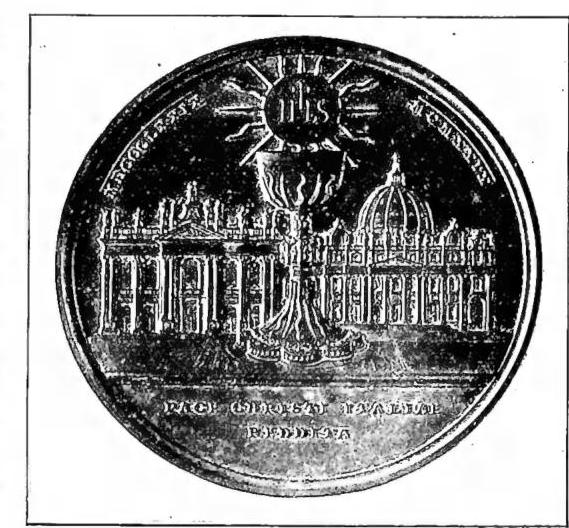
(Int. Enc. Cult.)
PATTI LATERANENSI - Annual medal designed by Mistruzzi commemorating the Reconciliation.
survived; even in May 1790, in the face of English threats, Spain invoked France’s aid in the name of the pact. The Constituent Assembly, on 26 August 1792, declared the old dynastic alliance null and void, while nevertheless declaring itself ready to renew the alliance with Spain.