
PASTOR, LUDWIG von. - Historian, baron by imperial grant (1908), b. in Aquisgrana on
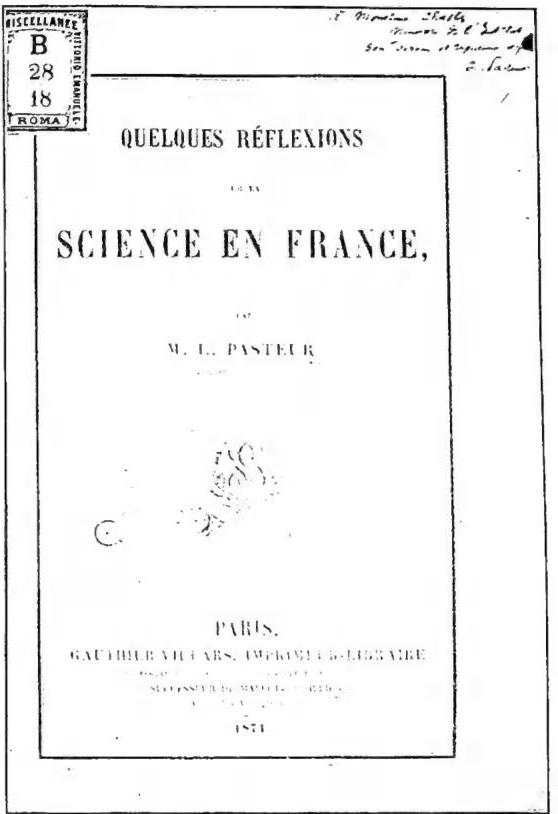
PASTEUR, LOUIS - Frontispiece of Quelques réflexions sur la science en France, with the author's autograph (Paris 1871). A portrait of P. is reproduced under V. MICROBIOLOGIA - Rome, specimen from the National Library.
Jan. 31, 1854, by a Lutheran father, died at Innsbruck Sept. 30, 1928. His Catholic mother raised him in her religion, and he was always a believing and practicing Catholic. During his university studies he began his research in Church history and had as his teacher the priest J. Janssens (v.), a known historian; he was also a pupil of Sickel in Vienna and of Weiss in Graz, where he graduated with a study on the religious policy of Charles V (July 18, 1878). He was a lecturer (1881-85) then professor of history at the Univ. of Innsbruck (1886-1900), Aulic Councilor (Hofrat) in 1899, director of the Austrian Historical Institute in Rome (1901-15, 1921-28), and Austrian Minister Plenipotentiary to the Holy See (1921-28).
The polemics between Catholic and Protestant scholars that accompanied the Bismarckian Kulturkampf in Germany led him to attempt a systematic examination of papal political tradition from a Catholic standpoint, in contrast to destructive Lutheran criticism (especially that of Ranke in his History of the Popes); while the events of the early and medieval Church did not interest him, those of the Renaissance and the Catholic Reformation, insofar as they preceded and accompanied the Protestant revolution, formed the primary object of his researches. From these derives the Geschichte der Päpste seit dem Ausgang des Mittelalters, the first volume of which appeared in 1886, the same year in which P. took up the chair of history at the University of Innsbruck. However, the intention to write this history already dated back to the feast of the Immaculate Conception (Dec. 8) of 1873. Pope Leo XIII appreciated from the begin-
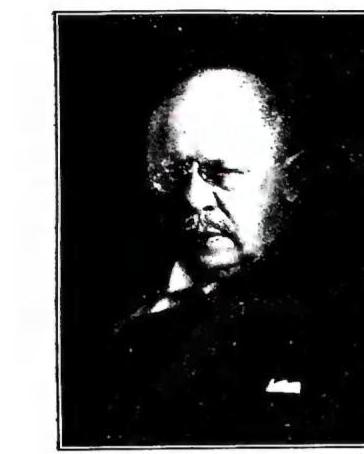
P.'s Geschichte was received by scholars with the greatest respect and admiration for its author, a marvelous investigator of documents in the Vatican Archives, and indeed those of Italy and all of Europe, for the history of the popes and the Church over a four-century period, such as no one had ever done before. Completely renewing traditional historiography, P. places the Roman church at the center of a grand historical panorama, showing that it dominated European civilization from the early Renaissance. In political events, in the development of letters and arts, in the spread of Christian European civilization into the new continents, the work of Rome appears dominant, upon which P. casts new light.
Certainly P.'s work is not without flaws; despite his scrupulous honesty and impartiality in seeking to establish historical truth, critical acuteness and depth of conception and judgment are sometimes lacking. Frequently the analytically exposed facts prevent P. to rise to a broad-scoped historical vision, as is manifest from his assessments regarding the Renaissance and the Counter-Reformation, where polemic sometimes gets the better of the historian. Contributing to P.'s aforementioned critical deficiencies was the very immense mass of documents that the archives offered him, and for which too often he lacked the support of preparatory research to facilitate synthesis.
As for the posthumous volumes, at his death P. had not written the entire treatment indicated in the general plan: the publishing house entrusted the drafting to others, who bear part of the responsibility for the judgments (v. preface to vols. XIV, XV, XVI). For the chapters concerning Clement XIV and the suppression of the Society of Jesus, which have given occasion to lively polemics regarding their true authorship and thus concerning the use of sources and the evaluation of things and persons, cf. G. Kratz-P. Leturia, Intorno al Clemente XIV del barone von P., Rome 1935. All this does not detract from the fact that P.'s work has a monumental character: moreover, it does not close, but opens the way to new, wide-ranging research and rectifications. P. accompanied the labors of his Geschichte with many important parallel researches: among other things, one must recall the new edition of Johannes Janssen's Geschichte des deutschen Volkes seit dem Ausgang des Mittelalters, which he subsequently furnished with ten volumes of Erläuterungen und Ergänzungen (1900-20). His manuscripts are now preserved in the Vatican Library. In the Tagebücher (cit. in bibl.) one will find the list of editions and versions of the History of the Popes (pp. 911-15), of the minor works (pp. 916-918), and the related bibliography on P. (pp. 918-20).
ning the grand project that P. intended to carry out according to the canons of the most rigorous historical criticism, and no less favor was shown him by Pius X and his successors; but P. was never the official historian of the papacy, as has sometimes been insinuated. Subsequently he brought out a full eleven volumes; after his death, through the work of various collaborators, vols. XIII, XIV, XV, XVI still appeared; thus the Geschichte in 1934 was complete according to the plan established by P.: from
The Italian version begun by C. Benedetti (first 3 vols. on the 2nd German ed., Trento 1800-66) was resumed for the same volumes in the 4th ed. by A. Meresti and continued by P. Cenci (Rome 1910-34). There are translations in French, English, Spanish, and Dutch. Among the various assessments of P.'s work by Catholics and Protestants, one may recall: I. F. Dengel, Ludwig Freiherr V. P., in Hist. Jahrbuch, 40 (1929), p. 1 ff. (Catholic) and W. Goetz, in Hist. Zeitschrift, 145 (1932), Protestant. Cf. also P. Cenci, Il barone L. V. P., in Pastor (L. ed. 1942, pp. vii-xxvii). Most recent and of great importance for understanding P.'s thought, the time and environment in which he lived and worked, is the vol.: L. V. P., Tagebücher-Briefe-Erinnerungen, edited by N. Wühr, Heidelberg 1930. Cf. in this regard A. Pelzer, L'historien L. V. P. d'après ses journaux, sa correspondance et ses souvenirs, in Rev. d'hist. écclés., 46 (1951), pp. 192-201. Francesco Cognasso