
PASTORALE (baculus, understood as pastoralis; cambuta, ferula). – A liturgical staff proper to bishops and abbots in pontifical functions, excepting those of Good Friday and the dead. To use it outside one’s own territory requires the permission of the Ordinary. It consists of a staff the height of a man, surmounted above by a spiral curve; it is delivered on the day of consecration and is carried in the left hand, the curve turned toward the people within one’s own territory. Toward the end of the Middle Ages, a piece of cloth, sometimes embroidered and also called a sudarium, was placed at the knot, i.e., below the curve; today it is no longer used except sometimes to distinguish the pastoral staff of an abbot (Decr. auth., 1113 ad 8).
Already in the 5th century it is found in use among abbots in Ireland; it is mentioned as a bishop’s insignia in canon 28 of the 4th Council of Toledo (633) and described by St Isidore of Seville (De off. ecl., II, 5, 12); in Gaul, under the names “cambuta,” “baculum,” or “virga,” it was used by bishops in the 8th century (Council of Aachen, 816, can. 134). But until the 10th century it was not regarded as a liturgical insignia either by liturgists or in liturgical books. Perhaps at the time of the Investiture Controversy in the 11th century it was introduced as a symbol of spiritual authority. At Rome it was never used by the popes, nor by cardinals, as is shown by the Ordinarium S. Romanae Ecclesiae (= Ordo Romanus XIV, n. 45), written by Gaetano Stefaneschi (early 14th cent.). Even today the pope never uses it; in certain functions, e.g., the opening and closing of the Holy Door or the consecration of a church, the pope employs a rod surmounted by a cross, called a ferula (q.v.), mentioned in the Pseudo-Constitutum Constantini, 14, with the expression “imperialia sceptra” (ed. P. Fedele, Fonti per la storia delle origini del dominio temporale della Chiesa di Roma, Rome 1920, p. 104), and in Ordo Romanus XII, n. 79 (prior basilicae Sancti Laurentii de Palatio dat ei ferulam quae est signum regiminis et correctionis et claves ipsius basilicae et sacri Lateranensis palatii: PL 78, 1097; the same is repeated in Ordo Romanus XVI, ibid., col. 1144). Cardinals, now as all bishops, use the pastoral staff in pontifical functions.
The origin of the pastoral staff is still unclear; perhaps it derives from the use of investiture with a golden rod in the ceremonial of the Byzantine imperial court, also employed in the 6th and 7th centuries by the Visigoths in Spain, where the first mention of a bishop’s pastoral staff is found. It is likely that the ceremonial of the Visigothic court, imitating that of Byzantium, introduced for bishops the use of a rod, with this difference: it was delivered not by the king but by bishops at the altar (Klausner).
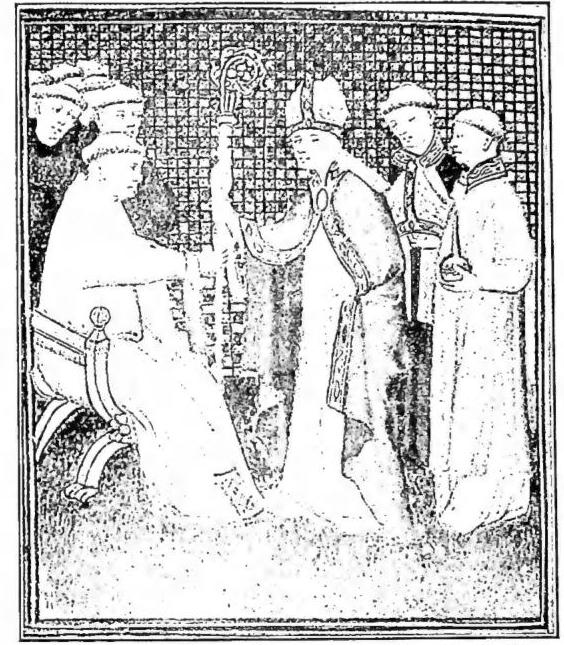
(from V. JALABERT, LOUIS, Les pontificaux mis. des bibl. publ. de France, Paris 1887, no. 18)
PASTORALE - The Bishop hands the abbot the pastoral staff adorned with the veil in use during the Middle Ages. Miniature from the Missal-Pontifical of Stefano Loypeau, Bishop of Luçon (late 14th century) - Paris, Bibliothèque nationale, ms. lat. 8886, f. 297v.
In the 15th and 16th centuries, enamel decoration disappeared; pilasters, columns, and round arches replaced the Gothic forms in the knot, while the statuettes at the end of the volute had a more naturalistic modeling.
Relief motifs of cherubim heads, curled leaves on the volute are found in pastoral staves of this period (e.g., in Nicotera Cathedral of S. Severina; in Orvieto, Museo dell’Opera del Duomo, etc.). In the Baroque period, the line of the volute, which had always remained firm even as it was enriched with decorative elements, became wavy and was formed by curled shapes (Monreale, S. Martino delle Scale; Crotone, Cathedral) or by crumpled volutes, such as the one Michele Cruer made in 1718 in embossed and partly gilded silver for the Grand Prior of the Constantinopolitan Order (Parma, S. Maria della Steccata), or more delicately formed by filigree tracery (Monreale, Cathedral).
In the 18th century, pastoral staves were also made of bone and ivory with a staff adorned with engravings; in general, the most beautiful were those in which motifs of leaves, flowers, and garlands formed an elegant volute around the central statuettes. Even when neoclassical motifs entered the goldsmiths’ workshops and handcrafting was replaced by mechanical work, the 18th-century model—where the rich Gothic or Renaissance decoration of the knot had been suppressed in favor of greater ease of grip—remained persistent, and it cannot be said that modern production has introduced many stylistic variants to this liturgical furnishing. — See pl. LXXI.