
CORONATION. — Ceremony by which a sovereign is invested with his dignity through the imposition of the crown, symbol of power. The term c. generally also includes the ceremonies of anointing and consecration and enthronement; it is likewise used for statues and images of Mary Most Holy, in recognition of her dignity.
SUMMARY: I. C. of emperors and kings. — II. C. of the pope. — III. C. of images of Mary Most Holy.
I. C. OF EMPERORS AND KINGS.
The Church’s moral guidance, which points out to every believer and to all humanity the salvation of the soul and the realization of the Kingdom of God, extends to earthly governments, which in carrying out their mandate can harm the spiritual welfare of their subjects no less than they can promote II. Therefore the Church has wished to consecrate every public authority to God and, beginning with the Carolingian renewal of the Empire, through an ancient and solemn rite has invested with their dignity the emperor, head of all Christian peoples, and the kings, heads of the new national states.
I. HISTORY AND LAW
It was precisely around this ceremony, by which Christianity exalts the universal character of the Empire and confirms the authority of sovereigns, that a dramatic dispute arose between the popes and the emperors: the former claiming for the Church the right to confer power, the latter more often accepting from the Church only the religious element of consecration, without obligations limiting that sovereignty which they claimed to receive directly from God, creator of all things and therefore the sole source of every power.The coronation thus affects relations between the State and the Church, which in turn determine it, creating a complex problem encompassing purely spiritual and exclusively temporal motives.
The problem in reality arose with the Church itself, born within the State that preceded it, but possessing universal characteristics that make it coincide with that State and that come directly from God. Hence an apparent contradiction in Christian literature, which, after emphasizing the supreme authority of the emperor elected by God, then demands the emperor’s own obedience to the norms established by the Church, the sole repository of the divine commandment.
The problem of these relations, whose vicissitudes are examined here, had two essential aspects in the Middle Ages: the existence and justification of the pope’s right to confer imperial dignity, and his position with regard to the emperors. Incorporated by the pontiff, as kings were by bishops, the latter considered temporal powers to be instituted by ecclesiastical consecration; and when, amid the full conflict between Empire and Church, imperial jurists claimed from Roman law the absolute power, and therefore the supremacy, of the emperor, their curialist opponents likewise relied on Roman law to claim that power for the pope, himself an emperor and the sole sovereign residing in the Rome of the Caesars. The pope thus appeared entitled to provide for the selection of whichever candidate to the imperial throne seemed most worthy and, on the basis of the power to bind and loose transmitted by Christ, to depose an emperor who proved unworthy. And the Dictatus Papae (VIII, XI, XII) has him dispose of temporal dignities and goods as well as of the very attributes of imperial dignity: a power exercised by Gregorio VII in the deposition of Enrico IV.
According to the decretal Per venerabilem of 1202 (c. 34, X, de elect., I, 6), by virtue of which Innocenzo III first attributes the Empire to Ottone IV and then to Federico II, the Empire must be regarded as dependent principaliter et finaliter upon the Holy See: 1) because it transferred the Roman Imperium from the East to the German kings in order better to defend it; 2) because it is from the pope that the king designated for imperial dignity receives blessing, incorporation, and investiture with that dignity—that is, is “consecrated” emperor. Alongside the right of examination and approval, the pope’s right to govern the Empire during periods when the throne was vacant was upheld. When the transmission of the Empire was challenged, both because of the inadequacy of the Donation of Constantine and the lack of confidence it inspired, and because of the existence of the principalities of the Latin East, Pope Innocenzo IV reaffirmed at Lyon the pontifical prerogatives on the basis of the transmission of sacerdotal and royal monarchy from Christ the priest and king to Pietro: the whole imperium was therefore legitimately transmitted by the pope to the emperor and had to return from the latter to the pope. The thesis, which counted among its interpreters Enrico da Susa and Guglielmo Durante, prevailed, causing the contrary principle—already upheld by Enrico IV and Federico I—to fall into decline, namely that imperial dignity was the source of all ecclesiastical and pontifical power. Thus, in 1273, the election of Rodolfo d’Asburgo by the electors was submitted to the pope’s approval, which he granted, immediately afterward warning the elected candidate to be ready for consecration; in 1303, moreover, Alberto d’Asburgo admitted that the emperor had to be the Church’s legitimate protector because the Church had transmitted the imperium from the Byzantines to the Germans, and that temporal power was derived by past and future emperors from those princes to whom the Church itself granted the right to elect the King of the Romans.
But against Bonifacio VIII, who in his letters of the preceding years and in the bull Unam Sanctam had proclaimed the absolute supremacy of the pope over all earthly powers, Filippo il Bello reacted with the violence of Anagni. The political crisis that continued beyond the pope’s death led jurists to limit the scope of the coronation: emperors and kings were to receive it as a special form of blessing, not as a conferral of authority. In this period, therefore, people began to hold (the writing of Marsilio da Padova, from 1324, would gain influence only later) that the election made by the electors required no papal confirmation. The adventure of Luigi il Bavaro, incorporated as emperor in Rome in 1329 by the urban prefect and anointed by two bishops in defiance of every tradition, precipitated the schism of the antipope Nicola V, opposed to Giovanni XXIII, and led to the electors’ declaration that from that moment the elected candidate was to be designated king and emperor independently of any papal confirmation. The decision was ratified at the Imperial Diet of Frankfurt.
The centuries-old dispute had by now weakened the Holy Roman Empire of the German Nation at its foundations: diminished in its mystical value and religious character, it could acquire nothing in the political sphere, where the national kingdoms, the German principalities, and the states and cities of Italy lived in practice outside it or in opposition to II.
The Holy Roman Empire, in which the highest ideal of the Middle Ages had been affirmed—the restoration to unity of the ancient Roman world for a humanity realizing on earth the Kingdom of Christ—still shone with an uncertain light until its end was officially recognized. Carlo V was the last Roman emperor incorporated by the Pope (Bologna, 24 February 1530).
The brief Napoleonic parabola likewise led to a renovatio imperii: La Providence a voulu que je rétablisse le trône de Charlemagne... Pour le Pape je suis Charlemagne, are Napoleon’s frequent words; and, almost as though Eginardo’s negative judgment had suggested it to him, after receiving anointing from the Pontiff he took the crown from his hands and placed it upon his own head, with the threatening words: Dio me l'ha data, guai a chi me la tocca. The contrast between pontifical anointing and secular coronation had completed its millennium (Rome, Christmas 800 — Paris, 2 December 1804).
Fulvio Crosara
II. LITURGY
I. Coronation of kings
The anointing of kingsis inspired by the Bible (I Sam. 16:13; II Par. 23:11; Ez. 16:8–14); nevertheless, the first example of a royal anointing is found among the Visigoths in Spain. Their king Wamba, in 672, after professing his fidelity («ex more fidem populis reddidit»), received the sacred anointing on his head; the tradition concerning the insignia is not yet mentioned. More than half a century later, in 751, in France, Pepin, son of Charles Martel, was consecrated in the cathedral of Soissons by Boniface, the Pope’s legate and archbishop of Mainz. This ceremony was repeated by Stephen II (754), in the monastery of S. Dionysius, where he consecrated Pepin together with his sons Charlemagne and Carloman. Subsequently, the coronation of the king was also added, as was done for the emperor. In 844 Louis II was anointed king, invested, and crowned in Rome; in 848 Charles the Bald was crowned at Orléans by the archbishop of Sens, and a second time at Metz, in 869 (the third time, in 875, he was crowned emperor in Rome). From that time onward, the anointing and coronation of kings became a fixed custom in the kingdom of the Western Franks, subsequently followed in other territories as well, for example, in Castile by Alfonso III in 866 and by Ordoño II in 914. In the Frankish kingdom of the East, Germany, Conrad I was the first king to be anointed, in 911; but he did not receive the crown from the Church. His successor Henry I refused the sacred anointing and coronation. But with the reign of Otto I and his coronation in 936, the rite of the king’s ordination was established. The rite of the so-called Romano-Germanic Pontifical, Ordo Romanus vulgatus, compiled at Mainz, records the ceremonies of the coronation of Otto II in 961.
According to this order, the kings of Germany were crowned at Aachen until 1531, with certain modifications dating from 1307. This order was also followed in England and France, though certainly with modifications and variations. The rite of the coronation of the king according to Roman usage was composed by order of Clement V for the coronation of Robert, king of Sicily (Ordo Rom., XIV), on the model of the imperial coronation. The present rite of the Roman Pontifical derives from the Pontifical of G. Durando (d. 1296).
The coronation of the king takes place on Sunday, by the competent metropolitan, assisted by the other bishops of the kingdom. It consists of two parts, one of which is performed before Mass, the other during Mass after the Epistle. Before Mass, the following takes place:
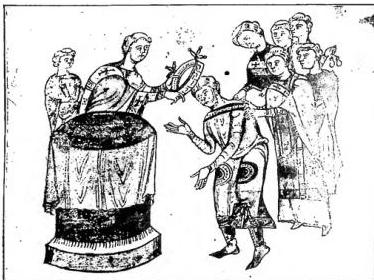
INCORONAZIONE - I. del Re. Il Re assistito da due dignitari con pallio s'inchina per ricevere dal vescovo la corona. L'altare ricoperto da un drappo è formato da un semplice cippo cilindrico - Ivrea, Biblioteca capitolare.
1) la presentazione con un breve esame, un'ammonizione al re futuro e la sua professione o il suo giuramento; 2) un'orazione di benedizione dell'arcivescovo assieme agli altri vescovi; 3) le litanie con due versetti per il re; 4) l'unzione del re con l'olio dei catecumeni fatta in forma di croce sul braccio destro dal polso al gomito, e sul dorso, tra le spalle. Nei riti anteriori talvolta si unsero con il erisma anche la testa e le mani. Questa unzione, considerata
nel medioevo come uno dei 12 Sacramenti, non è che un sacramentale secondo la decisione di Innocenzo III. Finita questa prima parte, il re indossa una veste simile ad un camice ed il manto reale.
La seconda parte comprende: 1) la consegna della spada regia, accompagnata da una allocuzione: il re riceve la spada che porge allo scudiero, il quale la ripone nel fodero. L'arcivescovo poi cinge il re della cintura. Quindi il re sguain la spada, lancia alcuni colpi («viriliter vibrat») e la ripone di nuovo nel fodero; 2) l'i.: assieme con gli altri vescovi l'arcivescovo impone la corona con le parole «accipe coronam»; seguono le consegne delle altre insegne, dello scettro, delle armille, del globo d'oro; 3) l'intronizzazione con acclamazioni del popolo.
Nell'i. della regina reggente si omette la cintura della spada, e in quella della regina non reggente anche il breve esame, l'ammonizione e il giuramento.
Il re incoronato e la regina ricevevano la Comunione prima sotto ambedue le specie, in seguito soltanto sotto una sola specie con la purificazione nel calice del metropolita.
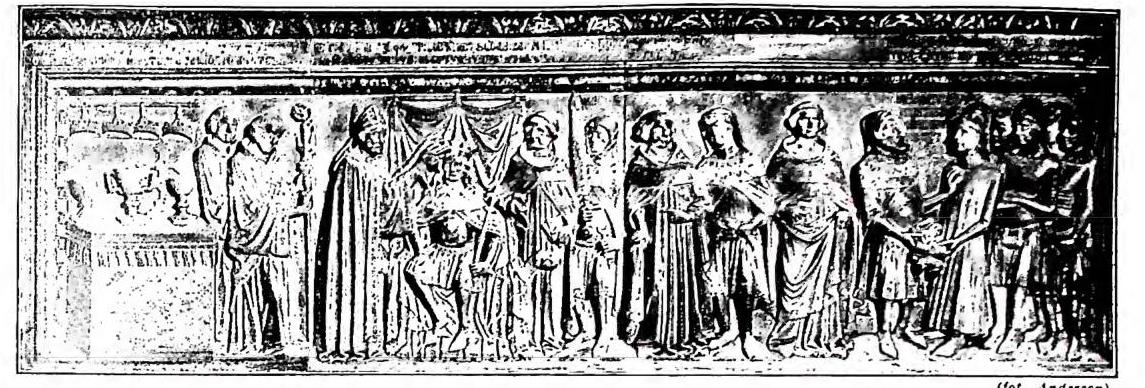
(phot. Anderson)
The text: J. Catalani, Pontificale Romanum... commentariis illustratum, I, tit. XX, De bened. et coronat. regis, Paris 1850, p. 575; M. Andrieu, Le Pontifical romain au moyen âge (Studi e testi), 86, 87, 88, 99, 4 vols., Vatican City 1938-41, passim.
2. I. of the emperors
The i. of the emperors in the West begins with that of Charlemagne (Christmas 800). The history of the rites begins with the i. of his successor Louis the Pious (816). Four or five periods may be distinguished: 1) the Carolingian-Frankish period, from Louis (816) to Berengar (915); 2) the period of the dynasty of the Ottonians: Otto I (962), Otto II (967), Otto III (996); 3) the period of the Salian dynasty: Henry II (1014), Conrad II (1027), Henry III (1046), Henry IV (1084); followed by a period of reform or transition: Henry V (1111), Lothair II (1133), Frederick I (Barbarossa, 1155), Henry VI (1191); 4) from Innocent III to the Caeremoniale Romanum: Otto IV (1209), Frederick II (1220), Henry VII (1312), Louis of Bavaria (1328), Charles IV (1355), Sigismund (1433), Frederick III (1452); 5) Caeremoniale Romanum: Charles V (1530).
A) The rite of the i. in the Carolingian-Frankish period is found in cod. Vat. lat. 7114. The shorter recension contains only the text of four prayers: at the ordination and consecration of the head with Chrism, at the i., and at the blessing; the longer recension adds the delivery of the scepter, ring, and sword, at first without formulas, and from 875 with the formulas «accipe virgam», «accipe regiae dignitatis anulum», «accipe gladium», together with the text of the Laudes «Exaudi Christe». The ceremony is preceded by the solemn reception at the steps of St. Peter’s (from 844), the candidate’s promise of peace and his adoption as «Filius Ecclesiae» (from 878); after the i. come the solemn procession to the Lateran and the common banquet of the pope and the emperor.
The emperor, like the bishops, receives anointing on the head with Chrism and wears clerical dress.
B) In the period of the Ottonians, under the influence of Cluny, a new ceremonial of the i. was used (contained in the Ordo Romanus vulgatus, Cencius I), which was first used at the i. of Otto I (2 February 962). Its similarity to the papal i. is shown in the recitation of three prayers by the bishops of Albano, Porto, and Ostia. Between the second and third prayers the litanies are recited; this is followed by the anointing, not of the head but of the right arm and between the shoulders, not with chrism but with the oil of the catechumens; the formula of the anointing is not found. After the prayer of the bishop of Ostia,
the i. performed by the pope follows. For the delivery of the insignia, the formulas of the Ordo are used. The anointing and the i. took place before the altar of St. Peter. The queen too was anointed and crowned.
C) The most illustrious period of the Roman Empire, that of the Salian dynasty, developed a ceremonial of the i. that was likewise highly elaborate, contained in Ordo Cencius II. The prefect solemnly goes out to meet the emperor, who is received by the pope at the gate of St. Peter’s. The elected emperor swears fidelity, is adopted as «filius Ecclesiae», and enters the Basilica with the pope; at the porta argentaria follows the first prayer of the bishop of Albano, then the scrutiny and profession of faith. This is followed by the second prayer, recited by the bishop of Porto. The elected emperor puts on the tunic, dalmatic, cope, and mitre; meanwhile the queen is brought into the Basilica. Mass is celebrated at the altar of St. Peter. Before the Gloria, the emperor and the queen are anointed by the bishop of Ostia. At the emperor’s request, the i. is performed by the pope at the altar of St. Maurice. The emperor receives the ring, sword, crown, and finally the scepter. After the Epistle, the praises are sung. At the Offertory, the emperor offers bread, candles, gold, and wine at the altar of St. Peter, and the queen offers the water for the sacrifice. After Mass, the procession to the Lateran takes place; the emperor, without his crown, holds the stirrup for the pope.
D) The new order, composed by the order of Innocent III, contains some changes: the promise of peace, the scrutiny, and the adoption as «Filius» no longer occur; instead, the elected emperor is enrolled among the Canons of St. Peter; the anointing takes place at the altar of St. Maurice. During Mass, after the Gradual, the pope crowns the emperor, then gives him the scepter, the golden orb or imperial apple, and finally the sword. The order of these insignia is sometimes changed, for example, in 1452: the scepter, the sword, the orb, and finally the crown; or, as in 1530: the sword, the orb in the right hand, the scepter in the left, and finally the crown.
E) All these ceremonies, like that of the i. of the pope, were codified by order of Innocent VIII in 1488 and published in the Caeremoniale Cappellae Pontificiae of 1516. The i. no longer takes place at the altar, but at the pope’s throne; the formulas for the delivery are recited by the pope alone.
In the Byzantine Empire, the emperor was crowned by the Church as early as the 4th century (Theodore I, 379-95); but here the specific element of Western ordination, namely anointing, is lacking. - Vedi tav. CVII.
(from V. JALABERT, LOUIS, Pontificaux mss. des bibl. ... publ. de France, Paris 1857, vol. 16)
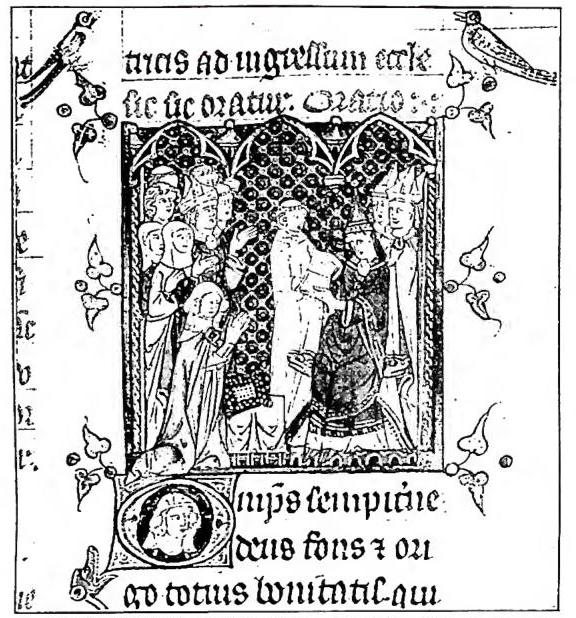
INCORONAZIONE – Beginning of the rite for the coronation of the empress by the Pope. Miniature from the Roman Pontifical adapted for the use of Besançon (first half of the 14th century) – Paris, Bibliothèque nationale, ms. lat. 17336, f. 43.
II. THE POPE’S.
It is the solemn inauguration of the papal reign. It does not confer supreme authority upon the elect, for this is granted to him « iure divino » immediately upon acceptance of the election, but constitutes an integral part of the enthronement (constitution of Nicholas II of 1059 § 6; Clement VI of 1351; CIC, can. 219).
Until the 10th century, bishops were not elected to the papal dignity because they were considered irremovable from their sees. Through episcopal consecration, the elect received together the power of order and that of jurisdiction. Beginning in the 10th century, bishops too were elected as popes, and for them the rite of enthronement was prescribed (constitution of Nicholas II of 1059). This rite began, like the consecration, with the procession to the altar; the pope himself said Mass; after the Confiteor, before the Gloria, the three bishops of Albano, Porto, and Ostia recited three prayers; the pallium was imposed upon the pope; at the cathedra, the pope received the homage of the clergy; and Mass continued. Both on the occasion of the consecration and on that of the enthronement, at the end of Mass at St Peter’s, before riding out to take possession of the Lateran, the « regnum » was placed upon the Pontiff’s head. It was similar in form to the « camelaucum » or « trigium » (Ordo Rom., IX [M. Andrieu, Les « Ordines romani » du haut moyen âge, I, Lovanio 1931, pp. 21-22, XL], 9th century); it was not yet the crown, but under the influence of imperial ideas, both for the emperor and for the pope, the first crown was added to the « regnum », perhaps in the time of Hildebrand (Gregory VII). In the first half of the 12th century, the coronation of the pope became the act of papal institution, joined either to the consecration or to the blessing alone. This development reached its culmination under Boniface VIII, during whose pontificate a second and third crown were added, and the « regnum » became the « triregnum » (tiara). The decree of
Clement VI of 1351 signified the end of this institution as a juridical act, which thereafter remained solely a liturgical act. The rites and texts of the papal coronation are found, in addition to Ordo Rom. IX (Andrieu, op. cit., XXXVI and XL, pp. 19, 21-22), in Ordo Rom. XIII vel Caeremoniale Romanum of Pope Gregory X (d. 1276), in Ordo Rom. XIV vel Ordinarium S. R. E. of Gaetano Stefaneschi of 1311, and then in the appendix to the Pontificale of G. Durando (d. 1296).