CANDLES. - They are the most common and obligatory means of liturgical illumination in religious functions. According to current prescriptions, candles must be made of beeswax, that is, entirely or for the most part from the eponymous product of bees (Decreta authentica S. R. C., no. 4147). Candles of stearin are therefore forbidden (ibid., 3063; 3376, 3), as are those of tallow (ibid., 2865), nor may electric lamps be used in their place (ibid., 4257, 5). Precise prescriptions, despite contrary abuses, regulate the number of candles in liturgical functions. For a private Mass of a bishop, there must be at least two, but there may also be four (Caerem. Episc., I, 29, 4); for a pontifical Mass, six (ibid., II, 11, 1), to which a seventh is added behind the cross when the celebrant is the diocesan bishop (ibid., I, 12, 12; Decr. 235, 8; 1131, 1; 2274, 6). For a private Mass of one who is not a bishop, neither more nor less than two (Missale Rom. Rubricae Gener., 20; Decr. 441, 567, 1051, 1125, 1131, etc.), for a solemn Mass, the Caerem. Episc. (I, 12, 24) considers four or even two sufficient for simple feasts and ferias, but in practice the common usage, the Missale Rom. Ritus celeb. Missae, 4, 4, and the Caerem. Episc. (I, 12, 11) prescribe or recommend six; for a sung Mass without ministers, there must be four (Decr. 1470, 2; 3377, 1); this number may also be maintained for a conventual or parochial low Mass, or for a Mass that takes the place of a solemn Mass on a feast day (Decr. 3697, 7; 3059, 7, 9; 3065).
For the exposition of the Blessed Sacrament, at least six candles are required (Decr. 1992; 4257, 2); for the same in solemn form, twelve (Decr. 3480) or twenty are required (Instructio Clementina, 6, in Decreta authent. S. R. C., IV, Rome 1900, p. 22).
The use of candles in the liturgy is connected with the history of liturgical illumination, of which they were certainly a principal element. Christian archaeological monuments reveal, more than a mere use, a funerary symbolism of candles, which signify the eternal light (G. Wilpert, La fede della Chiesa nascente, Vatican City 1938, p. 283) to which the deceased participate (F. Cabrol, Cierges, in DACL, III, col. 1618) and the glory that likens them to the great of the earth (Senatoriae videlicet sunt dignitatis, St. Jerome, Adv. Vigil. 6: PL 23, 339). It is known, in fact, that the emperor in his appearances was accompanied by lit candles.
The primary, though not exclusive, motive for the liturgical use of candles, as of light in general, is the necessity of illuminating the space, as St. Jerome notes (Adv. Vigil., 7: PL 23, 361). This, however, does not exclude the symbolic meaning natural to light, for which candles were lit iam sole rutilante... ad signum laetitiae demonstrandum (St. Jerome, op. cit., 1). This festive sense is often highlighted by ecclesiastical writers, who note the multitude and size of the candles (Eusebius, Vita Constantini, IV, 22; Prudentius, Paritephanon, II, 72; id., Cathenerinon, V, 20; Paulinus of Nola, Carmina, XIV, 100; Egeria, Pere-


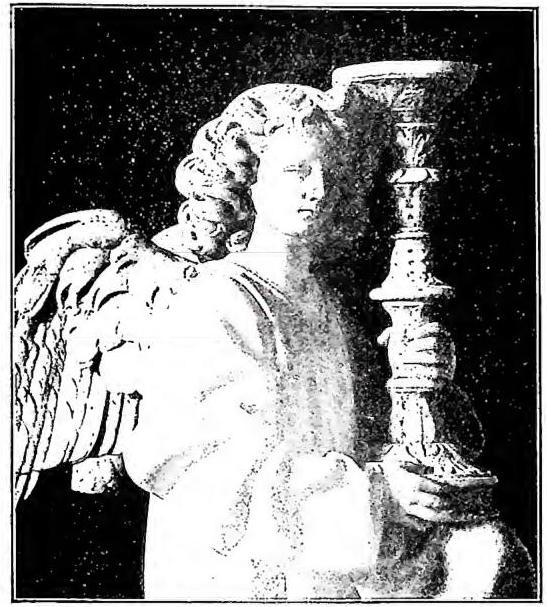
Candelere — Angel bearing a candelabrum, work by Niccolò dell'Arca (ca. 1470) — Bologna, S. Domenico, arca of the Saint,
gratiatio ad loca sancta, 24, 4; 7, 9). Soon, it seems, behind a popular form of devotion, Vigilantius reproached Christians for it (St. Jerome, Adv. Vigil., 4 and 7), although it derived from similar pagan customs (St. Jerome, ibid.; Cicero, De officiis, II, 8; Ammianus Marcellinus, Rer. Gestarum, XXII, 14; Tertullian, De idololatria, 15; Lactantius, Divin. Instit., VI, 2) which also concerned ecclesiastical authority (Synod of Elvira, cap. 34: Mansi, II, 11). Candles and lamps in general were used as a sign of cult for martyrs (Acta Martyrum selecta, ed. O. von Gebhardt, Leipzig 1902, pp. 127-29). Although abundantly used during liturgical worship, candles were merely an element of illumination, or a mark of honor paid to the Pope and to the Gospel, never of direct Eucharistic cult until the 12th-13th century, when they began to be placed on the altar. On several occasions and in different places, the Church had to intervene to prohibit superstitious uses regarding the number and placement of candles.
For archaeology: V. CREDO; for the blessing of candles: V. PURIFICATIORE.
CANDELIERE. —
I. Liturgy
The liturgical candelabrum derives from the usual furnishings of Roman houses, and for this reason its form has nothing specifically sacred about II. The first Christian iconographic examples are found in funerary art. St. Athanasius (Epist. Encyclica, 4: PG 25, 209) speaks of candelabra affixed to the walls of the church, removed by pagans who also took away the candles to light them for idols; candelabra of gold are mentioned by Prudentius (Peristephanon, II, 5, 71: PL 60, 300), and the Statuta Ecclesiae Antiquae (Denz-U, 154) state that the ordination of the acolyte is performed with the handing over of the cereoforaleum. In the Ordines Romani, in fact, it is the duty of the acolytes to carry before the Pope the seven cereostata, which were of gold and silver, or two before the Gospel (Ordo Rom., 1, 8; 3, 1; 11, 1). The Liber Pontificalis also frequently mentions candelabra donated to basilicas. There is no evidence that the candelabra which preceded the celebrating Pope were placed on the altar when he arrived there. In the earliest representations of altars, candelabra never appear. On the ivory cover (9th century) of an evangeliary preserved in Frankfurt on the Main, two candelabra are shown flanking the altar. The various Consuetudines of the 11th and 12th centuries speak of candelabra placed in front of and behind the altar. However, at the same time altars with candelabra begin to appear. The first to suppose them placed on the altar is Innocent III (De Sacro Altaris Mysterio, II, 21: PL 217, 811). A very ancient custom, on the other hand, was to place small candelabra on processional crosses and on ciboria of altars, or on iconostases. Today there are, against all rules, including aesthetic ones, up to thirty or forty.Ecclesiastical legislation requires that candelabra be placed on the surface of the altar. The Decreta authentica, n. 3759, permit them to stand on the small raised platform which completes the rear part of the altar, while it is forbidden to affix them to the wall (Decr. aut., n. 3137, 1 and 4). The Caeremoniate Episcoparum would have it that on feast days the candelabra be of silver, or at least of bronze or gilded copper, and be graduated so that the two central ones be the tallest, and above them the cross. But general usage is now contrary to this (Decr. aut., n. 3035, 7): V. CREDO, CEROFERARIO.
II. Art
Any support made of wood, iron, or stone intended to hold candles. In particular usage, that of the altar; if of large size or intended for several candles, it is generally called a candelabrum. From records and representations we know that candelabra of the Paleo-Christian and early medieval periods generally took the form of a stem resting on three or four feet and supporting a cup. There were bronze, silver, and gold ones. During the Romanesque period, the decorative taste of the time is reflected in candelabra. Examples: the silver ones of the cathedral of Hildesheim and the grand candelabrum of the cathedral of Milan, work by Nicholas of Verdun.In the Gothic period, the shaft, base, and knobs of the candelabrum are enriched with ornaments reflecting the characteristic decorative forms and motifs of the new style. Thus in the candelabrum donated by Doge Cristoforo Moro (1462-71) to the basilica of St. Mark in Venice. In the Renaissance, candelabra fully reflect the architectural taste of the time and the importance then attributed to the beauty of forms in every human activity. Examples: the candelabra of Andrea Riccio for the church of the Santo in Padua and of Antonio Gentili in the treasury of St. Peter in Rome. Even Benvenuto Cellini made candelabra for the bishop of Salamanca.