
CANDELABRO A SETTE BRACCI. — The candelabrum of the purest gold, made in a single piece, was placed on the southern side (Ex. 26, 35) of the sanctuary (Volg.: Sancta) of the Mosaic tabernacle and later of the temple of Jerusalem, opposite the table of the loaves of the Presence.
According to the Mišnah (Mēṇāḥāth, III, 7; IV, 8; IX, 3), its height was 3 cubits, that is, approximately 1.35 m. One talent of pure gold was used for it and its furnishings (Ex. 25, 39), that is, 49.11 kg. A base supported the main shaft, from which three branches extended laterally, all ending at the same level, namely at the height of the end of the central shaft, which formed the seventh arm. It bore four ornamental cups in the shape of almond blossoms, a kind of bulbs from which the flower emerged at the points where the lateral arms branched off; these, in turn, each bore three such ornamental cups. Seven lamps were placed on the seven arms (Ex. 25, 31-39; 37, 17-24), which according to Zach. 4, 2.10 signify «seven eyes of the Lord, which range through all the earth».
The seven lamps were lit during the night (Ex. 27, 21; Lev. 24, 3); whether, and how many, lamps were also lit during the day cannot be deduced with certainty from the biblical texts; tradition is uncertain: according to some, the lamps were lit only at night, whereas according to others, one or three lamps were lit during the day. The symbolism of the candelabrum, too, is presented differently. According to Flavius Josephus (Antiq. Iud., III, 6, 7; Bell. Iud., V, 5, 5) and Philo (Vita Moysis, II, 103), the seven lamps were a symbol of the seven planets; in rabbinic literature, however, the view predominates that they were a symbol of God’s presence among his people.
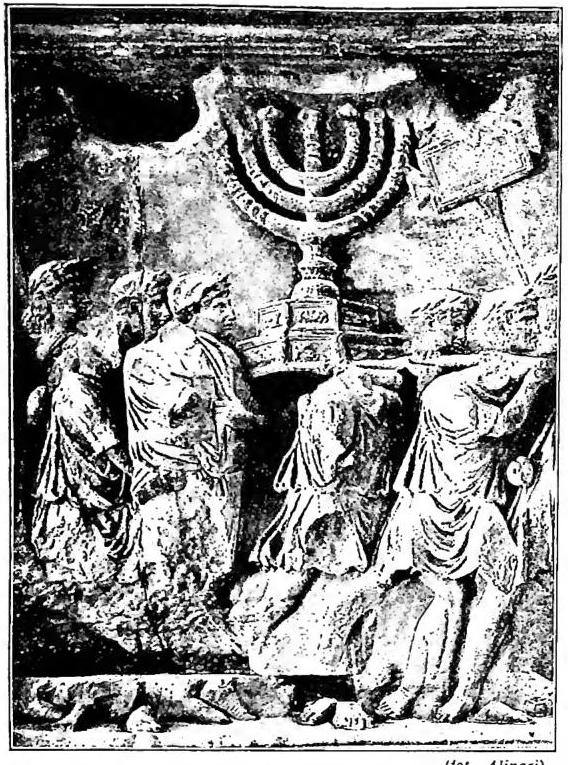
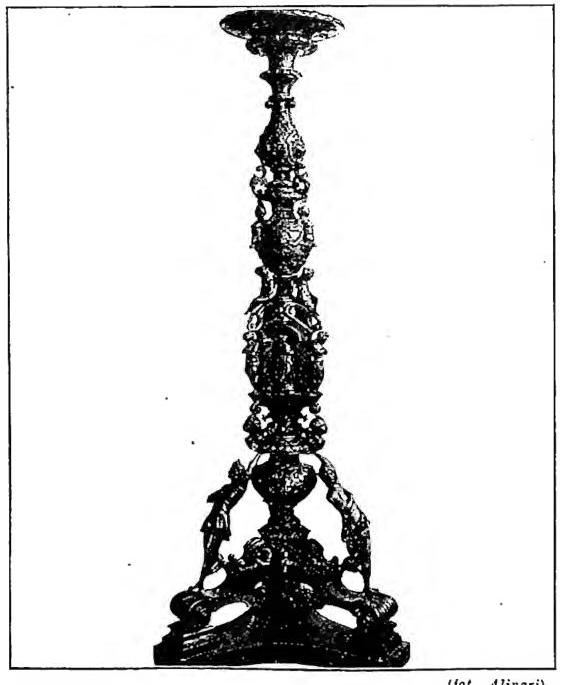
CANDELABRO A SETTE BRACCI - Relief of the imperial triumph in the interior of the Arch of Titus in Rome. Detail: the legionaries carry on their shoulders the seven-branched C. removed from the Temple of Jerusalem.
(1 Mach. 4, 49 ff.). According to Flavius Josephus (Antiq. Iud., III, 6, 7), this candelabrum, which was also in Herod’s Temple, had more ornaments than that of Moses, which accords with its representation on the Arch of Titus. The candelabrum transported by Titus to Rome was subsequently kept in the Temple of Peace, built by Titus himself. Then it seems to have been carried off, together with the table of the showbread, by the Vandals (A.D. 455) and transported to Africa, and then by Belisarius (A.D. 534) to Constantinople.