
GIUSEPPE, FLAVIO (Ιώσηπος). — Jewish historian, son of Mattia of priestly family, b. in Jerusalem ca. 37-38 A.D.
He received an education in accordance with rabbinic norms. In 64 he was sent on an embassy to Rome, where he must have come into contact with Christians bound by ties of kinship and friendship with the Jews of the Urbe. Returning to Jerusalem at the beginning of 66, he found war in the air and, although he judged such a proposal senseless, driven by personal interest he followed the current without taking a clear stand and remaining of moderate tendencies. Sent by the Sanhedrin to Galilee to organize its defense (Bell. Iud., II, 362-68), he trained there a rather large army (ibid., II, 376) and fortified various places including Jotapata. Having begun operations in the spring of 67, after a general flight of his troops from the camp at Garis (ibid., III, 127-31), J. shut himself up in Jotapata, which was taken after 47 days of siege in early July. Made prisoner, he skillfully avoided the danger of being sent to Nero in Rome by prophesying the empire to Vespasian and Titus; this was the fruit of his acute ability to assess political events (ibid., III, 399-408; cf. Suetonius, Vesp., 5; Dio Cassius, in the excerpt of Xiphilinus, LXVI, 1, 4; Appian, XXII, in Zonaras, Annal., XI, 16; Tacitus, Hist., I, 10; cf. II, 1), but the two Flavians, struck by the luminous prophecy, kept the prisoner with them, who, freed with the proclamation of Vespasian as emperor (July 1, 69), took the name of Flavius. J. remained at the side of Titus for the rest of the campaign, until the fall of Jerusalem, carefully noting all the events (C. Apion., I, 49, cf. 55) and with Titus he came to Rome where he was present at the triumph of the Flavians in 71 (Bell. Iud., VII, 121-57). Honored and showered with benefits by Vespasian and Titus, he narrated in the De Bello Iudaico the history of that campaign, with a pro-Roman spirit, justifying before his Jewish conscience his work in favor of the Romans with the consideration that “that God who distributed command in turn among the nations, now had settled in Italy” (Bell. Iud., V, 367). His relations with the Flavians cooled under Domitian, given the character of this Emperor averse to men of letters (Suetonius, Domit., 20) and ill-disposed toward the Jews against whom in 95 he began the persecution that also involved the Christians (Dio Cassius, LXVII, 14; Suetonius, Domit., 15), so much so that the other works of J. published under Domitian are dedicated to a private patron, Epaphroditus. However, this estrangement from friendship with the Flavians served to restore to J. some of his dignity as a man and his courage, since the other works are not tainted by the pro-Roman servility of the Bell. Iud., but are in praise of Judaism, and indeed the Contra Apionem, published precisely in 95, is an open apology of II. He died at about 65 years of age around 102-103.
Works: 1) De Bello Iudaico. — This work in 7 bks., whose title was War (Πόλεμος), used by J. himself in cross-references (Ant. Iud., I, 203; XIII, 72; XVIII, 11; XX, 258; Vita, 412) although almost all manuscripts have the title Conquest (“Αλωσις”), was published between 75 and 79 and presented to Vespasian (cf. Bell.
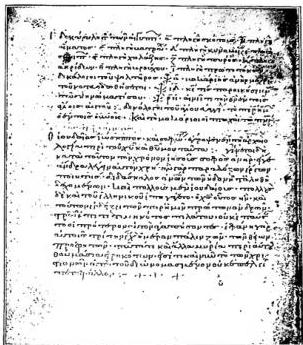
C. Apion., I, 50-51; Vita, 361).
It must have had the character of an unofficial report, from the Roman point of view, of the Jewish War, demonstrating its difficulties, and was intended to act as a pacification among the Jewish communities of Mesopotamia, which were in ferment against Rome (Bell. Iud., III, 108). To this latter end, no doubt, corresponded the Aramaic version, now lost (I, 3-6), of which the present Greek text is a reworking made by G. himself with the help of collaborators (C. Apion., I, 50). The first two books deal with events prior to the war (G.’s dependence on the writings of Nicolaus of Damascus for the period of Herod), and the seventh with events subsequent to II. For the narrative of the war (books III-VI), G. drew heavily on the Commentaries left by Vespasian and Titus (C. Apion., I, 56; Vita, 342, 358).
This work contains extremely important information on events about which, perhaps, nothing else would be known, but the critic’s eye must be able to discern what is historically acceptable from the great mass of material of dubious authority, bearing in mind that the author is far from free of bias and partisanship.
Prior to Cassiodorus (De iust. div. lit., 17), there existed a Latin translation attributed to Rufinus and circulated a Latin reworking known as Hegesippus, whether from corruption of ex Iosepho or because attributed to Hegesippus, an ecclesiastical historian of the 4th century (critical edition by V. Ussani in CSEL, 66), and this reworking served as the basis for Syriac, Hebrew, Arabic, and Ethiopic compilations. There also exists a Slavic version from the 13th century based on a Greek text with Christian interpolations.
2) Antiquitates Iudaicae (‘Ιουδαϊκή ‘Αρχαιολογία).
A vast compilation whose title ‘Αρχαιολογία’ comes from G. himself (I, 5; XX, 259, 267; C. Apion., I, 54, 127; II, 287; Vita, 430), who may have been inspired, both for the title and for the division (20 books) and compositional scheme, by the ‘Ρωμαική ‘Αρχαιολογία of Dionysius of Halicarnassus; it treats the history of the Jewish people from the creation of the world to 6 A.D., at which point it connects with Bell. Iud. It was published around 93-94 (the 13th year of Domitian, cf. XX, 267-68).
G.’s aim would be to treat the history of the Jews according to Jewish sources, to demonstrate that the social order given by Moses leads to true human happiness, having God as its ultimate goal (Antiq., I, 5-26). For this reason, G. professes to have faithfully translated the biblical text (I, 5, 17; IV, 196-97; X, 218, cf. II, 347; IX, 208, 214; C. Apion., I, 54). In reality, the critic must note something quite different, and from careful examination it must be concluded that G. made use of numerous compilations of Jewish and biblical history by Judeo-Alexandrian authors, excerpting and constructing a kind of mosaic and using the text of the Bible (of the LXX) only as filler. Of particular importance are the Roman documents containing provisions regarding the Jews, reported by G. (XIII, 259-66; XIV, 144-55; 185-267; 302-23; XVI, 160-78; XIX, 279-91; XX, 10-14), now considered substantially authentic and probably drawn from collections that existed in the Capitoline archives which Vespasian restored undique investigatis exemplaribus after the fire of 69 (Suetonius, Vesp., 8).
As for the historical value of Ant. Iud., what has been said of Bell. Iud. may be repeated, but it must be added that modern archaeological discoveries (Aramaic papyri of Elephantine, Greek papyri on the Tobiads) have confirmed information given by G. and hitherto considered fantastic.
An ancient Latin version was commissioned by Cassiodorus; between the 9th and 10th centuries, the work was summarized in a Greek Epitome (ed. B. Niese) used by Zonaras in the first books of his Annals.
The Testimonium Flavianum. Particularly important is the passage in Ant. Iud., XVIII, 63-64, where G. speaks of Jesus, of his Crucifixion and Resurrection, and of the Christians; it is called the testimonium flavianum. Transmitted unanimously by the entire manuscript tradition, its authenticity was doubted and denied in the 19th century. However, toward the end of that century, a reaction in favor of its authenticity began to take shape, supported even by Protestants such as Burkitt and Harnack.
Purely philological examination is clearly in favor of authenticity, while an undoubted Christian terminology expressing Christian concepts denotes inspiration drawn from a Christian creedal formula perhaps already in existence at that time. But who drew inspiration from the creedal formula—G. himself, who was undoubtedly in contact with Christians, or the presumed Christian interpolator? To this question it is impossible to give an answer at present. In the current state of knowledge, therefore, the testimonium, although genuine in its substance, may present Christian interpolations, but with equal and perhaps greater probability it can be maintained that it is entirely authentic.
3) Contra Apionem. An apology for Judaism, courageously published by G. around 95 A.D. The original title seems to have been On the Antiquity of the Jews (Περὶ τῆς τῶν Ἰουδαίων ἀρχιότητος, cf. Origen, Contra Celsum, I, 16; IV, 11 and Eusebius, Hist. eccl., III, 9). The title Contra Apionem was introduced by St. Jerome (Epist. 70 ad Magnum, 3; Adv. Iovinianum, II, 14; De viris ill., 13). A small work (2 books, of which only the second refutes the anti-Jewish accusations that Apion [v.], an Alexandrian grammarian, had collected in his Aegyptiaca).
G.’s defense of Judaism is skillful, but it lacks historical criticism all too often; everything that is in favor of the Jews, in his view, is authentic and genuine. Even in the C. Apionem and in the vast historical erudition displayed by the author, the method of G. of assembling his writings by excerpting from Hellenistic compilations is evident. The Judaism presented here is an altered, Hellenizing, rationalistic Judaism.
4) Vita (Βίος). An autobiography in which the genuine autobiographical information is reduced to very little (1-27 and 414-30), while the long central section (28-413) is a self-defense, or rather a counter-attack, against Justus (v.) of Tiberias, who had accused G. of disloyalty toward the Romans, conducted clumsily, claiming to complete the narrative of Bell. Iud., while in reality it often contradicts II.
According to the theory of B. Motzo (Saggi di storia e letteratura giudeo-ellenistica, Florence 1924, pp. 214-26), the autobiographical notices in Vita, 1-27 and 414-30 were incorporated in Ant. Iud. between XX, 266 and XX, 267-68, from which they were then detached, and, expanded in the central self-defense (28-413), published as an appendix to Ant. Iud.