
Enciclopedia Cattolica Vol. V, 1950 Sacred Scripture Peoples and figures

Herodias

ERODIADE

Italian original Cite
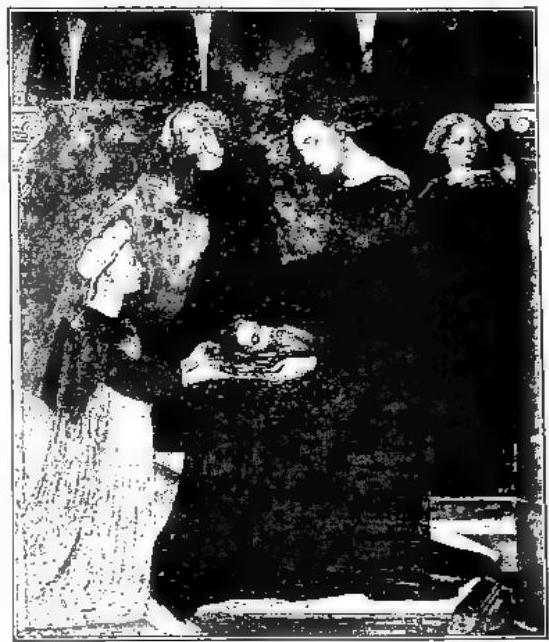
HERODIAS - H. receives the head of 1, John the Baptist. Detail of the fresco by Masolino da Panicale (1435) - Castiglione Olona, Collegiate church.

HERODIAS. - Daughter of Aristobulus, son of Herod the Great. She married her uncle Herod Philip, son of Herod the Great and of Mariamne II, daughter of the high priest Simon.

Herod Antipas (v.), the tetrarch, having come to Rome and been hosted by the aforementioned his brother Herod Philip, who lived there with his wife H., fell in love with her, promised to repudiate his own wife, daughter of the king of the Nabataean Arabs Aretas IV, and to marry her. But the legitimate wife, having learned of her husband's intentions, fled to her father before being repudiated; soon H., driven by ambition, went to live with the tetrarch, taking with her her own daughter Salome. Against this adultery John the Baptist protested publicly, and he was imprisoned.

But H. was watching for an opportunity to take revenge: since Antipas during a banquet for his birthday had promised Salome whatever she wished as a reward for her dances, the girl, on her mother's advice, asked for the head of John, who was immediately beheaded (Mk. 6:17-29; Mt. 24:3-12): this happened in the fortress of Machaerus. Although Flavius Josephus gives only the political reason as the cause of the Baptist's imprisonment and death, this does not exclude the other one given by the gospels.

When Agrippa, H.'s brother, was made king by Caligula, H. could not bear that Antipas should remain a mere tetrarch, and urged him to go with her to the Emperor to obtain that title. Appearing before Caligula at Baiae, Antipas found himself faced with an accusation of treason brought against him by Agrippa, from which he could not defend himself. He was therefore deposed and sent into exile at Lyon. H. did not accept the pardon offered her by Caligula and followed Antipas into exile. Nothing is known of their end.

Giuseppe Ricciotti

About this entry

By Giuseppe Ricciotti

How we know signed in print

Translated from the Enciclopedia Cattolica, vol. V (1950), coll. 514–515.

Printed pages Open in the page viewer
Page 327
vol. 5, coll. 513–514
Page 328
vol. 5, coll. 515–516

More by Giuseppe Ricciotti: Herodians ('Ἡρωδιανοί') · Herod I, called the Great, King of Judea · Pharisees · Philip Herod · Philip Herod

Cite this article

Chicago

Ricciotti, Giuseppe. “Erodiade.” In Enciclopedia Cattolica, vol. V, coll. 514–515. Città del Vaticano: Ente per l’Enciclopedia Cattolica e per il Libro Cattolico, 1950. https://azioneromana.com/article/erodiade.

MLA

Ricciotti, Giuseppe. “Erodiade.” Enciclopedia Cattolica, vol. V, Ente per l’Enciclopedia Cattolica e per il Libro Cattolico, 1950, coll. 514–515. Azione Romana, https://azioneromana.com/article/erodiade.

BibTeX

@incollection{ec5_erodiade,
  author    = {Ricciotti, Giuseppe},
  title     = {Erodiade},
  booktitle = {Enciclopedia Cattolica},
  volume    = {V},
  pages     = {514--515},
  note      = {Cited by column},
  publisher = {Ente per l’Enciclopedia Cattolica e per il Libro Cattolico},
  address   = {Città del Vaticano},
  year      = {1950},
  url       = {https://azioneromana.com/article/erodiade}
}

One of some 20,000 entries brought back from the twelve printed volumes (1948–54). Spotted something? Help us improve it.

Save for later

Enter your email and we will send you a sign-in link. No password. What you save (articles, verses, chapters, documents) follows you to any device.