
ERODE, called the Great, king of JUDEA. — Antipater (v.), chamberlain of Hyrcanus II, and of the Arabian Cypros, he was born ca. 73 B.C. and received an excellent education in Jerusalem. In 47 B.C., when Caesar assigned Palestine to Hyrcanus II with the title of ethnarch, Antipater was appointed ἑπίτροπος Ἰουδαίας, his eldest son Phasael στρατηγός of Judea, and E. of Galilee. Having entered office, E. purged his domains of brigands (in reality partisans of the deceased king Aristobulus II), killing their leader Eleazar without a trial before the Sanhedrin; he was therefore condemned by that body, but, saved by Hyrcanus II, took refuge with Sextus Caesar, governor of Syria, and was also appointed στρατηγός of Coele-Syria. In 45 he aided the Caesarians near Apamea; after Caesar’s death he went over to Cassius and finally, after the battle of Philippi, was accused before Antony together with Phasael, but both won his favor with lavish gifts and in 41 were appointed tetrarchs of their respective territories, while Hyrcanus II retained the high priesthood. E. then became related to the Hasmoneans by marrying Mariamne, the granddaughter of Hyrcanus II.
In 40, following an invasion by the Parthians, Antigonus was chosen king by them. E., Phasael, and Hyrcanus were besieged in Jerusalem. E. succeeded in taking refuge in Idumea and, after a perilous journey, reached Rome toward the end of 40; there he was proclaimed king.
At the beginning of 39 he landed at Ptolemais and, having gathered an army of Idumeans and mercenaries, occupied much of Galilee, Samaria, and Idumea. Toward the end of the winter of 37 he besieged Jerusalem and, with the help of the Romans, captured it five months later. Master of the city, E. put to death 45 leading men who were followers of Antigonus, confiscated their property, and appointed as high priest a certain Ananel, whom he shortly afterward replaced with his very young brother-in-law, Aristobulus (III). Since Aristobulus had been acclaimed by the people with excessive enthusiasm during the Feast of Tabernacles, E. had him drowned in the bath after a banquet at Jericho (35 B.C.). Summoned by Antony to Laodicea to justify himself, he returned acquitted.
After the battle of Actium (2 September 31 B.C.), E. abandoned Antony and, appearing before Octavian at Rhodes in the spring of 30, succeeded, with great skill, in having his kingdom confirmed. He received Octavian royally at Ptolemais and supplied provisions for his army in Egypt. When he went to Rhodes to meet Octavian, he had left his wife Mariamne and his mother-in-law Alexandra in the fortress of Alexandr(e)ion, entrusted to the custody of a certain Soemus.
On E.’s return, the guardian, suspected of adultery, was killed, and Mariamne herself was condemned to death. After the sentence had been carried out, E. nearly went mad with grief. During a serious illness of his, he also had Alexandra killed, since she had attempted to seize the fortified places of Jerusalem. In 7 B.C. he had the two sons born to Mariamne, Alexander and Aristobulus, strangled in Samaria, where they were imprisoned; they had already been accused by E. himself before Augustus at Aquileia in 12 B.C. and acquitted there, but were subsequently condemned at Berytus in a regular trial, in which they fell victim to the calumnies of Salome, E.’s sister, and of their elder brother Antipater, the son of another mother. Before long Antipater himself, guilty of an actual attempted parricide, was tried before Quintilius Varus and condemned. E. immediately sent envoys to Augustus to obtain approval of this sentence, but shortly afterward, in the autumn of 5 B.C., he fell ill; he then went to the hot springs of Callirrhoe on the eastern shore of the Dead Sea, and afterward to Jericho. When imperial confirmation of Antipater’s condemnation arrived, he had him killed. Five days later, shortly before Passover in 4 B.C., E. also died. He was buried at Herodium, near Bethlehem.
“Although elected king by the Senate, E. was not a rex socium in the juridical sense of the expression; he was, however, regarded as an ‘ally and friend’ (Antiq. Ind., XVII, 9, 6, § 246), although wholly subject to the will of Rome and Augustus. Although he enjoyed full autonomy in his kingdom, he could not mint gold and silver coins (indeed, only bronze coins of his remain), did not possess full judicial authority over members of his own family, and could not designate his successor without Rome’s approval; moreover, toward the end of his reign, his subjects had to swear allegiance to Caesar, as was done throughout the Roman provinces from 15 B.C. Nor was he permitted to undertake wars on his own account; when E. once violated this prohibition by conducting a brief war against the Arabs in 9 B.C. with the consent of the legate of Syria, Sentius Saturninus, this aroused the indignation of Augustus, who threatened that, if until then he had treated him as a friend, from then on he would treat him as a subject (Antiq. Ind., XVI, 9, 3, §§ 286-99). For the rest, E. demonstrated the most humble submission toward the Emperor by adorning himself with flattering epithets (φιλοκαῖσαρ, φιλορώμαιος), naming cities founded by him Καρνάτα, Σεβάστη, and Αγάλασσα, and going to Rome himself at least twice (18–17 and 12 B.C.). His devotion was rewarded by Augustus in 30 with the restoration of the territories occupied by Cleopatra and with the gift of Gadara and Hippos; in 24, with the gift of the portions of Zenodorus’ tetrarchy situated at the foot of Lebanon, together with Batanea, Trachonitis, and Auranitis. The legates of Syria were ordered always to act in accordance with his advice; Augustus himself undertook the expenses of a daily sacrifice to be offered in the Temple for himself and the Roman people (Philo, Legatio ad Gaius, 23, 156; 36, 291; 40, 312).
E. was fond of magnificent construction projects. He built entire cities, including Caesarea, with an excellent harbor, a temple to Augustus, and the royal palace; Antipatris, between Caesarea and Jerusalem, in honor of his father; and Phasaelis in the Jordan valley. He completely rebuilt the Temple of Jerusalem, almost doubling its area to the north and south with extensive substructures; enlarged the fortress overlooking the Temple and called it Antonia; and built the royal palace in the western part of the city. In 27 he renewed Samaria and, in honor of Octavian, who had been proclaimed “Augustus,” called it Σεβάστη, also building a temple to him on the mountain above II. He also adorned foreign cities with buildings: at Rhodes he built the temple of Apollo at his own expense and contributed to the construction of Nicopolis. His revenues are estimated to have amounted to about 1,000 talents annually, equivalent to approximately 11 million lire in gold.
He was practically a skeptic in religious matters: he began his reign in Rome with a sacrifice to Jupiter, built or restored pagan temples in various places, and plundered David’s tomb in Jerusalem; nevertheless, he respected the people’s religious sentiments when this did not impose excessive burdens on him. Although he rebuilt the Temple of Jerusalem, he never entered the priests’ court, the Holy Place, or the Holy of Holies, because he did not belong to the priestly class; he forbade his sister Salome to marry the Arab Silicus because the latter refused to accept circumcision. These formalities, however, did not win him the people’s affection, for they hated his licentious life and his cruelties.
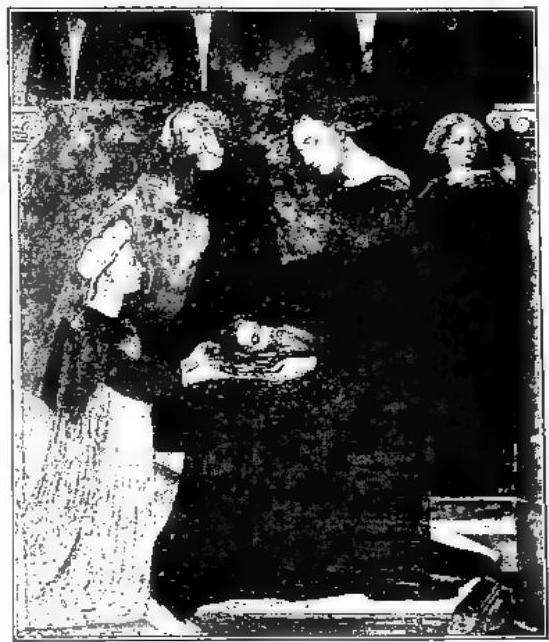
(Int. Alinari)
ERODIADE - E. receives the head of 1, Giovanni Battista. Detail of the fresco by Masolino da Papicale (1435) - Castiglioni d'Olona, Collegium.
rich, Das Haus des Herodes. Rome 1929; H. Duesberg, Le roi Hérode, Maredsous 1932; G. Ricciotti, Storia d'Israele, II, 57th ed., Turin 1947, passim. Giuseppe Ricciotti