
MORTO, MARE. – Lake of Palestine at the end of the Jordan River, enclosed between the steep mountains of Moab to the east and the desert of Judah to the west, approximately 76 km long and 16 wide, with an area of 945 sq km and a maximum depth of 791 m below sea level, thus constituting the deepest known continental depression on the globe. A flat peninsula projecting to the southeast, called al Lisân, divides it into two distinct parts, the smaller of which is a salt pond covered by 6–8 m of water, extending into the marsh of Sebbah.
Its principal characteristic is the intense concentration of salts (20–26%), among which magnesium, sodium, and calcium chlorides predominate, brought in by numerous tributaries (the principal ones being the Jordan to the north and the Vöde el-Mâğib, the biblical Arnon, to the east) and by the numerous thermal and sulphurous springs (Hammâm Zerqâ Mâ'in, ancient Calliroe [v.], to the east, and the abundant 'Ajn Gidî, the biblical Engaddi, to the west), which pour approximately 200 cubic metres per second into II. Although the M. M. has no outlet, the water level remains constant because of intense evaporation, with fluctuations depending on atmospheric and seasonal conditions. In
recent times, however, the level has risen, since in the north the small peninsula Ruğm el-Bahr is no longer visible and the path that permitted access on the western shore to Çebel Usdum, the rock-salt mountain in the south, with a maximum height of 150–75 m, has disappeared. The intense salinity (the specific gravity varies between 1.021 and 1.256) means that the waters are devoid of lacustrine fauna; fish carried in by the currents die as soon as they touch the waters.
In the Bible it is called Jâm hâ-'Arâbhâh (Vulgate: « mare solitudinis »), because of its geographical position in the deep depression of the Gör (Deut. 3, 17; Ios. 3, 16; 12, 3; II Reg. 14, 25); Jâm haq-Qadhmânî (« eastern sea »), in opposition to the Mediterranean Sea (Ez. 47, 18); or « anterior sea » (Ioel. 2, 20; Zach. 14, 18), in antithesis to the « posterior sea » or Mediterranean, according to the Jewish manner of orientation. More frequently it is called Jâm ham-melah (Vulg.: « mare salis » or « salissimum »), in opposition to the fresh waters of the Jordan (Num. 34, 3; Ios. 15, 2; 18, 19). In Gen. 14, 3 this designation con-
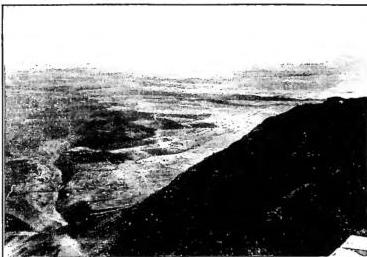
Among Hellenistic authors (Posidonius of Apamea, Diodorus Siculus, Flavius Josephus [Antiq. Iud., I, 9; IV, 5, 1; Bell. Iud., XVII, 6]), it is called Lake Asphaltitis, on account of the extensive floating patches of asphalt originating from the bituminous strata of the bottom. From the 2nd century onward, the name M. M. prevailed (Pausanias, 173), which St. Jerome adopted when glossing « mare salis » in Ios. 3, 16. In the Talmud and among modern Jews it is called « sea of Sodom », with reference to the catastrophe of the Pentapolis, whose memory survives in the name Çebel Usdum (Gen. 14). The Arabs call it Bahr Liût « lake of Lot ». In the mosaic map of Madaba, a sanctuary to the righteous Lot is shown south of the M. M.
In 1930 the systematic exploitation, especially of potash salts, was begun by Palestine Potash Ltd., with installations on the western shore of the M. M. These were partially destroyed north of 'Ajn Gidî during the Arab-Jewish war of 1948; the others have remained inactive owing to the lack of a road and of agreement between the Israeli government and the company.