
ROGEL (Heb. 'En-righèl “spring of the fuller” or “of the passer-by”?). — Name of a spring marking, south of the ancient city of Gerusalemme, the boundary between the territory of the tribe of Giuda and that of Beniamin (Ios. 15, 7; 18, 6), near 'Ebhen haz-Zöheleth (“serpentine stone,” from zhl, “to slip, to wind”), where Adonia, son of David, conspired against his father in order to have himself proclaimed king (I Reg. 1, 9).
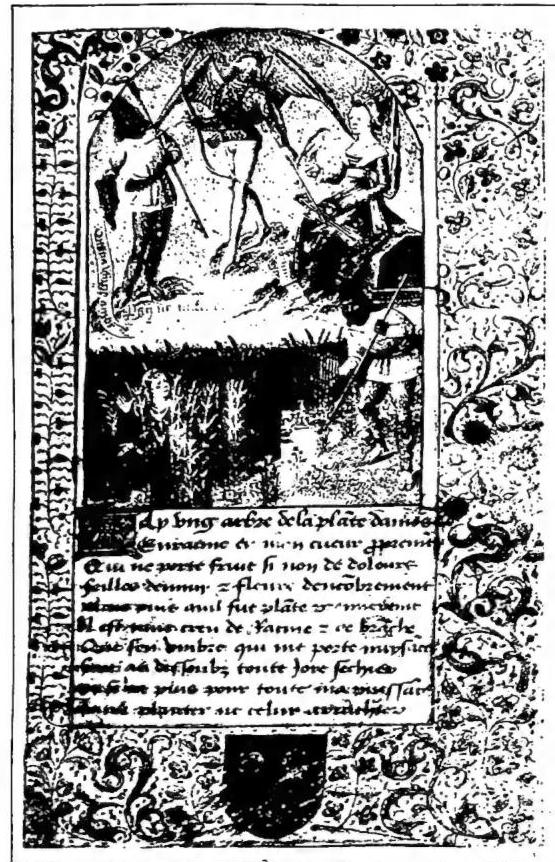
ROHAN, FAMILY. - Title page with miniature and ballad by Alain Chartier and coat of arms of the house of R. Miniature of the French School, 15th century - Strasbourg, ms. 78 B. 17, f. 22°.
It is identified with Bir Ajjub (“Job’s well”), southeast of Jerusalem, somewhat south of the confluence of the valley of Hinnöm and that of the Cedron. The well, about 40 m. deep, may have been called a “spring” because during the winter rains it overflows, almost becoming a “spring.”
The name ez-Zu'ejleh, which seems to preserve the trace of haz-Zöheleth, applied by the Arabs to the rocky and slippery slope which, opposite the “Virgin’s Fountain” (v. GIRON), leads to the village of Silwân, cannot present difficulties for the identification of R. with Bir Ajjub, since in ancient times the name haz-Zöheleth may have been given to the steep and slippery descent which, from the southern end of the village, led directly to Bir Ajjub.