
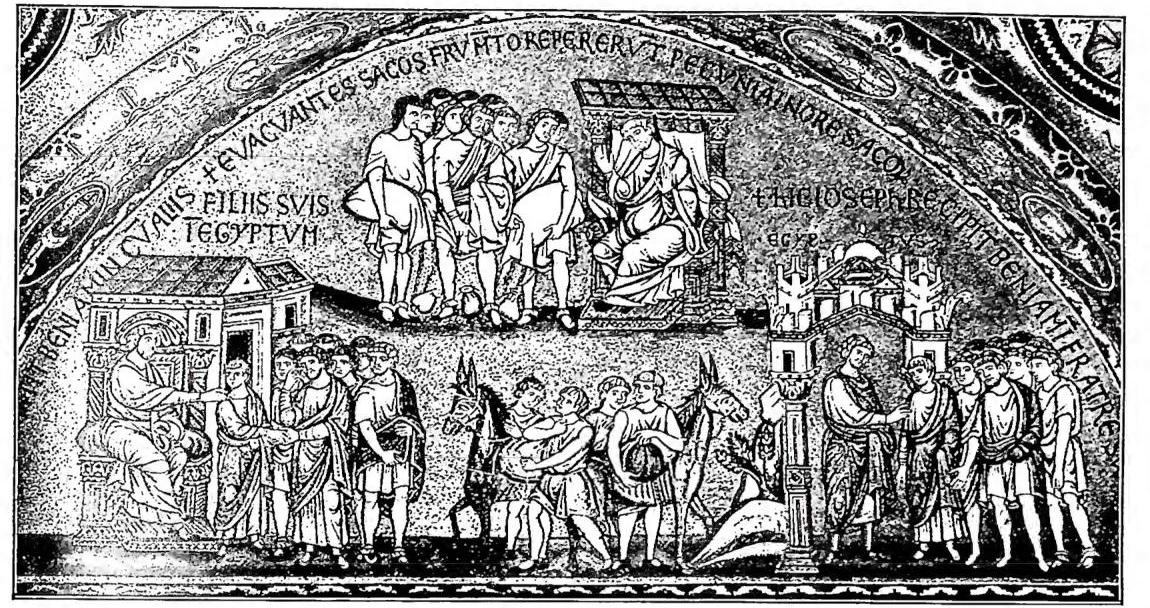
BENIAMIN (Hebr. Binjamīn). — The last son of Giacobbe. Rachele, dying while giving birth to him near Ephrata (Betlemme), had called him Ben-šai, “son of my sorrow.” Giacobbe changed this mournful name to that of B., “son of the right hand,” which is an auspice of happiness (“right hand”: strength, prosperity; Gen. 35:16–18). He was his father’s favorite, especially after the loss of Giuseppe, who had been taken as a slave to Egypt. Giuseppe too had a particular affection for B. (Gen. 42–45). Regarding the number and names of B.’s sons, Gen. 46:21, Num. 26:38–40, I Par. 7:6–11, and 8:1–5 present notable divergences.
B. was the progenitor of the tribe bearing the same name. In the Mari letters, the expressions mārē-jamina and bin-jamina (“southerners”) have no relation to the biblical name.
The tribe of B. lay between Ephraim to the north, Judah to the south, Dan to the west, and the Jordan to the east; between the northern shore of the Dead Sea, Cariathiarim, Bethoron, Bethel, and the Jordan somewhat north of Jericho. It was a small but very important territory: a mountainous region, with settlements easily transformed into fortresses, and with extremely fertile plains, especially that of Jericho. Its principal cities were Bethel, Gabaon, Jericho, and above all Jerusalem (Ios. 18, 11-28). It was warlike, bold, and stubborn (Gen. 49, 27). Aod (v.) is a Benjamite (Iudc. 3, 15-30). The warriors of B. took part, with Barac and Debora, in the decisive battle against the Canaanites of the north (Iudc. 5, 14).
Because of the brutal deed committed by the inhabitants of Gabaa, it risked being exterminated by the other tribes: approximately 600 men survived the massacre. With their women killed, they obtained 300 girls spared in the slaughter at Iabes of Galaad, and abducted others from Silo during a religious festival (Iudc. 19-20). The tribe recovered, and in the period of Samuel returned to its former power. It produced the first king of Israel, Saul, and rose up against the Philistines (I Sam. 10, 21). It supported Isboseth against David and reluctantly yielded primacy to Judah (II Sam. 2-5). At the division of the kingdom, for the most part it remained faithful to the Davidic dynasty (I Reg. 12, 20-23; II Par. 15, 9 sg.). The tribe subsequently merged its history with that of Judah, while retaining its own individuality (Esd. 2; Neh. 5, 11). S. Paolo takes care to note his membership in B. (Rom. 11, 1; Phil. 3, 5).