
SAMUELE (Heb. Šēmišel). — The last “judge” (v.) of Israel, the founder of the monarchy, and a prophet, he lived in the eleventh century B.C. He gave his name to the biblical book that recounts the history of himself, Saul, and David. His father, Elcana (v.), a Levite, was from Ramathaim (modern Rentis = Arimathea) in the mountainous territory of Ephraim (I Sam. 1:1). ANNAM (v.), who, being barren, obtained him from the Lord (ibid. 1:9–20); and, after raising him, she entrusted Eli (v.) at Silo, so that he might serve the Lord forever.
While still very young, he received from God a revelation concerning Eli’s family, and afterward others, which were always fulfilled, so that all Israel recognized him as a prophet. As an adult, he delivered the nation from the Philistines and then, into his old age, exercised the “judgeship,” which had a pronounced character of religious reform, traveling throughout the entire country (ibid. 7). He nevertheless resided in his native city, where people came from everywhere to consult him (ibid. 9:6–13), and from which he fostered associations of “prophets” (v.), whom he employed in his work of reform (ibid. 10:5, 10; 19:18–20). In his final years, two sons assisted him in the “judgeship,” but they differed too greatly from their father; this, together with serious historical reasons (for example, the imminent Philistine danger), led the people to ask him for a king. S. reluctantly agreed to the request and, by God’s command, Saul (v.) as king. He then laid down the office of judge (ibid. 12), but thereafter continued, when occasion arose, to convey God’s commands to the King (ibid. 15:1 ff.). After Saul’s transgression, S. David (v.) as king. He died at a very advanced age (ibid. 25:1), and after his death appeared to Saul, who wished to know the outcome of the battle of Gelboe, foretelling his defeat and death (ibid. 28:6–19).
According to s. Girolamo (PL 23, 343), the emperor Arcadius (d. in 408) transferred S.’s bones from Judea to Thrace; and Nicotero Callisto relates (PG 146, 1090) that the empress Pulcheria (d. in 453) transferred them to Constantinople, placing them in a “burial place built near the Hebdomon.”
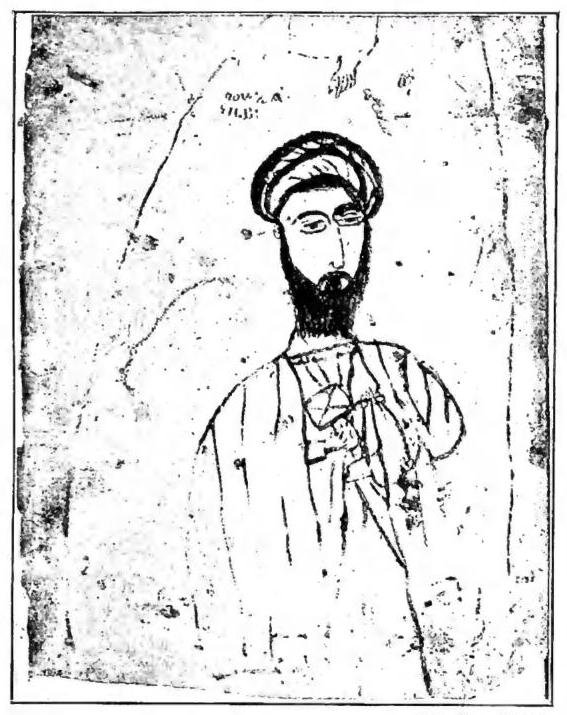
(Int. Enc. Cott.)
SAMUELE — S., above him the hand of God. Drawing from the 14th century. Vatican Library, cod. Borg. Ethiopico 3, f. 1.
whose ruin he wept with bitter tears (I Sam. 15:11–35; 16:1). In character, however, he was austere. He grew indignant with those who strayed from the path laid down by God (ibid. 13:11–14; 15:16–33). He was great and heroic in his fidelity and zeal. Jeremiah (15:1) would place him immediately after Moses for the power of intercession; Dante, too, would see him in Paradise as second only to Moses (Par., IV, 29).
LIBRI DI S. - Book (the division into two books is attested no earlier than 1448 A.D.) which in the Bible follows the Octateuch (Pentateuch, Joshua, Judges, Ruth, which in Hebrew Bibles is included among the mèghillòth). It improperly bears its present name, since S. was not, as the Talmud would have it, its author, nor is he the predominant figure in it: it was perhaps so called because of the false literary attribution. In the Septuagint and the Vulgate it is entitled Books I-II Regum (Βασιλείων “of the kingdoms”).
The lengthy narrative is, in its construction and design, one and compact, wholly directed towards a single end. It is natural to divide it into two blocks (the present two books), centred upon Saul and David. Everything preceding in the first book, the history of Eli ([v.] chaps. 1-3), of the Ark ([v.] chaps. 4-6), of S. (chaps. 7-8), is merely preparation for the coming of Saul ([v.] chaps. 9-31). David (v.), although he enters the scene halfway through Book I (I Sam. 16, 12 ff.), dominates the narrative only in Book II (II Sam. 2-4, king of Judah; 5-9, king of all Israel; 10-20, David’s sin and manifold expiation). An appendix of six miscellaneous documents (ibid. 21-24) now closes, or rather interrupts, the history which formerly ended with Solomon’s succession and David’s death (I Reg. 1-2).
Its subject is the introduction and stabilization of royal authority in Israel. But this was only the visible part of the divine plan: to reveal the other, hidden part was the author’s purpose. For centuries Israel had kept its gaze fixed upon the future Messiah; he was expected to be clothed with royal power (Gen. 49, 8 ff.; Num. 24, 17 ff.). S. sets down another milestone: the awaited one would be a king of the family of David, and would possess an everlasting kingdom (II Sam. 7). It was therefore necessary to show how the transition had been made from the “judgeship” to royal power; how the attempt of Saul the Benjaminite had failed; and how David’s authority, despite countless difficulties, had become firmly established.
The original Hebrew text of S. has suffered as have few other books of the Old Testament; nevertheless, its substance has been preserved, both as regards history and doctrine. Moreover, textual criticism provides effective assistance in healing many of these wounds inflicted by time. The basic text is the Masoretic text (Biblia Hebraica of R. Kittel-P. Kahle, Stuttgart 1937). Of the greatest importance is the Greek version of the Septuagint, from the second century B.C., transmitted in various recensions (it is commonly read in the edition of A. Rahlfs, Septuaginta, Stuttgart 1935); in general it displays extraordinary fidelity, but in comparison with the Masoretic text it has both notable omissions and additions. The most famous omissions occur in I Sam. 17-18, concerning which judgment is difficult. Of lesser assistance are the Aramaic (Targum of Jonathan, first century B.C.), Syriac (Pèliità, of uncertain date), Old Latin (second century A.D.), and Jerome’s version (Vulgate, 393 A.D.; Benedictine critical edition of 1944). It should also be recalled here that many sections of S. are likewise found in the book of Paralipomenon; this is of great assistance to criticism, but at the same time raises many problems.
The canonicity of S. has never been called into question, either in Judaism or in the Church.
Along with a magnificent unity of design, the book displays notable inequalities. It contains many passages in which the description is extremely detailed (e.g., I Sam. 1; 9-10; 25; II Sam. 9-20), without, however, aspiring to a complete biographical form; many other passages, of greater historical, political, and social value, are instead drawn up in a highly schematic form (e.g., I Sam. 7, 15 ff.; 14, 47-52; II Sam. 8, 1-18, etc.). Many pages are genuine masterpieces of narrative; others are dry enumerations. Finally, some episodes are reported more than once, with considerable differences. From this one may conclude: a) the book is not a continuous narrative, but a compilation from various pre-existing written and oral sources; b) the compilation was made by a single author, following a definite plan; it was not the successive stratification of documents; c) even though “duplicates” must sometimes be admitted, real “contradictions” perhaps never occur (I Sam. 17-18 deserves separate examination, since the textual question there remains unresolved); in general, the same phenomenon is found as that discussed among the various narratives of the Synoptic Gospels; d) most of the material goes back to the very period of the events themselves (there is general agreement concerning II Sam. 9-20).
The author of the whole book is unknown, but he must have lived in the tenth or ninth centuries B.C.; indeed, the appendix (II Sam. 21-24) cannot have been added after the eighth century, when Book I of the Psalms, which contains II Sam. 22, already existed. Subsequently the book underwent some further intentional retouching, but of slight importance.
In the rationalistic field, hypotheses abound, often arbitrary, yielding astonishing and contradictory results because of the extreme subjectivity of the criteria. Thus far every attempt to separate the primitive documents has failed (J. Wellhausen, 1871): something which, moreover, would not resolve a single difficulty.
Its historicity is solidly grounded in the antiquity of the sources, the marked impartiality of judgment, and its many confirmations, although these are sometimes only indirect.
For example, the religious and political situation agrees with that described in the book of Judges; the chronology of the Philistine invasion corresponds to the Egyptian data, and their presence in certain localities (Bethsan; the vicinity of Jerusalem) has been confirmed by archaeology; the emergence of a strong national monarchy in Israel is historically comprehensible in view of the contemporaneous precarious conditions of Assyria and Egypt, attested by their respective histories. Political institutions (court offices: II Sam. 8, 16 ff.; 20, 23 ff.) and military institutions (the “Thirty”: II Sam. 23, 13-29) are of Egyptian derivation.
The importance of S. is very great, artistically, historically, and religiously. Its artistic value is commonly acknowledged, and is especially manifest in its portrayal of characters, which are numerous. The narrative is of ever new and varied interest, with gripping exploits (I Sam. 14), deep feelings, outbursts of anger and idyllic scenes, enthusiasms and discouragements: life in its entirety. For the history of the first monarchy and of prophetism, S. is irreplaceable; moreover, it increases our knowledge of customs, mentalities, and beliefs. Religiously, the primary interest of S. derives from its messianism: literal (II Sam. 7, 23, 1-7; I Sam. 2, 10) and figurative (David as a type of the suffering and betrayed Christ); but teachings of a moral character also abound, especially concerning sin and forgiveness.