SYNOPTICS, GOSPELS. — Title attributed to the Gospels of Matthew, Mark, and Luke because, when transcribed in adjoining columns, they can easily be taken in with a single comprehensive glance (σύνοψις); the term “synopsis” for this form of transcription of the Gospels was first used by J. J. GRIESBACH, JOHANN JAKOB (v.) in 1774. The study of the “Synoptic problem” aims to give the reasons for the similarities and differences observed among the three S.
I. THE FACTS
The similarities and differences can easily be observed in the Greek Synopses of W. Larfeld,M.-J. Lagrange, and P. Vannutelli, as well as in P. Vannutelli’s Synopsis of the Gospels in Italian (Rome 1938).
1. Similarities in content
The Synoptics, unlike Giovanni, follow a generally common plan in recounting the public life of Jesus: the preaching of the Baptist, the baptism of Jesus, fasting and temptations, a ministry conducted predominantly in Galilee, the journey toward Judea, the final week in Jerusalem, the Passion, Death, Resurrection, and appearances. Within this common framework, the Synoptics include almost the same miracles and the same discourses. It is calculated that, if the material of the three Synoptics is divided into 100 parts, Marco has 93% in common with one or both of the others (and only 7% of his own), Matteo has only 42% of his own, and Luca 59% (cf. J. M. Vosté, De synopticorum mutua relatione, Rome 1928, p. 9, who cites the calculations of W. Strond and A. Norton).2. Similarities in the order of the sections
In addition to the general similarities of plan and common content, many sections follow one another in the same order, especially in Matteo and Luca; the order of Mt. 14–28 also frequently corresponds to that of Mc. 6,14–16,8. Certain groups of episodes, not linked to one another by any chronological or logical connection, are found recounted in the same order. For example: the preaching of the Baptist, the Baptism, and the temptations (Mt. 3,1–4, 12 = Mc. 1, 1–14 = Lc. 3,1–4, 14); the calming of the storm, the Gerasene demoniacs, the healing of the paralytic, the calling of Matteo-Levi, the dispute concerning fasting, the daughter of Jair and the woman with the hemorrhage (Mt. 8,23–9, 26 = Mc. 4,35–5,43 = Lc. 8, 22–56); Peter’s confession, the first prediction of the Passion, the Transfiguration, the lunatic, and the second prediction of the Passion (Mt. 16,13–17,22 = Mc. 8,27–9,32 = Lc. 9, 18–45).3. Similarities in literary form
Unlike Giovanni, the Synoptic Gospels have a simple, popular, anecdotal style; in certain passages the same Greek words occur in the same order. This happens not only in the discourses of Jesus or of others who, it should be noted, had spoken in Aramaic, but also in the very narrative of the events. The minor variations reflect the individual literary tastes, but the common foundation is evident. Here we transcribe from the Synopsis of P. Vannutelli, which accurately reflects the Greek, a passage in which the three Synoptic Gospels even agree in an anacoluthon:Mt. 9, 5–6.
5. For which indeed
is more feasible, to say:
Your sins
are forgiven,
or to say: Arise,
and walk?
6. But in order that you may know that the Son of Man has power on earth to forgive sins, then he says to the paralytic: Arise, take your bed, and go to your house.
See also the account of the Transfiguration (Mt. 17, 1–13 = Mc. 9, 1–12 = Lc. 9, 28–36). Also noteworthy are certain uniformities in rare constructions, such as ἀπεκρίμενο instead of the more common ἀπεκρίθη (Mt. 27, 12 = Mc. 14, 61 = Lc. 23, 9), and in quotations from the Old Testament that are uniform in the Synoptics but differ both from the Hebrew and from the Greek of the Septuagint (cf. Mt. 3, 3 = Mc. 1, 3 = Lc. 3, 4; Mt. 26, 31 = Mc. 14, 27).
4. Differences in content
The percentages indicated above show that Matteo and Luca contain a considerable amount of material of their own. Matteo has, in his own account, the anxiety of s. Giuseppe (1, 18–25), the Magi, the flight into Egypt, the massacre of the innocents, and the return (chap. 2), the parablesof the weeds (13, 24–30, 36–43), of the treasure, of the pearl, of the great net (13, 44–50), of the servant (18, 23–35), of the virgins (25, 1–13), the miracle of Pietro walking on the water (15, 28–31), and the promise of primacy (16, 17–19). Marco has only three sections of his own: the deaf stammerer of the Decapolis (7, 31–37), the blind man of Bethsaida (8, 22–26), and the brief parable of the seed growing by its own power (4, 26–29). Luca has much material of his own in the infancy narratives (chaps. 1–2); in addition: the episode of Marta and Maria (10, 38–42), the conversion of Zaccheo (19, 1–29), and many other passages in chaps. 9–19 (travel narratives). In the history of the Passion he has the episodes of Erode (23, 6–12), the good thief (23, 40–43), etc.
5. Differences in order
Inversions of the common sections or of details within those sections are frequent. For example, Lc. 4, 1–13 reverses the last two temptations recounted by Mt. 4, 1–11. At times, in a series of common sections, episodes proper to one of the Synoptic Gospels appear (cf. Mt. 8–13 with Mc. 1, 29–6, 13; the Sermon on the Mount of Mt. 5–7 with Lc. 6, 20–49; etc.).6. Difference in the choice of Greek words and in their order
Even in passages where the greatest similarities of content are noted, different terms (synonyms) and inversions of clauses are sometimes found. Normally the same events are reported more briefly by Matteo than by Marco, who, on the other hand, is more concise in his accounts of discourses. More striking are the differences among the Synoptics even in passages where the greatest verbal agreement would be expected; for example, in the genealogies (v.) of Jesus (Mt. 1, 1–17 and Lc. 3, 23–38), in the Pater noster (Mt. 6, 9–13 and Lc. 11, 2–4), in the words of consecration, where Matteo (26, 26–28; cf. Mc. 14, 22–24) differs from Luca (22, 19–20); and in the title of the Cross (Mt. 27, 37; Mc. 15, 26; cf. Lc. 23, 38 and Io. 19, 19).II. ATTEMPTS AT A SOLUTION
The difficulties raised by these facts have given rise to a great number of hypotheses attempting to provide a sufficient explanation of such concordia discors. Since some of these run counter to the traditional data concerning the origin of the Gospels, as well as to their historical value, the Pontifical Biblical Commission intervened with two responsa of 26 June 1912 (Denz-U, 2164 ff.).a) In treating the question, the authenticity and integrity of the three S. G. must be safeguarded, as must the substantial identity between the Greek version of Matthew and the primitive original, and the chronological order (Matthew, Mark, Luke); it is permissible to debate freely, resorting either to the hypothesis of oral or written tradition or to that of mutual dependence. b) These requirements are not preserved by the proponents of the “two-source” hypothesis, who derive Matthew and Luke from Mark and from a so-called collection of the Lord’s sayings.
The ancient ecclesiastical writers sought to harmonize the Gospels by composing concordances (diatessaron [v.]) or by dividing them into sections (the canons of Ammonius and Eusebius), so that they could easily
be compared. They did not address the question from a literary point of view. Only s. Agostino put forward the hypothesis of mutual dependence, asserting that Mark was «pedissequus, breviator Matthaei» (De consensu Ev., 1, 2: PL 34, 1044). It was only in the eighteenth century, with G. E. Lessing, that the Synoptic question began to be treated scientifically.
1. Hypothesis of a single common written source. – This was first proposed by G. E. Lessing (Neue Hypothese über die Evangelien, Berlin 1784, p. 45 ff.): the present Gospels would depend, as versions or recensions, upon a primitive Gospel written in Hebrew (similar to the one later found by s. Girolamo among the Nazarei [v.]); Matthew would have extracted his Gospel from it (in Greek), and Mark and Luke would have done likewise. According to J. G. Eichhorn (in Allgemeine Bibliothek der bibl. Lit., 3 [1794], p. 353 ff.), the primitive Gospel would have been written in Aramaic around A.D. 35; by elaborating this framework with additions from other sources, omissions, and inversions, Matthew would have composed his Gospel in Aramaic; the Greek version of Matthew would have added many details, for example, the infancy (chaps. 1–2). The hypothesis of the common written source was subsequently presented in various other forms and recently revived in Italy by P. Vannutelli, who likewise supposes that Matthew himself later produced the Greek recension of his Gospel (translation in the broad sense), and does not exclude the possibility that Mark followed the Petrine catechesis in order to lend liveliness to his narrative and that, in the sections proper to them, the individual evangelists followed other trustworthy written or oral sources. The hypothesis of a single common source, understood with these qualifications, does not conflict with the traditional data; it belongs to the eclectic solution preferred by many modern scholars.
2. Hypothesis of two written sources. – Although presented with many variations by different critics, it maintains that the three S. G. depend, for the events, predominantly upon Mark (or a Protomark), and, for the discourses, upon a collection of lóghia PAPA (v.) attributes to Matthew and which German critics designate by the siglum Q (Quelle, “source”). The two-source hypothesis, proposed by Schleiermacher (Über die Zeugnisse des Papias, in Theol. Studien und Kritiken, 5 [1832], pp. 735–68), was accepted by the overwhelming majority of non-Catholic critics, especially German ones. The history of the hypothesis up to 1892 was presented by H. J. Holtzmann (Einleitung in das N. Test., Freiburg 1892, p. 345 ff.), and that of the subsequent period by Goguel, Wernle (1899), and Bultmann (1925–31). Although they differed among themselves in determining the content and dates of the two sources, the proponents of this hypothesis agreed in holding that Mark was the oldest of the S. G., because it was more primitive in style, livelier, and less developed in theology, and in asserting that the other source (lóghia, Q) was postulated by the similarities between Matthew and Luke in the discourses.
Against this hypothesis it is pointed out that it does not agree with the most ancient tradition concerning the origin of the Gospels. That tradition places Matthew first in chronological order. It is nevertheless possible to admit that the Greek Matthew that has come down to us benefited, in its translation and composition, from the Gospel of Mark. The style of Mark, which seems more primitive, can also be explained by taking into account the “visual” character of his informant (s. Pietro [v.]); likewise, Mark’s less developed theology can be justified by considering the purpose and the recipients of the second Gospel. Nor does the testimony of Papia, or that of other sources, establish the existence of a collection of lóghia or sayings of Jesus distinct from the Gospel of Matthew that has come down to us. As can be seen, the main supports of this hypothesis have no basis in historical tradition; indeed, they conflict with II.
Catholics who favor the two-source hypothesis modify it in a manner consistent with tradition, holding that the Gospel of Mark and the lóghia (to be identified with the Aramaic work of Matthew) were common sources of the Greek Matthew and Luke. Thus, with secondary variations, think J. Sickenberger, H. Vogels, M.-J. Lagrange, Camerlynck, and others. L. Tondelli (Gesù Cristo, Turin 1936, p. 115) thinks that Matthew «first formed a collection of more limited material, especially of sayings of the Lord, of which Papia had knowledge; and then, later, ‘while Peter and Paul were founding the Church of Rome,’ according to the words of s. Ireneo, using the text of Mark that had already appeared, inserted the sayings he had himself collected into the narrative of Christ’s life, giving the account that aspect of a messianic demonstration which a Gospel for Jews required. He would have carried out this second work in Aramaic, and it would later, at an unspecified time, have been rendered into the Greek language». Understood in this sense, the two-source hypothesis would not conflict with the traditional data concerning the origin of the S. G. or concerning the substantial identity between the Aramaic Matthew and the Greek Matthew.
3. Hypothesis of several written sources. – B. H. Streeter (The four Gospels, Oxford 1924, pp. 151–260) proposed four sources; he was followed by many Anglicans. The sources would be Mark, Q (= lóghia), a Protomark (M), and a Protoluke (L). Others speak of many written sources, Aramaic and Greek, supposing them to be indicated by the term δῆλγαις used by Lc. 1, 1, where he alludes to his sources. This hypothesis too, although containing some positive element of a solution, does not by itself provide a sufficient explanation of the similarities and differences among the S. G.
The so-called “theory of the history of the forms (v.)” might also belong within this framework; it places at the origin many small literary units arising under the impetus of the community and subsequently fixed in the Gospels. But the proponents of this theory, which is subject to many reservations, do not put it forward as a solution to the Synoptic question.
4. Hypothesis of oral catechesis – J. C. L. Gieseler (Historisch-kritischer Versuch..., Leipzig 1818, p. 53) maintained that Matthew, Mark, and Luke committed the preaching, or apostolic catechesis (v. CATECHESIS), to writing without making use of written documents; this catechesis would initially have been fixed, almost stereotyped, orally, in a uniform form. He nevertheless admitted variants, depending on the diversity of places and recipients. Matthew would have committed to writing the form of the Palestinian catechesis intended for the Jews; Mark, that of the Roman catechesis preached by Peter; Luke, that of the Antiochene catechesis preached by Paul. This hypothesis had many supporters, especially among Catholics (R. Cornely, J. Knabenbauer, L. C. Fillion, C. Fouard, J. Felten, L. Murillo, etc.) and quite a few among Protestants (Westcott, de Wette, Godet, etc.). Almost all of them, however, admit, in addition to the principal oral source, some written source as well. Indeed, oral catechesis, although attested by the sources in different forms (Paul spoke of his «ways»: I Cor. 4, 17; of his «gospel» and «type of doctrine»: Rom. 2, 16; 6, 17), could not have been so stereotyped as to preserve certain expressions unchanged in secondary matters, while allowing itself so many liberties in others, where closer agreement would be expected. This hypothesis, by itself, explains neither the fundamental divergences nor the passages proper to Matthew and Luke. Nor should the strength of «Eastern» memory be exaggerated. Nevertheless, this hypothesis provides a fundamental element for the solution of the Synoptic problem.
5. Hypothesis of mutual dependence. – It was put forward in various forms. Some of these preserve the traditional data concerning the chronological order of the Gospels (admitting that Luke depends on Mark, and perhaps on Matthew, and that Mark depends on Matthew), whereas others reverse this order, especially those that maintain the priority of Mark. Many hold that the Greek Matthew made use of the Gospel of Mark (thus J. L. Hug, F. S. Patrizi, Cladder, etc.). Few, however, believe that the Synoptic problem can be solved solely through the mutual dependence of the Gospels, also because, although this hypothesis explains the similarities well, it does not by itself resolve the problem of the divergences.
III. THE MOST PROBABLE SOLUTION
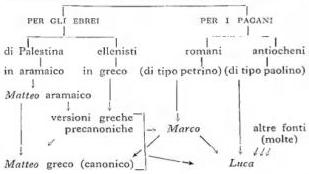
None of the various hypotheses proposed resolves the question by itself. For this reason, many modern scholars turn toward eclectic solutions, while assigning greater or lesser importance to certain elements.The hypothesis of the primitive oral catechesis, fundamentally uniform and partially different according to the various recipients, is certainly one of the positive elements that must be placed at the origin of the Gospels. It may be admitted that this catechesis, intended for the Jews, possessed a certain uniformity in Palestine, where it was fixed, both in Aramaic and in Greek, for the Hellenistic Jews. This catechesis certainly flowed into the Gospel of Matthew. As it spread into the pagan world, the primitive catechesis, while preserving its fundamental uniformity, necessarily underwent adaptations corresponding to the needs of the various audiences. Tradition informs us that Mark wrote according to the catechesis of Peter, and Luke according to that of Paul. This too is a positive element in the solution.
Moreover, Luke himself declares in his prologue (1, 1-4) that he made use of many oral and written sources. Among the « many » (πολλοί) who « set down in writing » what they knew by heart (this is the meaning of ἀνατάξασθαι), and from whom the investigator Luke benefited, one may also list the two earlier Gospels of Matthew and Mark. The former seems to have been used by Luke especially for the discourses, the latter especially for the narratives. Among those « many » one might also place other brief writings containing, for example, the accounts of the infancy (v.), which in Luke have a strongly Semitic coloring, quite different from the style of the prologue, and which might derive from a « Marian » source. Other oral and written sources (besides the preaching and writings of St. Paul) may be supposed, especially in his special sections (the accounts of the journeys, chaps. 9-19). For Matthew too, one may think of particular sources, especially for the history of the infancy, which seems to have been drawn from traditions deriving, even if indirectly, from St. Joseph, who appears there as the protagonist.
Assuming at the origin of the S. the influence of these various written and oral sources, emphasizing now one and now another according as the similarities or the differences predominate, and also taking into account the literary taste proper to the individual authors, who, even when dependent on other sources, like to « invertere » (as Tacitus writes, Annales, XV, 63) or to retouch, one reaches a relatively satisfactory solution of the synoptic question. Taking into account also the possible influences of the various precanonical Greek versions of Matthew’s original work, to which Papias alluded, the elements of the preferable solution may be summarized in the following scheme: