
THE DEMON-POSSESSED IN THE BIBLE. — In the Gospels (and Acts), numerous healings of the demon-possessed are narrated. With possessio, demon (v.) or several demons animate the body (Lesêtre), but as an adventitious motor (Benedict XIV) or an external principle of actions (Leistle): that is, they enter it, subsist and operate within it, and can torment it unless prevented from doing so by God (s. Bonaventure).
This is denied by the rationalists who deny miracles,
up to the moderns (such as O. Holtzmann, E. Rasmussen, J. Weiss, A. Harnack, etc.), who maintain the non-existence of spirits, which would be chimeras of superstitious peoples, a remnant of the obscurity of past centuries, symbols and representations of moral and physical evil; the symptoms of demonic possession described in the Gospels would refer to sufferers from nervous diseases (epileptics, hysterics, etc.); the cures would have taken place through hypnosis and suggestion: Jesus would not have expelled demons, but would have cured such sick people through his psychic power.
Properly speaking, the demon-possessed are not mentioned in the
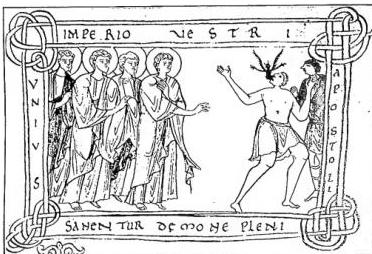
THE DEMON-POSSESSED IN THE BIBLE — Liberation of a demon-possessed person. Miniature from fol. 155 of the Sacramentary of Ivrea, commissioned by Bishop Warmondo (late 10th century).
Ivrea, Capitular Library.
Old Testament. At times an ethical demonic influence appears (I Reg. 22, 19-23; I Par. 18, 18-22: the spirit of falsehood deceives King Achab’s prophets), or even a physical one (as in the case of Job); but this influence is rather external. The case of Saul (I Sam. 16, 14-23; 19, 9) is understood by many (A. Calmet, M. Hagen, L. Janssens) as a profound melancholy caused and fostered by the evil spirit.
In the New Testament, Satan’s intervention extending to possessio is connected with the diabolical attempt to divert Christ’s mission through seduction and intimidation (Mc. 1, 12 ff.; Mt. 4, 1-11; Lc. 4, 1-13; Lc. 22, 31), thereby hindering the Kingdom of God (Lc. 11, 20; Mt. 12, 28).
The Son of God, on the contrary, came to undo the work of the devil (I Io. 3, 8), and the Apostles in turn are invested by the Master with the power to “cast out demons” (Lc. 10, 17-19). Jesus enters into the final struggle on the day of the Passion (Io. 12, 31 ff.; 14, 30; 16, 11), with a battle that has virtually already been won.
Various references to Jesus’ miracles place alongside the sick who were healed the demon-possessed who were freed (Mt. 4, 24; Mc. 1, 32, 34, 39; Mt. 8, 16; Lc. 4, 40 ff.; Mc. 3, 10; Lc. 6, 17-19; 7, 21).
That Jesus was immune from error or deception is clearly apparent from the Gospels, even when considered solely as historical books. Both He and the Evangelists clearly distinguish the sick from the demon-possessed, while admitting that certain illnesses are caused by demonic presence.
Moreover, although it is true that Jesus adapted himself to the manner of speaking of his contemporaries when dealing with physical phenomena or secondary questions, this did not occur in questions of a religious nature; indeed, on this point he intended to correct false ideas (cf. Io. 9, 1-3). Now, the influence of demons upon humanity constituted an important point of his religious mission; Jesus spoke of it on his own initiative (Lc. 11, 21 ff.; 22, 31; Io. 12, 31; 14, 30; 16, 11; Mt. 25, 41 etc.), and not solely for therapeutic purposes.
Numerous demon-possessed persons are found, especially in the Synoptics, above all in Galilee. They are possessed by one or more “unclean” or “evil spirits” (Mt. 12, 45, and parallels) that torment them (Mc. 5, 2-6), and speak through their mouths (Mc. 1, 34;
3, 10 etc.). Diabolical possession sometimes causes muteness (Mt. 9, 32; 12; 22), blindness (Mt. 12, 22), epilepsy (Mt. 17, 14-20), and madness (Mt. 5, 1-5). Not all illnesses, however, are attributed to demonic possessions; indeed, at times they are expressly distinguished (Lc. 6, 17-18; 7, 21; 8, 2; 13, 22 etc.).
Certain facts demonstrate the personal and intelligent character of satanic activity in the demon-possessed. The most important liberations of the demon-possessed are: “the man possessed by an unclean spirit” in the synagogue of Capernaum (Mc. 1, 23-28; Lc. 4, 33-37); the demon-possessed man of Gerasa (Mc. 5, 1-20; Mt. 8, 28-34; Lc. 8, 26-39; Peter’s confession is anticipated in the mouth of the demon-possessed man); the Syrophoenician demon-possessed girl (Mc. 7, 24-30; Mt. 15, 21-28; Jesus acts in accordance with the woman’s prayer and persuasion); the epileptic demoniac (Mc. 9, 18-29; Mt. 17, 14-21; Lc. 9, 37-42; Jesus recognizes the presence of the demon).
As for the manner of expelling demons from the unfortunate demon-possessed, Jesus refers to the method practiced by the Jews (Mt. 12, 27; Lc. 11, 19); in Act. 19, 13 Jewish exorcists are mentioned; some cast out demons in the name of Jesus (Mc. 9, 37). In denying the divine cause of the miracle, the Jews accused Jesus of performing the miracle by means of the prince of demons (Mt. 9, 34; 12, 24, 27; Mc. 3, 22; Lc. 11, 15, 19).
Jesus frees the demon-possessed by command alone: he does not at all follow the empirical therapies of the time, which were often based on magic.
For the other cases of the demon-possessed, V. DEMONIACAL MANIFESTATIONS.