
CAFARNAO. — A city “of Galilee” (Lk. 4:23; Καφαρναούμ, Lat. Capharnaum) mentioned sixteen times in the Gospels (4 in Mt., 3 in Mk., 4 in Lk., 5 in Jn.). It is called “maritime” (παραβελάσσιος) in Mt. 4:13. Jesus chose it as the permanent seat of his preaching (Mt. 4:13; Lk. 4:31; Jn. 2:12) and performed many miracles there (the liberation of a demoniac, the healing of the centurion’s servant, of the son of the royal official, of the paralytic, and of the woman with the hemorrhage, and the raising of Jairus’s daughter). At C., Levi-Matthew was called to follow Jesus, the tribute coin was paid, and the memorable discourse on the Eucharist was delivered. Not far from C. the Sermon on the Mount was pronounced. The Nazarenes are envious because of the miracles of which C. had been the fortunate setting (Lk. 4:23); but Jesus threatens C. with the severest punishment for its unbelief (Mt. 11:23; Lk. 10:15).
The present-day village of Tell Hüm corresponds to ancient C. This is indicated by the tax office of Matthew located there; it was at that point that customs duties had to be paid by those who, crossing the Jordan, entered the tetrarchy of Philip and its capital, Bethsaida Iulias. Fl. Josephus confirms this, relating (Vita, 72) that, while fighting near the Jordan, he fell to the ground and injured one of his hands and was consequently carried εἰς κώμην Κεφαρνακον λεγομένην (other readings: -νώμην or -νωκόν). Indeed, C. is the first inhabited village encountered by anyone coming from the Jordan; there are no traces of ruins between Tell Hüm and the Jordan (H. Kohl-C. Watzinger, p. 5; G. Dalman, Orte und Wege Jesu, p. 158).
Fl. Josephus mentions an important spring (πηγὴ γονιματάτη), which the inhabitants call Καφαρναούμ (Bell. Jud., III, 10, 8), and states that it contains the fish peculiar to the Nile called κοράκινος, and that the spring irrigates the plain of Gennesar. These two facts apply to the spring formed by seven smaller springs, called Ἑπτά-πηγον and today et-Tābigah. The channel still surviving leads
Altri autori preferiscono la località Hirbet Minjeh, che è sulla « via del mare »; vi fu trovato nel 1932 un castello romano quadrato di 70 m. di lato. Ma vale ancora oggi quanto scrisse J. van Kasteren in Revue biblique, 3 (1894), p. 65 s.: « Ritengo ormai giudicata la questione del sito di C. ».
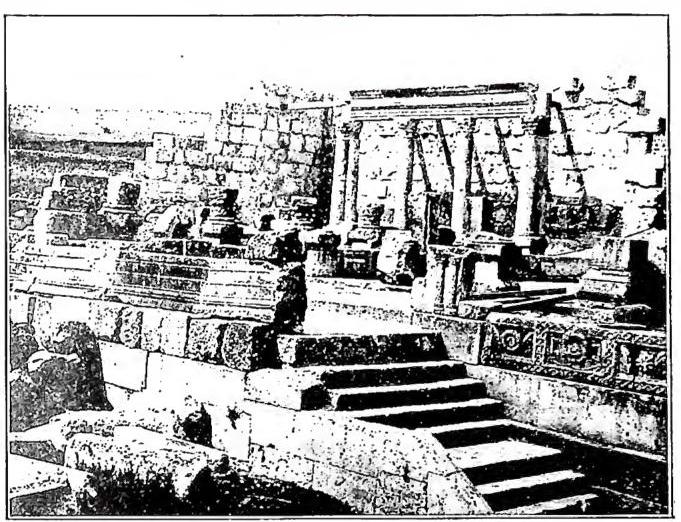
All'inizio di questo secolo un ampio terreno di Tell Hüm è stato comprato dalla custodia di Terra Santa. Vi sono state trovate imponenti rovine della sinagoga, esaminate da H. Kohl e C. Watzinger, che ricostruirono graficamente l'edificio sinagogale (24 x 18 m.). Le rovine furono riesaminate da G. Orfali, per le cui cure la sinagoga fu dal 1920 in poi ricostruita nella forma primitiva. Alcuni identificarono questa sinagoga con quella che il centurione della città di C. aveva edificato (Lc. 7,5), in cui Cristo promise
(Jo. 6, 26-59) la S.ma Eucaristia (così G. Orfali e B. Meistermann). Ma nell'edificio che oggi abbiamo esistettero dall'inizio immagini di animali e di centauri, che al tempo di Gesù erano tra gli Ebrei ritenute proibite. Perciò questa sinagoga appartiene allo stesso periodo delle altre trovate ed esplorate in Galilea, al tempo cioè degli imperatori Settimio Severo e Caracalla (193-217); così giustamente determinano l'età della sinagoga Kohl e Watzinger.