
BEDA, the VENERABLE, saint. - Doctor of the Church, born in 672-73 at the place where Benedict Biscop founded, in 674, the double monastery of Jarrow and Wearmouth. He was offered to this monastery by his relatives at the age of seven, soon moving to Jarrow where he spent his entire life. At thirty he was ordained a priest and never held any other dignity. “In this monastery I have spent my whole life, devoting myself entirely to meditation on the Scriptures, and amid the observance of regular discipline and the daily care of singing the office in church, I have always held study, teaching, and writing most dear” (Hist. eccl., V, 24).
His study was facilitated by the many precious manuscripts brought to him by his abbots from their frequent journeys to the continent and to Rome; he himself became a copyist, collator, and corrector of these texts. His teaching, the renown of his learning and writings, procured him many notable friendships, such as those of his disciples and later abbots of his monastery, Ceolbert and Cuthbert, of Nothelm, archbishop of Canterbury, Albinus, abbot of the same city, Acca, bishop of Hexham, who spurred him to compose many works that were later dedicated to them, supplied him with materials for his historical studies, and maintained correspondence with him. To Egbert, bishop of York, besides sending a long friendly letter on episcopal dignity, he also paid a visit in 734, but returned ill and never recovered. Confined to his bed, he continued to dictate excerptiones from the works of Isidore for the use of his monks and the Old English version of the Gospel of St. John. He died on 26 May 735, having reached chapter 6, verse 9.
Together with Isidore, B. is the greatest scholarly figure of the early Middle Ages and became one of the fathers of all subsequent culture. His influence spread especially through the school of York, which, with Alcuin, transplanted Anglo-Saxon learning into Carolingian civilization and consequently into European culture. His fame was such that the year of his death was recorded even in continental chronicles as a memorable event.
B. knew, besides Latin and Old English, Greek, and had some knowledge of Hebrew. He was familiar with Latin rhetoricians and the authors of late antiquity, but also read a good number of classical writers; he constantly studied the Fathers and ecclesiastical writers, collecting from an early age a very large number of extracts from their works. His writings on sacred subjects are almost entirely composed from these materials. Partly from personal inclination, partly to meet the needs of the school and the spirit of the times, he was an encyclopedic temperament and thus a polygraph. It may be said that he possessed all the sciences cultivated in his day to such a degree as to be considered an exceptional master of them.
His writings, of which he left a catalogue himself at the end of the Ecclesiastical History (V, 24), almost all have their origin and purpose in his teaching, with the exception of his historical works.
1. Exegetical works. - These form by far the largest part of his output and are commentaries on almost all the books of the Bible (some of which have been lost, such as those on the prophets). In these he usually repeats the interpretations of the Holy Fathers, especially Jerome and Augustine, chosen with discernment and illustrated by his own observations; but when he attempts to “fly with his own wings” he becomes prolix and excessively allegorical. He was the first to propose the theory of the four senses: historical, moral, allegorical, and mystical, which later became so familiar to the scholastics. The Homiliae for the various feasts of the year, about fifty in number, divided into two books, are essentially commentaries on passages of the Gospel. To these must be added a Libellus precum, prayers composed of excerpts from the psalms according to the Hieronymian Psalter ex hebraeo.
2. Didactic works. - Some are of an elementary nature. Such are the De metrica arte, a compendium of precepts drawn from ancient grammarians and reinforced with examples from Christian authors; the De schematibus et tropis Sacrae Scripturae, divided into two parts according to its title. Here again the terminology of ancient rhetoricians is applied to Scripture. The De orthographia is a little dictionary of words with brief grammatical and lexical notes and, above all, synonymic distinctions: it depends especially on Charisius. The De temporibus briefly treats the various divisions of time, the lunar cycle, and the paschal cycle, ending with a brief chronicle of the six ages of the world; it depends on Isidore’s Etymologiae, with some borrowings from Pliny and Macrobius. It was composed in 703. Essentially from the same sources is the De natura rerum, which concisely expounds in 50 chapters celestial and terrestrial cosmography.
The De temporum ratione, on the other hand, is intended to be a scientific work, composed for his monks, who found the previous treatises “too brief and too condensed, especially that on Time” (preface). It dates from 725. Not only are the previous sources exploited more thoroughly (Isidore, Pliny, and Macrobius), but all Christian chronographers are also utilized. Thus he composed an extensive system of universal chronology that became the standard for the entire Middle Ages, and also had the effect of introducing the Dionysian era, i.e., the calculation of dates from the year of Christ’s birth, into common usage. Even the universal chronicle of the final chapter, according to the six ages of the world, is greatly expanded here and continued up to 725, forming the obligatory framework for the ancient part of all medieval universal chronicles.
3. Historical works. - These form the best, most personal, and stylistically most valuable part of his literary legacy. The Historia sanctorum abbatum monasterii in Wieremitha et Giryum, Benedicti, Ceolfridi, Eostercini, Sigfridi etque Hscaetberthi deals with the work of foundation by Benedict Biscop and his zeal in elevating his monastery to the level of Italian culture. It is written with good historical judgment and, being the first history of an English monastery, provides a most interesting picture of the state of culture at that time.
The Vita Cutberti, of the great bishop of Lindisfarne who died in 687, was first written by him in hexameters between 705 and 726, and then, before 721, more extensively in prose. The chapters are, in both versions, forty-seven, but the material is partly changed. It is almost always a matter of miracles performed during his lifetime and prodigies after his death, and of information drawn from an anonymous earlier life and Lindisfarne traditions. The purpose is not so much historical as edifying, and this is especially reflected in the emphatic tone.
A similar character has the Vita s. Felicis, a prose adaptation of the poetic work of Paulinus of Nola for those who did not read verse, carried out along the lines of a similar anonymous adaptation of Prudentius’s hymn on St. Cassian. The Liber vitae et passionis s. Anastasii “badly translated from the Greek and worse corrected by some unskilled hand, as far as I could correct it according to the sense” has been lost. Nor is the Liber de locis sanctis anything more than an epitome in 17 chapters of Adamnan’s work (before 731).
The Martyrologium “on the birthdays of the holy martyrs, in which I have taken pains not only to note carefully the day on which they conquered the world but also the kind of contest and the judge under whom they did so, as far as I could discover” is the first of the so-called historical martyrologies, precursors of the present Roman Martyrology. Its primitive form is not known to us, for many soon set about adding to it; we know in fact that he left several days blank. However, it may be said that he drew his information from the passions of the martyrs and ancient ecclesiastical writers, and for simple mentions of names he depended on the Martyrologium Hieronymianum and liturgical books. In general, for his time, he shows great accuracy and prudence in the use of sources.
The Historia ecclesiastica gentis Anglorum, in five books, is his principal work, written at the invitation of his friend Albinus and dedicated in 731 to Ceolwulf, king of Northumbria. It begins with a description of the country drawn from Pliny, Orosius, and Solinus, then follows the history of the origins first according to Orosius and then according to Gildas and the life of St. Germanus, down to the time of Emperor Maurice. From this point (I, 23) the narrative becomes much more detailed, since the Christianization of the nation had begun and Bede had his own sources. It thus proceeds over a span of 135 years up to the author’s own time, combining civil and ecclesiastical history with a predominantly biographical and episodic method, while giving the greatest attention to the history of the southern kingdoms and the work of the missionaries who came from Rome. Bede was an outspoken opponent of Celtic customs (Easter observance and tonsure), and thus he either ignores or even discredits the work, however important, of the Irish and Scottish missionaries.
Despite this, Bede’s work marked an epoch in modern historiography. Even after Gregory of Tours’ book, which may have inspired him, it can be called the first true history of a nation worthy of the name. He first carefully selected his sources from the very places about which he wrote and from those best able to provide them. He enumerates them meticulously (including various lives of the saints) in his dedication to Ceolwulf, almost as if to avoid overburdening his own responsibility, as well as out of a debt of gratitude, and concludes: “I humbly beg the reader, if he finds anything in what we have written that is less accurate than the truth requires, not to impute this to us, for it is the true law of history that we have striven to commit to writing, simply and plainly, those things which we gathered from the common report for the instruction of posterity.”
In addition to this honesty and straightforwardness, he displays, for his time, a notable historical sense. Every event deemed supernatural is precisely attributed to a source, and what he recounts from his own knowledge rarely exceeds the bounds of plausibility. His views on ecclesiastical and political matters, and in general, are broad and secure for a monk. He knows how to treat the most varied events and persons with that delicacy and serenity characteristic of a superior mind. In short, modern scholarship has not been able to view the ancient history of the English differently from how he narrated II.
His narrative has the inestimable advantage of being firmly grounded in the Dionysian era ab incarnatione; it is clear, well-ordered, sufficiently proportioned, and does not lack real unity. For this reason it is easy to read and follow. The stylistic qualities also make it pleasant and often gripping. Bede aims and strives to be simple—that is, sober and modest—and never seeks rhetorical effects; yet he often becomes animated and knows how to vividly depict and narrate scenes that strike one for their freshness and for their air of truth and immediacy, albeit still semi-barbaric. The notable purity of his language also greatly aids the clarity of his expression. The Historia enjoyed prompt diffusion: by the end of the eighth century Paulus Diaconus was already making use of II.
Bede was already hailed by the Council of Aachen in 836 (Mansi, XIV, 726) as “venerable and an admirable teacher for modern times,” but the title venerabilis as a stable epithet for him begins to appear only in catalogues from the eleventh century. He was venerated as a saint in his homeland immediately after his death and later included by Baronius among the saints of the Roman Martyrology; in 1879 Leo XIII proclaimed him a Doctor of the Universal Church. His feast is celebrated on May 27.
Bede’s works were already in the ninth century in the great libraries of Reichenau, St. Riquier, Lorsch, and St. Gall, etc.; hence there are very numerous manuscripts of them. However, there is no good complete edition; the inadequate one by Giles, in six volumes, London 1843, reproduced in PL 90–95: vol. I, prolegomena and didactic works; II–IV, exegetical works; V, homilies, poems, and hagiographical works; VI, the history. Good critical editions are those of the Historia, the Vita sanctorum abbatum, and the Letter to Egbert by C. Plummer, Baeda opera historica (2 vols., Oxford 1896); of the Metrica and Orthographia in H. Keil, Grammatici latini, VII (Leipzig 1880, pp. 219 and 261); of the De schematibus et tropis in C. Halm, Rhetores latini minores (Berlin 1863, p. 607); of the two forms of the chronicle (in the De temporibus and the De ratione temporum) by Th. Mommsen in MGH, Auct. antiq., XIII, pp. 223 ff.; of the De locis sanctis by P. Geyer in CSEL, XXXIX, p. 301.
The name, originally Baeda, was already by his time more commonly written Beda; later it was often Latinized as Bedanus. Cf. H. Zimmer, Zur Orthographie des Namens B., in Neues Archiv, 16 (1891), p. 599. The data of his life are essentially those he himself left at the end of the Historia, inflated into a rhetorical Vita anonima (PL 90, 42) and reworked, after Mabillon and the Bollandists, especially by Plummer in the prolegomena to the cited edition. Bede speaks of his works as “notes drawn ex opusculis venerabilium Patrum,” and he recommends to copyists that marginal indications be added to the copies regarding their citations (PL 94, 698). Naturally this was done only exceptionally in certain manuscripts, of which cf. E. F. Sutcliffe, Annotations in the Ven. Bedae Commentary on S. Mark, in Biblica, 7 (1926), p. 428 and Some Footnotes to the Fathers, ibid., 6 (1925), p. 205. His sources are usually the four Latin Doctors. A list of quotations from profane authors was compiled by Plummer, loc. cit., and for the chronicle by Mommsen. A. Wilmart has identified a collection of such extracts from St. Augustine for a commentary on St. Paul, La collection de Bède le vénérable sur l'Apôtre, in Rev. bénéd., 36 (1926), pp. 16 ff. On his didactic and historical works see especially M. Manitius, Geschichte der lateinischen Literatur des Mittelalters, I, Munich 1911, pp. 70 ff., and the prolegomena of the cited editions, particularly Plummer’s. The Historia ecclesiastica was already translated into Old English by King Alfred the Great (849–901); ed. J. Schipper, Leipzig 1899. Nothing remains, however, of the Old English versions made by Bede himself.
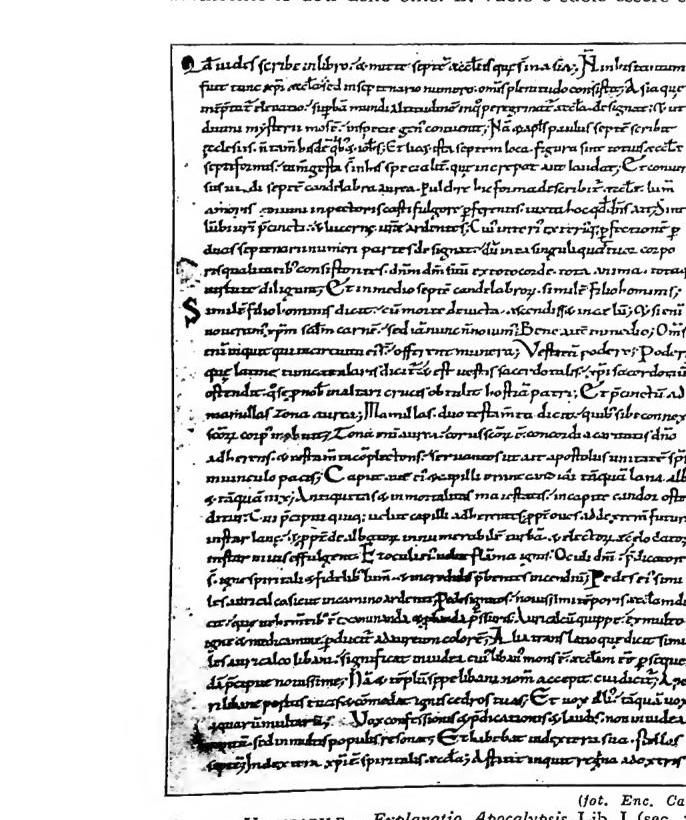
The Liber epistularum ad diversos has also been largely lost. Only sixteen letters survive, collected in PL
(photo Enc. Cott.)
BEDA THE VENERABLE — Explanatio Apocalypsis, Book I (11th century).
Vatican Library, Latin codex 641, fol. 5v.
94, 655 ff. — On the Homilies cf. G. Morin, La liturgie de Naples au temps de s. Grégoire et deux évangéliaires du VIIe siècle, in Revue bénédictine, 8 (1891), pp. 481 ff., and Le recueil primitif des homélies de Bède sur l'Évangile, ibid., 9 (1892), pp. 316 ff.; I. Chapman, Notes on the Early History of the Vulgata Gospel (Oxford 1908), pp. 76 ff. — On the martyrology, H. Quentin, Les martyrologes historiques du Moyen Age (Paris 1908) and his article Bède, in DACL, VII, cols. 395-402.
Many works, certainly apocryphal, circulate among those of B. in manuscripts and old editions. They are collected by Giles at the end of each class of those deemed authentic. Note that the four orations which close the Libellus precum are not by B. The De ratione computis (PL 90, 579) is a later extract from the De temporum ratione. The commentaries on Matthew and John are likewise later works, the former taken from Rabanus Maurus and the latter partly from Alcuino, as is also the case with the In Genesim; cf. Schönbach, Über einige Evangelienkommentare des Mittelalters (Sitzungsberichte der Wiener Akad., 146, iv), Vienna 1903. Instead, P. Lehmann, Wert und Echtheit einer B. abgesprochenen Schrift (Abhandl. der Bayr. Akad., iv), Munich 1919, tends to consider authentic the Liber quaestionum (PL 93, 455), which is listed among the spurious works. Morin, Notes sur plusieurs écrits attribués à B. le vénérable, in Rev. bénéd., 11 (1894), pp. 289 ff., recognizes the Capitula lectionum in Pentateuchum Moysi, Iosue, Iudicum in the Paris codex lat. 2342 as simple extracts from Isidore, and inclines to attribute to B. the argumenta and explanationes contained in the apocryphal In psalmorum librum exegesis (PL 97, 478). De Bruyne, Note sur les uns, et les éditions du commentaire de B. sur les Proverbes, in Journal of Theolog. Studies, 28 (1926-27), pp. 182 ff., has rediscovered B.’s commentary on Prov. (fragments in PL 91, 1051). Bedae Venerab. Expositio Actuum et Retractatio, ed. M. L. W. Laistner (Medieval Academy of America Publications, xxxv). On B. as interpreter of Scripture see R. Cornely, Introductio in utriusque Testamentibus libros sacros, I, Paris 1885, p. 465 and F. Plaine, s.V. in DB, I, col. 1538.