
VOLGATA. – The official version of the Bible in the Latin Church, called Vulgata editio librorum sacrorum from the Council of Trent (1545–63) onward. The ancient exegetes, especially St. Girolamo, used the term to designate the translation of the Septuagint (v.), which was widely disseminated both in its Greek text and in the Latin version.
I. HISTORY OF THE TEXT
The V. s. Girolamo, who devoted all his energy and his rare scriptural competence to providing the Latin Church with a correct version of the Bible, in place of the various inferior translations then in circulation, by that time containing no small number of errors. The need for a critically reliable text was felt by learned men such as s. Agostino (De doctrina christiana, II, 16: PL 34, 43) and Pope Damaso. Indeed, s. Girolamo began the work precisely at the advice of Pope Damaso in Rome in 383–84; it was completed only more than twenty years later, in 405–406.The V. is called the Hieronymian version. This assertion is correct only approximately. Certain books, in fact (Baruc, Ecclesiastico, Sapienza, I and II Maccabei, and the deuterocanonical portions of Ester), owe nothing to the Stridonite, who neglected these books, not included in the Hebrew canon (v. BIBBIA). Of the books of the New Testament, none was translated by Girolamo, who limited himself to revising the four Gospels against the best Greek codices (cf. the dedicatory letter to the Pope: PL 29, 557–62), and the other books with less care. The revision of the Acts and the Letters of the Apostles is still denied by some modern scholars, although their arguments are not apodictic. As for the remainder of the Old Testament, the Psalter is a version by Girolamo, but based on the Greek text of the Septuagint, completed at Bethlehem around 390; the other protocanonical books were translated from the original text between 391 and 406; while the little books of Giuditta and Tobia were rendered into Latin using an Aramaic text which probably was not the original, but only a translation of the Hebrew.
As can be seen, the V. work, completed according to clearly determined principles. It is therefore not easy to give an overall assessment of II. The portion not attributable to s. Girolamo must be judged in the same way as the ancient versions (v. LATINE, VERSIONI della BIBBIA). In the case of certain books, such as Maccabei, it can be shown that the choice among the various versions in circulation was not always the happiest. The New Testament presents a text highly esteemed by critics, who readily use it in their Greek editions; but the very fact that Girolamo not infrequently corrects the reading of the V. in his Pauline commentaries is a sign that, solely in order not to offend the excitability of his contemporaries with a novelty that was not absolutely necessary, he was content with a rather superficial revision. As for the Old Testament, the text of the Psalter is undoubtedly inferior, from the standpoint of textual criticism and clarity, to that of the Hieronymian Psalterium ex Hebraeo, which is a direct translation of the original text and never gained admission into the V.
The critical value of the version of the other books, although on the whole highly satisfactory, varies. This is due to the long period over which the work extended, to intrinsic difficulties, and to external factors, such as haste (the Cantico dei Cantici, the Proverbi, and the Ecceliante were translated in only three days) or a personal opinion concerning the inspiration of a particular book (Giuditta was translated reluctantly in a single night, Tobia in one day).
Compared with the ancient versions, the work of Girolamo
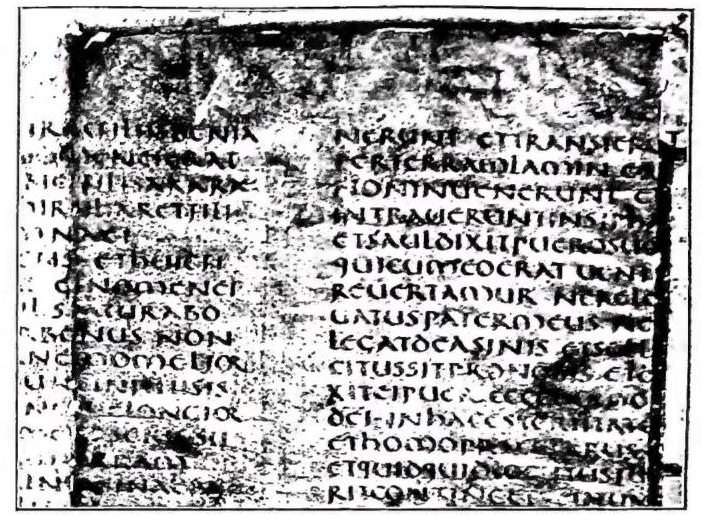
VOLGATA — Part of a leaf of the Quedlinburg Bible (I Reg. [I Sam.], nos. 1–8) containing the Vetus latina, the version current in the time of St. Jerome. An illuminated codex from the second half of the 4th century, preserved in three leaves at Quedlinburg and Berlin.
has the precious advantage of deriving directly from the original texts, not from a translation that already diverges considerably from the Hebrew, thereby raising extremely difficult problems of textual criticism. Linguistic competence and the assistance of learned rabbis, in certain cases, eliminated or reduced possible misunderstandings and hence inaccuracies in translation. The task was further facilitated by the pre-existing Greek and Latin versions, which were always kept in view. As he often explains in the prefaces and in Ep. 106, Jerome aimed at accurate but not pedantic fidelity, together with a certain stylistic elegance, in order to remedy the plebeian character of the language and style of the ancient versions. To achieve the latter aim and to respect certain rabbinic legends (cf. Ios. 14, 15; Neh. 9,7), he sometimes somewhat neglected exactness; but in general, even critics most prejudiced against the great biblical scholar are today unanimous in recognizing the perfection of the work. There are few cases in which St. Jerome misunderstood the text (cf. Gen. 49,2; Ier. 31, 15, etc.); more often he presupposes (cf. Is. 16, 1) or accentuates (cf. Is. 11, 10; 12, 3; 51, 5) the messianic sense.
The contemporaries received the new version with little enthusiasm. Rufinus collected all the most sensational accusations, to which the author responded both in several prefaces and in the apology (cf. Contra Rufinum, II, 24-35: PL 23, 468-78) with his unmistakable polemical fervor. St. Augustine too, although he lamented the state of the ancient versions, appeared somewhat disconcerted by the audacious innovation (cf. Epp. 71, 4-5; 82,35: PL 33, 242-43: 291; in the Jerome correspondence, Epp. 104, 4-5; 116,35: CSEL, LV, pp. 240-41: 421). Only gradually did he modify his attitude (cf. De doctrina christiana, IV, 15: PL 34, 96; De civitate Dei, XVIII, 43: CSEL, XL, 336). For this reason the version spread rather slowly and amid opposition. Its triumph over the ancient traditions was due above all to St. Gregory the Great (v.), St. Isidore (v.) of Seville, and St. Bede (v.). During the period of uncertainty as to which of the two translations should be preferred, a considerable number of textual alterations occurred. In addition to the errors that inevitably entered a book copied so frequently, there were reciprocal contaminations, whereby a reading from an ancient version entered the new one, or vice versa. The phenomenon was already noticed in antiquity; attempts were made to remedy it by harmonizing the text through more or less careful revisions. Since there were many such attempts, various types of manuscripts emerged, which, for practical convenience and also according to sound objective criteria, are now grouped into «Italian», «Spanish», and «Insular» or «Irish» codices.
The best type is the Italian, which derives from the revision of Cassiodorus (6th century) in his monastery of Vivarium and from the recension of Alcuin. Certain Spanish codices show the influence of the recension of Theodulf (9th century), whereas the Insular codices generally transmit a text that was also widely circulated in France, with influences from the recension of Alcuin (8th century), who carried out his work at the behest of Charlemagne. The cataloguing of manuscripts, however, is often carried out more out of practical necessity, following the predominant tendency, than for clear objective reasons. Indeed, the various types of text are quite often found coexisting in a single manuscript. The phenomenon was noted by theologians who, in the 11th–13th centuries, labored to publish a uniform and reliable text. This was the correctors (v.), who had in a certain sense been preceded by the revisions of St. Peter Damian (v.), St. Lanfranc (v.), St. Stephen Harding (v.), MANIACORIA, NICOLA (v.). The most widely disseminated text, both through manuscripts and through print immediately after its invention, was unfortunately one of the least perfect—namely, the text in use at the University of Paris, and therefore called «Parisian» or Biblia Parisiensis.
II. AUTHENTICITY OF THE VULGATE
The Council of Trent, in Session IV (8 April 1546), besides establishing the biblical canon (v. BIBBIA), defined the authenticity of the Vulgate and expressed the desire that a corrected edition should soon be printed, one that would possess an official character. At the same time, it sanctioned the designation Vulgate. As stated in the decree (cf. Denz-U, 785), the Council Fathers considered that “it would be beneficial for the Church of God to declare which among the Latin versions of the Sacred Books should be held to be authentic”; therefore it was established and declared “that this ancient and vulgata version, which has been approved in the Church through the usage of so many centuries, in public readings, disputes, preaching, and explanations, should be held to be authentic, and that no one should dare or presume to reject it under any pretext.”The value and significance of this decree have been much discussed; at times it was interpreted in a rather ridiculous manner, almost as though the Council had substituted this version for the original texts, and some even went so far as to proclaim it inspired. Today all admit—and this has also been officially declared—that the decree has not dogmatic but disciplinary force, and that it in no way detracts from the primacy of the original texts, nor from the importance of the ancient versions in other languages, indeed not even from the pre-Hieronymian Latin versions. The Vulgate is granted only an extrinsic official recognition, which guarantees its authenticity and prescribes its practical use (cf. letter of the Pontifical Biblical Commission to the bishops of Italy of 20 August 1941, § 2: AAS, 33 [1941], pp. 468–69).
Since the term “authentic” is used in the juridical and literary fields, the question arises as to the meaning to be attributed to it in the present conciliar decision. From the context, however, it clearly appears that the intention is not to define a problem of literary criticism, for example, concerning the author of the Vulgate, but only to grant it the force of settling a controversy, that is, of serving as an authoritative text in a dispute, and of being a genuine source of Revelation. What is at issue is juridical authenticity, by which the version is recognized as a document worthy of belief. Naturally, for a document to enjoy such a privilege, it must possess unquestionable intrinsic merit. Juridical authenticity presupposes, in other words, literary authenticity. Since the Council expressly refers (Denz-U, 784) to questions of dogma and morals, it must be admitted that, at least in passages dealing with these subjects, the Vulgate faithfully reproduces the sense of the original text. Even here, the version is not required to display a perfect and absolute fidelity down to the smallest details; identity of thought or substantial similarity is sufficient. Exegetes admit that a dogmatic text may appear in a more lucid form in translation than in the original, or may be expressed in a somewhat different manner. In itself, there is no contradiction in a passage of doctrinal value having been altered or being entirely absent from the version, since the same truth might have been transmitted in another text or through tradition. If it is proved that a reading of the Vulgate (cf. Io. 8, 25; I Io. 5, 7) has no counterpart in the original, the text cannot be presented as a scriptural argument, while retaining its doctrinal value as the expression of a constant tradition. The Vulgate, in fact, was declared authentic precisely because of its centuries-long use in the Church. Finally, it should be noted that the Council intended to approve a perfect text that it proposed to have prepared, not just any edition of the version attributed to s. Girolamo.
III. OFFICIAL EDITION
The preparation of this standard edition proved much more arduous than the Council Fathers had anticipated. Indeed, the work appeared only in 1592, and undoubtedly was not as perfect as it could have been and as was desired.It was only in 1561 that Pius IV appointed a commission for this purpose, under the presidency of four cardinals and with the learned and patient collaboration of G. Sirleto (v.). Taking as its basis the 1540 edition of Louvain, prepared by Giovanni Henten, together with the collation of several manuscripts, the commission prepared a respectable text; but, owing to the Pope’s death and other circumstances, the edition was not published. In 1569 s. Pius V convened a new commission, whose guiding spirit was once again Card. Sirleto, who, with the assistance of many scholars, perfected the preceding work. But even then the desired edition was not produced. Accordingly, in 1586 Sixtus V entrusted the task to Card. Carafa (v.) and another commission; after only two months, an excellent text (codex Cavafianus) was presented to the Pope, which may be called the fruit of all the preceding work. Sixtus V was surprised by certain new readings and by the abolition of numerous additions that appeared in the inaccurate editions then in circulation. For this reason he did not approve the text. He himself sifted through the various proposed emendations, in practice returning to the text of the Louvain Bible with certain rather arbitrary corrections and retaining many interpolations. In 1590 he published the work together with the constitution Aeternus ille of 1 March, concerning which there has often been discussion, and rightly so, including by those who believed they had found in it a nonexistent argument against papal infallibility. Naturally, those who had worked so diligently to prepare a correct text viewed with regret the publication that disregarded the fruits of their labors. After the death of Sixtus V (27 Aug. 1590), they requested the abolition of the apostolic constitution and the prohibition of the sale of the printed copies. To preserve the memory of the Pontiff, Card. Bellarmine proposed that a new corrected edition be prepared immediately and circulated under the name of Sixtus V. Pope, Gregory XIV, approved the initiative, appointing a commission of 7 cardinals and 11 consultors under the presidency of Card. Marcantonio Colonna. The directives in practice presupposed a return to the Carafa Codex, but with the recommendation that no changes be made unless demanded by genuine necessity («ne fieret mutatio, nisi cogeret necessitas»). The commission was established on 7 February 1591 and, after several months, delivered the text to the Pope, who, however, died on 15 October of that year. His successor, Clement VIII, ordered the final revisions. Finally, on 9 November 1592, the Biblia Sacra Vulgatae editionis Sixti Quinti Pont. Max. iussu recognita atque edita appeared, while copies issued in 1590 were being collected for destruction. Only in the Lyon edition of 1604 was the name of Clement VIII added to that of Sixtus V. For this reason it is called the Sixto-Clementine edition, although very little of the work of the former of these two Popes remained in II. And, if the revisers of Clement VIII are to be faulted for anything, it is precisely for not having entirely rejected the text of the preceding edition in order to return to the excellent Carafa Codex. In particular, they retained too many readings already eliminated by the commission of 1586.
In subsequent centuries, certain scholars (Francesco Luca di Bruges, Carlo Vercellone) collected a good number of variants in order to emend the text; but these were private suggestions that never received official approval. For the New Testament, an excellent critical edition was published by the Anglicans John Wordsworth and Henry Julian White. The work, begun with the first fascicle in 1889 and continued by other scholars, is not yet complete (the latest fascicle, containing the Catholic Epistles, appeared in 1949), since the Apocalypse is still lacking; but as early as 1911, after Wordsworth’s death, H. J. White produced a complete manual edition of II.
Only in 1907 did Pius X entrust the Benedictine Order with the task of preparing a critical edition; later Pius XI built for the monks of Clairvaux, who assumed the responsibility, the Abbey of S. Girolamo dell’Urbe. The purpose of this initiative is not to offer a new authoritative version of Scripture, nor to correct the Latin text in order to make it more faithful to the originals, but solely to provide an edition that, as far as possible, is identical to the one that came from the pen of s. Girolamo and the other authors of the most ancient version. In the preparatory work, the patient scholars undertook a careful examination of several hundred manuscripts of the V. in order to determine the “standard” texts that constitute the basis of the critical edition. After a period of preparation under the guidance of A. Gasquet and A. Amelli, publication was begun (1926) by H. Quentin and continued by P. Salmon. Because of the difficulty of the work and the adversity of the times, only ten volumes have so far been published, comprising the books Genesis–Psalms. The work has won the praise of critics; but there have also been some observations and disagreements concerning the value attributed to certain codices, especially with regard to the first books of the Pentateuch.
IV. CODEXES
The manuscripts and editions or reprints of the V. are countless. If liturgical texts and codices containing only a minimal portion are also included, there are approximately 30,000 manuscripts altogether. But even a superficial examination eliminates many of them, since they are of no value for textual criticism, being too recent in date or reproductions of a single type of text.Among the “Italian” codices, the Amiatinus (siglum A) occupies a place of honor, so called from Monte Amiata, where it was preserved for a long time. It is ordinarily the most highly esteemed manuscript, but its quality varies according to the books. The text derives from Cassiodorus’s recension, but it was written in England in the seventh or eighth century at the order of Abbot Ceolfrid, who sent it to Rome as a gift for the Pontiff. Since its bearer died during the journey, the manuscript ended up in the Cistercian monastery of Monte Amiata; it is now in the Laurentian Library in Florence. It had already been collated by the commission of Pius IV and has been the object of study, especially on the part of the critic C. Tischendorf. The Benedictine monks assigned it a position of the first order as representative of the great family of “Italian” codices; for the book of Tobias, however, it has been ranked below other manuscripts. The Fuldensis codex (siglum F), now at Fulda in Germany, is due to Bishop Victor of Capua [iv.], who died in 554. It contains the New Testament, together with the apocryphal letter of St Paul to the Laodiceans. The four Gospels are unified in the form of a Diatessaron (v.). The Feroiulensis codex (siglum J), from the sixth or seventh century, contains the Gospels, with some lacunae in that of St John. It is preserved for the most part in the Municipal Library of Cividale del Friuli, while some leaves are in Prague and others in Venice. The Lindisfarnensis (siglum Y), from the seventh or eighth century and kept in the British Museum, contains only the four Gospels with the Anglo-Saxon version. It is perhaps the text most similar to that of the Amiatinus. The ninth-century Paulinus (siglum P) is one of the most elegant codices in the Library of S. Paul in Rome. It is also one of the most reliable witnesses to Alcuin’s recension. The Vallicellianus (siglum V), from the ninth century and in the Vallicelliana Library in Rome, presents the same characteristics, except for artistic beauty.
Among the most notable “Spanish” codices is the Cavensis (siglum C), from the eighth or ninth century, preserved in the abbey of Cava dei Tirreni. Its text, with its many readings from the ancient Latin version, is a clear document of the easy mutual contamination among the various translations. The Turonensis (siglum G), now in the National Library of Paris and dating from the sixth or seventh century, contains part of the Pentateuch (Genesis–Numbers). It may be regarded as the archetype of the Spanish codices; this explains its use by the Benedictine editors. The Vaticano-Guelferytanus (siglum V) is a fifth-century palimpsest, containing only a large part of the book of Judges and fragments of Ruth and Job. The Theodalphianus (siglum Θ), also called Mesniamus after the family that owned it, represents the recension of Theodulf, as its name indicates. It contains the entire Bible and dates from the ninth century.
Among the “insular” codices, the following should be remembered: the Lichfeldensis (siglum L), in Lichfield, England, from the seventh or eighth century, containing only Mt. 1,1 – Lc. 3,9; the Dublinensis (siglum D), also called Book of Armagh, from 812; the Kenanensis (siglum Q), or Book of Kells, likewise preserved in Dublin, from the seventh or eighth century; and the Ottobonianus (siglum O), regarded by the Benedictine editors as a typical representative. It contains the Heptateuch, with some original readings or readings from the Vetus latina. It was probably written at Bobbio in the seventh or eighth century. — Vedi tav. CLIV.